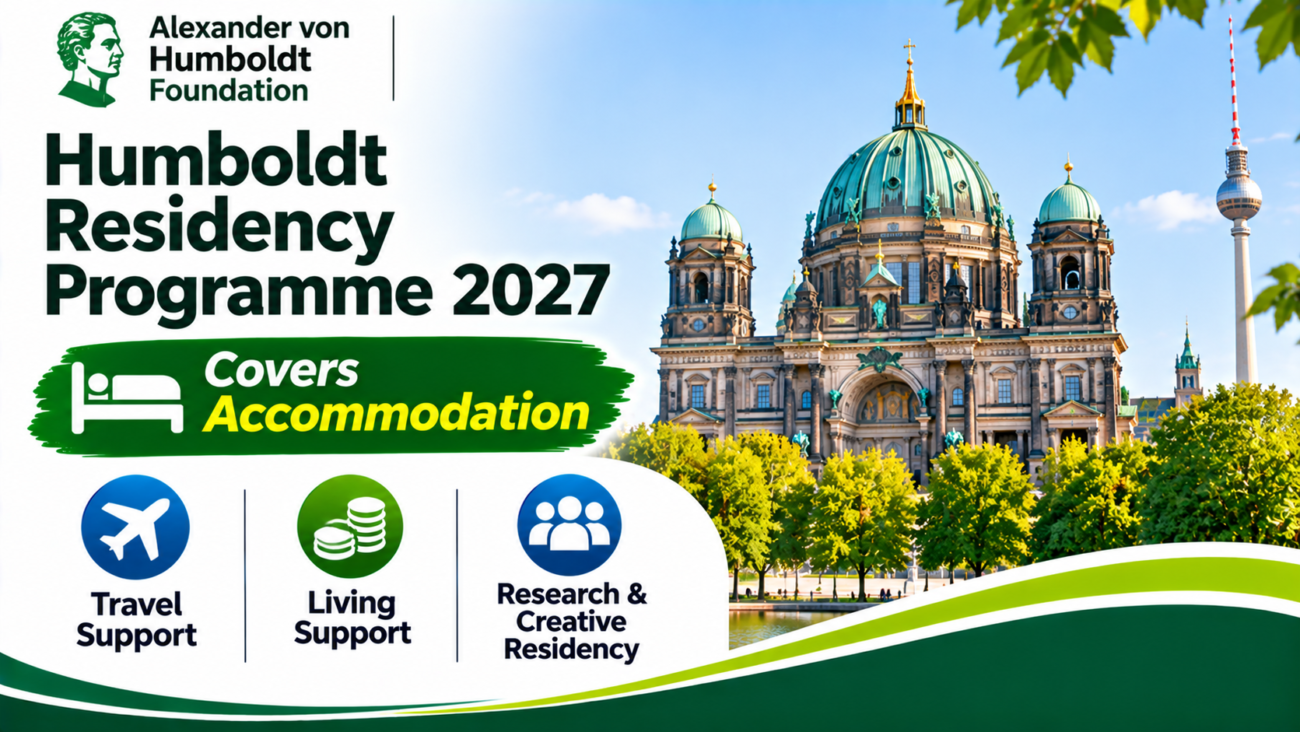
Humboldt Residency Programme 2027: Fully Funded Six-Week Residency in Germany with Accommodation, Travel and Living Support
Humboldt Residency Programme 2027: Fully Funded Six-Week Residency in Germany with Accommodation, Travel and Living Support. The Humboldt Residency Programme 2027, organised by the Alexander von Humboldt Foundation, is inviting applications from researchers, artists, journalists, writers, social entrepreneurs and civil society practitioners for a six-week international residency in Germany.
The programme will bring together 12 participants to explore the theme “Oceanic Horizons: Navigating the Future of Our Blue Planet.” Participants will exchange ideas, develop collaborative approaches to global challenges and communicate their findings to audiences beyond academia.
The funding package includes accommodation for the entire six-week in-person residency, a monthly living allowance or honorarium, return travel support and a budget for organising public events or communicating the programme’s outcomes.
The opportunity is particularly interesting for professionals working on environmental protection, ocean conservation, climate change, sustainable development, marine ecosystems, environmental policy and related areas.
Applications are open until 14 December 2026. International applicants, including eligible Zimbabweans, can apply under the relevant participant categories.
Humboldt Residency Programme 2027: Key details
| Opportunity detail | Information |
|---|---|
| Programme | Humboldt Residency Programme 2027 |
| Host organisation | Alexander von Humboldt Foundation |
| Country | Germany |
| Locations | Schloss Wiepersdorf and Berlin, with excursions |
| Theme | Oceanic Horizons: Navigating the Future of Our Blue Planet |
| Duration | Six weeks in person |
| Overall programme period | June–October 2027 |
| In-person residency | 2 August–10 September 2027 |
| Number of participants | 12 |
| Participant categories | Humboldt alumni, early-career researchers and civil society practitioners |
| Accommodation | Fully covered |
| Living support | Monthly allowance or honorarium |
| Travel support | Allowance for travel to and from Germany |
| Additional funding | Budget for public events or programme outputs |
| Eligible nationalities | International, subject to category-specific requirements |
| Application deadline | 14 December 2026 |
| Application method | Online |
1. About the Humboldt Residency Programme
Humboldt Residency Programme 2027: Fully Funded Six-Week Residency in Germany with Accommodation, Travel and Living Support
The Humboldt Residency Programme is an initiative of the Alexander von Humboldt Foundation designed to encourage collaboration between academia and society.
Every year, the programme brings together people from different professional backgrounds and countries to examine a major global or societal issue.
The 2027 edition will focus on the future of the world’s oceans and the relationship between ocean health, human activity and the future of the planet.
The programme will create opportunities for participants to exchange expertise, develop new perspectives and work together on ideas that can be communicated to wider audiences.
Unlike a conventional academic fellowship, the residency is deliberately interdisciplinary. It welcomes people whose work contributes to public debate, environmental action, research communication and practical solutions to global challenges.
The 2027 cohort will consist of 12 participants divided into three categories:
- Five alumni of the Alexander von Humboldt Foundation.
- Three early-career researchers.
- Four civil society practitioners, including people working in the arts, journalism, politics, social entrepreneurship and NGOs.
The Foundation will consider the professional background, geographical representation and diversity of the selected group.
2. The 2027 theme: Oceanic Horizons
The annual theme is “Oceanic Horizons: Navigating the Future of Our Blue Planet.”
The programme will examine the importance of oceans as ecosystems, climate regulators, sources of livelihoods and reservoirs of natural resources.
Oceans face growing pressure from climate change, pollution, overfishing and the destruction of marine habitats. These challenges also affect coastal communities, economies, food systems and global environmental security.
The programme invites participants to explore questions such as:
- How can marine ecosystems be protected while ocean resources are used sustainably?
- What role can renewable energy and marine biotechnology play in the blue economy?
- How should societies respond to rising sea levels and changing coastal environments?
- How can ocean governance address competing political, economic and social interests?
- What responsibilities do societies have towards the ocean and its ecosystems?
- How do oceans shape cultures, identities and communities around the world?
Applicants should demonstrate a clear connection between their professional work, research or wider engagement and these themes.
A background specifically in marine science is not compulsory. The Foundation welcomes contributions from different academic disciplines and professional sectors, provided applicants can demonstrate a relevant connection to the annual topic.
3. What the Humboldt Residency Programme provides
The programme is described by the Foundation as fully funded. Participants are not charged for taking part.
The funding package includes accommodation, living support, travel assistance and resources for communicating the results of the residency.
Monthly living allowance or honorarium
Participants receive financial support during the six-week residency.
The amount depends on the participant’s category:
- Researchers: Their stipends follow the Alexander von Humboldt Foundation’s usual fellowship rates.
- Civil society, journalism and arts participants: They receive an honorarium intended to be competitive with those offered by comparable residency programmes and to avoid financial disadvantage from participating.
The Foundation does not publish one fixed euro amount for every participant. Applicants should therefore not assume that all participants receive the same stipend.
Fully covered accommodation
Accommodation is covered throughout the six-week in-person residency.
The arrangement includes:
- Two weeks at Schloss Wiepersdorf in Brandenburg.
- Four weeks at an aparthotel in Berlin.
The accommodation costs are fully covered by the Alexander von Humboldt Foundation and the Cultural Foundation Schloss Wiepersdorf.
Selected participants do not have to pay for their programme accommodation.
Return travel support
The programme provides a travel allowance for the journey to Germany and the return journey home.
Potential visa application costs are also addressed in the programme’s official FAQ. The Foundation explains that visa-related costs are covered through the travel grant arrangements and that participants should not be charged for the visa required for the residency period, as specified in the invitation letter.
Applicants should follow the Foundation’s instructions before making travel or visa arrangements.
Budget for public events and programme outputs
The programme includes a budget for arranging public event formats or communicating the outcomes of the residency.
Possible activities include:
- Public debates and discussions.
- Interactive workshops.
- Media appearances.
- Publications and articles.
- Blog and social media content.
- Events involving relevant stakeholders.
- Other formats for communicating ideas beyond academia.
This is programme-related funding, not an additional personal living allowance.
Support for participants travelling with family
The Foundation aims to make the residency family-friendly.
Where necessary, it can arrange suitable accommodation for accompanying partners, children and other dependent family members in Wiepersdorf and Berlin. It can also help participants arrange childcare in Berlin.
However, there are important limitations:
- Family members do not receive a travel grant.
- There is no separate family allowance.
- Childcare cannot be provided externally at the remote Wiepersdorf location.
- Family accommodation and childcare arrangements must be discussed early.
Applicants who need family arrangements should raise the matter when invited rather than waiting until shortly before the residency.
4. Who can apply?
The Humboldt Residency Programme has three distinct participant categories. Applicants must identify the category that best matches their professional background.
Category 1: Humboldt Foundation alumni
The programme reserves five places for former recipients of a fellowship or award from the Alexander von Humboldt Foundation.
Applicants in this category must:
- Have previously received a fellowship or award from the Foundation.
- Hold an academic position.
- Currently be based outside Germany.
- Not be receiving funding through another Alexander von Humboldt Foundation programme when the residency begins in August 2027.
- Demonstrate relevant academic or professional expertise connected to the annual theme.
- Show an ability and willingness to communicate their work to audiences beyond academia.
Previous experience in public science communication is not compulsory, but applicants must demonstrate that they are willing and able to communicate their work effectively.
Category 2: Early-career researchers
Three places are reserved for early-career researchers.
Applicants must:
- Be currently pursuing a PhD or have completed a PhD less than four years before the start of the residency in August 2027.
- Hold an academic position.
- Currently be based outside Germany.
- Have a research profile relevant to the annual theme.
- Demonstrate potential for an academic career.
- Have experience in science communication or connecting research to wider social and political issues.
The four-year period is a strict requirement, although the Foundation says career interruptions such as maternity or paternity leave may be considered in calculating the period. Applicants in this situation should contact the programme before applying.
Category 3: Civil society practitioners
Four places are available for civil society practitioners.
This category is particularly relevant to people working in creative professions, journalism, NGOs, social entrepreneurship and other areas of public engagement.
Eligible professional profiles include:
Creatives and communicators
- Journalists.
- Authors and writers.
- Filmmakers.
- Curators.
- Artists.
- Designers.
Other civil society practitioners
- People working in politics.
- Social entrepreneurs.
- Representatives of NGOs.
- Campaign and advocacy professionals.
- Consultants.
- Representatives of social or political initiatives.
Applicants must:
- Demonstrate a clear connection between their previous work and the annual theme.
- Show the potential to share and multiply the ideas developed during the residency.
- Not currently hold an academic position.
Unlike the researcher categories, civil society, journalism and arts applicants may apply regardless of their place of residence, including those currently living in Germany.
5. Can Zimbabweans apply?
Humboldt Residency Programme 2027: Fully Funded Six-Week Residency in Germany with Accommodation, Travel and Living Support
Yes, Zimbabweans can be eligible, but the applicable participant category matters.
For Zimbabwe-based applicants, the civil society practitioner category may be particularly relevant if they work in environmental organisations, journalism, the arts, social entrepreneurship, public policy, advocacy or related professional areas.
Zimbabwean researchers may also qualify under the early-career researcher category if they meet the doctoral and academic-employment requirements and are not based in Germany.
Former recipients of Alexander von Humboldt Foundation fellowships or awards may be considered under the alumni category if they meet its additional conditions.
The programme is international, but it is not an unrestricted opportunity for anyone interested in ocean conservation. Applicants must meet the specific professional and employment conditions for one of the three categories.
English proficiency is essential. All communication among participants, the Foundation and cooperation partners takes place in English. Applicants must be confident discussing scientific and societal issues in English and contributing to fast-paced group discussions.
6. Residency dates and programme activities
The programme runs from June to October 2027, but the main in-person residency takes place over six consecutive weeks.
| Activity | Date |
|---|---|
| Virtual kick-off meeting | 29 June 2027 |
| Residency at Schloss Wiepersdorf | 2–13 August 2027 |
| Residency in Berlin | 13 August–10 September 2027 |
| Remote completion of programme outputs | September–October 2027 |
| Virtual wrap-up event | 26 October 2027 |
The two-week stay at Schloss Wiepersdorf will be followed by four weeks in Berlin.
The programme will also include excursions to institutions in northern Germany and along the North Sea and Baltic Sea coasts. The Foundation currently anticipates two excursions lasting approximately two to three days each.
Full in-person participation from 2 August to 10 September 2027 is mandatory. Applicants must be available for the entire six-week period.
The programme generally schedules meetings and working sessions from Monday to Thursday, usually between 9 a.m. and 3 p.m. Participants may continue some of their regular professional activities in a reduced capacity, particularly during afternoons and Fridays.
7. Documents required for the application
The official call identifies two documents that must be uploaded before the application can be submitted.
Curriculum vitae
Applicants must provide a CV of no more than three pages in PDF format.
The CV should clearly explain:
- Educational and professional background.
- Relevant work experience.
- Research or creative achievements.
- Previous projects connected to the annual theme.
- Relevant public engagement or communication experience.
The CV should be concise and demonstrate why the applicant is suitable for the selected participant category.
Introduction video
Applicants must record a short introduction video of no more than 60 seconds.
The video should introduce the applicant and explain why they believe they are a suitable participant for the Humboldt Residency Programme.
The Foundation encourages applicants to demonstrate their personality and creativity. Professional video production is not required.
The official technical requirements include:
- Maximum duration: 60 seconds.
- Format: MP4, MOV, AVI or MPEG.
- Orientation: Landscape, 16:9.
- A well-lit recording environment.
- Clear audio without distracting background noise.
The video must be uploaded through Smash, and the applicant must share the link in the online application form.
The Foundation advises applicants to upload the video on the same day they submit the application because the Smash link may expire after seven days.
Are recommendation letters required?
Humboldt Residency Programme 2027: Fully Funded Six-Week Residency in Germany with Accommodation, Travel and Living Support
No. The official FAQ states that letters of recommendation are not required and will not be considered if submitted.
Applicants should concentrate on preparing the requested CV and introduction video and completing the online application accurately.
8. How applications will be evaluated
The selection committee will assess applications using several criteria.
Motivation and programme objectives: Applicants must explain why they want to participate and how their experience connects to the objectives of the residency.
Relevance to the annual theme: The proposed perspective, professional experience or approach should contribute meaningfully to discussions about ocean health, human activity and planetary futures.
Suitability for the selected category: Applicants must demonstrate that they meet the requirements for the category under which they apply.
Professional achievements: The selection committee will consider the applicant’s previous work, expertise and achievements.
The Foundation will also consider the overall diversity of the group, including geographical representation, professional disciplines and gender.
The programme aims to create a diverse group rather than select 12 people with identical academic or professional backgrounds.
9. How to apply for the Humboldt Residency Programme 2027
Applications must be submitted online to the Alexander von Humboldt Foundation.
Follow these steps:
Step 1: Identify your participant category
Determine whether you qualify as a Humboldt Foundation alumnus, an early-career researcher or a civil society practitioner.
Step 2: Review the eligibility requirements
Check the professional, academic and employment conditions for your chosen category. Pay particular attention to the rules concerning academic employment and residence in Germany.
Step 3: Prepare your CV
Create a PDF CV of no more than three pages, highlighting relevant experience and achievements connected to the 2027 theme.
Step 4: Record your introduction video
Prepare a landscape-format video of no more than 60 seconds explaining who you are and why you would be a suitable participant.
Step 5: Upload the video
Upload the video to Smash and copy the shareable link. Submit the application and video link on the same day to avoid link-expiry problems.
Step 6: Complete the online application
Provide the required information and upload the CV and introduction video through the Foundation’s application platform.
Step 7: Submit before the deadline
Submit the completed application by 14 December 2026. Applications are assessed on a rolling basis, so applicants are encouraged not to wait until the final day.
10. Important application dates
| Application stage | Date |
|---|---|
| Application deadline | 14 December 2026 |
| Digital information session | 24 November 2026, 2–3 p.m. CET |
| Selection committee meeting | Mid-February 2027 |
| Expected selection decisions | End of February 2027 |
| Virtual kick-off | 29 June 2027 |
| Main in-person residency | 2 August–10 September 2027 |
| Virtual closing event | 26 October 2027 |
The digital information session is an opportunity to ask the Foundation questions about the programme and application process.
Applicants should also allow time for the Foundation to review submitted documents and send the application confirmation. According to the FAQ, confirmation may take a few days.
11. Application tips for prospective participants
Humboldt Residency Programme 2027: Fully Funded Six-Week Residency in Germany with Accommodation, Travel and Living Support
The programme is competitive, and applicants should demonstrate a clear contribution to its objectives.
Consider the following recommendations:
- Connect your experience to the ocean theme. Explain how your professional work, research or public engagement relates to marine conservation, climate change, environmental governance, coastal communities or the blue economy.
- Choose the correct participant category. The eligibility conditions differ considerably between researchers, former Humboldt Foundation award recipients and civil society practitioners.
- Show your wider societal contribution. The programme is interested in people who can communicate ideas beyond their immediate professional or academic circles.
- Prepare a convincing introduction video. Use the 60 seconds to communicate your professional identity, relevant experience and reasons for wanting to participate.
- Demonstrate international perspectives. Explain how your experience can contribute to discussions involving people from different countries and professional backgrounds.
- Check your availability. You must attend the complete six-week in-person residency. Applicants should make sure their work and personal responsibilities allow them to participate.
- Submit early. Applications are assessed on a rolling basis, so early submission is advisable.
12. Frequently asked questions
Is the Humboldt Residency Programme fully funded?
Yes. The Foundation describes the programme as fully funded. It covers accommodation, provides a monthly living allowance or honorarium, supports return travel and provides a budget for public events or programme outputs.
How much is the monthly stipend?
The Foundation does not publish one fixed amount for all participants. Researchers receive stipends based on its usual fellowship rates, while civil society, journalism and arts participants receive an honorarium intended to be competitive with comparable residency programmes.
Is accommodation free?
Yes. Accommodation at Schloss Wiepersdorf for two weeks and an aparthotel in Berlin for four weeks is fully covered for selected participants.
Does the programme pay for flights?
It provides a travel allowance for the journey to and from Germany. Applicants should follow the Foundation’s travel instructions and should not assume that independently purchased tickets will automatically be reimbursed.
Can Zimbabweans apply?
Yes, provided they meet the requirements of one of the three participant categories. Civil society practitioners can apply regardless of their country of residence. Researcher applicants must meet the relevant academic and residence requirements.
Do I need a PhD?
Not everyone needs a PhD. The PhD requirements apply to the early-career researcher category. Civil society practitioners and creative professionals are assessed under different criteria.
Can artists and journalists apply?
Yes. Artists, designers, filmmakers, writers, journalists and other creative professionals are specifically included in the civil society practitioner category.
Can I apply if I live in Germany?
Civil society, journalism and arts applicants may apply regardless of their place of residence. However, researchers, including Humboldt alumni and early-career researchers, must currently be based outside Germany.
Are recommendation letters required?
No. The Foundation states that recommendation letters are not required and will not be taken into account.
Must I attend the entire residency?
Yes. Full in-person participation from 2 August to 10 September 2027 is mandatory.
Can I bring my family?
Yes, suitable family accommodation may be arranged where necessary. However, family members do not receive travel grants or a separate family allowance. Childcare support is limited, particularly at the remote Wiepersdorf location.
When will successful applicants be notified?
The selection committee is expected to meet in mid-February 2027, with decisions anticipated at the end of February 2027.
Applicants with questions about their eligibility or the correct participant category can contact the Foundation directly.
Final thoughts
Humboldt Residency Programme 2027: Fully Funded Six-Week Residency in Germany with Accommodation, Travel and Living Support
Humboldt Residency Programme 2027: Fully Funded Six-Week Residency in Germany with Accommodation, Travel and Living Support. The Humboldt Residency Programme 2027 is an international opportunity for researchers, artists, journalists and civil society professionals who want to contribute to discussions about the future of the world’s oceans.
The programme provides a six-week stay in Germany, fully covered accommodation, living support, return travel assistance and resources for communicating the outcomes of the residency.
For Zimbabwean professionals, the civil society practitioner category may offer a particularly relevant route, especially for those working in environmental advocacy, journalism, the creative arts, social entrepreneurship or related areas.
The most important consideration is eligibility under the correct participant category. Interested applicants should review the official conditions, prepare their three-page CV and 60-second introduction video, and submit their applications before 14 December 2026.
Join the Vacancy Bridge WhatsApp Channel
Follow Vacancy Bridge on WhatsApp for the latest jobs, scholarships, internships and fellowships.
https://whatsapp.com/channel/0029Vakee9aHFxOyCIBPJA0o
APPLY NOW ON THIS OFFICIAL PAGE
SEO keywords
Humboldt Residency Programme 2027, Humboldt Foundation residency, fully funded residency Germany 2027, international residency programme, Germany research residency, artist residency Germany, civil society fellowship 2027, environmental fellowship Germany, ocean conservation programme, climate change residency, accommodation and travel funded residency, Zimbabwe opportunities 2027.
