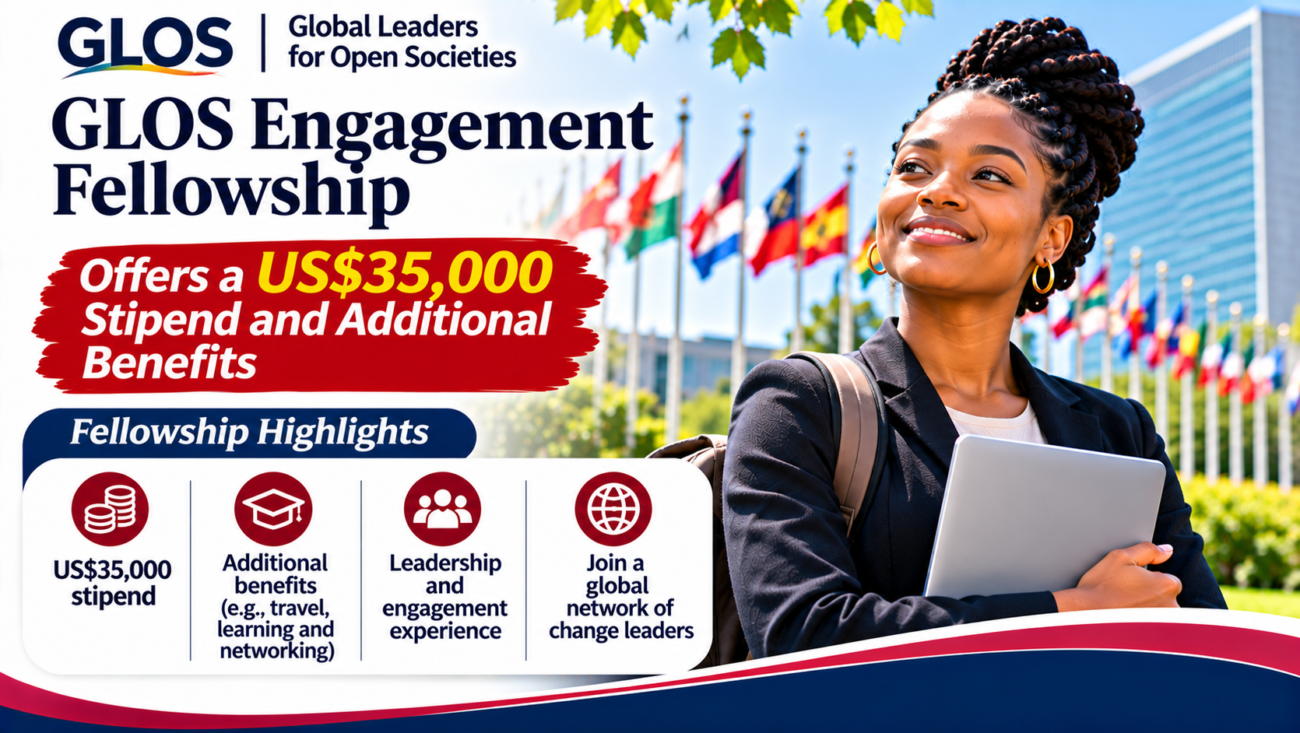
GLOS Engagement Fellowship 2027 offers a US$35,000 stipend and additional benefits
GLOS Engagement Fellowship 2027 offers a US$35,000 stipend and additional benefits. The 2027–2028 Great Lakes Observing System (GLOS) Engagement Fellowship is offering an exciting opportunity for graduate students and recent graduates interested in environmental science, community engagement, freshwater research and public policy.
The fellowship provides a US$35,000 living stipend as part of a total financial support package worth US$40,000, including additional funding for health insurance, relocation and professional development travel.
Based in Ann Arbor, Michigan, the United States, this one-year programme offers hands-on experience working with the Great Lakes Observing System and its regional and national partners.
The selected fellow will contribute to projects involving community engagement, participatory science, Indigenous community partnerships, environmental data and Great Lakes policy.
The programme will begin on 4 January 2027 and run until 3 January 2028.
Applications must be submitted by 13 November 2026 at 5 p.m. Eastern Time.
An important eligibility condition is that applicants must have recently completed, or be within one academic term of completing, a graduate degree or professional programme at an accredited university or institution in the United States or Canada.
GLOS Engagement Fellowship 2027: overview
| Opportunity detail | Information |
|---|---|
| Fellowship | 2027–2028 GLOS Great Lakes Engagement Fellowship |
| Host organisation | Great Lakes Observing System (GLOS) |
| Host country | United States |
| Duty station | Ann Arbor, Michigan |
| Fellowship duration | 12 months |
| Start date | 4 January 2027 |
| End date | 3 January 2028 |
| Total funding package | US$40,000 |
| Living stipend | US$35,000 |
| Additional support | Up to US$5,000 for health insurance and relocation |
| Professional development travel | Up to US$2,000 within the total package |
| Opportunity type | Graduate-level professional fellowship |
| Eligible applicants | Recent or near-completion graduate students from accredited U.S. or Canadian institutions |
| Work arrangement | Full-time, in person |
| Number of fellows | One Engagement Fellow |
| Application deadline | 13 November 2026, 5 p.m. Eastern Time |
About the Great Lakes Observing System
GLOS Engagement Fellowship 2027 offers a US$35,000 stipend and additional benefits
The Great Lakes Observing System (GLOS) is a nonprofit organisation established in 2005 to collect, manage and share information about the Great Lakes.
The Great Lakes are a major freshwater resource shared by the United States and Canada. They support communities, industries, transportation networks, ecosystems, recreation and economic activities across the region.
GLOS works to make real-time and historical Great Lakes data available to the public, researchers, policymakers, industries and other organisations.
Its work supports several important areas, including:
- Coastal resilience.
- Freshwater ecosystem protection.
- Public health.
- Navigation safety.
- Environmental monitoring.
- Water resource management.
- Climate and weather-related decision-making.
GLOS is a certified Regional Association within the National Oceanic and Atmospheric Administration’s (NOAA) Integrated Ocean Observing System (IOOS).
Through its work, the organisation helps connect scientific information with the people and communities that depend on reliable environmental data.
The Engagement Fellowship forms part of its broader efforts to develop professionals capable of working at the intersection of environmental science, public engagement and policy.
What does the GLOS Engagement Fellowship offer?
The fellowship provides a total financial support package valued at US$40,000.
The funding is structured to support the fellow’s living expenses, health insurance, relocation and professional development.
1. US$35,000 living stipend
The successful fellow will receive a stipend of US$35,000 to support living expenses throughout the one-year fellowship.
This is the main financial component of the programme.
The stipend is intended to help the selected candidate meet everyday expenses while working full-time in Ann Arbor, Michigan.
2. Up to US$5,000 for health insurance and relocation
GLOS provides up to US$5,000 from the remaining fellowship funds to cover eligible health insurance and relocation expenses.
Any remaining balance is intended to be used first for academic degree-related activities and then for fellowship-related activities.
Applicants should understand that this is a maximum allocation within the total package, not an additional US$5,000 cash payment on top of the US$35,000 stipend.
3. Professional development travel support
The fellowship provides for up to US$2,000 in professional development travel expenses within the total funding package.
This support can help the fellow attend relevant professional activities during the fellowship year.
Examples may include:
- Great Lakes science conferences.
- Environmental policy conferences.
- Professional development events.
- Relevant research and engagement activities.
GLOS may also provide supplemental funding for certain work-related travel, such as attendance at Great Lakes science or policy conferences.
4. Mentorship and professional guidance
The fellow will work with mentors from GLOS and interact with partner organisations across the Great Lakes region.
This provides an opportunity to learn from professionals working in environmental monitoring, community engagement, science communication and public policy.
5. Practical environmental engagement experience
The fellowship is designed to extend the fellow’s graduate education through practical workplace experience.
Participants will gain exposure to the activities of a regional nonprofit organisation that serves both the scientific community and the general public.
6. National professional networks
The fellow will contribute to GLOS initiatives connected to a national, multi-year programme involving all eleven Regional Associations of NOAA’s Integrated Ocean Observing System.
This provides exposure to a wider professional network working to improve how ocean, coastal and Great Lakes information reaches communities.
What will the GLOS Engagement Fellow do?
GLOS Engagement Fellowship 2027 offers a US$35,000 stipend and additional benefits
The successful candidate will support GLOS’s Service Delivery and Communications activities.
These activities connect environmental data, scientific research and community needs.
The fellowship involves several areas of work.
1. Community engagement and outreach
The fellow may assist with activities designed to understand the needs of communities that depend on Great Lakes environmental information.
This can include gathering information about how communities use observing systems and what additional data or services they require.
The fellow may also support engagement with Indigenous communities to understand their needs relating to environmental observing assets and data.
2. Participatory and community science
Participatory science involves working with communities and other stakeholders to support scientific research and environmental decision-making.
The fellow may help identify opportunities for community participation and improve engagement between researchers, environmental organisations and local communities.
3. Indigenous community partnerships
The programme includes opportunities to support work involving Indigenous communities and their environmental information needs.
This may involve surveying communities, gathering feedback and helping GLOS understand how its data services can better support different groups.
4. Great Lakes community of practice initiatives
The fellow may assist with synthesising engagement activities and identifying the needs of GLOS-led community groups.
Examples include:
- Lakebed 2030.
- Smart Great Lakes Initiative.
These initiatives bring together different stakeholders interested in improving knowledge, environmental monitoring and decision-making concerning the Great Lakes.
5. Community workshops
The fellow may assist with organising and supporting workshops that bring together community members, researchers, policymakers and other environmental stakeholders.
Activities may include workshop preparation, participant engagement, documentation and follow-up.
6. Data user needs assessments
The fellow may contribute to assessments connected to GLOS’s Seagull data platform.
This involves helping identify the information and services that different data users need and how GLOS can improve access to useful environmental information.
Who can apply for the GLOS Engagement Fellowship 2027?
The fellowship has specific academic and professional eligibility requirements.
It is designed for students who have recently completed, or are close to completing, a graduate degree or professional programme.
1. Graduate education requirement
Applicants must have recently completed, or be within one academic term of completing, a graduate degree or professional programme.
The qualification must be from an accredited institution in the United States or Canada.
This requirement is particularly important because holding a postgraduate qualification from an institution in another country does not automatically satisfy the published eligibility conditions.
2. Interest in Great Lakes resources
Applicants must demonstrate an interest in the Great Lakes and the environmental resources associated with the region.
This may include freshwater conservation, coastal resilience, environmental monitoring, water management and related subjects.
3. Community and participatory science
Candidates should demonstrate interest in community engagement and participatory science.
Experience working with communities, conducting research, supporting public engagement or participating in collaborative environmental initiatives can strengthen an application.
4. Interest in Indigenous partnerships
The fellowship particularly values experience or interest in Indigenous and Tribal partnership work.
Applicants should demonstrate an understanding of the importance of involving communities in environmental research, planning and decision-making.
5. Interest in binational environmental policy
The Great Lakes are shared by the United States and Canada.
Applicants should demonstrate an interest in the binational policy decisions that affect the region’s water resources and communities.
6. Academic and professional potential
Candidates should demonstrate academic ability, professional interests and a clear understanding of how the fellowship will support their future career development.
Can applicants from Zimbabwe and other African countries apply?
The fellowship does not publish a general nationality restriction limiting applications to U.S. or Canadian citizens.
However, the academic eligibility requirement is specific: applicants must have recently completed, or be within one academic term of completing, a graduate degree or professional programme at an accredited institution in the United States or Canada.
Therefore, a Zimbabwean or other African national who studied at an eligible U.S. or Canadian institution may explore the opportunity if they satisfy all other conditions.
A graduate who completed their qualification exclusively at a university in Zimbabwe or another country outside the United States and Canada would not meet the stated academic eligibility requirement.
The fellowship is also an in-person programme in Ann Arbor, Michigan. International applicants should independently verify their U.S. immigration and work authorisation eligibility before applying. The published fellowship description does not guarantee visa sponsorship.
Required application documents
Applicants must submit a complete application package containing all the documents specified by GLOS.
Incomplete applications may be rejected without review.
1. Two signed recommendation letters
Applicants must provide two signed letters of recommendation.
One letter must come from the applicant’s major professor.
If the applicant does not have a major professor, a faculty member who knows their academic work best may be substituted.
The second letter should come from an appropriate academic or professional referee who can discuss the applicant’s abilities and suitability for the fellowship.
Recommendation writers may also submit their letters directly to GLOS by email before the application deadline.
2. Personal education and career goal statement
Applicants must submit a statement of no more than 1,000 words.
The statement should explain:
- The applicant’s academic and professional background.
- Their education and career objectives.
- Their relevant abilities and experience.
- What they expect to gain from the fellowship.
- Their interest in community engagement.
- Their interest in participatory science.
- Any experience or interest in Indigenous partnership work.
The statement should clearly explain how the fellowship will contribute to the applicant’s professional development.
3. Personal and academic CV
Applicants must submit a personal and academic curriculum vitae.
The CV must not exceed two pages.
It should highlight relevant academic qualifications, research activities, professional experience, volunteering, awards and other achievements.
4. Official academic transcripts
Applicants must provide clear scanned copies of all official undergraduate and graduate academic transcripts.
The documents should be readable and complete.
Applicants should ensure that all required academic records are included.
5. List of completed and planned courses
GLOS Engagement Fellowship 2027 offers a US$35,000 stipend and additional benefits
Applicants must provide a list of courses completed and/or planned for the two academic terms preceding the fellowship start date.
This document must not exceed one page.
It should provide a clear summary of the applicant’s recent academic activities.
How to apply for the GLOS Engagement Fellowship 2027
Applications must be submitted by email directly to the Great Lakes Observing System.
Follow these steps:
Step 1: Review the official fellowship description
Read the full fellowship announcement and confirm that you meet the graduate education and other eligibility requirements.
Step 2: Prepare your CV
Prepare a personal and academic CV of no more than two pages.
Highlight relevant qualifications, research, community engagement and professional experience.
Step 3: Write your career goal statement
Prepare a statement of no more than 1,000 words explaining your academic background, career objectives and reasons for applying.
Step 4: Request two recommendation letters
Contact your major professor and another appropriate referee.
Ensure both letters are signed and submitted before the application deadline.
Step 5: Obtain your academic transcripts
Request clear official transcripts from your undergraduate and graduate institutions.
Step 6: Prepare your course list
Prepare a one-page list of courses completed and/or planned for the two academic terms preceding the fellowship start date.
Step 7: Submit your complete application
Indicate that you are applying for the GLOS Great Lakes Engagement Fellowship.
Applications must arrive by 5 p.m. Eastern Time on 13 November 2026.
Application deadline and selection timeline
| Activity | Date |
|---|---|
| Application deadline | 13 November 2026 |
| Closing time | 5 p.m. Eastern Time |
| Evaluation and selection | November–December 2026 |
| Anticipated selection completion | 11 December 2026 |
| Fellowship begins | 4 January 2027 |
| Fellowship ends | 3 January 2028 |
The selection process involves an evaluation panel that reviews and scores applications.
The three highest-scoring applicants will be interviewed by the GLOS panel.
Successful and unsuccessful applicants will receive email notifications, together with a written summary of the review panel’s comments.
How will applications be evaluated?
GLOS uses a weighted evaluation system to assess applications.
| Evaluation area | Weight |
|---|---|
| Recommendations and endorsements | 15% |
| Academic record and career goals | 45% |
| Additional relevant experience | 40% |
The academic record and career goals category includes the quality of the personal education and career goal statement, which accounts for 30%, and academic performance, which accounts for 15%.
Relevant experience is assessed through community engagement, participatory or citizen science, Indigenous or Tribal partnership work, diversity of education, extracurricular activities, honours, awards and communication skills.
Applicants should therefore prepare a strong statement and provide clear evidence of their relevant academic and community engagement experience.
Frequently asked questions
How much does the GLOS Engagement Fellowship pay?
The fellowship provides a US$35,000 stipend for living expenses as part of a total US$40,000 package.
What does the additional US$5,000 cover?
GLOS provides up to US$5,000 for health insurance and relocation expenses. Any remaining balance is allocated first to academic degree-related activities and then fellowship-related activities.
Does the fellowship cover travel?
Up to US$2,000 within the total package can be used for professional development travel. GLOS may also provide supplemental funding for certain work-related travel.
How long does the fellowship last?
The fellowship lasts 12 months, from 4 January 2027 to 3 January 2028.
Where is the fellowship based?
The fellowship is based at the GLOS offices located in the NOAA Great Lakes Environmental Research Laboratory in Ann Arbor, Michigan, USA.
Is the fellowship remote?
No. It is a full-time, in-person fellowship. Applicants should be prepared to work on site.
Can Zimbabwean graduates apply?
Zimbabwean applicants may qualify if they have recently completed, or are within one academic term of completing, a graduate degree or professional programme at an accredited U.S. or Canadian institution and satisfy all other requirements.
Can applicants with a Bachelor’s degree apply?
The published requirements specify a graduate degree or professional programme. A Bachelor’s degree alone does not satisfy this requirement.
How many recommendation letters are required?
Two signed recommendation letters are required. One must be from the applicant’s major professor or an appropriate faculty substitute.
What is the word limit for the career statement?
The personal education and career goal statement must not exceed 1,000 words.
What is the application deadline?
Applications must be submitted by 13 November 2026 at 5 p.m. Eastern Time.
Join the Vacancy Bridge WhatsApp Channel
Follow Vacancy Bridge on WhatsApp for the latest jobs, scholarships, internships and fellowships.
https://whatsapp.com/channel/0029Vakee9aHFxOyCIBPJA0o
APPLY NOW ON THIS OFFICIAL PAGE
Final thoughts
GLOS Engagement Fellowship 2027 offers a US$35,000 stipend and additional benefits
GLOS Engagement Fellowship 2027 offers a US$35,000 stipend and additional benefits. The 2027–2028 GLOS Great Lakes Engagement Fellowship provides an attractive professional development opportunity for graduate students and recent graduates interested in freshwater science, environmental policy and community engagement.
With a US$35,000 living stipend, additional support for health insurance and relocation, professional development travel funding and a year of mentorship, the programme offers valuable experience at the intersection of science and public service.
However, applicants should pay close attention to the academic eligibility requirements. The fellowship is specifically intended for individuals who have recently completed, or are close to completing, graduate education at an accredited institution in the United States or Canada.
Eligible candidates should prepare their recommendation letters, academic transcripts, CV and career goal statement and submit their applications before 13 November 2026.
Disclaimer: Vacancy Bridge shares fellowship and career opportunities to help readers discover relevant programmes. The Great Lakes Observing System is responsible for eligibility assessments, application reviews and final selection. Applicants should consult the official fellowship description for complete requirements and funding conditions.
SEO keywords
GLOS Engagement Fellowship 2027, Great Lakes Engagement Fellowship 2027, GLOS Fellowship 2027–2028, US$35,000 fellowship stipend, US$40,000 graduate fellowship, Great Lakes Observing System, environmental science fellowship USA, community engagement fellowship, freshwater science opportunities, environmental policy fellowship, participatory science fellowship, Indigenous community engagement, graduate fellowships in the United States.
