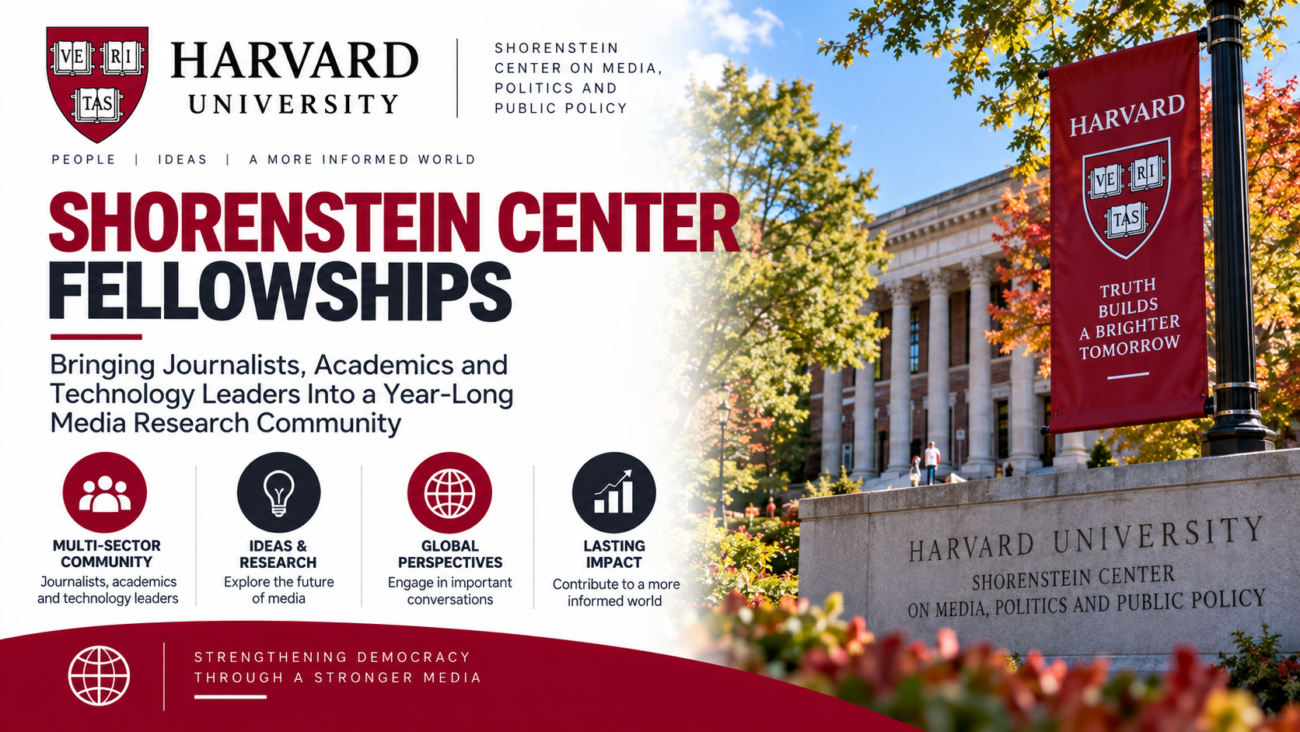
Harvard Shorenstein Center Fellowships Bring Journalists, Academics and Technology Leaders Into a Year-Long Media Research Community
Harvard Shorenstein Center Fellowships Bring Journalists, Academics and Technology Leaders Into a Year-Long Media Research Community. The Harvard Kennedy School Shorenstein Center on Media, Politics and Public Policy is offering an exceptional fellowship opportunity for experienced professionals working across journalism, technology, academia, media, public policy and the wider information ecosystem.
The Shorenstein Fellows Program brings together approximately:
🌍 20 LEADERS EACH YEAR
for a year-long intellectual and professional fellowship focused on some of the most important challenges facing media, technology, politics and public information.
The programme welcomes professionals including:
📰 Journalists & News Creators
💻 Technologists & Civic-Tech Innovators
🎓 Academics & Scholars
🎬 Filmmakers
📱 Media Executives
🏛️ Policymakers & Policy Analysts
📚 Nonfiction Authors
🤝 Political & Public-Policy Practitioners
Unlike a conventional residential Harvard fellowship requiring participants to move to Cambridge for an entire year, the current Shorenstein Fellows Program is:
MOSTLY REMOTE
and designed around independent work, intellectual exchange and engagement with the wider Harvard research community.
The next fellowship programme begins:
📅 SEPTEMBER 1, 2027
and applications are due:
⏰ MAY 1, 2027
However, prospective applicants should understand one important financial detail:
⚠️ THE SHORENSTEIN FELLOWSHIP IS UNPAID.
There is no fellowship salary or monthly living stipend.
Participation itself is free, and fellows receive travel stipends to support up to two trips to Cambridge, Massachusetts, during the fellowship year.
🎓 Shorenstein Fellows Program: Quick Overview
| Detail | Information |
|---|---|
| Institution | Harvard Kennedy School |
| Center | Shorenstein Center on Media, Politics and Public Policy |
| Programme | Shorenstein Fellows Program |
| Duration | One Year |
| Format | Mostly Remote |
| Cohort Size | Approximately 20 fellows |
| Career Level | Mid- to Senior-Career |
| Salary/Stipend | Unpaid |
| Participation Fee | Free |
| Travel Support | Stipends for up to two Cambridge trips |
| Harvard Email | Provided during fellowship |
| Harvard Library Access | Provided during fellowship |
| Next Programme Starts | September 1, 2027 |
| Application Deadline | May 1, 2027 |
| Research Format | Independent/Self-Directed Project |
| Main Areas | Media, Technology, Politics & Public Policy |
🏫 About the Shorenstein Center
The Shorenstein Center on Media, Politics and Public Policy is a research center based at:
Harvard Kennedy School
at Harvard University.
Its work focuses on media and the flow of essential information within societies.
Since its establishment in:
1986
the Center has hosted hundreds of fellows working across journalism, academia, technology, politics, policymaking and related fields.
The fellowship community brings together professionals who approach the information environment from very different perspectives.
This interdisciplinary structure is a defining feature of the programme.
🌐 What Is the Shorenstein Fellows Program?
The current Shorenstein Fellows Program brings together practitioners and scholars pursuing self-directed work at the intersection of:
Media
Technology
Politics
and
Public Policy.
Fellows develop independent projects while contributing to the Shorenstein Center’s wider intellectual and research community.
Rather than requiring every fellow to pursue the same research question, the programme allows participants to investigate issues connected with their own professional expertise.
This can make the fellowship relevant to people working across very different areas of the information ecosystem.
🗓️ A One-Year Fellowship
The current programme is:
ONE YEAR IN LENGTH.
During the fellowship year, participants pursue an independent project or line of inquiry.
They also have regular opportunities to interact with:
Other fellows
Shorenstein Center faculty
Center staff
Harvard students
and
Members of the wider research community.
This is a significant change from older versions of some Shorenstein fellowships, which historically operated on shorter residential or semester-based structures.
Applicants should therefore rely on the current fellowship information rather than older programme descriptions circulating online.
💻 Is the Fellowship Remote?
Yes — primarily.
The current Shorenstein Fellows Program is described as:
MOSTLY REMOTE.
This means fellows generally do not need to relocate permanently to Cambridge for the entire fellowship year.
Boston-area fellows are welcome to use the Center’s on-campus resources.
Other participants can engage remotely while making selected visits to Harvard for programme events and campus engagement.
This structure can make the programme particularly attractive to experienced professionals who want to continue their careers while participating in the fellowship.
💰 Is the Shorenstein Fellowship Paid?
Harvard Shorenstein Center Fellowships Bring Journalists, Academics and Technology Leaders Into a Year-Long Media Research Community
No.
This is one of the most important points prospective applicants need to know.
The current Shorenstein Fellows Program is:
UNPAID
and:
FREE TO PARTICIPATE IN.
Fellows should therefore not expect a:
Monthly stipend
Salary
or
Living allowance
simply for participating.
Applicants should take this into account when considering whether the fellowship fits their professional and financial circumstances.
✈️ Travel Stipends
Although the fellowship is unpaid, participants do receive some travel support.
The Shorenstein Center provides:
TRAVEL STIPENDS FOR UP TO TWO TRIPS TO CAMBRIDGE
during the fellowship year.
These visits support participation in programme events and opportunities for engagement with the Harvard campus community.
Applicants should wait for their individual fellowship documentation before assuming which specific travel expenses will be covered.
📚 Harvard Library Access
Selected fellows receive access to valuable Harvard resources during their fellowship term.
This includes:
HARVARD LIBRARY RESOURCES
both:
Online
and
In person.
For journalists, academics and professionals pursuing independent research, access to Harvard’s research infrastructure can be particularly valuable.
📧 Harvard Email Account
Fellows also receive:
A HARVARD EMAIL ACCOUNT
for the duration of the fellowship.
However, access to Harvard systems is tied to the fellowship term.
When the fellowship ends, access to systems including Harvard email and library resources concludes.
🔬 What Do Fellows Work On?
Each fellow pursues an:
INDEPENDENT PROJECT OR LINE OF INQUIRY
during the fellowship.
Projects should connect meaningfully with the Center’s mission and the broader intersection of:
Media
Technology
Politics
Public policy
and the information ecosystem.
Fellows work independently while developing their projects in collaboration with the Center.
✍️ Fellows Produce Public-Facing Work
The programme is not simply an informal professional networking year.
Fellows are expected to produce original content or programming.
This can include:
Expert commentary
Op-eds
Essays
Stories
Webinars
or other forms of public-facing work.
The Shorenstein Center can support fellows in shaping, publishing and promoting this work.
The aim is to help translate professional expertise and research into material that contributes to public understanding of the information ecosystem.
📰 Journalists
Experienced journalists are a central part of the fellowship community.
Potential applicants can include:
Investigative journalists
News reporters
Editors
Digital journalists
Independent journalists
News creators
and other professionals working within journalism.
The 2026–27 cohort, for example, includes journalists working across both established and independent media environments.
📱 News Influencers and Creators
The fellowship’s eligibility extends beyond conventional newsroom journalism.
The Center specifically welcomes:
NEWS INFLUENCERS AND CREATORS.
This reflects the changing nature of how people receive information.
Digital creators increasingly influence public understanding through:
Social media
Newsletters
Video platforms
Podcasts
and independent digital-media brands.
Professionals working in these spaces can therefore be relevant candidates when their work connects with the Center’s mission.
💻 Technologists
Technology professionals are another important target group.
Applicants can include people working in:
Civic technology
Artificial intelligence
Media technology
Digital products
Newsroom tools
Data
Information systems
and related fields.
Technology is increasingly central to how information is created, distributed and consumed.
The fellowship therefore provides space for technologists to examine these issues alongside journalists, researchers and policymakers.
🤖 AI and Newsroom Technology
Artificial intelligence is already represented strongly within the current fellowship community.
The 2026–27 cohort includes professionals working on:
AI
Editorial technology
Newsroom tools
Product design
and the broader relationship between emerging technology and public information.
For professionals researching how AI affects:
Journalism
Public trust
Information integrity
News production
or
Media institutions,
the Shorenstein environment may provide a particularly relevant intellectual community.
🎓 Academics and Scholars
Academic applicants are also welcome.
The programme specifically identifies scholars working in areas such as:
Political science
and
Media studies
as examples.
However, the current fellowship community spans broader academic and research areas.
The 2026–27 class includes expertise in areas such as:
Social science
Public health
Media research
AI
and digital information.
Academics should propose work that connects meaningfully with the Shorenstein Center’s research mission.
🏛️ Policymakers and Policy Professionals
The programme also welcomes:
Policymakers
Political advisors
and
Policy analysts.
These professionals can bring valuable insight into how information systems interact with:
Government
Institutions
Public policy
Political communication
and civic life.
This interdisciplinary mix enables fellows to examine information challenges from perspectives beyond journalism alone.
🎬 Filmmakers and Media Executives
Filmmakers and media executives can also apply to the Shorenstein Fellows Program.
However, applicants should note an important restriction:
The fellowship cannot be used to develop a film project.
Professionals interested specifically in documentary filmmaking should also investigate the Center’s separate:
Documentary and Visual Storytelling Fellowships
which operate under their own structures and application requirements.
👩💼 What Career Level Is Required?
The fellowship is designed primarily for:
MID- TO SENIOR-CAREER PROFESSIONALS.
This means it should not be promoted simply as an entry-level fellowship for recent graduates.
The Center is looking for applicants who already possess substantial professional experience, expertise and perspectives that can contribute meaningfully to the fellowship community.
Professional achievement and the strength of the proposed project are therefore important.
🌍 Who Should Apply?
Harvard Shorenstein Center Fellowships Bring Journalists, Academics and Technology Leaders Into a Year-Long Media Research Community
The Shorenstein Center specifically welcomes applications from professionals including:
Journalists
News influencers
Digital creators
Civic-tech innovators
Media innovators
Nonfiction authors
Academics
Political scientists
Media scholars
Policymakers
Political advisors
Policy analysts
Filmmakers
and
Media executives.
Applicants should be able to demonstrate how their proposed work connects to the Center’s mission.
🧑🤝🧑 Engagement With the Harvard Community
Fellows are expected to contribute to the Center rather than simply work privately on their own projects.
Engagement can include:
Participating in events
Mentoring students
Advising on Center projects
and interacting with the wider Harvard research community.
Fellows are encouraged to build relationships across:
Harvard Kennedy School
and the broader:
Harvard University community.
This community component is one of the fellowship’s major professional-development benefits.
🎯 What Makes a Strong Fellowship Project?
A strong proposal should connect the applicant’s professional expertise with an important question involving the information environment.
Potential areas might involve:
AI and journalism
Newsroom technology
Public trust
Misinformation
Creator-led news
Media business models
Political communication
Public-health communication
Digital civic infrastructure
Information integrity
Community journalism
Media accountability
or other relevant issues.
These are examples rather than a fixed list of approved topics.
Applicants should develop an original project that fits their own expertise and the Center’s mission.
⚠️ Human-Subject Research
Applicants planning conventional academic research involving human subjects should pay particular attention to the fellowship rules.
The Center states that fellows are:
Discouraged from pursuing human-subject research requiring IRB oversight.
Researchers should therefore design projects that are practical within the structure and timeframe of the fellowship.
🌍 International Perspective
The fellowship community is not confined to one professional background or geographic perspective.
The 2026–27 cohort includes people bringing perspectives from:
The United States
Europe
and
Africa
and from environments including:
Independent newsrooms
Major media organizations
Technology companies
Academic institutions
Public institutions
and community-focused organizations.
Applicants should nevertheless review the current application form for any specific participation or administrative requirements applicable to their circumstances.
👥 The 2026–27 Fellowship Cohort
The current 2026–27 Shorenstein Fellows demonstrate the programme’s interdisciplinary reach.
The cohort includes expertise spanning:
Journalism
AI and newsroom technology
Health communication
Social science
Product design
Creator and influencer studies
Government
Philanthropy
and
Civic accountability.
This diversity illustrates why the programme should not be described simply as a journalism fellowship.
It is a broader media, technology and public-information fellowship.
🏆 More Than 300 Fellows Since 1986
The Shorenstein Center reports that it has hosted:
MORE THAN 300 FELLOWS
since its establishment in 1986.
Past participants have included:
Journalists
Scholars
Practitioners
Policymakers
and experts from other fields.
The programme therefore connects new fellows with a substantial alumni and professional network.
📅 Shorenstein Fellowship 2027 Deadline
Harvard Shorenstein Center Fellowships Bring Journalists, Academics and Technology Leaders Into a Year-Long Media Research Community
The next Shorenstein Fellows Program begins:
SEPTEMBER 1, 2027
Applications are due:
MAY 1, 2027.
In some cases, fellows may be permitted to begin their fellowship in:
JANUARY.
Applicants interested in an alternative start should follow the Center’s instructions and contact the programme if necessary.
📝 How to Apply
Applications are submitted through the Shorenstein Center’s official fellowship application process.
Step 1: Review the Fellowship
Read the current programme description and FAQs carefully.
Step 2: Consider Your Professional Fit
The programme is primarily aimed at established mid- to senior-career practitioners and scholars.
Step 3: Develop Your Project Idea
Identify a self-directed project or line of inquiry relevant to media, technology, politics, public policy or the broader information ecosystem.
Step 4: Consider the Public Output
Think about how your work could result in public-facing material such as:
An op-ed
Essay
Expert commentary
Story
Webinar
or related programming.
Step 5: Submit the Official Application
Complete the current application before:
May 1, 2027.
📄 What Should Applicants Prepare?
The exact requirements should be taken from the current application form.
However, applicants should be prepared to explain:
Their professional background
Area of expertise
Proposed fellowship project
Why the project matters
How it aligns with the Shorenstein Center
and
What they expect to produce during the fellowship year.
Applicants should avoid relying on old application requirements from previous versions of the fellowship.
🏆 How Competitive Is the Fellowship?
The programme brings together only about:
20 LEADERS PER YEAR.
The applicant pool can span journalism, academia, technology, policymaking, media and other professional fields.
Selection therefore involves more than having an interesting idea.
Applicants should demonstrate:
Substantial professional experience
Relevant expertise
A compelling project
Clear alignment with the Center’s mission
and
Potential to contribute meaningfully to the fellowship community.
💼 Can Fellows Continue Working?
The current programme is mostly remote and built around self-directed projects, making it structurally different from a full-time residential academic fellowship.
However, applicants should carefully consider whether they have enough time to:
Pursue their project
Produce original work
Participate in Center activities
Engage with students
and
Contribute to the research community.
Professional flexibility will therefore be important.
💵 Salary and Benefits Explained
Applicants should be particularly careful about the financial structure.
The Shorenstein Fellows Program provides:
❌ No fellowship salary
❌ No general monthly stipend
✅ Free participation
✅ Travel stipends for up to two Cambridge visits
✅ Harvard email account during the fellowship
✅ Harvard library access during the fellowship
✅ Engagement with Harvard Kennedy School and the wider Harvard community
✅ Support for developing and promoting public-facing work
✅ Access to a multidisciplinary professional network
The fellowship’s value is therefore primarily:
INTELLECTUAL, PROFESSIONAL AND INSTITUTIONAL
rather than financial.
🌟 Why This Fellowship Matters
The information environment is changing rapidly.
Journalism now intersects increasingly with:
Artificial intelligence
Social platforms
Independent creators
Digital products
Data
Political communication
and changing patterns of public trust.
Addressing these challenges requires people from different professional worlds to work together.
The Shorenstein fellowship creates a community where:
Journalists can learn from technologists
Technologists can engage with scholars
Researchers can interact with practitioners
and
Policy professionals can contribute institutional perspectives.
This interdisciplinary model is one of the programme’s strongest characteristics.
⚠️ Common Application Mistakes
Prospective applicants should avoid:
- Describing the fellowship as fully funded
- Claiming that fellows receive a monthly salary
- Using old four-month fellowship information for the current programme
- Assuming the fellowship requires a full-year relocation to Harvard
- Treating it as an entry-level graduate fellowship
- Submitting a project unrelated to the Center’s mission
- Applying primarily to develop a film project
- Designing a project heavily dependent on human-subject research requiring IRB oversight
- Ignoring the public-facing output requirement
- Using outdated deadlines
- Assuming participation automatically provides permanent Harvard affiliation
The current fellowship is a one-year, mostly remote and unpaid programme for experienced professionals and scholars.
❓ Frequently Asked Questions
What is the Shorenstein Fellows Program?
It is a one-year fellowship bringing practitioners and scholars together to pursue independent projects involving media, technology, politics and public policy.
Is this a Harvard fellowship?
Yes. The Shorenstein Center is based at Harvard Kennedy School.
How long is the fellowship?
The current fellowship lasts one year.
Is it residential?
No. The current programme is mostly remote.
Do I need to move to Cambridge?
Not for the entire fellowship. Boston-area fellows can use on-campus resources, while other fellows primarily participate remotely.
Is the fellowship paid?
No. The current Shorenstein Fellows Program is unpaid.
Is there an application fee?
The fellowship is free to participate in.
Does Harvard provide travel support?
Fellows receive travel stipends supporting up to two trips to Cambridge during the fellowship year.
Do fellows receive Harvard library access?
Yes. Fellows receive online and in-person Harvard library access during their fellowship term.
Do fellows get a Harvard email address?
Yes. A Harvard email account is provided during the fellowship.
Who can apply?
The programme welcomes mid- to senior-career journalists, creators, technologists, scholars, policymakers, political practitioners, filmmakers and media executives, among others.
Can academics apply?
Yes. Scholars, including people working in areas such as political science and media studies, are specifically identified as potential applicants.
Can technology professionals apply?
Yes. Civic-tech and media innovators are among the programme’s target applicants.
Can filmmakers apply?
Yes, but the Shorenstein Fellows Program cannot be used to develop a film project.
What must fellows produce?
Fellows are expected to create original public-facing content or programming, which can include expert commentary, essays, op-eds, stories or webinars.
When does the next fellowship begin?
The next programme begins on:
September 1, 2027.
What is the application deadline?
Applications are due:
May 1, 2027.
🚀 Final Thoughts
Harvard Shorenstein Center Fellowships Bring Journalists, Academics and Technology Leaders Into a Year-Long Media Research Community
The Harvard Shorenstein Center Fellows Program provides an unusual opportunity for experienced professionals working across:
Journalism
Technology
Academia
Media
Politics
and
Public policy
to become part of a year-long Harvard research and intellectual community.
Approximately:
20 LEADERS
join the programme each year.
They pursue independent projects while engaging with fellow participants, Harvard researchers, students and the wider Shorenstein Center community.
The current programme is:
🌍 MOSTLY REMOTE
📅 ONE YEAR LONG
and:
💻 BUILT AROUND SELF-DIRECTED WORK.
Applicants should nevertheless be clear about the financial arrangements:
THE FELLOWSHIP IS UNPAID.
Its benefits instead include free participation, Harvard library access, a Harvard email account, support for public-facing work, engagement with Harvard’s intellectual community and travel stipends for up to two visits to Cambridge.
For journalists, researchers, technologists, media innovators, creators and policy professionals seeking time and community to investigate major questions affecting the modern information ecosystem, the programme offers a distinctive professional opportunity.
The next programme begins:
September 1, 2027
and applications close:
May 1, 2027.
📲 Get More Harvard Fellowships & Global Opportunities
Stay updated with Harvard fellowships, journalism opportunities, research fellowships, technology programmes, scholarships, international jobs and professional development opportunities through the Vacancy Bridge WhatsApp Channel.
Join the Vacancy Bridge WhatsApp Channel
https://whatsapp.com/channel/0029Vakee9aHFxOyCIBPJA0o
APPLY ON THIS OFFICIAL PAGE
🔑 Key Details
Institution: Harvard University / Harvard Kennedy School
Center: Shorenstein Center on Media, Politics and Public Policy
Programme: Shorenstein Fellows Program
Duration: One Year
Format: Mostly Remote
Cohort: Approximately 20 Fellows
Career Level: Mid- to Senior-Career
Fields: Journalism, Media, Technology, Academia, Politics & Public Policy
Salary: Unpaid
Participation Cost: Free
Travel: Stipends for up to two Cambridge trips
Harvard Library: Access provided during fellowship
Harvard Email: Provided during fellowship
Next Start Date: September 1, 2027
Deadline: May 1, 2027
Application: Online through the Shorenstein Center
🔎 SEO Keywords
Harvard Shorenstein Center Fellowships, Harvard Fellowships 2027, Shorenstein Fellows Program 2027, Harvard Journalism Fellowship, Harvard Media Fellowship, Harvard Technology Fellowship, Harvard Kennedy School Fellowships, Journalism Fellowships 2027, Media Fellowships 2027, Fellowships for Journalists, Fellowships for Academics, Fellowships for Technology Leaders, Harvard Fellowship for Journalists, Harvard Fellowship for Technologists, Media Research Fellowships, Shorenstein Center Application, Shorenstein Fellowship Deadline 2027, Harvard Remote Fellowship, Remote Fellowships 2027, Harvard Kennedy School Media Fellowship, Journalism Research Fellowship, Technology and Media Fellowship, Fellowships for Mid Career Professionals, International Journalism Fellowships, Media Technology Research Fellowship, Vacancy Bridge.
