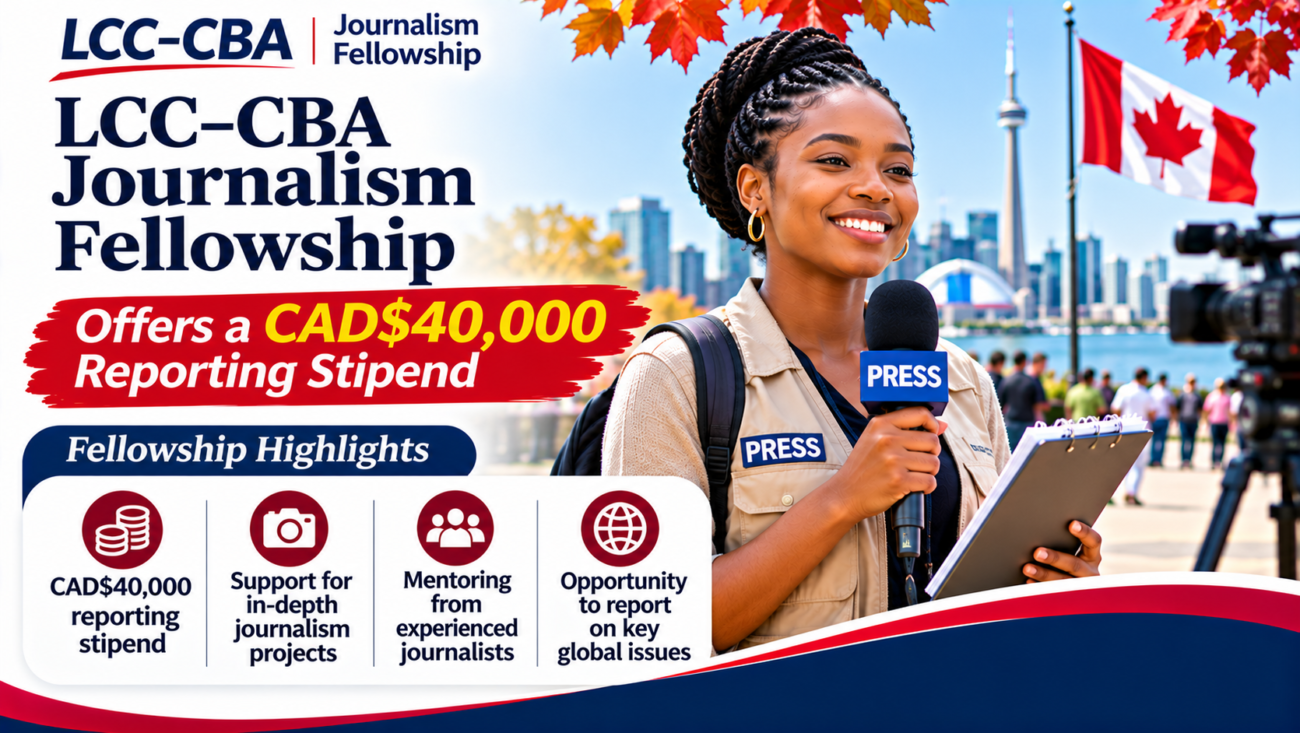
LCC–CBA Journalism Fellowship 2027 offers a CAD$40,000 reporting stipend
LCC–CBA Journalism Fellowship 2027 offers a CAD$40,000 reporting stipend. The 2027 Law Commission of Canada–Canadian Bar Association (LCC–CBA) Journalism Fellowship is inviting applications from experienced journalists interested in investigating important legal and justice issues affecting Canadian society.
The one-year fellowship provides a CAD$40,000 stipend to support the production of original, in-depth print or digital journalism exploring how laws, legal institutions and the justice system influence people’s lives.
The fellowship is jointly organised by the Law Commission of Canada and the Canadian Bar Association. It recognises the important role journalism plays in improving public understanding of the law, highlighting underreported justice issues and encouraging informed discussions about legal reform.
The selected fellow will produce a series of four original long-form articles, each between 2,500 and 4,000 words. The articles must be fact-based, non-partisan and published quarterly.
The programme is particularly interested in reporting that examines emerging legal issues, identifies gaps in public understanding and explores how Canada’s legal institutions can respond to challenges affecting individuals and communities.
Applications are open until 4 December 2026. Journalists must have at least five years of full-time professional experience and be based in Canada.
LCC–CBA Journalism Fellowship 2027: overview
| Opportunity detail | Information |
|---|---|
| Fellowship | 2027 LCC–CBA Journalism Fellowship |
| Organisers | Law Commission of Canada and Canadian Bar Association |
| Host country | Canada |
| Duration | One year |
| Opportunity type | Professional journalism fellowship |
| Stipend | CAD$40,000 |
| Reporting requirements | Four original long-form articles |
| Article length | 2,500–4,000 words each |
| Publication format | Print or digital |
| Eligible applicants | Experienced journalists based in Canada |
| Minimum experience | Five years of full-time work experience |
| Application deadline | 4 December 2026 |
| Selection notification | January 2027 |
| Fellowship commencement | January 2027 |
| Application method | Email submission |
| Application fee | No fee stated in the official call |
About the fellowship
LCC–CBA Journalism Fellowship 2027 offers a CAD$40,000 reporting stipend
The LCC–CBA Journalism Fellowship was established through a partnership between the Law Commission of Canada and the Canadian Bar Association.
The programme supports journalism that explores the relationship between law and society. Its central objective is to make legal issues more understandable and accessible to the public through investigative reporting and human-centred storytelling.
Legal systems influence many aspects of everyday life, including family relationships, employment, housing, immigration, criminal justice, public institutions and individual rights.
However, important legal developments and justice challenges are not always adequately explained or covered in mainstream media.
The fellowship seeks to address this gap by supporting an experienced journalist to investigate emerging and underreported issues and produce comprehensive articles that help readers understand how the law works and how it affects them.
The selected fellow will have an opportunity to contribute to public legal education and discussions about the future of Canada’s justice system.
About the Law Commission of Canada
The Law Commission of Canada (LCC) is an independent federal agency committed to engaging Canadians in the ongoing development and evolution of law.
Its work involves examining legal issues, identifying areas where reform may be needed and encouraging informed discussions about how laws and legal institutions can respond to changing social conditions.
Through research, public engagement and collaboration with different stakeholders, the Commission contributes to discussions about the effectiveness, accessibility and fairness of Canada’s legal system.
The LCC works to make law more responsive to the experiences and needs of people across Canada.
About the Canadian Bar Association
The Canadian Bar Association (CBA) is a national professional organisation representing members of Canada’s legal profession.
Its membership includes lawyers, judges, notaries, academics and law students.
The organisation promotes the rule of law, access to justice, professional development and improvements to the legal system.
Through its partnership with the Law Commission of Canada, the CBA supports journalism that makes legal issues more accessible to the public and encourages greater understanding of justice-related challenges.
What does the CAD$40,000 fellowship offer?
The LCC–CBA Journalism Fellowship provides a CAD$40,000 stipend for the selected journalist to undertake a one-year reporting project.
The funding supports the development and production of four original long-form articles.
1. CAD$40,000 reporting stipend
The successful applicant will receive a total fellowship stipend of CAD$40,000.
According to the official call, the stipend will be paid quarterly upon submission of each completed article.
This means the payment schedule is connected to the delivery of the four reporting pieces rather than being described as a single upfront payment.
2. Support for in-depth reporting
The fellowship provides an opportunity to investigate complex legal and justice issues that require detailed research, interviews and careful analysis.
The selected journalist will have a year to develop and produce a series of comprehensive articles.
3. Publication and distribution opportunities
The articles will be shared through the networks of the Law Commission of Canada and the Canadian Bar Association.
The official call identifies several publication channels, including:
- Law Commission of Canada website.
- Canadian Bar Association website.
- CBA National Magazine.
- Other suitable print and digital publications.
This provides an opportunity for the fellow’s reporting to reach both general readers and members of the Canadian legal community.
4. Public engagement opportunities
The selected fellow may also be invited to participate in public engagement activities connected to the articles.
Examples include:
- Conference presentations.
- Podcast episodes.
- Public discussions.
- Other initiatives designed to increase awareness of legal and justice issues.
These activities provide additional opportunities to communicate research findings and encourage informed discussions.
5. Professional recognition
LCC–CBA Journalism Fellowship 2027 offers a CAD$40,000 reporting stipend
Being selected for the fellowship provides an opportunity to undertake a substantial journalism project in collaboration with two established Canadian legal institutions.
The fellow’s work will contribute to public discussions about the role of law, justice and legal institutions in Canadian society.
Important funding clarification: The CAD$40,000 is a professional reporting stipend paid quarterly after completed articles are submitted. The official call does not describe it as a university scholarship or a general travel and accommodation package.
What will the selected fellow be expected to do?
The selected journalist will be responsible for producing a series of four original long-form articles during the one-year fellowship.
Each article must be between 2,500 and 4,000 words.
The articles should:
- Examine important Canadian law and justice issues.
- Explore emerging or underreported topics.
- Be based on reliable research and evidence.
- Present balanced and non-partisan reporting.
- Explain how legal issues affect individuals and communities.
- Improve public understanding of Canada’s justice system.
The articles are expected to be published quarterly.
The fellow may also be invited to participate in public engagement activities based on the reporting series.
Suggested reporting themes
The fellowship encourages proposals that investigate critical legal issues affecting Canadian society and topics that deserve greater public attention.
Applicants can explore different areas of law and justice, provided their proposed projects demonstrate public importance and relevance to Canada.
Potential themes include:
1. Access to justice
Reporting could investigate barriers that prevent individuals and communities from accessing legal services.
Possible issues include the cost of legal representation, delays in court proceedings, access to legal aid and challenges faced by people living in remote communities.
2. Criminal justice and corrections
Journalists may examine how Canada’s criminal justice system operates and how its policies affect individuals, families and communities.
Potential areas include prison conditions, rehabilitation, sentencing, policing and the treatment of vulnerable groups.
3. Indigenous legal traditions and justice
Proposals could explore the relationship between Indigenous legal traditions and Canada’s formal legal institutions.
Reporting may examine Indigenous approaches to justice, legal recognition, self-governance and access to culturally appropriate legal services.
4. Technology and the justice system
The growing use of artificial intelligence and digital technologies raises important questions about legal accountability, privacy, evidence and fairness.
Journalists could investigate how technological developments are changing courts, legal processes and access to justice.
5. Family law and social protection
Reporting could examine how family law affects children, parents and vulnerable individuals.
Potential issues include child protection, family disputes, domestic violence and access to legal support.
6. Housing, employment and human rights
Applicants may investigate how legal rules affect people’s access to housing, employment opportunities, workplace protections and fundamental rights.
These are illustrative themes. Applicants should develop original proposals that address issues requiring greater public understanding.
Who can apply for the LCC–CBA Journalism Fellowship 2027?
LCC–CBA Journalism Fellowship 2027 offers a CAD$40,000 reporting stipend
The fellowship is designed for experienced journalists who are based in Canada and interested in producing comprehensive reporting on legal and justice issues.
Applicants must meet the following requirements.
1. Professional journalism experience
Applicants must have a minimum of five years of full-time work experience.
The fellowship is intended for established journalists who have the professional background and reporting skills required to undertake a substantial investigative or long-form reporting project.
2. Must be based in Canada
Applicants must be based in Canada.
This is an important eligibility condition. Journalists living outside Canada should not assume they qualify simply because they cover Canadian affairs or have previously published articles about Canada.
3. Interest in legal and justice reporting
Applicants should demonstrate a commitment to expanding their knowledge of the Canadian justice system.
They should also show an interest in producing comprehensive reports on legal issues affecting Canadian society.
4. Ability to produce long-form journalism
The selected fellow must be capable of researching, writing and completing four original articles of 2,500–4,000 words each.
Applicants should demonstrate their ability to produce accurate, well-researched and engaging journalism.
5. Commitment to public understanding
The proposed reporting should help the public better understand important legal issues and the role of Canada’s legal institutions.
Projects should be accessible to both general readers and legal professionals.
Can journalists from Zimbabwe apply?
The official eligibility requirements specify that applicants must be based in Canada and have at least five years of full-time work experience.
Therefore, journalists who are based in Zimbabwe and do not meet the Canadian location requirement are not eligible under the published criteria.
The fellowship is not an international journalism grant open to applicants from every country.
Zimbabwean journalists who are currently based in Canada may explore the opportunity if they satisfy the remaining eligibility and professional requirements.
Required application documents
Applicants must submit a complete application package by email.
The official 2027 call requests the following materials:
1. Curriculum vitae
Prepare an up-to-date CV outlining your journalism experience, professional background, employment history and relevant reporting achievements.
The CV should clearly demonstrate that you meet the minimum five-year full-time experience requirement.
2. Samples of previous work
Applicants must submit up to three samples of previously published journalism.
Choose examples that demonstrate:
- Strong research and reporting.
- Clear and engaging writing.
- Accuracy and factual reliability.
- Ability to investigate complex issues.
- Experience producing in-depth stories.
Where possible, select samples that demonstrate an ability to explain complicated issues to a general audience.
3. Two reference letters
Applicants must provide two reference letters.
These should support the applicant’s professional experience, journalistic ability and suitability for the fellowship.
4. Project proposal
Applicants must submit a project proposal of no more than 750 words.
The proposal should explain:
- How the project addresses underreported issues and improves public understanding of law.
- Why the proposed issues are important to Canadians.
- The potential public impact of the reporting.
- How the project could inform broader responses to law and justice challenges.
- The key information sources that will be used.
The proposal should be specific, realistic and supported by a clear reporting approach.
5. Multimedia components
Applicants should describe any multimedia elements that may accompany their proposed articles.
These may include:
- Photography.
- Video.
- Podcast episodes.
- Other relevant digital storytelling formats.
Multimedia components should complement the written reporting and help communicate the project’s findings.
6. Publication and content distribution plan
LCC–CBA Journalism Fellowship 2027 offers a CAD$40,000 reporting stipend
Applicants must provide a plan explaining how the reporting will be published and distributed.
The plan may identify:
- Print publications.
- Digital news platforms.
- Websites.
- Substack publications.
- Blogs.
- Other relevant distribution channels.
The objective is to ensure the reporting reaches both the general public and legal professionals.
Additional advantage: The official call states that letters from editors confirming interest in the proposed articles and their eventual publication will be considered favourably during the application review.
How to apply for the LCC–CBA Journalism Fellowship 2027
Applications must be submitted by email to the Law Commission of Canada.
Follow these steps:
Step 1: Review the official call for applications
Read the official fellowship document carefully to understand the requirements, reporting expectations and eligibility conditions.
Step 2: Prepare your CV
Ensure your CV clearly demonstrates at least five years of full-time journalism experience.
Step 3: Select up to three work samples
Choose your strongest published articles or other relevant journalism work.
Step 4: Obtain two reference letters
Contact appropriate professional referees and allow sufficient time for them to prepare their letters.
Step 5: Develop your project proposal
Prepare a proposal of no more than 750 words addressing the required themes, public impact, research sources and reporting approach.
Step 6: Prepare your publication plan
Explain how you intend to distribute the articles and reach the intended readership.
Include any editor correspondence confirming publication interest, if available.
Step 7: Submit your application by email
Subject suggestion: Application – 2027 LCC–CBA Journalism Fellowship
Ensure that all attachments are included and that the application arrives before the deadline.
Application deadline and selection timeline
The official 2027 call provides the following timeline:
| Activity | Date |
|---|---|
| Applications open | November 2026 |
| Application deadline | 4 December 2026 |
| Selection notification | January 2027 |
| Fellowship commencement | January 2027 |
| Fellowship duration | One year |
Applicants should submit their materials early enough to allow time for checking attachments, references and the project proposal.
The selected candidate will be notified in January 2027 with a view to beginning the fellowship during that month.
Tips for preparing a competitive application
LCC–CBA Journalism Fellowship 2027 offers a CAD$40,000 reporting stipend
Choose an underreported issue. Develop a proposal that explores a legal or justice issue that has not received sufficient public attention.
Demonstrate public importance. Explain why the proposed topic matters to Canadians and how the reporting could improve public understanding.
Use credible sources. Identify the institutions, experts, communities, documents and other sources that will support the investigation.
Show reporting experience. Select work samples that demonstrate your ability to research complex subjects and produce comprehensive journalism.
Develop a realistic publication plan. Explain how the four articles will reach both general readers and legal professionals.
Secure editorial interest. An editor’s letter confirming interest in the proposed articles may strengthen the application.
Keep the proposal focused. The maximum length is 750 words. Make every section relevant to the proposed project and its potential impact.
Frequently asked questions
How much is the LCC–CBA Journalism Fellowship worth?
The fellowship is valued at CAD$40,000 for one year.
How is the CAD$40,000 stipend paid?
The official call states that the stipend is paid quarterly upon submission of each completed article.
How many articles must the fellow produce?
The selected journalist must produce four original long-form articles.
What is the required length of each article?
Each article must be between 2,500 and 4,000 words.
Who is eligible to apply?
Journalists with at least five years of full-time work experience who are based in Canada and interested in reporting on legal and justice issues.
Can journalists from Zimbabwe apply?
Journalists based in Zimbabwe are not eligible under the published Canada-based requirement. Zimbabweans who are based in Canada may apply if they meet the other conditions.
What is the application deadline?
Applications must be submitted by 4 December 2026.
Do I need to submit a project proposal?
Yes. Applicants must provide a project proposal of no more than 750 words.
How many work samples are required?
Applicants may submit up to three samples of previous journalism work.
Are reference letters required?
Yes. Two reference letters must be included.
Can I include a letter from an editor?
Yes. Letters from editors confirming interest in the proposed articles and their eventual publication will be considered favourably.
When will the successful applicant be announced?
The selected candidate will be notified in January 2027.
Join the Vacancy Bridge WhatsApp Channel
Follow Vacancy Bridge on WhatsApp for the latest jobs, scholarships, internships and fellowships.
https://whatsapp.com/channel/0029Vakee9aHFxOyCIBPJA0o
APPLY NOW ON THIS OFFICIAL PAGE
Final thoughts
LCC–CBA Journalism Fellowship 2027 offers a CAD$40,000 reporting stipend
LCC–CBA Journalism Fellowship 2027 offers a CAD$40,000 reporting stipend. The 2027 LCC–CBA Journalism Fellowship offers an important professional opportunity for experienced journalists who want to investigate legal and justice issues affecting Canadian society.
With a CAD$40,000 reporting stipend, a one-year fellowship period and opportunities to publish through established Canadian legal and media networks, the programme provides valuable support for high-quality journalism.
However, applicants should pay close attention to the eligibility conditions. The fellowship requires at least five years of full-time journalism experience and is specifically intended for journalists based in Canada.
Eligible candidates should prepare their CVs, work samples, two reference letters and a focused project proposal before submitting their applications by 4 December 2026.
SEO keywords
LCC CBA Journalism Fellowship 2027, CAD$40,000 journalism fellowship, Canadian journalism fellowships 2027, Law Commission of Canada fellowship, Canadian Bar Association journalism fellowship, legal journalism opportunities, justice reporting fellowship, investigative journalism fellowship Canada, journalism stipend 2027, long-form journalism opportunities, Canadian law and justice reporting, journalism fellowships for experienced journalists.
