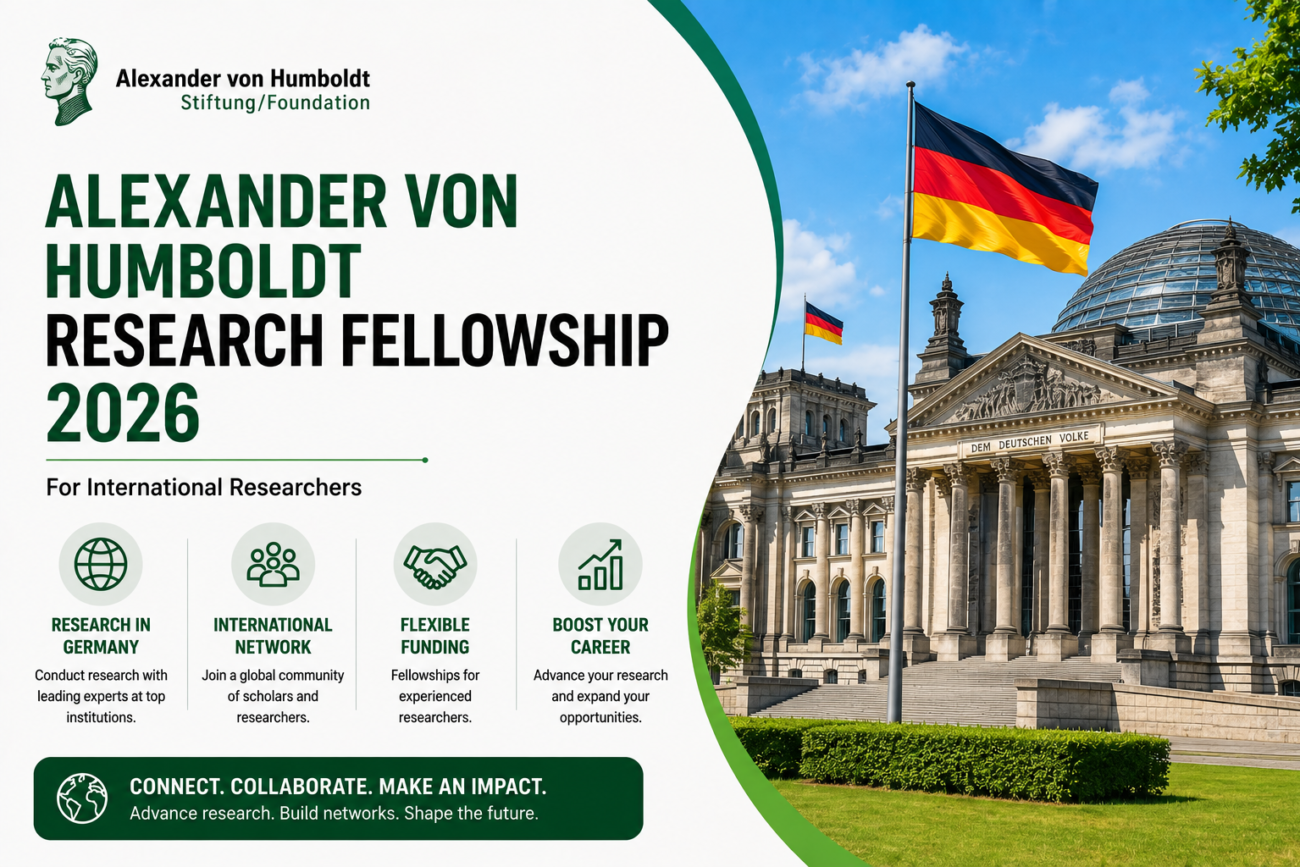
🎓 Alexander von Humboldt Research Fellowship 2026 for International Researchers 🇩🇪
🎓 Alexander von Humboldt Research Fellowship 2026 for International Researchers 🇩🇪. The Alexander von Humboldt Foundation offers the prestigious Humboldt Research Fellowship for highly qualified international researchers who want to conduct independent research in Germany with an academic host of their choice.
The fellowship is open to researchers from all countries outside Germany and across all academic disciplines, including science, engineering, medicine, humanities and social sciences. Fellows receive monthly funding of up to €3,600, alongside additional benefits such as family support, health-insurance subsidies, travel allowances and optional German-language training.
A major update applies to the 2026 application cycle: the current call has already reached its maximum number of applications. The next application call opens on 15 November 2026.
🇩🇪 Humboldt Research Fellowship 2026 – Quick Overview
| Detail | Information |
|---|---|
| 🏢 Organisation | Alexander von Humboldt Foundation |
| 🎓 Programme | Humboldt Research Fellowship |
| 🇩🇪 Destination | Germany |
| 🌍 Nationality | Researchers worldwide, subject to programme rules |
| 🔬 Research Fields | All academic disciplines |
| 👩🔬 Career Levels | Postdoctoral & experienced researchers |
| 💰 Postdoc Fellowship | €3,000/month + additional benefits |
| 💰 Experienced Researcher | €3,600/month + additional benefits |
| ⏳ Postdoc Duration | 6–24 months |
| ⏳ Experienced Researcher Duration | 6–18 months |
| 🏫 Host | German university or eligible research institution |
| 📅 Next Call Opens | 15 November 2026 |
| 🎯 Earliest Start from Next Call | September 2027 |
🌍 Who Can Apply?
🎓 Alexander von Humboldt Research Fellowship 2026 for International Researchers 🇩🇪
The Humboldt Research Fellowship targets postdoctoral and experienced researchers with above-average academic qualifications.
There is no restriction to a particular discipline.
Researchers can apply from areas including:
🔬 Natural Sciences
⚗️ Chemistry
🧬 Biological Sciences
🏥 Medicine
⚙️ Engineering
💻 Computer Science
🌱 Environmental Sciences
🌍 Climate & Sustainability
📊 Economics
⚖️ Law
📚 Humanities
👥 Social Sciences
Applicants develop their own research project and conduct it in collaboration with an academic host at a German research institution.
👩🔬 Two Fellowship Categories
The programme has different requirements and funding levels depending on the applicant’s career stage.
1. Humboldt Research Fellowship for Postdocs
This route is intended for researchers at the beginning of their postdoctoral careers.
Applicants should generally have completed their doctorate—or equivalent academic qualification—within the previous:
4 years
Researchers expecting to complete their doctorate before the relevant selection meeting may also be eligible under specified conditions.
Applicants are expected to demonstrate academic achievement through publications that meet international academic standards.
💰 Postdoctoral Fellowship Amount
Successful postdoctoral fellows receive:
€3,000 per month
plus potential additional benefits.
The research fellowship can run for:
6–24 months
and may be divided into as many as three stays within a three-year period.
👨🔬 2. Fellowship for Experienced Researchers
More established academics can apply through the experienced-researcher pathway.
Applicants should generally have completed their doctorate within the previous:
12 years
and should demonstrate a substantial academic publication record and a leadership role appropriate to their career level, such as lecturer, assistant professor or independent research-group leader.
💰 Experienced Researcher Fellowship Amount
Successful experienced researchers receive:
€3,600 per month
plus additional benefits.
The fellowship normally lasts:
6–18 months
and can also be divided into up to three research stays within three years.
💰 Additional Financial Benefits
The monthly fellowship is only part of the support available.
Depending on individual circumstances, additional assistance may include:
✈️ Travel allowances
🏥 Subsidies for private full health insurance
👨👩👧 Family benefits for partners and children
🇩🇪 Intensive German-language training
🤝 Personal support from the Humboldt Foundation
The Foundation also provides continued alumni support after the research fellowship has ended.
🇩🇪 German Language Course
Successful fellows and their partners may be able to undertake an intensive German-language course before the fellowship begins.
The Foundation explains that the intensive course can last approximately two to four months and takes place immediately before the research fellowship.
This can be particularly valuable for international researchers moving to Germany for the first time.
🏫 You Need a Research Host in Germany
Applicants cannot simply choose Germany as their destination and apply without identifying a host.
You need a researcher at a:
German university
or
eligible German research institution
who is willing to host and academically support your project.
The host must provide a mentoring agreement, confirmation that research facilities are available and a detailed statement supporting the application.
Potential hosts can come from universities and research institutions throughout Germany.
💶 Research Funding for the Host Institution
🎓 Alexander von Humboldt Research Fellowship 2026 for International Researchers 🇩🇪
The programme also provides support to the German host institution.
If a fellowship is awarded, the host institution can receive a monthly research-cost allowance of:
€800/month
for natural sciences and engineering
or
€500/month
for humanities and social sciences.
This funding is separate from the researcher’s personal fellowship allowance.
🌍 Nationality Requirements
The programme primarily targets researchers coming to Germany from abroad.
Applicants generally should not be German nationals, although specific exceptions exist for German citizens or people educated in Germany who have been living and working abroad for an extended period and intend to remain internationally based.
Applicants should check the detailed mobility and nationality requirements before preparing an application.
🇩🇪 Previous Stay in Germany
The programme also has an important mobility requirement.
Generally, applicants must not have lived in Germany for more than:
90 days in total during the 18 months before submitting the application.
Special rules apply in certain circumstances, so researchers already living or working in Germany should carefully check their eligibility before applying.
🗣️ Language Requirements
Language requirements depend on the research field.
Natural Sciences & Engineering
Applicants need good knowledge of:
German or English.
Humanities, Social Sciences & Medicine
Good German is required when it is necessary for successfully conducting the proposed research.
Otherwise, good English can be sufficient.
An English-language certificate is not automatically required simply because the research will be conducted in English.
📄 Documents Required
The Humboldt application is detailed, so candidates should start preparing well before the application portal opens.
Required documents include:
- CV – maximum 2 pages
- Research outline – maximum 5 pages
- Complete publication list
- List of selected key publications
- Key publications
- Doctoral certificate or appropriate proof of completion
- German-language certificate where required
- Two expert reviews
- Host statement
- Confirmation that research facilities are available
Additional documentation may be required depending on an applicant’s circumstances.
✍️ Two Expert Reviews Are Required
Applicants also need two expert assessments.
For postdoctoral applicants, these should normally include the doctoral supervisor and another researcher, preferably from outside the applicant’s institute.
Experienced researchers should obtain reviews from important research collaborators and/or academics familiar with their work.
The reviewers upload their assessments directly through a protected system. An application cannot be submitted without the required reviews.
🔬 Your Research Proposal Matters
Academic excellence alone does not guarantee selection.
The Humboldt Foundation evaluates applications according to criteria including:
Academic record
Quality and originality of publications
Originality of the proposed research
Scientific methodology
Feasibility of the project
Potential for future academic development
and, for experienced researchers,
Independence of the research profile.
A strong proposal therefore needs to explain not only what you intend to investigate but also why the research matters, what is innovative about it and why the selected German host institution is appropriate.
📊 How Competitive Is the Humboldt Fellowship?
🎓 Alexander von Humboldt Research Fellowship 2026 for International Researchers 🇩🇪
The fellowship is highly competitive.
The Foundation reports that applications have increased significantly since 2024. In response, it introduced a new call-based application system with three calls annually.
Each call currently has a maximum capacity of:
800 applications
Once that limit is reached, the round can close even before the next scheduled call.
This has already happened with the current 2026 call. (
🚨 Important 2026 Application Update
Researchers planning to apply should pay particular attention to the new schedule.
The Foundation’s official website currently states that it has:
reached the maximum number of applications for the current call.
As a result, new applications cannot presently be created.
The next call will open:
📅 15 November 2026
That call is linked to the July 2027 selection meeting, with the earliest possible fellowship start in approximately:
September 2027.
2026 Call Schedule
| Call Opens | Selection Meeting | Earliest Fellowship Start |
|---|---|---|
| 15 March 2026 | November 2026 | February 2027 |
| 15 July 2026 | March 2027 | May 2027 |
| 15 November 2026 | July 2027 | September 2027 |
Because calls can close after reaching 800 applications, researchers should have their documents, research proposal and host arrangements prepared before the next application window opens.
📝 How to Apply
🎓 Alexander von Humboldt Research Fellowship 2026 for International Researchers 🇩🇪
Applications are submitted online directly to the Alexander von Humboldt Foundation.
The process broadly involves:
- Confirming your eligibility.
- Developing your research project.
- Identifying an appropriate academic host in Germany.
- Obtaining agreement from the host.
- Preparing your research outline and publications.
- Arranging two expert reviews.
- Completing the online application.
- Ensuring your host uploads the required supporting documentation.
The Foundation emphasizes that applications with missing documents or major deviations from its application specifications can be rejected without further academic review.
🌟 Why the Humboldt Fellowship Stands Out
The Humboldt Research Fellowship offers more than financial support.
Successful researchers receive the opportunity to conduct an independent project at a German institution while becoming part of the international Humboldt Network.
The programme can be particularly valuable for researchers seeking to:
🔬 Strengthen their international research profile
🤝 Establish collaborations with German researchers
📚 Produce high-quality publications
🌍 Expand international academic networks
🏫 Gain experience at German universities and research institutes
🚀 Develop toward independent academic leadership
The Foundation also maintains relationships with fellows after their initial research stays through its alumni programmes.
Final Thoughts
🎓 Alexander von Humboldt Research Fellowship 2026 for International Researchers 🇩🇪
The Alexander von Humboldt Research Fellowship 2026 is an excellent opportunity for highly qualified international researchers seeking funded research experience in Germany.
Postdoctoral researchers can receive €3,000 per month for 6–24 months, while experienced researchers can receive €3,600 per month for 6–18 months, with additional benefits potentially covering family support, health insurance, travel and language training.
The most important update for prospective applicants is that the current call has reached capacity. Researchers who have not already started an application should prepare for the:
📅 Next call opening: 15 November 2026
Because each call currently accepts a maximum of 800 applications, preparing your German host, research proposal, publication documentation and references in advance is particularly important.
Key Details
🏢 Organisation: Alexander von Humboldt Foundation
🎓 Programme: Humboldt Research Fellowship
🇩🇪 Country: Germany
🌍 Applicants: International researchers
🔬 Fields: All disciplines
👩🔬 Postdocs: €3,000/month
👨🔬 Experienced Researchers: €3,600/month
⏳ Duration: 6–24 months, depending on career stage
💰 Additional Support: Travel, family, insurance and other allowances subject to conditions
🏫 German Host: Required
📅 Next Call: 15 November 2026
🎯 Earliest Start from Next Call: September 2027
📲 Get more research fellowships, fully funded scholarships, PhD opportunities, grants, internships and international opportunities through the Vacancy Bridge WhatsApp Channel:
Join the Vacancy Bridge WhatsApp Channel
APPLY ON THIS OFFICIAL PAGE
SEO Keywords
Alexander von Humboldt Research Fellowship 2026, Humboldt Research Fellowship Germany, Alexander von Humboldt Fellowship 2027, Germany Research Fellowship, Fully Funded Research Fellowship Germany, Postdoctoral Fellowship Germany 2027, Humboldt Fellowship for International Researchers, €3000 Postdoctoral Fellowship, €3600 Research Fellowship, Research Fellowships in Europe, International Research Fellowships 2027, Postdoctoral Opportunities Germany, Fellowships for African Researchers, Germany Fellowships for International Researchers, Alexander von Humboldt Foundation Fellowship, Funded Research Opportunities Germany, Postdoc Scholarships Germany, Academic Research Fellowships, Research Grants Germany, Vacancy Bridge.
