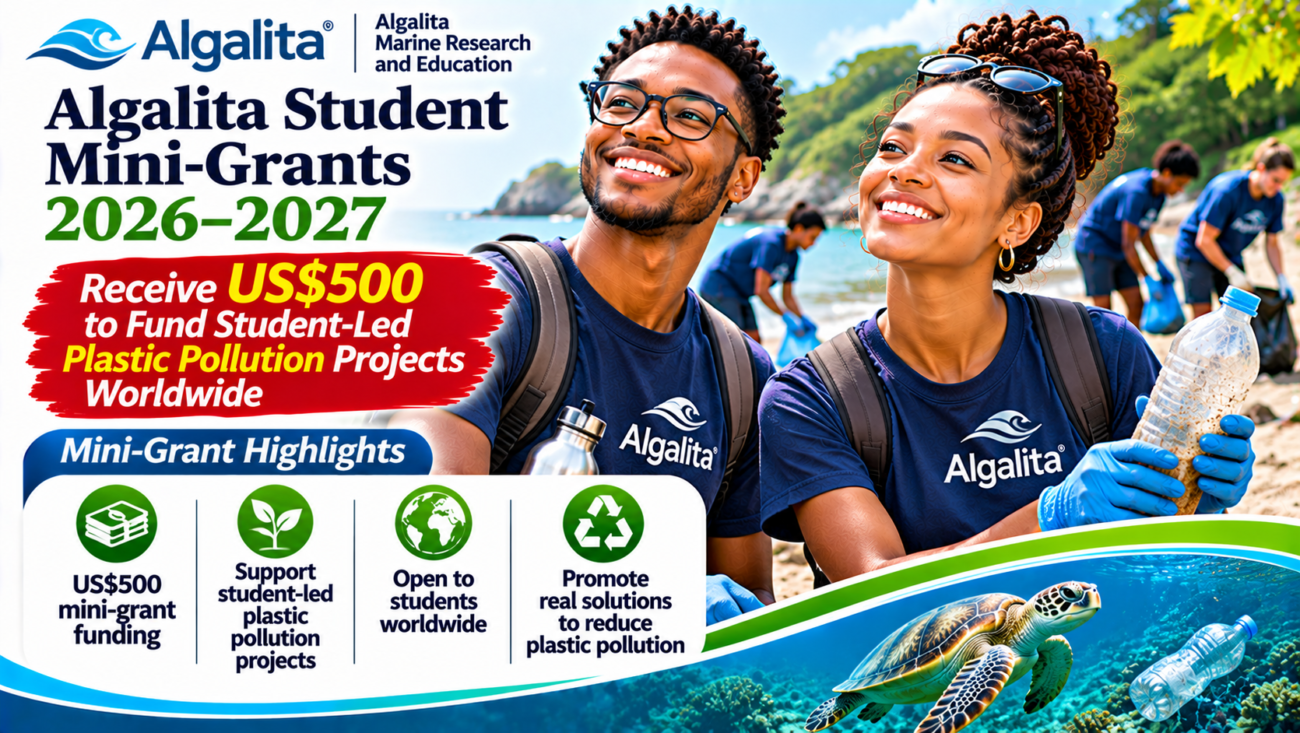
Algalita Student Mini-Grants 2026–2027: Receive US$500 to Fund Student-Led Plastic Pollution Projects Worldwide
Algalita Student Mini-Grants 2026–2027: Receive US$500 to Fund Student-Led Plastic Pollution Projects Worldwide. The Algalita Student Mini-Grants 2026–2027 programme is inviting students from around the world to apply for financial support to develop projects addressing plastic pollution in their schools, neighbourhoods and wider communities.
Organised by Algalita through its Wayfinder Society, the initiative supports young environmental leaders who want to understand the root causes of plastic pollution and develop practical solutions that create lasting change.
For the 2026–2027 school year, Algalita will award 10 individual Student Mini-Grants worth US$500 each.
Selected applicants will receive financial support to implement their proposed projects, as well as mentorship and guidance from Algalita staff throughout the school year.
The programme is open to students aged 11–25 worldwide. Applicants from Zimbabwe, South Africa, Nigeria, Kenya, Ghana, Zambia and other countries can apply if they meet the eligibility requirements.
Unlike traditional academic scholarships, these mini-grants support student-led environmental projects, educational activities and community initiatives rather than university tuition.
Application deadline: 15 January 2027 at 5:00 p.m. Pacific Time.
1. Algalita Student Mini-Grants 2026–2027: Quick overview
| Opportunity detail | Information |
|---|---|
| Programme | Algalita Student Mini-Grants |
| Academic year | 2026–2027 |
| Organiser | Algalita Marine Research and Education |
| Programme platform | Wayfinder Society |
| Opportunity type | Student project grant |
| Funding amount | US$500 per selected student |
| Number of grants | 10 |
| Total funding allocation | US$5,000 |
| Eligible applicants | Students aged 11–25 |
| Eligible countries | Worldwide |
| Project focus | Plastic pollution and environmental action |
| Project location | School, neighbourhood or wider community |
| Adult advisor | Required |
| Application opening date | 15 October 2026 |
| Application deadline | 15 January 2027 |
| Deadline time | 5:00 p.m. Pacific Time |
| Winners announced | Late February 2027 |
| Application method | Online |
2. About Algalita
Algalita Student Mini-Grants 2026–2027: Receive US$500 to Fund Student-Led Plastic Pollution Projects Worldwide
Algalita Marine Research and Education is an organisation dedicated to addressing plastic pollution through education, research and community action.
The organisation works to increase public understanding of plastic pollution and encourage practical solutions that address the causes of the problem.
Its work recognises that plastic pollution is not simply an issue of littering. It is also connected to how plastic products are designed, manufactured, consumed, discarded and managed.
Through educational programmes and youth engagement initiatives, Algalita encourages students to investigate the plastic problem and develop solutions that can create positive change in their communities.
The Wayfinder Society provides an online learning and engagement platform where young people can develop environmental knowledge, complete learning activities and participate in initiatives addressing plastic pollution.
The Student Mini-Grants programme extends this work by providing financial assistance to young people who want to turn their ideas into practical projects.
3. What does the Algalita Student Mini-Grant offer?
US$500 in project funding
Each selected student receives a mini-grant of:
US$500.
The money is intended to help young people implement projects that address the root causes of plastic pollution.
The funding can support practical activities, educational initiatives, community research and other approved project expenses.
For the 2026–2027 school year, Algalita plans to award 10 individual grants, representing a total funding allocation of US$5,000.
This is project funding rather than a personal monthly stipend or university scholarship.
Mentorship and guidance
Selected students receive ongoing support from Algalita staff throughout the school year.
The support includes periodic check-ins to:
- Review project progress.
- Celebrate achievements.
- Identify challenges.
- Discuss possible solutions.
- Strengthen project implementation.
- Help students achieve their environmental objectives.
Applicants must also identify an adult advisor who can guide and support their project.
International youth networking
Selected students become connected to a wider community of young people working to reduce plastic pollution.
This provides an opportunity to exchange ideas, learn from other environmental initiatives and share experiences with young changemakers.
Social media exposure
Algalita may collaborate with selected grantees to share their projects and achievements through its social media channels.
This can help increase awareness of student-led environmental activities and inspire other young people to take action.
Opportunity to create lasting community impact
The programme encourages projects that address the underlying causes of plastic pollution rather than focusing only on temporary cleanup activities.
Students are encouraged to develop practical initiatives that can continue producing positive results beyond the grant period.
4. What types of projects can receive funding?
The Student Mini-Grants support new or existing student-led initiatives that address plastic pollution.
Projects can take place in schools, neighbourhoods or wider communities.
Algalita encourages applicants to develop solutions that help people understand the causes of plastic pollution and reduce their dependence on disposable plastic products.
Examples include the following.
Campus reuse systems
Students can develop initiatives that reduce single-use plastic products in schools and universities.
Possible activities include:
- Reusable food containers.
- Reusable drinking cups.
- Water refill stations.
- Reusable cafeteria dishware.
- School-based plastic reduction systems.
These projects encourage students to replace disposable products with reusable alternatives.
Fix-It clinics and repair cafés
Repair initiatives help people extend the useful life of products rather than discarding them.
Students may organise community repair events where people learn how to repair household items, electronics, clothing and other reusable materials.
This can help reduce unnecessary waste and encourage a culture of reuse.
Community cleanup and research campaigns
Students can organise cleanup activities that also collect information about the sources and types of plastic waste in their communities.
Examples include:
- School cleanup campaigns.
- Community litter assessments.
- Plastic waste data collection.
- Mapping plastic pollution hotspots.
- Documenting common disposable plastic products.
- Sharing findings through reports and presentations.
The programme encourages projects that connect cleanup activities with education, research and storytelling.
Environmental education campaigns
Students may organise workshops and awareness campaigns to educate their communities about plastic pollution.
Possible activities include:
- School environmental clubs.
- Peer-to-peer education.
- Community awareness sessions.
- Environmental presentations.
- Plastic reduction challenges.
- Educational posters and videos.
Policy advocacy projects
Students can develop initiatives that encourage schools, local authorities and communities to adopt policies that reduce plastic pollution.
Examples include:
- Promoting plastic-free school events.
- Encouraging reusable packaging.
- Advocating for refill stations.
- Supporting local plastic reduction policies.
- Encouraging responsible waste management.
Creative arts and communication projects
Art and communication can help communities understand the effects of plastic pollution.
Students may develop:
- Environmental photography projects.
- Educational videos.
- Community exhibitions.
- Creative storytelling campaigns.
- Plastic pollution awareness posters.
- Digital communication campaigns.
School gardens and composting initiatives
Algalita Student Mini-Grants 2026–2027: Receive US$500 to Fund Student-Led Plastic Pollution Projects Worldwide
Students may establish school gardens and composting programmes that encourage sustainable food practices and reduce unnecessary packaging.
Projects could include:
- Composting food waste.
- Reducing disposable food packaging.
- Promoting reusable lunch containers.
- Teaching sustainable food practices.
- Developing environmentally friendly school gardens.
Community-based research
Students interested in research can investigate plastic pollution in their communities.
Potential research topics include:
- Common sources of plastic waste.
- Community attitudes towards plastic reduction.
- Disposable packaging consumption.
- Recycling and reuse practices.
- Plastic pollution in rivers and waterways.
- Community solutions to waste management challenges.
These are examples rather than a complete list. Applicants are encouraged to develop creative, locally relevant projects.
5. Who can apply for the Algalita Student Mini-Grants?
The programme is open to students aged 11–25 from anywhere in the world.
Applicants must meet the following requirements.
Age requirement
Applicants must be between 11 and 25 years old on 15 January 2027, the application deadline.
Students outside this age range are not eligible for this funding round.
Worldwide eligibility
The programme is open to applicants worldwide.
Students do not have to be citizens of the United States or residents of a particular country.
This means young people from Africa, Asia, Europe, the Americas and other regions can apply.
Student status
Applicants must be students who are developing or leading projects that address plastic pollution.
They can apply through an individual Wayfinder Society account or a student account established through a teacher or class arrangement.
Commitment to environmental action
Applicants should demonstrate a genuine commitment to addressing plastic pollution.
They should explain how their proposed project will contribute to environmental education, waste reduction, reuse, research, policy advocacy or other solutions.
Adult project advisor
Every applicant must identify an adult advisor who can provide guidance and support throughout the project.
Suitable advisors may include:
- Teachers.
- Environmental club coordinators.
- Sustainability programme mentors.
- Youth programme advisors.
- Community environmental leaders.
- Other adults with relevant experience.
Important: Family members cannot be listed as the applicant’s project advisor.
6. Can students from Zimbabwe apply?
Yes. Zimbabwean students are eligible to apply.
Algalita confirms that its Student Mini-Grants are open to applicants anywhere in the world.
Students from Zimbabwe who are between 11 and 25 years old can therefore apply if they satisfy the programme’s other requirements.
This provides an opportunity for young people in Zimbabwe to develop environmental projects addressing plastic pollution in schools, communities and neighbourhoods.
Potential project ideas for Zimbabwean applicants include:
- School-based plastic reduction campaigns.
- Community plastic waste education.
- Reusable water bottle initiatives.
- Plastic pollution awareness in local communities.
- River and wetland plastic pollution research.
- School recycling and reuse initiatives.
- Community repair and reuse workshops.
- Youth-led environmental advocacy.
- Plastic waste mapping and data collection.
Applicants should ensure that their projects focus on addressing the causes of plastic pollution and creating meaningful community change.
7. Mandatory Wayfinder Society learning activities
One of the most important application requirements is completing two mandatory learning activities through the Wayfinder Society platform.
Applicants must successfully complete both activities before the application deadline.
Activity 1: The Story of Plastic – Watch the Film
Applicants must watch the film The Story of Plastic through the Wayfinder Society learning platform and complete the required activity instructions.
The film explores the plastic pollution problem, including the production, consumption and disposal of plastic products.
Students should use the activity to strengthen their understanding of the environmental and social issues connected to plastic pollution.
Activity 2: The Story of Plastic – System Mapping
Applicants must also complete the System Mapping activity.
This activity helps students examine the connections between plastic production, consumption, waste management and pollution.
It encourages participants to understand the wider systems contributing to the plastic problem.
Important completion requirement
Both activities must be completed successfully before 15 January 2027.
Applicants must earn the required activity hours individually rather than through a team account.
The Wayfinder Society profile records the hours earned through the programme.
Although completing these two activities is mandatory, the selection committee may also consider the applicant’s total accumulated Wayfinder Society hours as an indicator of engagement.
8. How will applications be assessed?
Algalita Student Mini-Grants 2026–2027: Receive US$500 to Fund Student-Led Plastic Pollution Projects Worldwide
Algalita encourages applicants to explain their personal motivation, previous environmental activities and plans for using the funding.
The selection process considers several factors.
Participation in Wayfinder Society
Applicants must demonstrate that they have completed the required learning activities.
Their recorded participation and engagement with the platform may also be considered.
Commitment to reducing plastic pollution
Applicants should explain why they care about plastic pollution and how they intend to continue contributing to solutions.
The programme welcomes different academic and professional interests, including:
- Environmental science.
- Sustainability.
- Zero waste.
- Social justice.
- Environmental justice.
- Chemistry.
- Social sciences.
- Policy.
- Marketing.
- Business communications.
- Education.
- Community development.
Students from other disciplines are also encouraged to apply if they can connect their interests to addressing plastic pollution.
Project quality and community impact
Applicants should explain what they intend to achieve with the grant.
A strong proposal should identify:
- The plastic pollution problem.
- The target community.
- The activities to be implemented.
- The expected results.
- The project timeline.
- How the funding will be used.
- How progress will be measured.
Motivation and personal experience
The application asks students to explain their involvement in the plastic pollution movement and what they have learned from participating in Wayfinder Society.
Applicants should provide genuine examples of their environmental activities and future ambitions.
Adult advisor support
Applicants must provide the name, title and contact details of their chosen advisor.
The advisor should have the ability to provide meaningful support throughout the project.
If selected as a finalist, the applicant and advisor may be invited to a one-on-one video interview.
9. How can applicants use the US$500 grant?
The grant can be used to support eligible activities connected to the student’s environmental project.
Algalita provides several examples of possible project expenses and activities.
These include:
- Purchasing reusable materials for a school initiative.
- Establishing water refill systems.
- Organising environmental education workshops.
- Supporting community cleanup activities.
- Conducting plastic pollution research.
- Producing educational communication materials.
- Organising repair and reuse events.
- Supporting policy advocacy activities.
- Developing creative environmental campaigns.
- Attending relevant conferences that strengthen plastic reduction advocacy.
Applicants should clearly explain the amount requested and how they intend to use the funds.
Successful students must document how the grant money is spent.
Algalita requires recipients to submit an expense report within one year of receiving the funding.
Students should therefore maintain receipts and other relevant financial records.
10. How to apply for the Algalita Student Mini-Grants 2026–2027
Applications are submitted online through the Wayfinder Society Student Mini-Grant programme.
Follow these steps.
Step 1: Visit the official application page
Open the Algalita Student Mini-Grants page.
Read the eligibility requirements and application instructions carefully.
Step 2: Create a Wayfinder Society account
Applicants must create an individual account on the Wayfinder Society platform if they do not already have one.
Students participating through a teacher may use an eligible student account arrangement.
Step 3: Complete the two mandatory learning activities
Complete the following activities:
- The Story of Plastic – Watch the Film.
- The Story of Plastic – System Mapping.
Ensure that both activities are successfully recorded on your individual profile before the deadline.
Step 4: Develop your environmental project
Identify a plastic pollution problem in your school or community.
Develop a realistic project that explains how you will address the issue.
Consider the resources required, activities to be implemented and expected results.
Step 5: Identify an adult advisor
Choose an adult who can provide guidance and support throughout the project.
This could be a teacher, environmental club coordinator, mentor or youth programme advisor.
Family members cannot serve as the nominated advisor.
Step 6: Prepare your project budget
Explain how you intend to use the US$500 grant.
Your budget should be realistic and connected directly to the activities you propose.
Step 7: Complete the online application
Provide the required personal information, explain your motivation and describe your project.
You should also provide your advisor’s name, title and contact information.
Step 8: Submit before the deadline
Submit the completed application before:
15 January 2027 at 5:00 p.m. Pacific Time.
Only one application per person is accepted.
11. Application deadline and important dates
| Event | Date |
|---|---|
| Application opening date | 15 October 2026 |
| Application deadline | 15 January 2027 |
| Deadline time | 5:00 p.m. Pacific Time |
| Finalist interviews | After application review |
| Winners announced | Late February 2027 |
| Grant allocation | US$500 per selected student |
| Number of recipients | 10 |
Important time-zone information for Zimbabwe
Algalita Student Mini-Grants 2026–2027: Receive US$500 to Fund Student-Led Plastic Pollution Projects Worldwide
Zimbabwe operates on Central Africa Time (CAT), which is 10 hours ahead of Pacific Standard Time in January.
The deadline of 5:00 p.m. Pacific Time on 15 January 2027 corresponds to:
3:00 a.m. on 16 January 2027 in Zimbabwe.
Applicants should submit their applications earlier rather than waiting until the final hours.
12. Why should students apply?
The Algalita Student Mini-Grants offer several benefits to young people interested in environmental protection.
Financial support: Selected students receive US$500 to implement their proposed projects.
International eligibility: Applicants can apply from anywhere in the world.
Environmental leadership: Students gain experience designing and leading practical community initiatives.
Mentorship: Selected recipients receive guidance from Algalita staff and their chosen adult advisors.
Practical experience: Students learn how to plan, budget, implement and evaluate environmental projects.
International networking: Participants connect with a wider community of young people working to address plastic pollution.
Publicity opportunities: Selected projects may be featured through Algalita’s social media channels.
Long-term impact: The programme encourages solutions that help communities reduce plastic pollution beyond a single cleanup event.
13. Frequently asked questions
How much funding does Algalita provide?
Each selected student receives a US$500 mini-grant.
How many students will receive funding?
Algalita plans to award 10 individual mini-grants for the 2026–2027 school year.
Is the programme open to international applicants?
Yes. Students from anywhere in the world can apply.
Can Zimbabwean students apply?
Yes. Zimbabwe is eligible because the programme is open worldwide. Applicants must satisfy the age and other requirements.
What is the age limit?
Applicants must be between 11 and 25 years old on 15 January 2027.
Do applicants need to be university students?
The programme is open to students aged 11–25 and supports projects in schools, neighbourhoods and wider communities. It is not restricted to university students.
Is an adult advisor compulsory?
Yes. Every applicant must identify an adult advisor who can provide support throughout the project.
Can a parent or family member serve as the advisor?
No. Algalita states that family members cannot be listed as the project advisor.
Do I need to complete any online courses?
Yes. Applicants must complete The Story of Plastic – Watch the Film and The Story of Plastic – System Mapping before the application deadline.
Can I use the money for a school environmental project?
Yes. Eligible project examples include school reuse systems, plastic reduction campaigns, environmental education, research and community initiatives.
Is the grant a scholarship?
No. It is a project grant designed to support student-led environmental initiatives. It is not a university tuition scholarship or personal living stipend.
When will winners be announced?
Algalita expects to announce the successful recipients in late February 2027.
Do successful students receive mentorship?
Yes. Selected recipients receive ongoing support from Algalita staff, including periodic project check-ins.
Is there an application fee?
The official application information does not list an application fee. Applicants should use the official Algalita application platform.
Final note from Vacancy Bridge
Algalita Student Mini-Grants 2026–2027: Receive US$500 to Fund Student-Led Plastic Pollution Projects Worldwide
Algalita Student Mini-Grants 2026–2027: Receive US$500 to Fund Student-Led Plastic Pollution Projects Worldwide. The Algalita Student Mini-Grants 2026–2027 programme provides an exciting opportunity for young people to receive US$500 in funding to develop practical solutions to plastic pollution.
With worldwide eligibility, mentorship and support from Algalita staff, the programme is particularly relevant to students who want to make a positive environmental contribution in their schools and communities.
Young people in Zimbabwe and other African countries can apply, provided they are between 11 and 25 years old, complete the required Wayfinder Society learning activities and nominate a suitable adult advisor.
Applicants should begin preparing their project ideas early and ensure that their proposals explain the problem they want to address, how the funding will be used and the results they hope to achieve.
Application deadline: 15 January 2027 at 5:00 p.m. Pacific Time.
Vacancy Bridge shares international grants, scholarships, fellowships, internships and career opportunities to help readers discover opportunities and access their original application sources. Always verify the latest requirements and application instructions directly with the grant provider before applying.
Join the Vacancy Bridge WhatsApp Channel
Follow Vacancy Bridge on WhatsApp for the latest jobs, scholarships, internships and fellowships.
https://whatsapp.com/channel/0029Vakee9aHFxOyCIBPJA0o
APPLY NOW ON THIS OFFICIAL PAGE
SEO keywords
Algalita Student Mini-Grants 2026–2027, Algalita Student Grant 2027, US$500 student environmental grant, plastic pollution grants for students, environmental grants for young people, youth environmental funding 2027, student-led environmental projects, plastic pollution funding worldwide, grants for African students, grants for Zimbabwean students, youth climate action grants, Wayfinder Society Mini-Grants, environmental project funding, sustainability grants for students, international student mini-grants.
