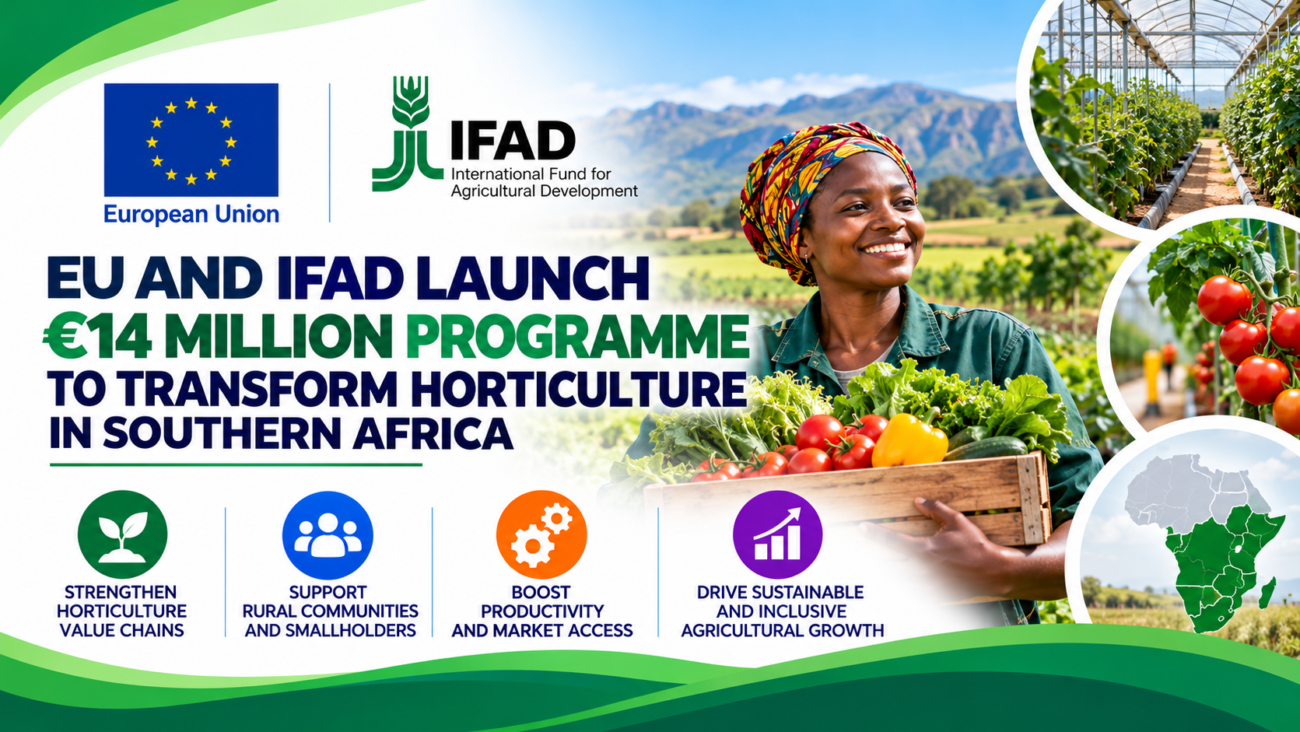
EU and IFAD Launch €14 Million Programme to Transform Horticulture in Southern Africa
EU and IFAD Launch €14 Million Programme to Transform Horticulture in Southern Africa. The European Union (EU) and the International Fund for Agricultural Development (IFAD) have launched a major €14 million regional programme designed to strengthen climate-resilient horticulture, smallholder productivity and market access across Southern Africa.
Known as the:
🌱 Agroecological Transitions for Horticulture in Arid Zones — ATHAZ
the programme will operate in:
🇿🇼 Zimbabwe
🇿🇲 Zambia
and:
🇧🇼 Botswana
from:
📅 2026 TO 2030.
ATHAZ aims to reach approximately:
👨🌾 15,000 SMALLHOLDER FARMING HOUSEHOLDS
representing around:
🌍 75,000 PEOPLE
with particular attention to:
👩 WOMEN
and:
🧑 YOUNG PEOPLE.
⚠️ Important Accuracy Note
The:
💰 €14 MILLION
is the overall budget of the ATHAZ regional programme.
It is not a €14 million open grant fund that individual farmers, startups or NGOs can currently apply to directly.
The programme will be implemented through IFAD and its technical partners together with:
- National research institutions
- Agricultural extension services
- Farmer organisations
- Governments
- Private-sector actors.
Therefore, farmers and agribusinesses are more likely to participate through programme activities, value chains, innovation hubs, farmer organisations and implementation partnerships rather than by submitting applications for individual €14 million grants.
🌍 Quick Overview
| Detail | Information |
|---|---|
| Programme | Agroecological Transitions for Horticulture in Arid Zones |
| Acronym | ATHAZ |
| Funding Organisation | European Union |
| Programme Coordinator | IFAD |
| Funding | €14 Million |
| Programme Period | 2026–2030 |
| Countries | Zimbabwe, Zambia & Botswana |
| Target Households | Around 15,000 |
| Estimated Beneficiaries | Around 75,000 People |
| Priority Groups | Women & Young People |
| Innovation Hubs | 9 |
| Horticultural Value Chains | 30 |
| Main Focus | Climate-Resilient Horticulture |
| Water Efficiency | Priority |
| Agroecology | Priority |
| Seed Systems | Priority |
| Integrated Pest Management | Priority |
| Market Access | Priority |
| Value Addition | Priority |
| Main Implementation Period | 2026–2030 |
🏛️ What Is ATHAZ?
EU and IFAD Launch €14 Million Programme to Transform Horticulture in Southern Africa
ATHAZ stands for:
Agroecological Transitions for Horticulture in Arid Zones.
It is an EU-funded DeSIRA+ programme coordinated by IFAD to help small-scale horticulture producers develop agricultural systems that are:
MORE RESILIENT
MORE PRODUCTIVE
MORE WATER-EFFICIENT
and:
MORE PROFITABLE.
The programme responds particularly to growing challenges involving:
💧 WATER SCARCITY
🌡️ CLIMATE PRESSURES
🌱 SOIL & PRODUCTION RESILIENCE
🐛 PEST MANAGEMENT
and:
📈 MARKET ACCESS.
🇿🇼 What Will ATHAZ Do in Zimbabwe?
Zimbabwe is a major focus of the new programme.
ATHAZ will build on IFAD’s existing:
Horticulture Enterprise Enhancement Project — HEEP.
HEEP already supports smallholder farmers and micro, small and medium-sized enterprises involved in profitable and sustainable horticulture value chains.
Through ATHAZ, farmers in Zimbabwe will receive support to test and adopt approaches involving:
💧 MORE EFFICIENT WATER USE
🌱 RESILIENT SEED SYSTEMS
🐛 INTEGRATED PEST MANAGEMENT
🌾 SUSTAINABLE PRODUCTION
📈 MARKET ACCESS
and:
🏭 VALUE ADDITION.
💧 Water Efficiency
Water scarcity is becoming an increasingly serious challenge for horticulture farmers in Zimbabwe and other dry areas of Southern Africa.
ATHAZ therefore aims to help farmers:
PRODUCE MORE WITH LESS WATER
through improved practices, technologies and better agricultural management.
This may help reduce vulnerability to:
DROUGHT
ERRATIC RAINFALL
and:
LONGER DRY PERIODS.
🌱 Resilient Seed Systems
The programme will also support:
RESILIENT SEED SYSTEMS
to improve farmers’ access to planting materials better suited to changing production conditions.
This may help horticultural producers respond to challenges such as:
HEAT
PESTS
WATER STRESS
and:
VARIABLE GROWING CONDITIONS.
🐛 Integrated Pest Management
Another important area is:
INTEGRATED PEST MANAGEMENT — IPM.
Rather than depending only on pesticides, IPM combines methods such as:
PEST MONITORING
BIOLOGICAL CONTROLS
PREVENTION
and:
TARGETED CROP-PROTECTION MEASURES.
EU and IFAD Launch €14 Million Programme to Transform Horticulture in Southern Africa
The aim is to protect crops while supporting more sustainable horticultural production.
🌿 Agroecological Horticulture
ATHAZ places strong emphasis on:
AGROECOLOGY.
This means developing farming systems that make greater use of:
ECOLOGICAL PROCESSES
LOCAL KNOWLEDGE
BIODIVERSITY
SOIL HEALTH
and:
RESOURCE-EFFICIENT PRODUCTION.
The FiBL-led ATHAZ-CONNECT component specifically aims to strengthen smallholder livelihoods through agroecological horticulture linked to sustainable markets.
📈 Stronger Access to Markets
ATHAZ is not focused only on production.
It will also help farmers build stronger connections with:
BUYERS
PROCESSORS
MICRO, SMALL & MEDIUM ENTERPRISES
DOMESTIC MARKETS
REGIONAL MARKETS
and potentially:
HIGHER-VALUE INTERNATIONAL MARKETS.
This is important because increasing production alone does not guarantee higher farmer incomes.
Farmers also need:
RELIABLE BUYERS
BETTER PRICES
MARKET INFORMATION
and:
VALUE-ADDITION OPPORTUNITIES.
🥬 30 Horticultural Value Chains
Across Zimbabwe, Zambia and Botswana, ATHAZ aims to strengthen:
30 HORTICULTURAL VALUE CHAINS.
A value chain includes the different stages involved in moving horticultural products from:
SEED
to:
FARM
to:
PROCESSING
to:
TRANSPORT
to:
MARKET
and ultimately:
THE CONSUMER.
Strengthening these chains can improve opportunities for:
FARMERS
TRADERS
PROCESSORS
TRANSPORTERS
and:
AGRIBUSINESSES.
🤝 More Than 300 Market Contracts
The FiBL-led ATHAZ-CONNECT component aims to facilitate:
MORE THAN 300 MARKET CONTRACTS
connecting farmers and value-chain actors with commercial buyers.
This “market-pull” approach is intended to ensure that farmers produce with clearer knowledge of:
WHO WILL BUY
WHAT QUALITY IS REQUIRED
and:
WHICH PRODUCTS HAVE COMMERCIAL DEMAND.
EU and IFAD Launch €14 Million Programme to Transform Horticulture in Southern Africa
🌱 250 Participatory Guarantee System Groups
ATHAZ-CONNECT also aims to support:
250 PARTICIPATORY GUARANTEE SYSTEM — PGS — FARMER GROUPS.
PGS systems can provide locally focused assurance around:
ORGANIC
and:
AGROECOLOGICAL PRODUCTION PRACTICES.
They may help producers access markets where buyers value:
SUSTAINABLE
SAFE
and:
RESPONSIBLY PRODUCED FOOD.
🏢 National Organic Market Organisations
The FiBL component also plans to establish:
NATIONAL UMBRELLA ORGANISATIONS
to support domestic organic market systems in each participating country.
These structures could help coordinate:
FARMERS
MARKETS
CERTIFICATION SYSTEMS
BUSINESSES
and:
CONSUMERS.
🧪 Nine Innovation Hubs
The regional programme will establish:
9 INNOVATION HUBS
across Zimbabwe, Zambia and Botswana.
These hubs are intended to bring together:
FARMERS
SCIENTISTS
EXTENSION OFFICERS
PRIVATE-SECTOR ACTORS
and:
POLICYMAKERS
to test and scale practical agricultural solutions.
🔬 Research Meets Farmer Knowledge
A key feature of ATHAZ is the combination of:
SCIENTIFIC RESEARCH
with:
FARMER KNOWLEDGE.
Rather than researchers developing solutions completely separately from farmers, the programme will work with producers to:
TEST
ADAPT
and:
SCALE
practical innovations under real farming conditions.
🤝 Who Will Implement ATHAZ?
IFAD will coordinate the programme.
Key technical partners include:
🔬 International Centre of Insect Physiology and Ecology — icipe
🌱 Research Institute of Organic Agriculture — FiBL
and:
🌍 Biovision Africa Trust — BvAT.
The programme will also work with:
NATIONAL RESEARCH SYSTEMS
AGRICULTURAL EXTENSION SERVICES
FARMER ORGANISATIONS
GOVERNMENTS
and:
PRIVATE-SECTOR COMPANIES.
🇿🇼 Zimbabwe Implementation Partners
FiBL’s project information also identifies Zimbabwean partners including:
Zimbabwe Organic Producers and Promoters Association — ZOPPA
and:
Community Technology Development Organisation — CTDO.
EU and IFAD Launch €14 Million Programme to Transform Horticulture in Southern Africa
These types of organisations can play an important role in:
FARMER MOBILISATION
TRAINING
MARKET DEVELOPMENT
and:
AGROECOLOGY PROMOTION.
👩 Women Are a Priority
ATHAZ places particular emphasis on:
WOMEN FARMERS.
Women often play a major role in horticulture production, food processing and rural markets but may face challenges accessing:
LAND
FINANCE
IRRIGATION
TECHNOLOGY
and:
HIGH-VALUE MARKETS.
The programme aims to make sure women can benefit meaningfully from new agricultural opportunities.
🧑 Youth Are Also a Priority
Young people are another important target group.
Horticulture can create employment and entrepreneurship opportunities in areas such as:
PRODUCTION
IRRIGATION
SEED SUPPLY
PROCESSING
LOGISTICS
MARKETING
DIGITAL AGRICULTURE
and:
AGRIBUSINESS.
ATHAZ aims to ensure youth are included in the transition toward more profitable and sustainable horticultural systems.
💼 Opportunities for Agribusinesses
The programme could also create opportunities for:
MICRO ENTERPRISES
SMALL BUSINESSES
MEDIUM-SIZED ENTERPRISES
and:
PRIVATE INVESTORS.
Potential areas include:
💧 Irrigation Technologies
🌱 Seed Businesses
🥬 Horticultural Production
📦 Packaging
❄️ Cold Storage
🚚 Transport & Logistics
🏭 Food Processing
♻️ Organic Inputs
🐛 Biological Pest Control
and:
📱 Agricultural Technology.
EU and IFAD Launch €14 Million Programme to Transform Horticulture in Southern Africa
The EU says it is also expanding investment in sustainable agricultural value chains, including improved access to:
FINANCE
EUROPEAN TECHNOLOGY
EQUIPMENT
and:
TECHNICAL EXPERTISE.
🌍 Potential Access to Higher-Value Markets
One goal is to strengthen connections between Southern African horticulture producers and:
DOMESTIC
REGIONAL
and:
INTERNATIONAL MARKETS.
The EU specifically notes opportunities to strengthen access to higher-value markets, including:
🇪🇺 THE EUROPEAN UNION MARKET.
Farmers seeking such markets may need to improve areas such as:
QUALITY
FOOD SAFETY
TRACEABILITY
PRODUCTION STANDARDS
and:
CONSISTENCY OF SUPPLY.
🇿🇼 How Does ATHAZ Link to Zimbabwe’s HEEP Programme?
ATHAZ builds on the:
Horticulture Enterprise Enhancement Project — HEEP.
HEEP aims to increase:
INCOME
FOOD SECURITY
and:
EMPOWERMENT
among smallholder farmers engaged in sustainable horticultural value chains.
HEEP has a total project cost of approximately:
💰 US$66.55 MILLION
with:
US$37.14 MILLION
in IFAD financing.
ATHAZ adds a stronger regional:
AGROECOLOGY
RESEARCH
CLIMATE RESILIENCE
and:
MARKET SYSTEMS
dimension to this existing investment.
🌍 Why Southern Africa?
Southern Africa faces growing agricultural risks from:
DROUGHT
HIGH TEMPERATURES
WATER SCARCITY
ERRATIC RAINFALL
and:
CLIMATE VARIABILITY.
Horticulture can generate strong incomes from relatively small areas of land, but it also requires:
WATER
QUALITY INPUTS
GOOD CROP MANAGEMENT
and:
ACCESS TO RELIABLE MARKETS.
ATHAZ is intended to help farmers overcome these constraints.
🥕 Why Horticulture?
Horticulture covers crops such as:
VEGETABLES
FRUITS
HERBS
and other high-value produce.
For smallholder farmers, horticulture can provide:
FASTER CASH FLOW
HIGHER VALUE PER HECTARE
NUTRITIOUS FOOD
EMPLOYMENT
and:
VALUE-ADDITION OPPORTUNITIES.
However, horticulture can also be vulnerable to:
WATER SHORTAGES
PESTS
POST-HARVEST LOSSES
and:
PRICE VOLATILITY.
ATHAZ is designed to address several of these challenges simultaneously.
🌱 What Is Agroecology?
Agroecology applies ecological principles to agricultural production.
Examples can include:
SOIL HEALTH MANAGEMENT
CROP DIVERSIFICATION
BIOLOGICAL PEST CONTROL
COMPOSTING
EFFICIENT WATER USE
LOCAL SEED SYSTEMS
and:
REDUCING DEPENDENCE ON UNSUSTAINABLE INPUTS.
EU and IFAD Launch €14 Million Programme to Transform Horticulture in Southern Africa
The aim is to make farming systems more:
RESILIENT
ECONOMICALLY VIABLE
and:
ENVIRONMENTALLY SUSTAINABLE.
📊 Evidence and Policy Development
ATHAZ is not only designed to help individual farmers.
The programme will also generate:
EVIDENCE
RESEARCH RESULTS
and:
PRACTICAL LESSONS
that can inform:
NATIONAL AGRICULTURAL POLICIES
and:
FUTURE INVESTMENTS.
Successful approaches could potentially be scaled beyond the original project areas.
💶 Is ATHAZ a Grant Programme for Farmers?
Not in the form of a currently announced direct cash grant application.
The:
€14 MILLION
is programme funding provided by the European Union.
The official launch does not announce a general application form where individual farmers can request a portion of the €14 million.
Farmers are more likely to benefit through:
TRAINING
DEMONSTRATION ACTIVITIES
INNOVATION HUBS
VALUE-CHAIN SUPPORT
MARKET LINKAGES
FARMER GROUPS
and:
PARTNER-LED IMPLEMENTATION.
📝 How Can Farmers Participate?
The official launch announcement does not yet publish one universal individual farmer application process.
Interested farmers should therefore monitor:
IFAD
EU DELEGATIONS
NATIONAL AGRICULTURAL AUTHORITIES
HEEP IN ZIMBABWE
FARMER ORGANISATIONS
and:
ATHAZ IMPLEMENTATION PARTNERS
for local participation announcements.
🇿🇼 Opportunities for Zimbabwean Farmers
Zimbabwean horticulture farmers could potentially benefit from programme activities involving:
💧 WATER-EFFICIENT PRODUCTION
🌱 RESILIENT SEEDS
🐛 INTEGRATED PEST MANAGEMENT
📚 FARMER TRAINING
🔬 RESEARCH & DEMONSTRATION
🥬 AGROECOLOGICAL PRODUCTION
📈 MARKET CONNECTIONS
and:
🏭 VALUE ADDITION.
Because ATHAZ builds directly on HEEP in Zimbabwe, existing HEEP implementation structures may also be important channels for participation.
🇿🇲 Opportunities in Zambia
EU and IFAD Launch €14 Million Programme to Transform Horticulture in Southern Africa
Zambia is one of the three programme countries.
Farmers and horticultural value-chain actors may benefit from:
AGROECOLOGY
MARKET DEVELOPMENT
FARMER ORGANISATION SUPPORT
and:
CLIMATE-RESILIENT TECHNOLOGIES.
FiBL’s ATHAZ project information lists Zambian partners including:
PELUM ZAMBIA
and:
COMMUNITY TECHNOLOGY DEVELOPMENT TRUST — CTDT.
🇧🇼 Opportunities in Botswana
Botswana will also participate in the regional programme.
The country’s arid and semi-arid conditions make:
WATER EFFICIENCY
and:
CLIMATE-RESILIENT PRODUCTION
especially relevant.
Programme implementation will involve the same broader model of:
RESEARCH
INNOVATION
MARKETS
and:
AGROECOLOGY.
🧾 Programme Timeline
ATHAZ runs from:
📅 2026 TO 2030.
The FiBL-led ATHAZ-CONNECT component began on:
📅 1 MARCH 2026
and is scheduled to continue until:
📅 31 DECEMBER 2030.
The regional programme was officially launched in Harare on:
📅 8 OCTOBER 2026.
❓ Frequently Asked Questions
EU and IFAD Launch €14 Million Programme to Transform Horticulture in Southern Africa
What is ATHAZ?
ATHAZ is the Agroecological Transitions for Horticulture in Arid Zones programme funded by the European Union and coordinated by IFAD.
How much funding does the programme have?
💰 €14 MILLION.
Who funds ATHAZ?
The:
EUROPEAN UNION.
Who coordinates it?
IFAD.
Which countries are covered?
🇿🇼 Zimbabwe
🇿🇲 Zambia
and:
🇧🇼 Botswana.
How long will the programme run?
From:
2026 TO 2030.
How many households will benefit?
Approximately:
15,000 SMALLHOLDER FARMING HOUSEHOLDS.
How many people does that represent?
Approximately:
75,000 PEOPLE.
Are women targeted?
Yes.
Women are explicitly identified as a priority group.
Are young people targeted?
Yes.
How many innovation hubs will be created?
9.
How many value chains will be strengthened?
30.
Will the programme help farmers access markets?
Yes.
Market access and value addition are central components.
Will it support water-efficient agriculture?
Yes.
Improved water efficiency is one of the programme’s core priorities.
Will there be support for organic or agroecological agriculture?
Yes.
The FiBL-led component specifically promotes agroecological horticulture and sustainable market systems.
Will farmers receive €14 million in direct grants?
No.
€14 million is the total programme budget, not an individual farmer grant fund.
Is there a public farmer application form?
The official launch announcement does not currently publish one universal farmer application form.
Can agribusinesses benefit?
Potentially, yes.
The programme explicitly works with private-sector actors and aims to connect farmers to MSMEs, markets and value chains.
🚀 Final Thoughts
EU and IFAD Launch €14 Million Programme to Transform Horticulture in Southern Africa
EU and IFAD Launch €14 Million Programme to Transform Horticulture in Southern Africa. The launch of the €14 million ATHAZ programme represents a significant new investment in:
🌱 CLIMATE-RESILIENT HORTICULTURE
💧 WATER-EFFICIENT AGRICULTURE
🥬 AGROECOLOGY
📈 MARKET ACCESS
and:
💼 RURAL LIVELIHOODS
across:
🇿🇼 ZIMBABWE
🇿🇲 ZAMBIA
and:
🇧🇼 BOTSWANA.
From 2026 to 2030, the EU-funded programme aims to reach around:
15,000 SMALLHOLDER HOUSEHOLDS
or approximately:
75,000 PEOPLE
with a particular focus on:
WOMEN
and:
YOUTH.
ATHAZ will establish:
9 INNOVATION HUBS
and strengthen:
30 HORTICULTURAL VALUE CHAINS.
The FiBL-led market component also aims to facilitate:
MORE THAN 300 MARKET CONTRACTS
and support:
250 PGS FARMER GROUPS.
For Zimbabwe, the programme is particularly important because it builds directly on IFAD’s existing:
HORTICULTURE ENTERPRISE ENHANCEMENT PROJECT — HEEP
while introducing stronger regional collaboration around:
RESEARCH
AGROECOLOGY
CLIMATE RESILIENCE
and:
HIGHER-VALUE MARKETS.
Farmers, agribusinesses and farmer organisations should monitor IFAD, the EU Delegation, national agriculture authorities and ATHAZ implementation partners for future local participation, procurement, market-linkage and programme announcements.
📲 Join the Vacancy Bridge WhatsApp Channel
Get agriculture grants, agribusiness opportunities, climate funding, farmer programmes, IFAD opportunities, EU funding, scholarships, fellowships, jobs and international opportunities through Vacancy Bridge.
👉 Join here: https://whatsapp.com/channel/0029Vakee9aHFxOyCIBPJA0o
APPLY NOW ON THIS OFFICIAL PAGE
🔑 Key Details
Programme: Agroecological Transitions for Horticulture in Arid Zones
Acronym: ATHAZ
Funding Organisation: European Union
Programme Coordinator: IFAD
Total Funding: €14 Million
Programme Period: 2026–2030
Countries: Zimbabwe, Zambia & Botswana
Target Households: Approximately 15,000
Estimated Beneficiaries: Approximately 75,000
Priority Groups: Women & Youth
Innovation Hubs: 9
Horticultural Value Chains: 30
Market Contracts Target: More Than 300 Through ATHAZ-CONNECT
PGS Farmer Groups: 250
Water Efficiency: Priority
Agroecology: Priority
Integrated Pest Management: Priority
Resilient Seed Systems: Priority
Market Access: Priority
Value Addition: Priority
Zimbabwe Link: Builds on HEEP
Technical Partners: icipe, FiBL & Biovision Africa Trust
Launch Date: 8 October 2026
Programme End: 2030
Direct €14m Farmer Grant: No
🔎 SEO Keywords
EU IFAD €14 Million Programme, EU IFAD Horticulture Programme 2026, ATHAZ Programme 2026, Agroecological Transitions for Horticulture in Arid Zones, IFAD Zimbabwe 2026, EU Agriculture Funding Zimbabwe, Horticulture Programme Zimbabwe 2026, Horticulture Grants Southern Africa, Agriculture Funding Southern Africa, IFAD Horticulture Programme, EU Horticulture Funding, Climate Resilient Agriculture Zimbabwe, Climate Resilient Horticulture, Zimbabwe Agriculture Opportunities 2026, Zambia Horticulture Programme, Botswana Horticulture Programme, Smallholder Farmer Support Southern Africa, EU Grants Agriculture Africa, IFAD Farmer Programmes, Agroecology Zimbabwe, Agroecology Zambia, Agroecology Botswana, Water Efficient Farming Africa, Irrigation Opportunities Zimbabwe, Sustainable Horticulture Africa, Horticulture Value Chains Africa, Agribusiness Opportunities Zimbabwe, Farmer Market Access Zimbabwe, HEEP Zimbabwe, Horticulture Enterprise Enhancement Project, ATHAZ CONNECT, FiBL Southern Africa, icipe Agriculture Programme, Biovision Africa Trust, Women Farmers Africa, Youth Agriculture Opportunities, €14 Million Agriculture Programme, EU DeSIRA Plus, Southern Africa Agriculture Funding, Climate Smart Agriculture Funding, Horticulture Market Opportunities, Vacancy Bridge.
