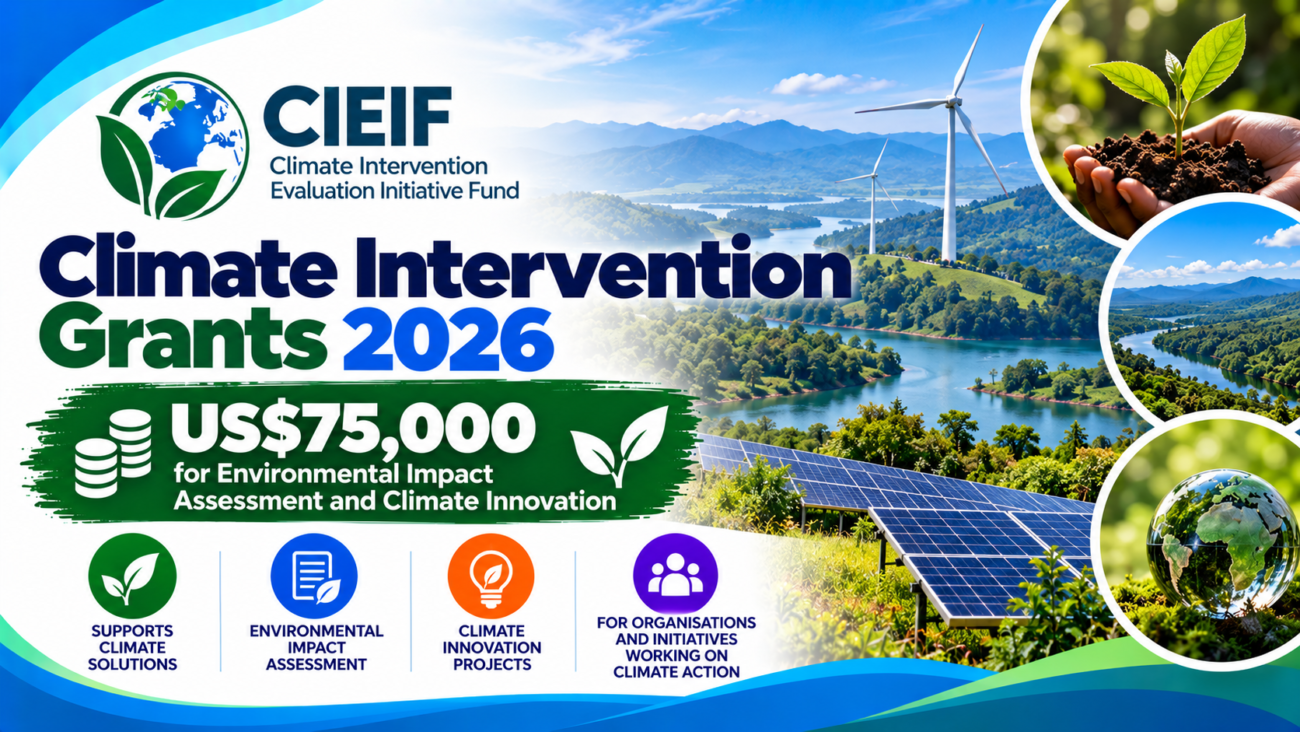
CIEIF Climate Intervention Grants 2026: US$75,000 for Environmental Impact Assessment and Climate Innovation
CIEIF Climate Intervention Grants 2026: US$75,000 for Environmental Impact Assessment and Climate Innovation. The Climate Intervention Environmental Impact Fund (CIEIF) has opened its sixth grant round, offering three grants of US$75,000 each to qualified teams worldwide developing innovative climate-intervention technologies that are approaching small-scale field testing. The funding is specifically designed to support environmental impact assessment, predictive impact modelling and engagement with potentially affected communities, regulators and other stakeholders.
Applications close on:
📅 1 DECEMBER 2026
and grant decisions are expected by:
📅 1 FEBRUARY 2027.
⚠️ Important Accuracy Note
This is not a general climate-action, clean-energy or environmental grant.
CIEIF does not fund ordinary projects in:
- Climate adaptation
- Renewable energy
- Climate resilience
- General emissions reduction
- Sustainable development
- Basic research
- Technology development
- Field-test implementation
Instead, the fund supports the environmental and social due diligence surrounding an innovative climate-intervention technology that is already:
CLOSE TO FIELD TESTING.
The grant must focus primarily on at least one of these three areas:
🌱 ENVIRONMENTAL IMPACT ASSESSMENT
📊 PREDICTIVE IMPACT MODELLING
or:
🤝 STAKEHOLDER ENGAGEMENT.
💰 Quick Overview
| Detail | Information |
|---|---|
| Funder | Climate Intervention Environmental Impact Fund |
| Common Name | CIEIF |
| Grant Round | Sixth Grant Round |
| Number of Grants | 3 |
| Grant Amount | US$75,000 Each |
| Geographic Scope | Global |
| Main Focus | Climate Intervention Environmental Impact Analysis |
| Environmental Impact Assessment | Eligible |
| Predictive Impact Modelling | Eligible |
| Stakeholder Engagement | Eligible |
| Field-Test Implementation Costs | Not Funded |
| Basic Research | Not Funded |
| Individuals | Not Eligible |
| Student Projects | Not Eligible |
| Nonprofit Organisations | High Priority |
| Private Businesses | Can Be Considered |
| Application Language | English |
| Maximum Proposal Length | 20 Pages |
| Standard Application Form | None |
| Deadline | 1 December 2026 |
| Expected Decisions | 1 February 2027 |
| Initial Payment | One-Third Upfront |
| Remaining Payments | Linked to Negotiated Benchmarks |
🌍 What Is the Climate Intervention Environmental Impact Fund?
CIEIF Climate Intervention Grants 2026: US$75,000 for Environmental Impact Assessment and Climate Innovation
The Climate Intervention Environmental Impact Fund supports scientists, innovators, researchers and organisations that are preparing to test climate-intervention technologies with the potential to address:
ROOT CAUSES OF GLOBAL WARMING
or:
MAJOR GLOBAL EFFECTS OF CLIMATE CHANGE.
Its role is not to finance the full climate technology.
Instead, CIEIF concentrates on the important work required before or around a field test, including understanding:
ENVIRONMENTAL RISKS
SOCIAL IMPACTS
ECONOMIC EFFECTS
PUBLIC-HEALTH CONCERNS
REGULATORY REQUIREMENTS
and:
COMMUNITY ACCEPTANCE.
💰 How Much Funding Is Available?
CIEIF is offering:
THREE GRANTS
worth:
💵 US$75,000 EACH.
Applicants should explain clearly how the full US$75,000 would be used primarily for:
ENVIRONMENTAL IMPACT ASSESSMENT
PREDICTIVE MODELLING
and/or:
STAKEHOLDER ENGAGEMENT.
💳 How Is the Funding Paid?
Selected applicants receive the first:
ONE-THIRD OF THE US$75,000
after project scoping discussions with CIEIF.
The second and third payments are then released according to:
NEGOTIATED PROJECT BENCHMARKS.
CIEIF also states that:
REPEATED ANNUAL FUNDING MAY BE POSSIBLE.
🌱 What Activities Can Be Funded?
The grant can support work in three core areas.
1️⃣ Environmental Impact Assessment
Projects may use funding to investigate potential impacts of a proposed climate-intervention field test on areas such as:
ECOSYSTEMS
WATER
SOILS
AIR QUALITY
BIODIVERSITY
and:
LOCAL ENVIRONMENTS.
CIEIF may also consider wider impacts involving:
ECONOMIC
SOCIAL
and:
PUBLIC-HEALTH
risks.
2️⃣ Predictive Impact Modelling
Projects can use funding for:
PREDICTIVE MODELLING
to understand the likely environmental or social effects of an intervention before or during field testing.
This can help researchers identify:
POTENTIAL RISKS
UNINTENDED CONSEQUENCES
and:
MITIGATION NEEDS.
3️⃣ Stakeholder Engagement
The grant can also fund engagement with people or institutions potentially affected by the proposed intervention.
This can include:
LOCAL COMMUNITIES
GOVERNMENT AGENCIES
REGULATORS
INDIGENOUS OR COMMUNITY STAKEHOLDERS
and other relevant parties.
🌦️ What Climate Technologies Can Be Eligible?
CIEIF Climate Intervention Grants 2026: US$75,000 for Environmental Impact Assessment and Climate Innovation
CIEIF considers innovative technologies with potential to scale to meaningful climate benefits.
Examples identified by the fund include:
🌱 BIOCHAR
🪨 ENHANCED WEATHERING
🌊 MARINE CARBON-DIOXIDE REMOVAL
🐄 LIVESTOCK METHANE CAPTURE
🌫️ ATMOSPHERIC METHANE REMOVAL
☁️ CLOUD BRIGHTENING
❄️ ICE & LAND ALBEDO ENHANCEMENT
🌊 OCEAN FERTILISATION
🏭 GREENHOUSE-GAS REMOVAL COATINGS
and other comparable climate interventions.
🚫 Which Technologies Are Excluded?
CIEIF specifically excludes:
STRATOSPHERIC OR HIGHER SOLAR RADIATION MANAGEMENT
including approaches such as stratospheric aerosol interventions.
It also excludes:
DIRECT AIR CAPTURE — DAC
and:
CARBON CAPTURE, UTILISATION & STORAGE — CCUS
because those fields already have other major funding mechanisms.
⚠️ This Is Not Funding for the Technology Itself
CIEIF makes a clear distinction between:
ASSESSING A CLIMATE INTERVENTION
and:
PAYING TO BUILD OR DEPLOY IT.
The fund does:
NOT SUPPORT BASIC RESEARCH
and does:
NOT PAY FOR FIELD-TEST IMPLEMENTATION.
Applicants therefore need to demonstrate that their proposed technology has already advanced far enough to justify:
REAL-WORLD FIELD TESTING.
🎯 Who Can Apply?
CIEIF considers applications from:
QUALIFIED INVESTIGATORS
and:
PROJECT TEAMS
working through eligible organisations.
The fund gives highest priority, other factors being equal, to:
NONPROFIT INSTITUTIONS
including:
ACADEMIC INSTITUTIONS.
🏢 Can Private Companies Apply?
Yes.
CIEIF states that applications from:
PRIVATE BUSINESS PROJECTS
preparing climate-intervention field tests may also be considered.
🚫 Can Individuals Apply?
No.
CIEIF explicitly states:
INDIVIDUALS ARE NOT FUNDED.
🎓 Can Student Projects Apply?
No.
The programme also specifically excludes:
STUDENT PROJECTS.
🌍 Is the Grant Open Worldwide?
Yes.
CIEIF states that:
THE REACH OF POTENTIAL GRANTS IS GLOBAL.
CIEIF Climate Intervention Grants 2026: US$75,000 for Environmental Impact Assessment and Climate Innovation
This means suitable projects can come from:
AFRICA
ASIA
EUROPE
THE AMERICAS
OCEANIA
and other regions.
🌍 International Projects
International projects are eligible.
However, CIEIF says that international projects may receive higher priority where a:
U.S. NONPROFIT PARTNER
is available to accept the grant as a donation.
This is an important consideration for organisations outside the United States.
🇿🇼 Can Zimbabwean Organisations Apply?
Potentially, yes.
Because CIEIF describes its grants as:
GLOBAL
an eligible organisation or qualified project team from Zimbabwe could potentially apply if the proposed climate technology meets the fund’s technical and field-testing requirements.
A Zimbabwean project would need to demonstrate that:
✅ The technology is genuinely innovative
✅ It is near field-test readiness
✅ It could scale to meaningful climate benefits
✅ The grant will fund impact assessment, modelling or stakeholder engagement
and:
✅ The applicant is an eligible organisation rather than an individual or student project.
🌍 Example of an Africa-Based Project
CIEIF’s 2026 grantees include Carbizon, a University of Antwerp-linked project conducting a field test in:
🇰🇪 MURANG’A COUNTY, KENYA.
The project is testing high-intensity:
ENHANCED ROCK WEATHERING
using basalt, biochar and organic matter.
CIEIF funding supports:
ENVIRONMENTAL IMPACT ASSESSMENT
IMPACT MODELLING
and:
LIFE-CYCLE ASSESSMENT.
This demonstrates that African field-test locations can qualify.
📄 Proposal Requirements
There is:
NO STANDARD APPLICATION FORM.
Applicants instead prepare a written proposal.
The application must:
BE IN ENGLISH
and should not exceed:
20 SINGLE-SPACED PAGES
using:
12-POINT FONT.
Biosketches and essential scientific publications can be included as additional supporting material.
📝 What Must the Proposal Include?
CIEIF Climate Intervention Grants 2026: US$75,000 for Environmental Impact Assessment and Climate Innovation
CIEIF requires applicants to answer ten core areas.
1. Applicant and Team Information
Provide:
FULL CONTACT INFORMATION
BIOSKETCHES
ALL PROFESSIONAL POSITIONS
and:
DETAILS OF THE APPLYING ORGANISATION.
A website for the entity should also be provided.
2. Field-Test Description
Explain:
WHAT YOU INTEND TO TEST
WHERE
WHY THE TECHNOLOGY IS READY
and:
WHAT RESEARCH HAS ALREADY BEEN COMPLETED.
Applicants should also identify foreseeable:
TECHNICAL
ENVIRONMENTAL
SOCIAL
ECONOMIC
and:
PUBLIC-HEALTH
issues.
3. Innovation and Scalability
Applicants must explain:
WHAT MAKES THE INTERVENTION INNOVATIVE
and:
HOW IT COULD SCALE TO A CLIMATE-RELEVANT LEVEL.
CIEIF places significant emphasis on:
SCALABILITY.
4. Government Permits
Applicants must identify all required:
PERMITS
APPROVALS
and:
REGULATORY PROCESSES.
5. Previous Scientific Evidence
Provide a list of publications supporting:
TECHNICAL FEASIBILITY
and:
SCALABILITY.
6. Independent Consultants
Applicants must identify at least:
TWO INDEPENDENT CONSULTING FIRMS
that could potentially help perform:
IMPACT ASSESSMENT
MODELLING
or other relevant specialist work.
7. US$75,000 Budget
Applicants need a rough budget showing how the:
US$75,000
will be used.
Eligible costs may include:
APPLICANT STAFF TIME
CONSULTANTS
and closely related assessment expenses.
8. Other Funding
Applicants must disclose:
ALL OTHER FUNDING SOURCES
supporting the investigation.
9. Insurance
The application should describe insurance that may cover the proposed:
FIELD TEST.
10. Publication Commitment
Applicants must confirm that results will be made public through:
A PEER-REVIEWED JOURNAL
or:
AN INDEPENDENTLY PEER-REVIEWED REPORT.
CIEIF Climate Intervention Grants 2026: US$75,000 for Environmental Impact Assessment and Climate Innovation
📚 Publication Is a Major Selection Criterion
CIEIF places strong importance on:
TRANSPARENCY.
A major selection factor is whether applicants are willing to publish their:
IMPACT-RELATED RESULTS.
The organisation wants supported projects to become useful examples for future climate-intervention field testing.
🤖 Important AI Application Rule
CIEIF currently states that:
AI USE IN COVER LETTERS AND APPLICATIONS IS NOT ACCEPTABLE.
The fund says applications detected as using AI will be:
REJECTED
and the applicant may be:
BARRED FROM FUTURE APPLICATIONS.
Applicants should therefore prepare their proposal personally and follow CIEIF’s instructions carefully.
📝 How to Apply
Step 1 — Check Project Eligibility
Your technology must be:
INNOVATIVE
SCALABLE
and:
CLOSE TO FIELD TESTING.
Step 2 — Confirm the Grant Purpose
The proposed US$75,000 must primarily support:
EIA
PREDICTIVE MODELLING
or:
STAKEHOLDER ENGAGEMENT.
Step 3 — Prepare the Proposal
Maximum:
20 PAGES
single-spaced, 12-point font, English only.
Step 4 — Address All Ten Required Questions
Do not skip any required section.
Step 5 — Prepare a Rough Budget
Show how:
US$75,000
will be used.
Step 6 — Identify Consultants
List at least:
TWO POTENTIAL INDEPENDENT CONSULTING FIRMS.
Step 7 — Confirm Publication Commitment
Be prepared to publish results through peer review.
Step 8 — Contact CIEIF Before Sending
When the application is ready, applicants must first contact:
PETER T. JENKIN
📅 Application Deadline
The sixth grant-round deadline is:
📅 1 DECEMBER 2026.
🏆 When Will Decisions Be Announced?
Grant decisions are expected by:
📅 1 FEBRUARY 2027.
📋 Application Checklist
Before applying, confirm:
✅ Eligible Organisation
Required.
✅ Individual Application
Not eligible.
✅ Student Project
Not eligible.
✅ Innovative Climate Intervention
Required.
✅ Near Field-Test Readiness
Required.
✅ Climate-Relevant Scalability
Required.
✅ Environmental Impact Assessment
Included where relevant.
✅ Predictive Modelling
Included where relevant.
✅ Stakeholder Engagement
Included where relevant.
✅ Government Permits
Identified.
✅ Prior Research
Documented.
✅ Publications
Listed.
✅ Two Potential Consultants
Identified.
✅ Rough US$75,000 Budget
Prepared.
✅ Insurance Information
Included.
✅ Publication Commitment
Confirmed.
✅ Application Language
English.
✅ Page Limit
Maximum 20 pages.
✅ Deadline
1 December 2026.
🎯 How to Strengthen Your Application
🌍 Demonstrate Global Climate Relevance
CIEIF Climate Intervention Grants 2026: US$75,000 for Environmental Impact Assessment and Climate Innovation
CIEIF wants technologies that can potentially scale to:
MEANINGFUL CLIMATE BENEFITS.
Explain the possible climate impact if the intervention succeeds at larger scale.
🔬 Show the Technology Is Ready
Do not submit an early-stage concept.
Provide:
PRIOR RESEARCH
PUBLICATIONS
PILOT DATA
or other evidence showing the technology is ready for:
FIELD TESTING.
🌿 Focus on Environmental Due Diligence
The fund is not financing invention.
Your proposal should clearly centre on:
UNDERSTANDING IMPACTS.
🤝 Explain Stakeholder Risks
Identify who could be affected by the proposed test and how you will involve them.
📊 Build a Realistic Assessment Budget
Your budget should demonstrate how the full:
US$75,000
adds value to the impact-assessment process.
📚 Commit to Transparency
CIEIF values projects willing to:
PUBLISH RESULTS
even when findings identify risks or limitations.
⚠️ Common Application Mistakes
Avoid:
- Applying for a conventional adaptation project
- Applying for renewable-energy funding
- Requesting money for technology development
- Requesting field-test implementation costs
- Applying as an individual
- Applying as a student project
- Submitting a technology far from field-test readiness
- Ignoring stakeholder engagement
- Ignoring government permits
- Failing to show scalability
- Omitting two potential independent consultants
- Exceeding 20 pages
- Using a language other than English
- Failing to commit to publication
- Using AI to draft the application despite CIEIF’s explicit prohibition
- Sending the application without first contacting the Fund Manager
❓ Frequently Asked Questions
CIEIF Climate Intervention Grants 2026: US$75,000 for Environmental Impact Assessment and Climate Innovation
How much does CIEIF provide?
💰 US$75,000 PER GRANT.
How many grants are available?
The sixth round offers:
THREE GRANTS.
Is the funding global?
Yes.
CIEIF states that:
THE REACH OF POTENTIAL GRANTS IS GLOBAL.
Can African organisations apply?
Yes, potentially, if they meet all programme requirements.
Can Zimbabwean organisations apply?
Potentially, yes, because the programme is global.
Can individuals apply?
No.
Can students apply?
Student projects are not eligible.
Can universities apply?
Yes.
Nonprofit academic institutions receive priority where other factors are equal.
Can companies apply?
Yes.
Private businesses preparing qualifying climate-intervention field tests may be considered.
Can the grant pay for the field test?
No.
CIEIF does not fund implementation of the climate intervention itself.
Can it fund basic research?
No.
What does it fund?
The main eligible areas are:
ENVIRONMENTAL IMPACT ASSESSMENT
PREDICTIVE IMPACT MODELLING
and:
STAKEHOLDER ENGAGEMENT.
Is Direct Air Capture eligible?
No.
Is CCUS eligible?
No.
Is stratospheric solar geoengineering eligible?
No.
Is biochar potentially eligible?
Yes.
Is enhanced rock weathering potentially eligible?
Yes.
Is methane removal potentially eligible?
Yes.
How long can the proposal be?
Maximum:
20 SINGLE-SPACED PAGES.
Is there an application form?
No.
CIEIF does not use a standard application template.
Can applicants use AI to write the proposal?
CIEIF explicitly says:
NO.
It states that AI use in cover letters or applications is unacceptable.
What is the deadline?
📅 1 DECEMBER 2026.
When will results be announced?
Expected by:
📅 1 FEBRUARY 2027.
🚀 Final Thoughts
CIEIF Climate Intervention Grants 2026: US$75,000 for Environmental Impact Assessment and Climate Innovation
CIEIF Climate Intervention Grants 2026: US$75,000 for Environmental Impact Assessment and Climate Innovation. The CIEIF Sixth Grant Round 2026 offers a specialised funding opportunity for climate innovators whose technologies are ready to move toward:
SMALL-SCALE FIELD TESTING.
Three selected projects will receive:
💰 US$75,000 EACH
to investigate potential:
🌿 ENVIRONMENTAL IMPACTS
📊 PREDICTED RISKS
and:
🤝 STAKEHOLDER CONCERNS.
The programme is:
🌍 GLOBAL
and can support eligible nonprofit institutions, academic organisations and qualifying private-sector projects.
However, it is important to understand that CIEIF does:
NOT FUND GENERAL CLIMATE PROJECTS
NOT FUND BASIC RESEARCH
and:
NOT FUND THE IMPLEMENTATION OF FIELD TESTS.
The strongest applicants will already have a scientifically credible technology, evidence of field-test readiness, a clear understanding of regulatory and environmental risks, and a strong plan for:
EIA
MODELLING
or:
STAKEHOLDER ENGAGEMENT.
Applications close on:
📅 1 DECEMBER 2026
with decisions expected by:
📅 1 FEBRUARY 2027.
📲 Join the Vacancy Bridge WhatsApp Channel
Get climate grants, environmental funding, research grants, innovation funding, African opportunities, fellowships, scholarships, internships, UN opportunities and international funding calls through Vacancy Bridge.
👉 Join here: https://whatsapp.com/channel/0029Vakee9aHFxOyCIBPJA0o
APPLY NOW ON THIS OFFICIAL PAGE
🔑 Key Details
Funder: Climate Intervention Environmental Impact Fund
Common Name: CIEIF
Grant Round: Sixth Round
Funding: US$75,000 Per Grant
Number of Grants: 3
Geographic Scope: Global
Primary Purpose: Environmental & Social Due Diligence for Climate Intervention Field Tests
Environmental Impact Assessment: Eligible
Predictive Impact Modelling: Eligible
Stakeholder Engagement: Eligible
Basic Research: Not Eligible
Field-Test Implementation: Not Eligible
General Adaptation Projects: Not Eligible
Clean-Energy Projects: Not Eligible
Individuals: Not Eligible
Student Projects: Not Eligible
Nonprofits: Priority
Academic Institutions: Priority
Private Businesses: Potentially Eligible
Application Language: English
Proposal Limit: 20 Pages
Standard Form: None
Initial Payment: One-Third Upfront
Remaining Payments: Milestone-Based
Repeated Annual Funding: Possible
Publication Requirement: Yes
AI-Written Applications: Prohibited by CIEIF
Deadline: 1 December 2026
Expected Decisions: 1 February 2027
🔎 SEO Keywords
CIEIF Climate Intervention Grants 2026, Climate Intervention Environmental Impact Fund, US$75000 Climate Grant, $75000 Environmental Grant 2026, Climate Innovation Grants 2026, Environmental Impact Assessment Grant, Climate Intervention Funding, Climate Technology Grants 2026, Global Climate Grants 2026, Climate Research Funding 2026, Environmental Impact Funding, Climate Modelling Grants, Stakeholder Engagement Grants, Climate Restoration Funding, Enhanced Weathering Grants, Biochar Grants 2026, Methane Removal Funding, Marine Carbon Removal Grant, Climate Intervention Field Test Funding, Environmental Due Diligence Grants, Climate Technology Impact Assessment, Global Environmental Grants, International Climate Funding, Climate Grant for Universities, Climate Grant for Nonprofits, Climate Funding for Companies, African Climate Grants 2026, Climate Grants for Zimbabwe, Environmental Funding Africa, Climate Innovation Funding Africa, CIEIF Sixth Grant Round, CIEIF Application 2026, CIEIF Deadline December 2026, US$75000 Research Grant, Climate Intervention Project Funding, Environmental Assessment Funding, Climate Science Grants, Carbon Removal Impact Assessment, Global Climate Innovation Grant, Vacancy Bridge.
