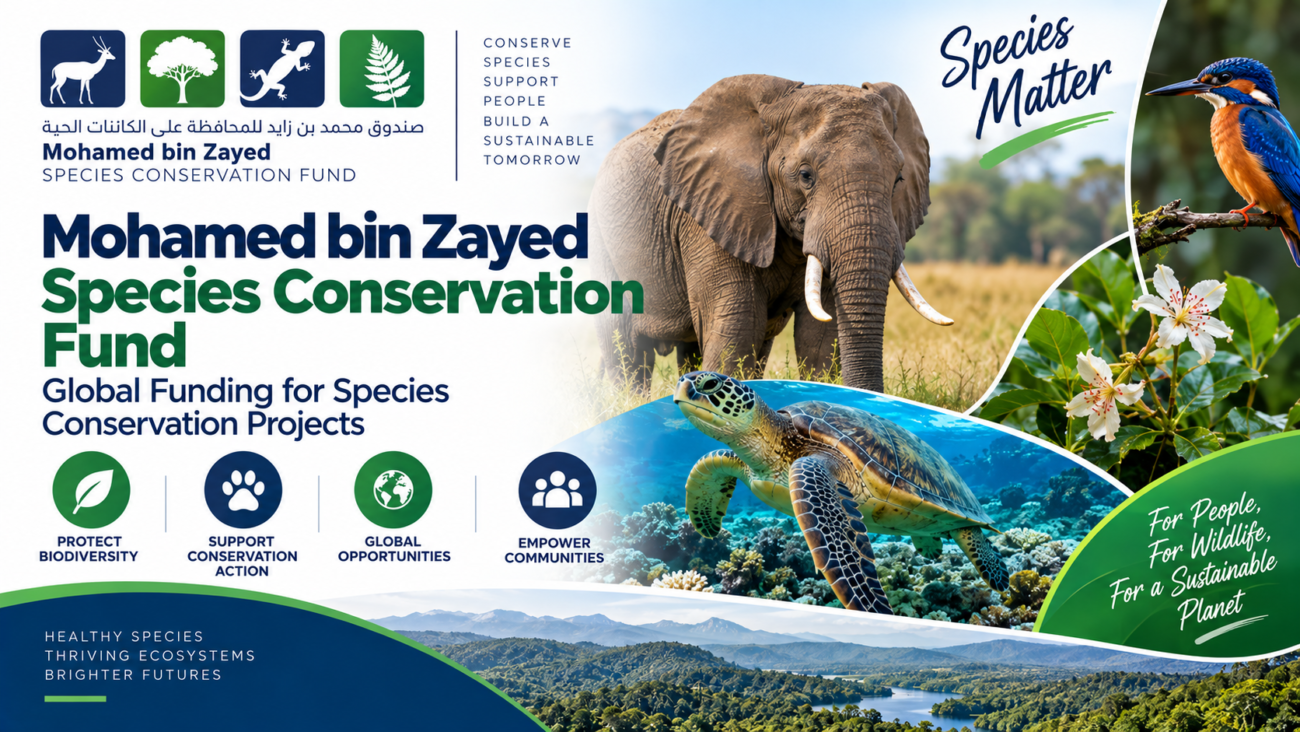
Mohamed bin Zayed Species Conservation Fund 2026: Global Funding for Species Conservation Projects
Mohamed bin Zayed Species Conservation Fund 2026: Global Funding for Species Conservation Projects. The Mohamed bin Zayed Species Conservation Fund (MBZ Fund) provides grant funding for conservation projects working to protect threatened and poorly known animal, plant and fungus species around the world.
The Fund has a global focus and has supported conservation initiatives across more than 160 countries. Its grants are designed particularly for practical species-conservation work, including projects involving field surveys, research, monitoring, direct conservation action, recovery management and capacity building. The Fund states that it does not apply geographic or taxonomic bias to species conservation applications, although projects are assessed through an independent evaluation process.
For 2026, the Fund has introduced a revised application timetable. Applications are now accepted during specific grant windows rather than throughout the entire year. The December 2026 grant cycle is scheduled to accept applications from 15 September to 15 October 2026, with funding decisions expected by the end of December 2026.
The Fund’s current priorities continue to include species facing a high threat of extinction, particularly Endangered and Critically Endangered species, as well as Data Deficient species and species that are not formally assessed but may be highly threatened.
🌍 Mohamed bin Zayed Species Conservation Fund 2026
Mohamed bin Zayed Species Conservation Fund 2026: Global Funding for Species Conservation Projects
The Mohamed bin Zayed Species Conservation Fund was established to provide targeted financial support to people and organizations working directly on species conservation.
Unlike broad environmental grants that may cover large institutional programmes, the MBZ Fund has historically focused strongly on species-specific conservation initiatives and practical conservation work.
The Fund’s global approach means that applications can come from conservationists working in different countries and ecosystems. Its supported species have included animals, plants and fungi, reflecting the Fund’s broad taxonomic scope.
The Fund is particularly relevant to conservationists who have identified a specific species or group of species facing significant conservation challenges and need financial support to carry out practical work.
🌱 Quick Overview
| Detail | Information |
|---|---|
| Funding Programme | Mohamed bin Zayed Species Conservation Fund |
| Funding Type | Species conservation grants |
| Geographic Scope | Global |
| Eligible Species | Animal, plant and fungus species |
| Main Focus | Species conservation |
| Priority Species | Threatened and poorly known species |
| Particular Priority | Endangered and Critically Endangered species |
| Other Priority | Data Deficient and potentially highly threatened species |
| Typical Activities | Fieldwork, surveys, research, monitoring, conservation action, recovery management and training |
| Applicants | People directly involved in species conservation |
| 2026 December Cycle | 15 September–15 October 2026 |
| 2026 December Deadline | 15 October 2026 |
| Expected Decision | End of December 2026 |
| Application Language | English |
| Budget Currency | US dollars |
| Application Method | Online |
| Geographic Restrictions | Global |
| Official Website | Mohamed bin Zayed Species Conservation Fund |
The current 2026 timetable was announced by the Fund as part of a change from its previous year-round application approach.
🏛️ About the Mohamed bin Zayed Species Conservation Fund
The Mohamed bin Zayed Species Conservation Fund is a philanthropic conservation fund established to support species conservation around the world.
Its stated purpose is to provide targeted grants to individual species conservation initiatives, recognize conservation leaders and increase attention to species conservation within the wider environmental debate.
The Fund’s approach is centered on species rather than restricting support to a particular geographic region.
Historically, the Fund has described its eligibility as extending to all animal, plant and fungus species conservation efforts, subject to assessment and approval.
According to Fund materials, more than 2,500 projects have been supported globally, with grants reaching more than 160 countries. The Fund also reports a broad network of conservationists, biologists, ecologists, field workers, volunteers and support personnel involved in its work.
🐘 1. What Does the Fund Support?
Mohamed bin Zayed Species Conservation Fund 2026: Global Funding for Species Conservation Projects
The MBZ Fund supports projects designed to contribute directly to the conservation of species.
Its funding can be relevant to projects involving:
- Species surveys
- Population monitoring
- Field research
- Data collection
- Conservation assessments
- Direct species protection
- Recovery management
- Conservation planning
- Training and capacity building
- Species-focused community conservation
- Genetic or other conservation research
- Other practical species conservation activities
The Fund has historically emphasized in situ conservation, meaning work carried out to conserve species in their natural habitats.
However, it also recognizes that ex situ conservation can be important in certain circumstances, including genetic analysis, workshops and maintaining populations outside their natural habitat.
Applicants should therefore demonstrate a clear connection between the proposed activities and the conservation of the target species.
🔬 2. What Species Can Be Supported?
One of the distinctive features of the MBZ Fund is its broad taxonomic scope.
Applications can concern:
🐾 Animal Species
Projects may focus on threatened mammals, birds, reptiles, amphibians, fish, insects and other animal species.
🌿 Plant Species
Plant conservation projects can also fall within the Fund’s scope.
🍄 Fungi
The Fund’s eligibility extends to fungi conservation as well.
The Fund states that it does not discriminate on the basis of selected species or geographic region.
However, broad eligibility does not mean every proposal will receive funding. Applications are evaluated against the Fund’s conservation priorities and selection criteria.
🚨 3. Priority for Threatened Species
The Fund’s current application approach places particular attention on species facing serious extinction threats.
Its 2026 announcement indicates that consideration remains directed toward species facing a high threat of extinction, with emphasis on:
- Endangered species
- Critically Endangered species
- Data Deficient species
- Unlisted species suspected to be highly threatened
This means applicants should provide credible evidence supporting the conservation significance of the target species.
Where appropriate, applicants should reference recognized conservation assessments such as the IUCN Red List and explain the specific threats affecting the species.
🌍 4. Global Funding Opportunity
The Fund is international in scope.
Its conservation activities have extended across numerous countries and regions, and its published materials state that eligibility is not restricted by geography.
This makes the programme potentially relevant to conservationists working in:
- Africa
- Asia
- Latin America
- Europe
- The Middle East
- Pacific island states
- Other regions where threatened species conservation projects are being implemented
Applicants should nevertheless demonstrate that their proposed work has a clear species-conservation objective and meets the Fund’s requirements.
👩🔬 5. Who Can Apply?
The Fund is intended for people directly involved in species conservation.
Its funding information states that anyone directly involved in species conservation can apply.
Potential applicants may therefore include:
- Conservation researchers
- Field biologists
- Ecologists
- Species specialists
- Conservation practitioners
- Local conservation organizations
- Research teams
- Community-based conservation initiatives
- Other individuals directly involved in species conservation
Applicants should not assume that simply having an environmental interest is sufficient.
A strong application should demonstrate the applicant’s direct connection to the proposed conservation work and the target species.
🎯 6. What Makes a Project Relevant?
Mohamed bin Zayed Species Conservation Fund 2026: Global Funding for Species Conservation Projects
A project is more clearly aligned with the Fund when it has a direct and measurable connection to species conservation.
For example, a proposal might seek support for:
A field survey to determine the remaining population of a threatened species.
Population monitoring to understand changes in abundance or distribution.
Threat assessment to identify factors contributing to species decline.
Conservation action designed to reduce an identified threat.
Recovery management for a highly threatened population.
Training to strengthen local capacity for species conservation.
Research that provides information needed for practical conservation decisions.
The precise activities that can be funded depend on the Fund’s current requirements and assessment process.
💰 7. How Much Funding Is Available?
The Fund has historically provided relatively targeted grants rather than presenting itself simply as a conventional large institutional funding programme.
Earlier Fund materials described two grant categories:
- Grants of up to US$5,000
- Grants between US$5,000 and US$25,000
However, these figures come from earlier published Fund materials and should not automatically be treated as the current 2026 maximum award.
Applicants should therefore check the current application portal and guidelines before preparing their budget.
This distinction is important because funding structures and programme conditions can change over time.
📊 8. Small and Targeted Conservation Grants
A defining feature of the Fund has historically been its focus on smaller, targeted projects.
The Fund has stated that it seeks to reduce unnecessary administrative barriers, particularly for smaller conservation initiatives where excessive application requirements can reduce the practical value of the funding.
This approach can be particularly relevant to conservationists working on species that receive relatively little mainstream funding.
Projects involving lesser-known species may therefore still be relevant where applicants can demonstrate a clear conservation need.
🌿 9. In Situ Conservation
The Fund has traditionally shown strong interest in in situ conservation, or conservation work undertaken in the species’ natural environment.
Examples include:
- Field surveys
- Population counts
- Habitat-based monitoring
- Direct conservation interventions
- Threat reduction
- Recovery programmes
- Local conservation training
Funding information indicates that in situ work is generally a major focus of the programme.
Applicants should clearly explain where the project will take place and how the proposed activities will benefit the target species in its natural environment.
🧬 10. Ex Situ Conservation
The Fund also recognizes that some conservation challenges require work outside a species’ natural habitat.
Potential examples include:
- Genetic analysis
- Conservation breeding
- Maintaining ex situ populations
- Specialized workshops
- Other conservation-support activities
The Fund has indicated that some grants may support ex situ conservation in appropriate circumstances.
Applicants should clearly justify why an ex situ approach is necessary and how it contributes to the overall conservation of the target species.
👩🎓 11. Support for Young Conservationists
The Fund’s published information indicates that priority can be given to projects supporting the professional development of young conservationists.
This can make the programme relevant not only to established conservation researchers but also to emerging professionals who are building practical experience in species conservation.
Applicants should explain any training, mentorship or capacity-building component where it forms a meaningful part of the proposed project.
🗓️ 12. 2026 Grant Application Timeline
The Fund has changed its application schedule for 2026.
Previously, applications were accepted throughout the year. The Fund announced that, beginning in 2026, applications would instead be organized into specific grant cycles.
The published 2026 schedule includes:
🥇 April Grant Cycle
Applications for the April cycle closed on 31 January 2026, with decisions expected toward the end of April.
🥈 September Grant Cycle
The September cycle opened from 1 May to 31 May 2026, with decisions expected toward the end of September.
🥉 December Grant Cycle
The December cycle is scheduled to open:
15 September 2026
and close:
15 October 2026
Funding decisions for this cycle are expected by the end of December 2026.
For applicants preparing a proposal now, the 15 October 2026 deadline is therefore the key date for the December cycle.
⏰ 13. December 2026 Deadline
Mohamed bin Zayed Species Conservation Fund 2026: Global Funding for Species Conservation Projects
Applicants targeting the December 2026 funding cycle should submit their applications during the published window:
15 September–15 October 2026.
The closing date is:
15 OCTOBER 2026
Applications should be completed before the deadline rather than left until the final hours.
The Fund introduced the application windows partly because the number of submissions has increased substantially and additional time is needed to assess applications and identify suitable projects.
📝 14. How to Apply
Applications are submitted online through the Mohamed bin Zayed Species Conservation Fund’s application system.
The Fund’s application information indicates that applications should be submitted in English, with budgets and financial information presented in US dollars.
Step 1 — Identify the Target Species
Clearly identify the species or species group that the project will address.
Step 2 — Establish the Conservation Need
Explain the current conservation status and the main threats facing the species.
Step 3 — Define the Project
Describe what you intend to do, where the project will take place and how the activities will benefit the species.
Step 4 — Develop a Realistic Budget
Prepare a detailed project budget and present financial information in US dollars as required.
Step 5 — Explain Expected Outcomes
Identify the practical conservation results you expect the project to achieve.
Step 6 — Demonstrate Your Experience
Explain your role in species conservation and provide relevant research, fieldwork or project experience.
Step 7 — Submit Online
Complete and submit the application through the Fund’s online system before the applicable cycle deadline.
📋 15. Application Checklist
Before submitting an application, applicants should prepare:
✅ Target Species
Clearly identify the species being conserved.
✅ Conservation Status
Provide reliable information about its conservation status.
✅ Threat Analysis
Explain the principal threats affecting the species.
✅ Project Objectives
Define specific and achievable conservation objectives.
✅ Methodology
Explain how the proposed activities will be implemented.
✅ Location
Identify where the project will take place.
✅ Expected Outcomes
Describe measurable conservation results.
✅ Project Team
Explain the experience and responsibilities of the people implementing the project.
✅ Budget
Prepare a realistic budget in US dollars.
✅ Supporting Information
Include relevant research, conservation data and other supporting evidence.
✅ English Application
Ensure the application is prepared in English.
✅ Deadline
Submit during the appropriate grant window.
🔬 16. What Should a Strong Project Proposal Explain?
Mohamed bin Zayed Species Conservation Fund 2026: Global Funding for Species Conservation Projects
A strong conservation proposal should make it easy for reviewers to understand five central questions:
1. What species are you trying to conserve?
The species should be clearly identified.
2. Why does it need conservation?
Provide evidence of population decline, habitat loss, exploitation, disease, invasive species, climate-related threats or other relevant pressures.
3. What will you do?
Describe the actual fieldwork, research or conservation intervention.
4. How will the project help?
Connect each activity to a meaningful conservation outcome.
5. How will you measure success?
Explain the indicators that will demonstrate progress.
Avoid presenting a general environmental project without a clear connection to a particular species or species conservation objective.
📈 17. Demonstrating Conservation Impact
Applicants should focus on practical outcomes rather than simply describing the importance of biodiversity.
For example, a project might aim to:
- Improve population data
- Identify previously unknown populations
- Reduce a specific threat
- Improve species monitoring
- Strengthen conservation management
- Protect breeding populations
- Improve survival rates
- Train local conservation personnel
- Generate information needed for future conservation action
The expected results should be realistic in relation to the project’s timeframe and budget.
🌍 18. Can African Conservation Projects Apply?
Mohamed bin Zayed Species Conservation Fund 2026: Global Funding for Species Conservation Projects
Yes.
The Fund has a global geographic focus and has supported conservation initiatives across numerous countries.
This makes the opportunity potentially relevant to conservationists working on threatened species in African countries, including projects involving:
- Mammals
- Birds
- Reptiles
- Amphibians
- Fish
- Invertebrates
- Plants
- Fungi
African applicants should nevertheless ensure that their project clearly meets the Fund’s current requirements rather than assuming that geographic eligibility guarantees funding.
🐒 19. Conservation Projects for Lesser-Known Species
The MBZ Fund can be particularly relevant to projects involving species that may receive less attention from large international conservation programmes.
The Fund has historically highlighted its support for less high-profile species and has also supported work concerning species classified as Data Deficient or Not Evaluated.
This is important because a species does not necessarily need to be globally famous to have conservation significance.
Applicants should provide evidence demonstrating why their target species requires intervention.
🧑🔬 20. Selection and Review Process
The Fund uses an independent evaluation structure to assess grant applications.
Historical Fund materials describe an independent board or advisory structure involving conservation specialists who review proposals and determine funding allocations.
The Fund has also stated that its increased application volume led to a revised 2026 timetable designed to provide additional time to assess submissions, identify duplications and review applications more carefully.
Applicants should therefore expect competition for available funding.
⚠️ 21. Competition for Funding
The number of applications received by the Fund has historically exceeded the amount it could support.
For example, the Fund reported that in 2014 it received requests totaling approximately US$23.5 million while distributing approximately US$1.55 million.
More recently, the Fund reported that it supported approximately 8.5% of applications received in the preceding year, which contributed to the decision to introduce specific application windows for 2026.
These historical and recent figures illustrate that applicants should not interpret eligibility as an indication that funding will be awarded.
💡 22. Tips for Preparing an Application
1. Focus on One Clear Conservation Problem
Avoid trying to address too many unrelated problems in one proposal.
2. Identify the Species Clearly
Use the accepted scientific and common name where appropriate.
3. Explain the Threat
Support claims about the species’ status with credible evidence.
4. Make the Project Practical
Clearly describe what will actually happen in the field or laboratory.
5. Connect Activities to Conservation Outcomes
Explain why each major expenditure and activity is necessary.
6. Use Evidence
Population data, previous research, surveys and conservation assessments can strengthen the case.
7. Prepare a Realistic Budget
Ensure requested costs are directly related to the proposed conservation work.
8. Demonstrate Local Knowledge
Where relevant, explain your team’s experience in the project location and with the target species.
9. Avoid Generic Environmental Language
The proposal should be specifically about species conservation.
10. Submit Before the Deadline
For the December 2026 cycle, applications should be submitted by 15 October 2026.
⚠️ 23. Common Application Mistakes
Mohamed bin Zayed Species Conservation Fund 2026: Global Funding for Species Conservation Projects
Applicants should avoid:
- Submitting after the applicable grant window
- Describing a broad environmental project without a species focus
- Failing to explain the conservation status of the target species
- Providing unsupported claims about extinction risk
- Using an unrealistic project budget
- Failing to explain how activities will benefit the species
- Ignoring monitoring and evaluation
- Providing vague project objectives
- Treating the grant as unrestricted institutional funding
- Assuming older grant amounts automatically apply to 2026
- Submitting financial information in a currency other than the required US dollars
- Failing to complete the application in English
- Waiting until the final day to submit
❓ Frequently Asked Questions
What is the Mohamed bin Zayed Species Conservation Fund?
It is a global philanthropic funding programme that provides targeted grants for species conservation initiatives involving animal, plant and fungus species.
Who can apply?
The Fund states that anyone directly involved in species conservation can apply, subject to its application and assessment requirements.
Can international conservationists apply?
Yes. The Fund has a global focus and its eligibility is not restricted to a particular geographic region.
What species are eligible?
The Fund’s scope includes animal, plant and fungus species conservation.
Does the Fund prioritize endangered species?
The 2026 application announcement states that consideration continues to focus on species facing a high threat of extinction, particularly Endangered and Critically Endangered species. Data Deficient and potentially highly threatened unlisted species can also be considered.
Can Data Deficient species be supported?
Yes. The Fund has historically supported projects involving Data Deficient species and continues to identify them among its areas of conservation interest.
Can plant conservation projects apply?
Yes. The Fund’s stated scope includes plant conservation.
Can fungi conservation projects apply?
Yes. Fungi are included within the Fund’s broad species-conservation scope.
What types of projects can receive funding?
The Fund has supported practical species-conservation activities such as surveys, data gathering, direct conservation action, recovery management and training.
Does the Fund support fieldwork?
Yes. Field-based species conservation is an important part of the Fund’s historical funding approach.
Can ex situ conservation projects apply?
Potentially. The Fund recognizes the importance of ex situ work, including genetic analysis and maintaining ex situ populations, although such projects should demonstrate their conservation relevance.
How much money does the Fund provide?
Earlier Fund materials described grants of up to US$5,000 and grants between US$5,000 and US$25,000. However, applicants should consult the current application materials rather than assuming those historical amounts are the current 2026 limits.
When is the 2026 deadline?
For the December 2026 grant cycle, applications are scheduled to close on:
15 October 2026.
When did the December 2026 application window open?
The December cycle opened on:
15 September 2026.
When are decisions expected?
For the December 2026 cycle, the Fund expects decisions by the end of December 2026.
Must applications be submitted in English?
Yes. Current funding information states that applications must be submitted in English.
What currency should the budget use?
The Fund’s current application information states that budgets and financial data should be submitted in US dollars.
Is this a scholarship?
No. The Mohamed bin Zayed Species Conservation Fund is a conservation grant programme, not an educational scholarship.
Can young conservationists benefit?
Yes. Fund information indicates that priority can be given to projects supporting the professional development of young conservationists.
Is the Fund restricted to large conservation organizations?
The programme has historically supported individual conservationists and grassroots projects as well as wider conservation initiatives.
📌 Key Details
Funding Programme: Mohamed bin Zayed Species Conservation Fund
Funding Type: Species conservation grant
Geographic Scope: Global
Species: Animals, plants and fungi
Priority: Threatened and poorly known species
Particular Focus: Endangered and Critically Endangered species
Additional Priority: Data Deficient and potentially highly threatened unlisted species
Eligible Applicants: People directly involved in species conservation
Application Language: English
Budget Currency: US dollars
2026 December Application Window: 15 September–15 October 2026
2026 Deadline: 15 October 2026
Expected Decision: End of December 2026
Application Method: Online
Official Programme: Mohamed bin Zayed Species Conservation Fund
🚀 Final Thoughts
Mohamed bin Zayed Species Conservation Fund 2026: Global Funding for Species Conservation Projects
Mohamed bin Zayed Species Conservation Fund 2026: Global Funding for Species Conservation Projects. The Mohamed bin Zayed Species Conservation Fund is a global funding opportunity for conservationists working to protect threatened and poorly known species.
Its scope extends across animals, plants and fungi, and the Fund’s global approach means conservation projects are not limited to one country or region.
The programme can be particularly relevant to projects involving practical conservation activities such as field surveys, population monitoring, research, data collection, direct conservation action, recovery management and training.
For applicants targeting the final 2026 funding cycle, the important dates are:
Opening: 15 September 2026
Closing: 15 October 2026
Expected decision: End of December 2026.
Applicants should pay particular attention to the conservation status of their target species, the evidence supporting the proposed intervention, the practicality of their project and the relationship between requested funding and measurable conservation outcomes.
Because the Fund has updated its application timetable and funding procedures over time, applicants should consult the current official application system and guidelines before submitting a proposal.
📲 Get More Grants, Scholarships & Global Opportunities
Stay connected with Vacancy Bridge for scholarships, fellowships, grants, internships, research opportunities and international funding opportunities.
Vacancy Bridge is an independent platform that shares opportunity information and is not the funding organization or selection authority. Applicants should always verify current eligibility requirements, deadlines, funding conditions and application instructions through the official programme website before applying.
Join the Vacancy Bridge WhatsApp Channel
https://www.whatsapp.com/channel/0029Vakee9aHFxOyCIBPJA0o
APPLY ON THIS OFFICIAL PAGE
🔎 SEO Keywords
Mohamed bin Zayed Species Conservation Fund 2026, Mohamed bin Zayed Species Conservation Fund, MBZ Species Conservation Fund, MBZ Fund grants 2026, species conservation grants, wildlife conservation grants, biodiversity grants 2026, conservation funding opportunities, environmental grants, global conservation grants, grants for endangered species, grants for critically endangered species, plant conservation grants, animal conservation grants, fungi conservation grants, conservation research grants, wildlife research funding, biodiversity funding opportunities, international conservation grants, Africa conservation grants, conservation grants for NGOs, conservation grants for researchers, species protection funding, environmental funding opportunities 2026, biodiversity conservation funding, threatened species grants, conservation project funding, wildlife grants for researchers, global environmental grants, Vacancy Bridge
