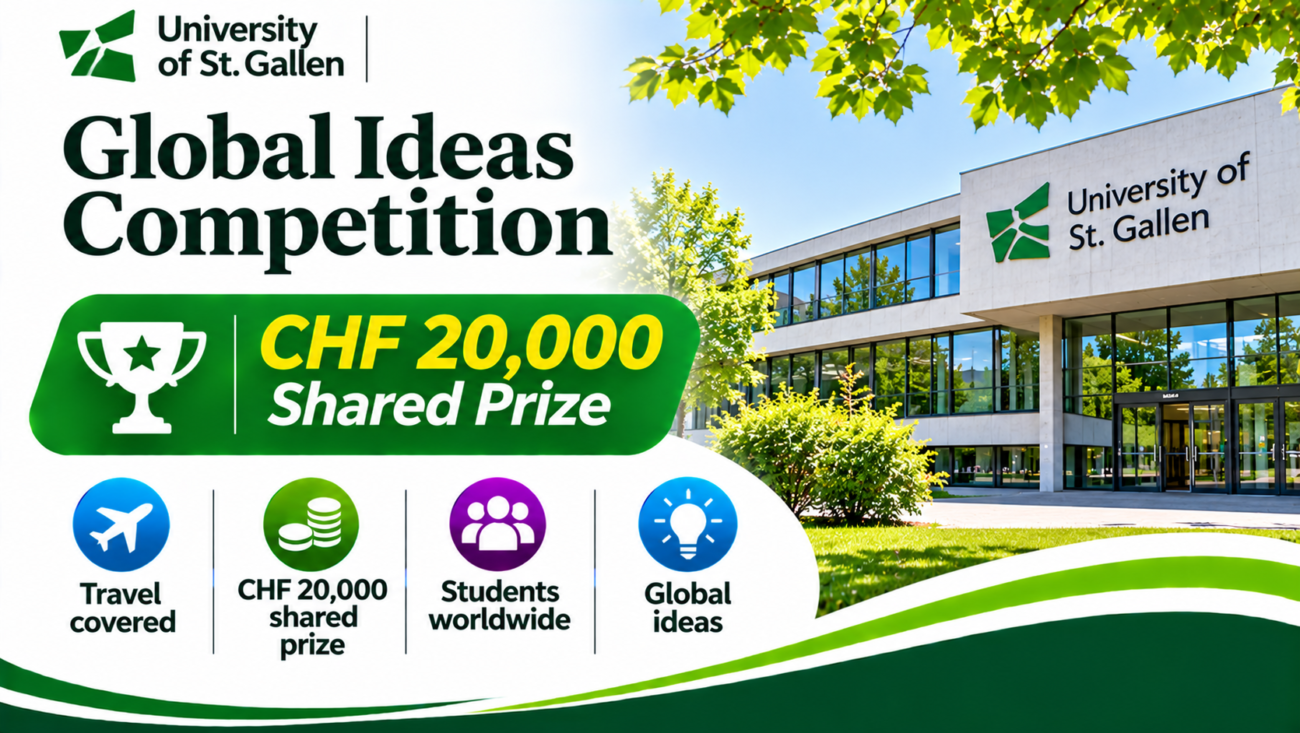
St. Gallen Global Ideas Competition Covers Travel for Selected Students and Offers a Shared CHF 20,000 Prize
St. Gallen Global Ideas Competition Covers Travel for Selected Students and Offers a Shared CHF 20,000 Prize. The St. Gallen Global Ideas Competition 2027 is inviting outstanding graduate and postgraduate students from around the world to propose practical solutions to pressing global challenges. Organised by the St. Gallen Symposium, the competition gives selected participants an opportunity to attend the 56th St. Gallen Symposium in Switzerland as Leaders of Tomorrow, with travel, accommodation and participation expenses covered.
The competition also offers a CHF 20,000 prize fund shared among the three best ideas. The strongest submissions will have an opportunity to present their ideas on the Symposium’s main stage and engage with senior leaders from business, politics, academia and civil society.
The competition is open to eligible master’s and postgraduate students in any field of study who were born in 1997 or later. Applicants must submit an evidence-based Solution Brief of up to 1,000 words and a three-minute Video Explainer.
Application deadline: 1 February 2027, 11:59 p.m. in the last time zone (UTC−12). St. Gallen Symposium+2
1. St. Gallen Global Ideas Competition 2027: Key Details
| Detail | Information |
|---|---|
| Competition | Global Ideas Competition 2027 |
| Organiser | St. Gallen Symposium |
| Event | 56th St. Gallen Symposium |
| Location | St. Gallen, Switzerland |
| Symposium dates | 27–29 April 2027 |
| Eligible applicants | Graduate and postgraduate students |
| Eligible study level | Master’s degree or higher |
| Eligible fields | All fields of study |
| Age requirement | Born in 1997 or later |
| Nationality | All nationalities |
| Entry format | Individual submissions only |
| Main submission | Solution Brief, maximum 1,000 words |
| Video submission | Video Explainer, maximum 3 minutes |
| Prize fund | CHF 20,000 shared by three awardees |
| Travel support | Expenses-paid Symposium participation for the top 100 selected participants |
| Application fee | No fee indicated on the official competition page |
| Application deadline | 1 February 2027 |
| Expected results | By mid-March 2027 |
The competition is not a conventional scholarship or university admission programme. It is an international ideas competition through which selected students can qualify for participation in the St. Gallen Symposium. St. Gallen Symposium
2. About the St. Gallen Symposium
The St. Gallen Symposium is an international platform that brings together emerging leaders and established decision-makers to discuss important economic, political and social issues.
Its annual event creates opportunities for dialogue between generations, connecting students and young professionals with experienced leaders from business, government, academia and civil society.
The 56th St. Gallen Symposium will take place from 27 to 29 April 2027 in St. Gallen, Switzerland.
The event is expected to bring together approximately:
- 200 young leaders.
- More than 600 senior leaders.
- Participants from business, politics, academia and civil society.
The Global Ideas Competition is one of the routes through which graduate students can qualify to attend the Symposium as Leaders of Tomorrow. St. Gallen Symposium+1
3. What Does the Global Ideas Competition Offer?
The competition provides selected participants with international exposure, travel support, networking opportunities and the possibility of winning a share of the CHF 20,000 prize.
3.1 Expenses-paid participation in Switzerland
Top 100 selected participants
The competition’s top 100 participants qualify as Leaders of Tomorrow and receive expenses-paid participation at the 56th St. Gallen Symposium.
According to the organisers, the support includes:
- International travel to Switzerland.
- Accommodation during the Symposium.
- Board and meals during the programme.
- Airport transfers.
- Public transport in St. Gallen during the Symposium week.
- Free participation in the Symposium.
The organising committee contacts selected participants to discuss their itineraries and arrange their flights or train tickets.
Accommodation is provided in private student flats across St. Gallen. Participants with specific accommodation requirements should notify the organisers early. St. Gallen Symposium
3.2 CHF 20,000 shared prize fund
Total competition prize fund
CHF 20,000
St. Gallen Global Ideas Competition Covers Travel for Selected Students and Offers a Shared CHF 20,000 Prize
Shared by the three best ideas
The organisers have not specified an individual prize amount for each of the three awardees on the current competition page.
The three highest-ranked ideas share the CHF 20,000 prize fund.
The competition does not advertise CHF 20,000 as an award for every selected participant. The prize is reserved for the three best ideas.
3.3 Opportunity to present ideas on the main stage
The strongest competitors may be invited to present their ideas on the main stage of the St. Gallen Symposium.
This offers an opportunity to communicate a proposed solution to an international audience of senior decision-makers and emerging leaders.
3.4 Networking with global leaders
Selected Leaders of Tomorrow can interact with more than 600 senior leaders from business, politics, academia and civil society.
This creates opportunities to:
- Exchange ideas with experienced professionals.
- Discuss global challenges.
- Build international relationships.
- Learn from established decision-makers.
- Connect with other promising young researchers and professionals.
3.5 Membership of an international community
Participation also provides access to the wider St. Gallen Symposium community.
The organisers describe the Leaders of Tomorrow network as a community that extends beyond the annual event, offering opportunities for continued engagement and exchange. St. Gallen Symposium
4. What Expenses Are Covered and What Must Applicants Pay?
Although selected participants receive expenses-paid participation, there is an important distinction between the costs covered by the organisers and those that remain the participant’s responsibility.
| Expense | Coverage |
|---|---|
| Symposium participation | Covered |
| International flights or train travel | Arranged and covered by organisers |
| Accommodation | Covered |
| Board and meals | Covered during the programme, although some meals may not be covered depending on arrival and departure times |
| Airport transfers | Provided |
| Local public transport | Free transport ticket during the Symposium week |
| Swiss visa application | Applicant’s responsibility |
| Personal spending | Applicant’s responsibility |
| Additional travel outside the programme | Not automatically covered |
Important for international applicants: The organisers do not obtain visas on behalf of participants. Each selected Leader of Tomorrow is responsible for applying for and obtaining their own Swiss visa.
The Symposium provides the necessary invitation documents and can inform the relevant Swiss embassy about the invitation. If difficulties arise, the organisers state that they are willing to assist.
Participants are advised to bring approximately CHF 100–200 as pocket money. Some meals may not be covered depending on travel arrival and departure times. St. Gallen Symposium
5. Who Can Apply for the St. Gallen Global Ideas Competition 2027?
The competition is open to graduate and postgraduate students from different academic disciplines and nationalities.
However, applicants must satisfy specific age, academic-enrolment and university requirements.
5.1 Academic qualification
Applicants must be enrolled in a graduate or postgraduate programme at master’s level or higher.
Eligible students may include:
- Master’s degree students.
- Doctoral students.
- PhD candidates.
- Students enrolled in other postgraduate programmes recognised by their universities.
Bachelor’s students are generally not eligible.
There is a limited exception for students whose current year of study is equivalent to international graduate-level education, such as certain fourth-year honours programmes. The university must confirm this status in writing.
5.2 Age requirement
Applicants must have been born in 1997 or later.
Students born before 1997 do not meet the published age requirement.
5.3 University requirement
Applicants must be enrolled at a recognised or regular university.
For this competition, a regular university is defined as an institution of higher education that:
- Conducts research.
- Offers at least one PhD programme.
The organisers may consider exceptions on a case-by-case basis.
5.4 Nationality
The competition is international and does not restrict eligibility to specific nationalities.
Students from Africa, Asia, Europe, North America, South America and other regions can apply if they meet the academic and age requirements.
Zimbabwean master’s and PhD students are eligible to apply if they satisfy the published conditions and attend a university that meets the competition’s definition of a regular university. St. Gallen Symposium
5.5 Individual applications only
The competition accepts individual submissions.
Applicants cannot submit a joint Solution Brief as a team. The idea and submission must be the applicant’s own work and must be prepared specifically for the Global Ideas Competition. St. Gallen Symposium
6. What Is the 2027 Competition Theme?
The 2027 Global Ideas Competition asks:
What could we solve, if we could agree?
St. Gallen Global Ideas Competition Covers Travel for Selected Students and Offers a Shared CHF 20,000 Prize
The central question for the 2027 Global Ideas Competition
The organisers want participants to identify real problems that remain unresolved because the people or institutions involved cannot reach an agreement.
Applicants must propose a new arrangement, partnership or approach that could make solving the problem more effective.
The competition focuses on cooperation and the conditions required to turn an idea into practical action.
A strong submission should explain:
- What problem needs to be solved?
- Why has it remained unresolved?
- What evidence demonstrates that the problem is important?
- What new arrangement or partnership could help solve it?
- Which people or institutions must participate?
- How would the proposed solution work in practice?
Applicants are encouraged to choose a problem they understand from the inside rather than proposing an abstract idea without practical evidence. St. Gallen Symposium
7. Suggested Research Areas and Competition Ideas
The competition accepts applicants from any field of study. Students can select a problem connected to their academic background, professional interests or experience in their communities.
The following are illustrative areas in which applicants could develop proposals.
7.1 Climate change and environmental sustainability
Possible topics include:
- Cooperation between governments and businesses to reduce industrial pollution.
- Agreements to improve cross-border water management.
- Partnerships for renewable energy development.
- Collaborative approaches to managing climate-related disasters.
- Shared financing models for environmental restoration.
7.2 Healthcare and public health
Applicants could explore:
- Partnerships to improve access to essential medicines.
- Cross-border disease surveillance agreements.
- Cooperation between public and private healthcare providers.
- Shared approaches to funding rural healthcare.
- Better coordination of health data and research.
7.3 Education and skills development
Potential ideas include:
- Partnerships to improve access to technical and vocational training.
- Agreements between universities and employers to address skills shortages.
- Cross-border recognition of academic qualifications.
- Cooperative financing models for higher education.
- Digital education partnerships for underserved communities.
7.4 Technology and artificial intelligence
Possible topics include:
- International agreements on responsible AI development.
- Cooperation to improve access to digital infrastructure.
- Data-sharing arrangements between research institutions.
- Partnerships to address cybersecurity challenges.
- Responsible approaches to digital identity and privacy.
7.5 Agriculture and food security
Students interested in agriculture could investigate:
- Cross-border agricultural trade cooperation.
- Partnerships for agricultural technology adoption.
- Shared water-management systems for farmers.
- Agreements to improve regional food distribution.
- Cooperative approaches to reducing post-harvest losses.
7.6 International trade and economic cooperation
Potential research topics include:
- Removing barriers to regional trade.
- Improving cooperation between customs authorities.
- Shared investment models for infrastructure.
- Partnerships to support small and medium-sized enterprises.
- Cooperation between governments and businesses to improve employment opportunities.
These are examples to help applicants identify relevant problems. They are not official competition categories or prescribed project topics.
8. What Applicants Must Submit
The Global Ideas Competition 2027 has two main submission components:
- A Solution Brief.
- A Video Explainer.
Applicants must also provide identification, university enrolment confirmation and a short abstract through the application form.
8.1 Solution Brief: Maximum 1,000 words
The Solution Brief is the main written component of the competition.
It must not exceed 1,000 words across four sections.
The four sections are:
| Section | What to include |
|---|---|
| 1. Summary | Introduce the problem and summarise your proposed idea |
| 2. Evidence and Analysis | Explain the problem and support your argument with evidence |
| 3. Proposal | Present the proposed solution, partnership or new arrangement and explain its originality |
| 4. Implementation Path | Explain who must participate and how the proposal could be put into practice |
The organisers provide an official template to guide applicants.
The Solution Brief is assessed anonymously during the first round. This means the applicant’s name, email address and university must not appear in the document, file name or file metadata.
Applicants must state the exact word count in their document.
The reference list, Auxiliary Aids Directory and optional Evidence Annex do not count towards the 1,000-word limit. St. Gallen Symposium
8.2 Three-minute Video Explainer
St. Gallen Global Ideas Competition Covers Travel for Selected Students and Offers a Shared CHF 20,000 Prize
Applicants must also submit a video of no more than three minutes.
The video should explain the idea in the applicant’s own words, as though they were pitching it to an influential speaker they hoped to meet at the Symposium.
The organisers advise applicants to:
- Speak directly to the camera.
- Explain the idea naturally.
- Avoid using slides.
- Avoid screen sharing.
- Avoid reading a prepared script.
- Use brief notes if necessary.
The video is reviewed during the second stage of assessment.
A sophisticated camera or professional production equipment is not required. The organisers explain that a phone camera in a quiet room is sufficient and that the assessment focuses on the applicant’s thinking rather than production quality or English fluency. St. Gallen Symposium
8.3 Identification document
Applicants must provide a copy of their passport or another official government-issued identification document to verify their age.
A driving licence is not accepted.
Identification documents in languages that do not use the Roman alphabet should be provided in English.
8.4 University enrolment confirmation
Applicants must submit an official confirmation of matriculation or enrolment from their university.
The document must confirm that the applicant is enrolled in a graduate or postgraduate programme as of 1 February 2027.
8.5 Short abstract
Applicants must also provide a short abstract of approximately 200–300 words directly in the registration form.
This abstract should communicate the central problem and proposed idea clearly.
9. Rules on Artificial Intelligence, Referencing and Originality
The St. Gallen Symposium allows applicants to use AI tools and other forms of assistance, but these must be declared.
This is an important requirement for anyone using ChatGPT, translation tools, proofreading software or other digital services while preparing their submission.
AI tools are permitted, but must be declared
Applicants must include an Auxiliary Aids Directory explaining:
- Which tool or service was used.
- How it was used.
- Which parts of the submission it affected.
For example, an applicant who uses an AI tool to identify counterarguments or improve the organisation of a proposal must disclose that assistance.
Failure to declare auxiliary tools may result in disqualification.
All sources must be cited
Applicants must reference the sources used in their Solution Brief and connect each source to the relevant section of the document.
The organisers state that submissions will be checked for plagiarism.
The idea must be original
The Solution Brief must be written specifically for the competition and represent the applicant’s own idea.
Self-plagiarism is also prohibited. Applicants should not simply recycle a previously submitted essay or competition entry.
The first-round assessment is anonymous, so personal information must be removed from the Solution Brief and its file metadata. St. Gallen Symposium
10. How the Selection Process Works
The competition uses a two-stage evaluation process.
- Eligibility and document verificationThe International Students’ Committee checks applicants’ eligibility and verifies whether their submitted documents are complete and readable.
- Anonymous assessment of the Solution BriefThe jury evaluates the written proposal without seeing the applicant’s identity. The focus is on the quality of the argument, evidence and proposed solution.
- Video Explainer assessmentVideos are reviewed in the second round to help confirm that the idea belongs to the applicant and that they understand the proposal.
- Selection of the top 100Applicants selected among the top 100 qualify as Leaders of Tomorrow and receive expenses-paid participation at the 56th St. Gallen Symposium.
- Final award selectionThe three best ideas share the CHF 20,000 prize fund. The strongest competitors may also present their ideas on the Symposium’s main stage.
The organisers expect to communicate results by email by mid-March 2027. St. Gallen Symposium
11. How to Apply for the St. Gallen Global Ideas Competition 2027
Applications are submitted online through the official St. Gallen Symposium competition portal.
Follow these steps:
Step 1: Check your eligibility
Confirm that you will be enrolled in a master’s or postgraduate programme on 1 February 2027, were born in 1997 or later and attend a university that meets the competition’s requirements.
Step 2: Review the competition question
Study the question: “What could we solve, if we could agree?”
Identify a real problem that remains unresolved because the parties involved cannot reach an agreement.
Step 3: Download the official Solution Brief template
Visit the official competition page and download the template.
The template provides the structure for the four sections of the 1,000-word proposal.
Step 4: Develop your proposed solution
Explain the problem, provide supporting evidence, identify the relevant stakeholders and present a practical arrangement that could help solve it.
Step 5: Prepare the Video Explainer
Record a video of no more than three minutes, explaining your idea naturally and in your own words.
Step 6: Prepare your supporting documents
Prepare:
- Passport or other accepted official government identification.
- University enrolment confirmation.
- Anonymous Solution Brief.
- Video Explainer.
- A 200–300-word abstract for the registration form.
Step 7: Complete the online registration
Open the official competition portal and complete the registration form.
Upload the required documents and ensure your Solution Brief does not contain personal identifying information.
Step 8: Declare all assistance and references
Include your sources and Auxiliary Aids Directory. If you used AI, translation, proofreading or other tools, disclose how they contributed to your submission.
Step 9: Submit before the deadline
Complete the application by 1 February 2027 at 11:59 p.m. in the last time zone (UTC−12).
13. How Competitive Is the Global Ideas Competition?
The Global Ideas Competition is a selective international competition.
The organisers report receiving approximately 1,000 submissions annually from graduate and postgraduate students around the world. The top 100 are selected to attend the Symposium as Leaders of Tomorrow, while three awardees share the CHF 20,000 prize fund. St. Gallen Symposium
This means applicants need more than an interesting topic. Their submissions must demonstrate clear reasoning, strong evidence and a realistic solution.
What can make an application competitive?
Choose a problem you understand.
The organisers encourage applicants to select a challenge they understand from the inside. This can help them provide more credible evidence and realistic recommendations.
Focus on a specific disagreement.
The competition is not simply asking applicants to identify a global problem. It wants them to explain why the relevant parties cannot agree and what new arrangement could change that.
Identify the people who must cooperate.
A proposal should identify the governments, businesses, communities, organisations or other stakeholders that would need to participate.
Provide evidence.
Use credible research, statistics, documented cases and other relevant information to support the argument.
Explain implementation.
A strong idea must be practical. Explain what happens first, who takes responsibility and how the proposed arrangement could operate.
Respect the word limit.
The Solution Brief must remain within 1,000 words. Applicants should prioritise clarity and evidence rather than lengthy background information.
14. Advice for African and Zimbabwean Applicants
The competition provides an opportunity for eligible African postgraduate students to bring regional and local challenges into an international discussion.
Zimbabwean students can consider projects based on challenges they understand through their academic work, professional experience or community involvement.
Potential subjects could include:
- Regional electricity cooperation and energy security.
- Cross-border agricultural trade and food distribution.
- Water-sharing agreements between communities and institutions.
- Financing arrangements for renewable energy.
- Regional recognition of professional and academic qualifications.
- Partnerships to improve access to essential medicines.
- Cooperation to reduce barriers affecting small businesses.
- Shared approaches to climate adaptation.
These examples are not prescribed topics. Applicants should select a problem they understand and can support with reliable evidence.
Important visa preparation
Students selected among the top 100 must arrange their own Swiss visas.
The organisers provide invitation documentation and can inform the relevant Swiss embassy about the participant’s invitation, but they do not take responsibility for obtaining the visa.
Zimbabwean applicants should therefore consider the visa application process and timing if selected. They should also budget for any visa application expenses, as these are not covered by the organisers.
15. Frequently Asked Questions
1. Is the St. Gallen Global Ideas Competition free to enter?
The official competition page does not indicate an application fee. Participation at the Symposium is free for selected Leaders of Tomorrow, with travel, board and lodging covered by the organisers.
2. Can Zimbabwean students apply?
Yes. Applicants from Zimbabwe can apply if they meet the age, postgraduate enrolment and university requirements.
3. Can undergraduate students participate?
Generally, no. Applicants must be enrolled in a master’s or postgraduate programme. An exception may apply to certain honours-level students whose university confirms in writing that their current study level is equivalent to international graduate-level education.
4. What is the age limit?
Applicants must have been born in 1997 or later.
5. Can students from any academic discipline apply?
Yes. The competition accepts students from any field of study, provided they meet the eligibility requirements.
6. Is the CHF 20,000 prize awarded to every selected student?
No. The CHF 20,000 prize fund is shared among the three best ideas. The top 100 selected participants qualify for expenses-paid participation at the Symposium, but they do not all receive a share of the prize.
7. Does the competition cover flights and accommodation?
Yes. The organisers cover travel, board and lodging for selected Leaders of Tomorrow attending the Symposium.
8. Are visa expenses covered?
No. Participants are responsible for applying for and obtaining their own visas and paying the associated application expenses. The organisers provide invitation documentation and can assist with relevant communication.
9. Can applicants submit as a team?
No. Only individual submissions are accepted.
10. What is the maximum length of the Solution Brief?
The Solution Brief must not exceed 1,000 words across its four sections. References, the Auxiliary Aids Directory and an optional Evidence Annex do not count towards the limit.
11. Is the video compulsory?
Yes. Applicants must submit a Video Explainer of no more than three minutes.
12. Can I use ChatGPT or other AI tools?
Yes. AI tools are permitted, but applicants must disclose how they used them in the Auxiliary Aids Directory. All sources and other forms of assistance must also be declared.
13. Must the Solution Brief include my name?
No. The first-round written submission is assessed anonymously. Your name, email address and university must not appear in the document, file name or file metadata.
14. When will the results be announced?
The organisers expect to announce the competition results by email by mid-March 2027.
15. When will the Symposium take place?
The 56th St. Gallen Symposium is scheduled for 27–29 April 2027 in Switzerland. St. Gallen Symposium
JOIN THE VACANCY BRIDGE WHATSAPP CHANNEL
https://whatsapp.com/channel/0029Vakee9aHFxOyCIBPJA0o
APPLY NOW ON THIS OFFICIAL PAGE
17. Final Summary
St. Gallen Global Ideas Competition Covers Travel for Selected Students and Offers a Shared CHF 20,000 Prize
St. Gallen Global Ideas Competition Covers Travel for Selected Students and Offers a Shared CHF 20,000 Prize. The St. Gallen Global Ideas Competition 2027 offers eligible graduate and postgraduate students an opportunity to present original solutions to important global challenges and engage with international leaders in Switzerland.
The competition provides two major benefits:
- The top 100 selected participants qualify for expenses-paid participation at the 56th St. Gallen Symposium, including travel, accommodation and board.
- The three best ideas share a CHF 20,000 prize fund and may present their proposals on the Symposium’s main stage.
The competition is open to students of all nationalities and academic disciplines who are enrolled in a master’s or postgraduate programme and were born in 1997 or later.
Applicants must prepare an anonymous Solution Brief of up to 1,000 words, a three-minute Video Explainer, proof of identity, university enrolment confirmation and a short abstract.
The deadline is 1 February 2027.
For students in Zimbabwe and other African countries, this is an opportunity to bring locally relevant challenges and practical solutions into an international forum. Interested applicants should begin preparing their proposals early, particularly because the competition places considerable emphasis on originality, evidence and practical implementation.
SEO Keywords
St. Gallen Global Ideas Competition 2027, St. Gallen Symposium 2027, CHF 20,000 competition, fully funded student competition Switzerland, international postgraduate competitions, graduate student competitions 2027, travel funded competitions for students, Leaders of Tomorrow St. Gallen, postgraduate opportunities for Africans, competitions for Zimbabwean students, international leadership opportunities, global student ideas competition, master’s student opportunities, PhD student competitions, funded international student events.
