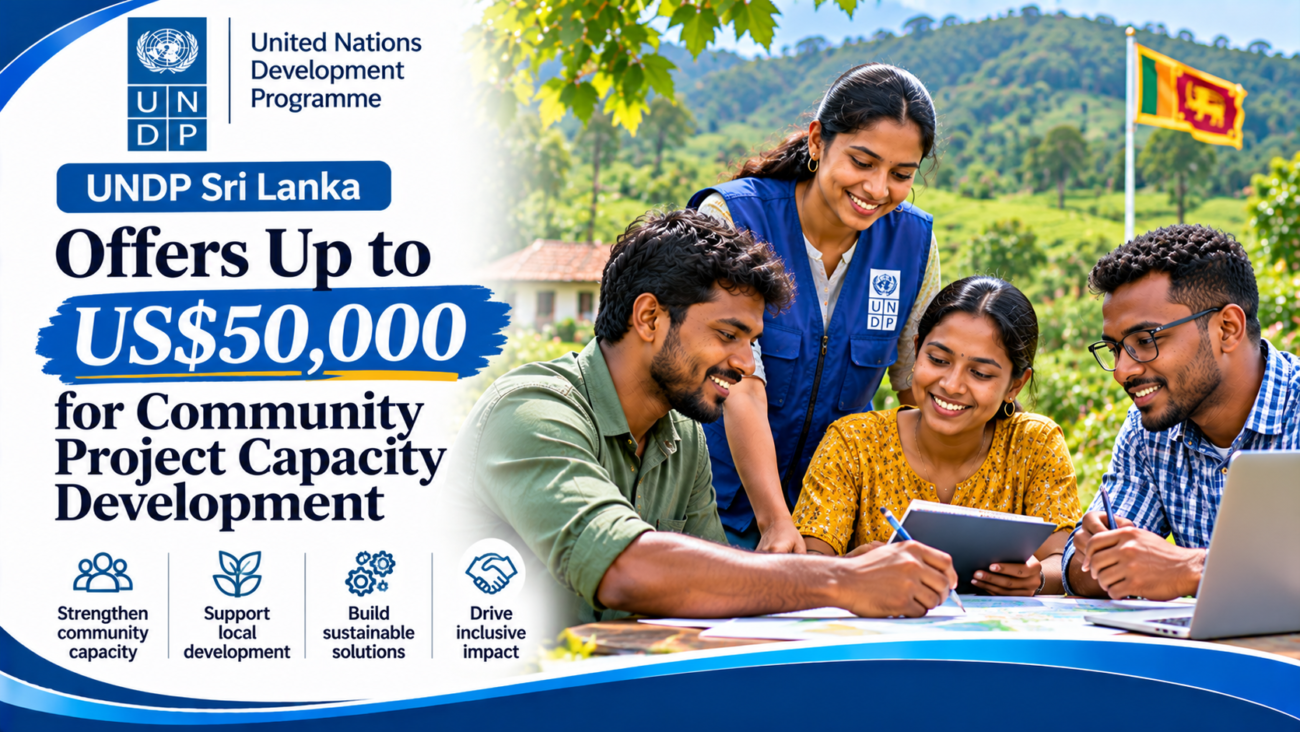
UNDP Sri Lanka offers up to US$50,000 for community project capacity development
UNDP Sri Lanka offers up to US$50,000 for community project capacity development. The United Nations Development Programme (UNDP) in Sri Lanka, through the Global Environment Facility (GEF) Small Grants Programme, is inviting proposals for a grant of up to US$50,000 to strengthen the capacity of community-based environmental projects.
The funding opportunity is part of the GEF Small Grants Programme’s Eighth Operational Phase (OP8). It aims to support approximately 20–25 community projects in Sri Lanka’s Badulla, Monaragala and Ampara districts through capacity development, technical assistance, knowledge management, partnerships and policy engagement.
One organisation will be selected to deliver the assignment across the three districts for approximately 30 months.
The deadline for submitting proposals is 19 November 2026 at 11:59 p.m. Sri Lanka time.
This is an organisational grant rather than an individual scholarship or a grant of US$50,000 for each community project. Organisations interested in applying should review the official UNDP terms of reference, guidance note and application template.
UNDP Sri Lanka community project grant 2026: Overview
| Grant detail | Information |
|---|---|
| Grant provider | United Nations Development Programme (UNDP) |
| Programme | GEF Small Grants Programme |
| Operational phase | Eighth Operational Phase (OP8) |
| Grant opportunity | Capacity Development and Knowledge Management Grant |
| Maximum funding | US$50,000 |
| Number of awardees | One organisation |
| Target projects | Approximately 20–25 community grantee projects |
| Eligible applicants | Registered nonprofit, NGO, civil society and academic organisations |
| Geographic focus | Badulla, Monaragala and Ampara districts, Sri Lanka |
| Assignment duration | Approximately 30 months |
| Proposal deadline | 19 November 2026 |
| Submission time | 11:59 p.m. Sri Lanka time |
1. About the UNDP GEF Small Grants Programme
UNDP Sri Lanka offers up to US$50,000 for community project capacity development
The Global Environment Facility Small Grants Programme (GEF SGP) is an initiative that supports community-led projects addressing environmental challenges while contributing to sustainable livelihoods and community wellbeing.
The programme is implemented by UNDP and funded by the Global Environment Facility.
It works with civil society organisations, community-based organisations and other eligible groups to support local initiatives that contribute to global environmental benefits.
The programme recognises that communities play an important role in protecting natural resources, conserving biodiversity and responding to environmental challenges.
Its approach is based on supporting local organisations with financial resources, technical expertise and capacity development so they can implement sustainable projects.
In Sri Lanka, the Eighth Operational Phase focuses on three districts:
- Badulla
- Monaragala
- Ampara
The programme supports integrated landscape approaches that connect community-level environmental activities with wider environmental and development priorities.
2. What is the US$50,000 grant about?
UNDP Sri Lanka offers up to US$50,000 for community project capacity development
The Capacity Development and Knowledge Management Grant is designed to strengthen the organisations implementing community environmental projects under the GEF Small Grants Programme.
UNDP is seeking one qualified organisation to provide coordinated capacity development and knowledge management support to approximately 20–25 regular community grantee projects.
The selected organisation will work across Badulla, Monaragala and Ampara districts.
The assignment is expected to last approximately two and a half years, equivalent to 30 months.
Rather than funding a single environmental activity, the grant supports an organisation that will help multiple community projects improve their planning, implementation, monitoring, reporting and long-term sustainability.
The selected organisation will also help document lessons, encourage collaboration and strengthen the ability of community groups to contribute to environmental policy discussions.
3. How much funding is available?
The maximum grant amount is:
US$50,000
UNDP expects to select one organisation to undertake the assignment across the three operational districts.
This means the US$50,000 is the maximum funding for the selected organisation’s overall assignment. It is not US$50,000 for each of the 20–25 community projects.
The selected organisation will be responsible for managing the approved budget and delivering the activities and outputs specified in the grant agreement.
Applicants should prepare a realistic budget that reflects the work required across the three districts and the approximately 30-month implementation period.
4. Who can apply?
The official UNDP call invites proposals from eligible registered organisations with the capacity to deliver the required activities.
Eligible organisation categories include:
- Registered nonprofit organisations
- Non-governmental organisations (NGOs)
- Civil society organisations (CSOs)
- Academic institutions
Applicants should demonstrate that they have the organisational capacity and relevant experience to support community-based environmental projects.
The selected organisation must be able to work with multiple community grantees and coordinate activities across the three target districts.
Organisational capacity
Applicants should be prepared to demonstrate their ability to:
- Manage projects and grant-related activities
- Provide technical assistance and capacity development
- Work with community-based organisations
- Coordinate activities across different locations
- Support monitoring and evaluation
- Manage project information and documentation
- Develop knowledge products and reports
- Facilitate partnerships and stakeholder engagement
The full terms of reference and application documents should be consulted for the precise eligibility and assessment requirements.
Is this open to individuals?
No. This is an organisational funding opportunity.
Individual applicants cannot apply for the grant in a personal capacity. The proposal must be submitted by an eligible registered organisation.
5. Geographic focus: Which districts are covered?
The assignment focuses on three districts in Sri Lanka.
Badulla
The selected organisation will support community projects operating in Badulla and help strengthen their organisational and technical capacity.
Monaragala
The organisation will work with community grantees in Monaragala, supporting project implementation, monitoring and knowledge-sharing activities.
Ampara
The organisation will also provide capacity development and technical support to community projects in Ampara.
The selected grantee is expected to cover the entire operational landscape rather than concentrate only on one district.
Can organisations in Zimbabwe apply?
This particular assignment is designed for community projects operating in Badulla, Monaragala and Ampara, Sri Lanka.
It is not a general international grant for organisations to implement projects in Zimbabwe or other countries.
Organisations based outside Sri Lanka should carefully examine the full call and confirm whether they meet the requirements before preparing a proposal. The project activities and geographic coverage are specifically tied to the Sri Lankan programme.
6. What activities will the selected organisation undertake?
The assignment is organised around four major areas of work.
A. Capacity assessment and project design support
UNDP Sri Lanka offers up to US$50,000 for community project capacity development
The selected organisation will assess the institutional, technical and operational capacity of participating community grantees.
This will help identify areas where organisations need additional support.
Activities may include:
- Reviewing existing project documents
- Assessing organisational capacity
- Identifying project implementation challenges
- Developing capacity development plans
- Supporting project design and implementation
- Improving organisational governance
- Strengthening financial management practices
- Providing training and mentoring
- Supporting environmental and social risk management
- Improving community engagement
The organisation will be expected to provide practical support tailored to the needs of individual community grantees.
B. Results-based management, monitoring and knowledge generation
The selected organisation will help participating projects improve their monitoring and reporting systems.
This is important because community environmental projects need reliable information to demonstrate their achievements and identify implementation challenges.
Activities may include:
- Reviewing project results frameworks
- Strengthening monitoring systems
- Supporting indicator development
- Improving data collection
- Supporting project reporting
- Developing monitoring tools
- Establishing a project information database
- Verifying project information
- Preparing analytical reports
- Developing dashboards and visual communication materials
The organisation will also support the collection and analysis of project information for programme-level monitoring.
C. Knowledge exchange, documentation and partnerships
Another major responsibility is to strengthen knowledge-sharing among participating community organisations.
The selected organisation will help communities learn from one another and document successful approaches.
Activities may include:
- Organising peer-learning workshops
- Facilitating knowledge-sharing sessions
- Supporting field visits and practical demonstrations
- Developing partnerships
- Organising at least one knowledge fair
- Producing 12–15 case studies
- Producing 12–15 photo stories
- Establishing a knowledge repository
- Documenting community experiences
- Supporting collaboration across the three districts
The case studies and photo stories will help capture the challenges, approaches, results and lessons emerging from community projects.
D. Policy engagement and advocacy
The fourth area focuses on helping community organisations engage more effectively with policy processes.
The selected organisation will help grantees understand how their project experiences and environmental results can contribute to wider discussions and decision-making.
Activities may include:
- Identifying policy and institutional challenges
- Strengthening evidence-based advocacy
- Supporting policy analysis
- Preparing policy recommendations
- Facilitating stakeholder dialogue
- Organising a national-level policy forum
- Documenting community experiences
- Promoting constructive engagement with relevant institutions
The aim is to strengthen the ability of community organisations to communicate their experiences and contribute to environmental decision-making.
7. Which environmental issues does the programme support?
The GEF Small Grants Programme’s Eighth Operational Phase focuses primarily on two environmental priorities.
Sustainable land management
Sustainable land management aims to address land degradation and promote the responsible use and conservation of land resources.
Community projects may work on improving land management practices, restoring degraded areas and supporting sustainable livelihoods.
Biodiversity conservation
Biodiversity conservation is another central priority.
Projects may contribute to protecting ecosystems, conserving natural resources and supporting community-based conservation initiatives.
Cross-cutting themes
UNDP Sri Lanka offers up to US$50,000 for community project capacity development
Depending on individual project needs, activities may also address:
- Climate change
- Sustainable agriculture
- Food systems
- Sustainable natural resource management
- Nature-based solutions
- Sustainable livelihoods
- Social inclusion
- Gender equality
The selected organisation will help participating community grantees strengthen their ability to plan and implement activities that contribute to these environmental priorities.
8. What deliverables are expected?
The selected organisation will be responsible for producing a range of outputs throughout the assignment.
These may include:
| Work area | Expected outputs |
|---|---|
| Capacity assessment | Portfolio profile and capacity assessment framework |
| Organisational development | Capacity baselines and development plans |
| Training | Training materials, mentoring records and follow-up documentation |
| Monitoring | Improved monitoring tools and reporting arrangements |
| Knowledge management | Centralised project information database or repository |
| Data analysis | Portfolio-level results summaries and analytical reports |
| Knowledge sharing | Peer-learning activities and at least one knowledge fair |
| Documentation | 12–15 case studies and 12–15 photo stories |
| Partnerships | Stakeholder mapping and partnership records |
| Policy engagement | Evidence summaries, recommendations and policy dialogue activities |
The full guidance note provides more detail on the expected activities and implementation approach.
9. How long will the assignment last?
The assignment is expected to last approximately 30 months from commencement.
During this period, the selected organisation will work with the UNDP Sri Lanka GEF Small Grants Programme Secretariat and participating community grantees.
The implementation approach is divided into three broad phases.
Phase 1: Inception and capacity assessment
The selected organisation will review project documentation, assess the capacities of participating grantees and identify their individual and shared needs.
The findings will be used to develop an implementation plan and capacity development strategy.
Phase 2: Capacity development and technical support
The organisation will deliver training, mentoring, technical assistance and other support activities.
The support will be tailored to the needs of participating community projects.
Phase 3: Consolidation, learning and sustainability
The final phase will focus on reviewing progress, documenting lessons, strengthening partnerships and ensuring that the systems developed can continue to support community projects.
10. How to apply for the UNDP Sri Lanka grant
Interested organisations should download the official call for proposals and review the accompanying documents before preparing their submissions.
Follow these steps.
Step 1: Visit the official UNDP programme page
UNDP Sri Lanka offers up to US$50,000 for community project capacity development
Find the section titled Proposals for the Capacity Development and Knowledge Management Grant.
Step 2: Download the call for proposals
Download and read the official advertisement.
It provides the key grant details, eligibility categories, geographical coverage, funding ceiling and submission deadline.
Step 3: Download the guidance note and terms of reference
Review the guidance note carefully to understand the assignment’s four main work areas and the expected outputs.
The organisation should assess whether it has the technical and operational capacity to deliver the required work across all three districts.
Step 4: Download the application form
Use the official application template provided on the UNDP programme page.
Prepare the proposal in the required format and provide the information requested.
Step 5: Prepare the technical proposal
The proposal should demonstrate how the organisation intends to carry out the assignment.
Applicants should explain their proposed approach to capacity assessment, technical assistance, monitoring, knowledge management, partnerships and policy engagement.
Step 6: Prepare the budget
Develop a detailed budget that remains within the maximum funding ceiling of US$50,000.
The budget should be consistent with the proposed activities and the approximately 30-month assignment.
Step 7: Submit the proposal by email
Applicants should follow the official instructions for naming and attaching their documents.
Step 8: Submit before the deadline
The final submission deadline is:
19 November 2026 at 11:59 p.m. Sri Lanka time.
Proposals received after the deadline will not be considered.
11. Application deadline and important dates
| Activity | Date |
|---|---|
| Call for proposals published | October 2026 |
| Informational webinar | 10 November 2026 |
| Proposal submission deadline | 19 November 2026 |
| Deadline time | 11:59 p.m. Sri Lanka time |
| Assignment duration | Approximately 30 months |
Informational webinar
UNDP announced an informational webinar for interested applicants.
- Date: 10 November 2026
- Time: 11:00 a.m.–12:00 p.m. Sri Lanka time
- Meeting ID: 817 0344 9203
Applicants who missed the webinar should use the official guidance note and terms of reference to understand the requirements.
12. Contact information
For questions about the grant, organisations can contact the UNDP Sri Lanka GEF Small Grants Programme Secretariat.
Telephone: 011 2580692, extensions 1421 or 1422
Additional contact: 071 2854510
Applicants should direct questions about eligibility, proposal preparation and submission requirements to the official programme team.
13. Tips for preparing a competitive proposal
UNDP Sri Lanka offers up to US$50,000 for community project capacity development
Demonstrate relevant organisational experience
Explain your organisation’s experience in community development, environmental projects, capacity building or related work.
Provide specific examples of previous assignments where possible.
Show the ability to work across all three districts
The selected organisation must cover Badulla, Monaragala and Ampara.
Demonstrate how your organisation will coordinate activities and provide support across the entire operational landscape.
Present a practical capacity development approach
Explain how you will assess the needs of participating organisations and tailor support to their individual circumstances.
Avoid proposing generic training sessions without showing how they will address actual capacity gaps.
Demonstrate monitoring and knowledge management expertise
The assignment requires strong skills in data management, monitoring, reporting and documentation.
Explain how your organisation will help community grantees collect reliable information and demonstrate project results.
Include a clear work plan
The proposed work plan should cover the full assignment period and identify key activities, deliverables and implementation milestones.
Prepare a realistic budget
Ensure that the budget reflects the resources needed to deliver the assignment across three districts over approximately 30 months.
Demonstrate partnership and facilitation skills
The selected organisation will work with community groups, government institutions, academic organisations and other stakeholders.
Show how your organisation will build productive relationships and facilitate collaboration.
14. Frequently asked questions
How much funding does UNDP offer?
The maximum grant amount is US$50,000.
How many organisations will receive the grant?
One organisation will be selected to deliver the assignment across Badulla, Monaragala and Ampara.
How many community projects will benefit?
The selected organisation will support approximately 20–25 regular community grantee projects.
Who can apply?
Registered nonprofit organisations, NGOs, civil society organisations and academic institutions that meet the requirements of the official call.
Can an individual apply?
No. This is an organisational grant, not an individual funding opportunity.
Can Zimbabwean organisations apply?
The assignment is specifically designed to support community projects in three Sri Lankan districts. It is not a general international grant for projects in Zimbabwe. Organisations outside Sri Lanka should confirm their eligibility directly with UNDP before applying.
What is the duration of the grant?
The assignment is expected to last approximately 30 months.
What activities will the selected organisation undertake?
The work covers capacity development, project design and implementation support, monitoring and knowledge generation, knowledge exchange and policy engagement.
What is the application deadline?
19 November 2026 at 11:59 p.m. Sri Lanka time.
Where should applications be submitted?
UNDP Sri Lanka offers up to US$50,000 for community project capacity development
Is this funding for individual community projects?
No. The US$50,000 is the maximum grant for one selected organisation responsible for providing capacity development and knowledge management support to the wider portfolio of community projects.
Final thoughts
UNDP Sri Lanka offers up to US$50,000 for community project capacity development
UNDP Sri Lanka offers up to US$50,000 for community project capacity development. The UNDP Sri Lanka Capacity Development and Knowledge Management Grant offers an opportunity for one qualified organisation to receive up to US$50,000 to strengthen community-based environmental projects.
Through the GEF Small Grants Programme, the selected organisation will support approximately 20–25 community projects in Badulla, Monaragala and Ampara over an assignment lasting around 30 months.
The work will focus on strengthening organisational capacity, improving project monitoring, documenting environmental results, building partnerships and promoting evidence-based policy engagement.
Eligible organisations should review the official call, prepare their technical proposals and budgets, and submit their applications before 19 November 2026 at 11:59 p.m. Sri Lanka time.
Join the Vacancy Bridge WhatsApp Channel
Follow Vacancy Bridge on WhatsApp for the latest jobs, scholarships, internships and fellowships.
https://whatsapp.com/channel/0029Vakee9aHFxOyCIBPJA0o
APPLY NOW ON THIS OFFICIAL PAGE
SEO keywords
UNDP Sri Lanka grants 2026, UNDP community project grant, US$50,000 UNDP grant, GEF Small Grants Programme Sri Lanka, capacity development grant 2026, community environmental projects, knowledge management grant, UNDP NGO funding, Sri Lanka NGO grants, civil society organisation grants, environmental project funding, biodiversity conservation grants, sustainable land management, Badulla community grants, Monaragala grants, Ampara environmental projects, UNDP funding opportunities.
