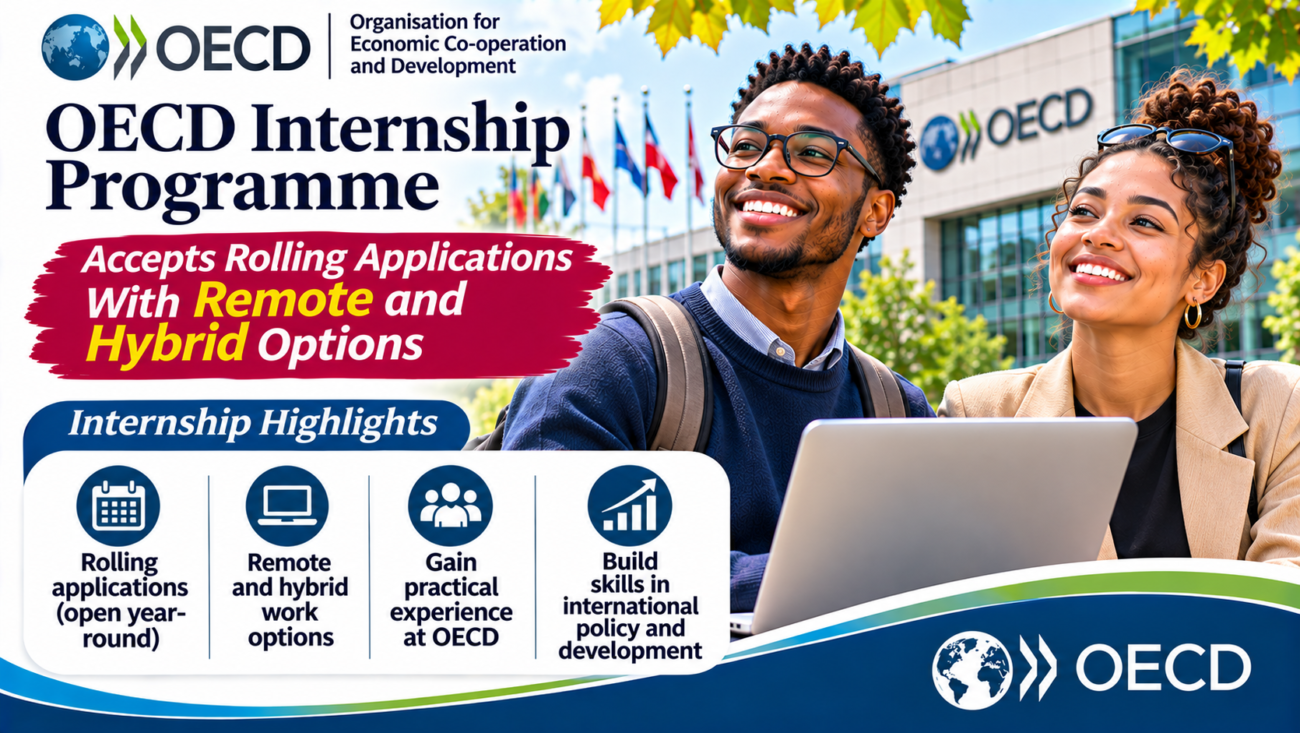
OECD Internship Programme 2027: Rolling Applications With Remote, Hybrid and In-Person Opportunities
OECD Internship Programme 2027: Rolling Applications With Remote, Hybrid and In-Person Opportunities. The Organisation for Economic Co-operation and Development (OECD) offers international internship opportunities for university students interested in gaining practical experience in public policy, economics, international development, education, climate change, digital transformation and other areas of global importance.
Through its Internship Programme, the OECD welcomes motivated students from diverse academic backgrounds to work alongside policy analysts, economists, researchers and other specialists. Interns contribute to research, policy analysis, data collection, publications, meetings and organisational activities.
One of the programme’s attractive features is its flexible working arrangements. Depending on the requirements of the hiring team, internships may be conducted in person, in a hybrid format or fully remotely.
The programme accepts applications on a rolling basis throughout the year. Internships normally last between one and six months, with the possibility of renewal up to a total of 12 months.
Interns based in Paris receive a contribution towards living expenses of €1,000 per full month worked. This is a living allowance rather than a salary, and the published amount applies to Paris-based interns.
The opportunity is particularly relevant to students studying economics, international relations, law, statistics, development studies, public administration, environmental sciences, computer science, communications and other disciplines connected to the OECD’s work.
Application deadline: Rolling recruitment. Applicants can submit applications throughout the year, although individual vacancy announcements and recruitment arrangements may have their own closing dates.
1. OECD Internship Programme: Quick overview
| Opportunity detail | Information |
|---|---|
| Programme | OECD Internship Programme |
| Host organisation | Organisation for Economic Co-operation and Development |
| Main location | Paris, France |
| Other locations | OECD-affiliated bodies and other eligible placements |
| Opportunity type | International internship |
| Academic level | Bachelor’s, master’s and PhD students |
| Eligible disciplines | Multiple academic and professional fields |
| Duration | 1–6 months |
| Possible extension | Up to 12 months in total |
| Working hours | 40 hours per week; exceptional part-time arrangements may be possible |
| Working arrangements | In person, hybrid or fully remote, depending on team requirements |
| Paris living allowance | €1,000 per full month worked |
| Application deadline | Rolling applications |
| Application method | Online |
| Nationality | Primarily OECD member-country nationals; non-member nationals considered for specific programmes and projects |
2. About the OECD
OECD Internship Programme 2027: Rolling Applications With Remote, Hybrid and In-Person Opportunities
The Organisation for Economic Co-operation and Development is an international organisation that works with governments and policymakers to develop policies aimed at improving economic and social well-being.
The OECD provides a platform for governments to exchange information, compare policy approaches, develop international standards and address economic, social and environmental challenges.
Its work covers a wide range of global issues, including:
- Economic growth and development.
- International trade and investment.
- Education and skills development.
- Employment and labour markets.
- Climate change and environmental protection.
- Digital transformation and artificial intelligence.
- Public governance and institutional reform.
- Taxation and international finance.
- Gender equality and social inclusion.
- Health systems and public policy.
- Science, technology and innovation.
The organisation conducts research, collects and analyses data, publishes reports and provides policy recommendations to governments.
Its Internship Programme gives university students an opportunity to contribute to this work while developing their analytical, technical and professional skills.
3. What does the OECD Internship Programme offer?
€1,000 monthly living allowance for Paris-based interns
The OECD provides interns located in Paris with a contribution towards living expenses of €1,000 per full month worked.
This financial support is intended to help interns meet some of their living costs during their placement.
It is important to understand that this payment is a living allowance, not a salary.
The €1,000 monthly contribution applies to Paris-based interns. Applicants considering remote placements or other locations should not assume that the same allowance automatically applies.
Students should also budget for accommodation, food, transport and other personal expenses because the allowance may not cover all the costs of living in Paris.
Flexible working arrangements
The OECD allows its Directorates to organise internships according to operational requirements.
Depending on the hiring team’s needs, selected interns may work:
- In person: Working at the OECD’s offices, primarily in Paris.
- Hybrid: Combining office attendance with approved remote working.
- Fully remotely: Working remotely where the host team agrees to this arrangement.
The availability of each arrangement is determined by the hiring team and must be agreed with the manager.
Remote work is subject to OECD information-security and geographical access requirements. It should not be interpreted as permission to work from any country without prior approval.
International professional experience
Interns work alongside policy experts, economists, researchers, administrative professionals and other specialists.
This provides exposure to an international organisation and an opportunity to understand how policy research and international cooperation work in practice.
Development of analytical and technical skills
The programme is intended to help interns strengthen their analytical, research, drafting, communication and technical abilities.
Depending on the placement, interns may work with data, prepare research documents, analyse policy issues or support organisational projects.
International networking
Interns interact with professionals and colleagues from different countries and academic backgrounds.
This experience can help participants develop professional relationships and gain a better understanding of international policy work.
Annual leave
Interns are entitled to 2.5 working days of annual leave for each full month worked. French public holidays are also observed for applicable placements.
4. What will OECD interns do?
The responsibilities of interns depend on their academic background, the Directorate or department hosting them and the projects assigned.
Successful candidates may support policy analysts, researchers and corporate teams.
Typical responsibilities include:
Research and policy analysis
Interns may participate in preparing studies, policy documents and research reports.
They may also review existing materials, examine policy developments and help identify relevant information for ongoing projects.
Data collection and analysis
Some placements involve collecting, organising and analysing data.
Students with backgrounds in economics, statistics, mathematics, computer science and related fields may find opportunities to apply their quantitative and technical skills.
Preparing publications and reports
Interns may contribute to working papers, policy publications, technical annexes, research notes and other documents.
Good drafting and communication skills are therefore important.
Meetings and seminars
Interns may participate in meetings, seminars, workshops and other professional activities.
These activities provide exposure to the OECD’s work and its engagement with policymakers, researchers and other international stakeholders.
Communication and organisational support
Some placements focus on corporate functions rather than policy research.
Depending on the assignment, interns may support communications, event planning, finance, human resources, information technology, legal services or administrative activities.
5. Areas of internship opportunities
OECD Internship Programme 2027: Rolling Applications With Remote, Hybrid and In-Person Opportunities
The OECD works across numerous policy and administrative areas. Applicants should identify the fields that best match their academic qualifications and interests.
Economic policy and development
Potential areas include:
- Economics.
- Development.
- Development effectiveness.
- International investment.
- Finance.
- Trade and agriculture.
- Employment.
- Inclusive growth.
- Regional development.
- Public finance.
Environment and climate change
Relevant areas include:
- Climate policy.
- Environmental protection.
- Energy.
- Agriculture and fisheries.
- Sustainable development.
- Transport.
- Environmental economics.
Education and social policy
Potential fields include:
- Education and skills.
- Health.
- Gender and diversity.
- International migration.
- Social policy.
- Employment and labour markets.
Digitalisation, science and technology
Opportunities may relate to:
- Artificial intelligence.
- Digital transformation.
- Science and technology.
- Innovation.
- Competition policy.
- Corporate governance.
- Information technology.
Governance and international cooperation
Other areas include:
- Public governance.
- Bribery and corruption.
- Regulatory reform.
- International relations.
- Legal services.
- Monitoring and evaluation.
- Global relations.
Corporate and administrative functions
The OECD also recruits interns for organisational support functions, including:
- Communications, media and public relations.
- Event management.
- Finance, budget and accounting.
- Human resources.
- Information technology.
- Legal services.
- Office administration.
- Translation.
The availability of placements in these areas depends on the needs of individual teams.
6. Who can apply for the OECD Internship Programme?
The programme is intended for motivated students who are enrolled in accredited degree programmes and whose academic background is relevant to the work of the OECD.
Applicants must satisfy the following requirements.
Full-time university enrolment
Applicants must be enrolled in a full-time degree programme at an accredited university throughout the entire internship.
Eligible academic levels include:
- Bachelor’s degree programmes.
- Master’s degree programmes.
- PhD programmes.
Students must remain enrolled for the complete duration of the placement.
Applicants who expect to graduate during the proposed internship period may not meet this requirement if they will no longer be enrolled.
Relevant academic discipline
Applicants should be studying a subject connected to the OECD’s policy or corporate activities.
The programme accepts students from a wide range of disciplines, provided their academic background is relevant to the work of the hiring team.
Minimum availability
Candidates must be available for at least one month.
Internships normally last between one and six months, with possible renewal up to a total of 12 months.
The OECD encourages applicants to consider placements of at least four months to gain the greatest benefit from the experience.
Language requirements
Applicants must have an excellent command of at least one of the OECD’s two official languages:
- English.
- French.
They should also have working knowledge of the other language or be willing to learn it.
Knowledge of additional languages may be an advantage.
Analytical and computer skills
Applicants should have good quantitative and information technology skills.
The level of technical knowledge required will depend on the internship.
For example, a statistics or economics placement may require stronger quantitative skills, while a communications internship may place greater emphasis on writing and digital communication.
Communication and teamwork
Candidates should demonstrate:
- Good drafting and communication skills.
- Strong analytical abilities.
- Ability to conduct research independently.
- Good organisational skills.
- Ability to prioritise tasks.
- Ability to work in multicultural teams.
- Adaptability to changing working methods and technologies.
7. Can applicants from Zimbabwe and other non-member countries apply?
This is an important eligibility consideration.
The OECD states that internships are primarily allocated to nationals of OECD member countries.
However, applicants who are not nationals of member countries may also be considered for specific programmes and projects.
These opportunities can include placements across certain OECD-affiliated bodies and agencies, such as:
- International Energy Agency (IEA).
- Nuclear Energy Agency (NEA).
- Financial Action Task Force (FATF).
- International Transport Forum (ITF).
Zimbabwe is not an OECD member country.
Therefore, Zimbabwean students should not assume that every general OECD Internship Programme placement is open to them.
They may consider applying where a specific programme or project accepts non-member-country nationals, but they should verify nationality eligibility for the particular opportunity before submitting an application.
Applicants from other non-member countries should follow the same approach.
Important: Meeting the academic requirements does not automatically overcome nationality restrictions. The eligibility of non-member-country applicants depends on the relevant programme, project and hiring arrangements.
8. Can OECD internships be done remotely from Zimbabwe?
OECD Internship Programme 2027: Rolling Applications With Remote, Hybrid and In-Person Opportunities
The OECD offers remote and hybrid working arrangements in certain cases. However, there are important geographical restrictions.
According to the OECD Intern Handbook, access to the OECD network for teleworking is restricted to:
- OECD member countries; and
- Countries with which the OECD has a Privileges and Immunities agreement.
Interns must inform their supervisor and Resource Management Adviser about the location from which they intend to telework. Remote working arrangements require the relevant approval.
This means that the phrase “fully remote” should not be interpreted as allowing every selected intern to work from any country.
For Zimbabwean applicants, the geographical restrictions are particularly important. Zimbabwe is not an OECD member country, and applicants should obtain written confirmation from the OECD about whether a proposed remote working location is permitted before relying on a remote placement.
The availability of remote work also does not remove the programme’s nationality and academic eligibility conditions.
9. Internship duration and working hours
The OECD Internship Programme offers placements with flexible durations.
| Arrangement | Details |
|---|---|
| Minimum duration | 1 month |
| Standard maximum initial duration | 6 months |
| Possible renewal | Up to 12 months in total |
| Standard working hours | 40 hours per week |
| Exceptional part-time arrangement | Minimum 20 hours per week |
| Preferred duration | At least 4 months |
| Recruitment | Rolling basis |
The OECD normally organises internships on a full-time basis.
Part-time placements may be arranged in exceptional circumstances, subject to approval.
The final duration and working arrangements depend on the hiring team’s requirements and the selected candidate’s availability.
10. How much does the OECD pay interns?
The OECD provides a contribution towards living expenses for interns based in Paris.
The published amount is:
€1,000 per full month worked.
For illustration, the allowance would amount to:
| Internship duration | Illustrative living allowance |
|---|---|
| 1 full month | €1,000 |
| 2 full months | €2,000 |
| 3 full months | €3,000 |
| 4 full months | €4,000 |
| 5 full months | €5,000 |
| 6 full months | €6,000 |
These figures assume full months worked in Paris and are illustrative calculations, not guaranteed payments for every internship arrangement.
The OECD describes this payment as a contribution to living expenses rather than a salary.
Funding clarification: The €1,000 contribution is specifically published for Paris-based interns. The programme page does not establish that the same amount is paid to interns working remotely or at every affiliated body. Applicants should confirm the financial arrangements in their individual offer.
11. How to apply for the OECD Internship Programme
OECD Internship Programme 2027: Rolling Applications With Remote, Hybrid and In-Person Opportunities
Applications are submitted online through the OECD recruitment platform.
The programme uses a rolling recruitment process, so candidates can apply throughout the year.
Follow these steps.
Step 1: Visit the official OECD Internship page
Start by reading the programme requirements and application instructions.
Review the academic, nationality, language and working-arrangement requirements.
Step 2: Identify your preferred areas of interest
Consider the OECD’s policy and corporate activities.
Choose areas that match your academic background, skills and professional interests.
Applicants should be prepared to explain why they are interested in the selected areas.
Step 3: Prepare your CV
Prepare an updated CV highlighting:
- Academic qualifications.
- University and current degree programme.
- Relevant coursework.
- Research experience.
- Professional or volunteer experience.
- Quantitative and computer skills.
- Language abilities.
- Publications or academic projects, where relevant.
Your CV should clearly demonstrate how your background relates to the OECD’s work.
Step 4: Prepare your cover letter
The OECD requires applicants to provide a cover letter through the Message to Hiring Manager section of the online application.
Your cover letter should explain:
- Why you want to intern at the OECD.
- Your preferred policy or corporate areas.
- How your academic background relates to those areas.
- Relevant research, technical or professional experience.
- What you hope to contribute.
- Your earliest availability and preferred internship duration.
Avoid using a generic cover letter that does not explain your interest in the organisation’s work.
Step 5: Submit the online application
Complete the application through the OECD’s official recruitment platform.
Provide accurate personal, academic and professional information.
Indicate your availability clearly and submit the required supporting information.
Step 6: Wait for the pre-screening process
The OECD Internship Office reviews applications and identifies suitable candidates.
Shortlisted applications are made available to the relevant Directorates for consideration.
Step 7: Attend an interview or written assessment
Hiring teams may invite shortlisted applicants to an interview and/or written test.
The assessment may examine the candidate’s academic background, technical knowledge, communication skills and suitability for the particular placement.
Step 8: Receive an offer and sign the internship agreement
Successful candidates receive an internship offer and are asked to sign an internship agreement.
The final arrangement will specify the placement, duration, working conditions and applicable financial support.
12. Application deadline and recruitment timeline
The OECD accepts applications on a rolling basis throughout the year.
There is no single annual closing date for the general programme.
However, individual vacancy announcements may have specific closing dates. Applicants should always check the deadline displayed on the relevant recruitment listing.
The OECD advises candidates to apply well in advance because the selection process can take up to three months.
| Recruitment stage | What happens |
|---|---|
| Online application | Candidate submits application and cover letter |
| Pre-screening | Internship Office reviews applications |
| Directorate review | Suitable candidates are shared with hiring teams |
| Interview or written test | Hiring teams assess shortlisted applicants |
| Offer | Successful candidates receive an internship offer |
| Agreement | Candidate signs the internship agreement |
If an applicant is not contacted within six months of submitting an application, the OECD indicates that the application has not been retained on that occasion. Applicants may then apply again.
Candidates should provide accurate availability information and update it if their circumstances change.
13. How to improve your chances of selection
OECD Internship Programme 2027: Rolling Applications With Remote, Hybrid and In-Person Opportunities
The OECD receives applications from students with diverse academic and professional backgrounds.
Applicants should therefore make their applications relevant to the specific areas they select.
Demonstrate knowledge of the OECD
Read recent OECD reports, policy papers and publications related to your preferred fields.
This can help you explain why the organisation’s work interests you.
Highlight analytical skills
Provide examples of research, data analysis, academic projects or other work that demonstrates your ability to examine complex issues.
Tailor your cover letter
Explain how your studies and experience relate to the policy areas you select.
For example, an economics student interested in development policy should explain their relevant coursework, research interests and understanding of economic development challenges.
Show strong writing skills
The OECD produces reports, policy documents and research publications.
Clear, well-organised writing can strengthen an application, particularly for research and policy placements.
Explain your availability
State when you can start and how long you are available.
Since recruitment is rolling, clear availability information can help hiring teams assess whether your schedule matches their needs.
Demonstrate international awareness
The OECD works on policy issues that affect countries and communities around the world.
Applicants should demonstrate an interest in international cooperation and the ability to work in multicultural teams.
14. Frequently asked questions
Is the OECD Internship Programme open throughout the year?
Yes. The OECD recruits interns on a rolling basis and accepts applications throughout the year. Individual vacancy listings may nevertheless have specific closing dates.
Does the OECD offer remote internships?
Yes. Depending on the requirements of the hiring team, internships may be in person, hybrid or fully remote. The arrangement must be agreed with the manager and comply with OECD geographical and information-security requirements.
Can I work remotely from Zimbabwe?
Do not assume that you can. The OECD restricts teleworking access to OECD member countries and countries covered by a relevant Privileges and Immunities agreement. Zimbabwean applicants should obtain confirmation from the OECD before relying on a remote arrangement.
How much does the OECD pay interns?
Interns based in Paris receive a contribution towards living expenses of €1,000 per full month worked. This is a living allowance, not a salary.
Is the OECD internship fully funded?
No. The programme provides a living allowance to Paris-based interns, but it should not be described as a fully funded scholarship. Applicants should budget for accommodation, transport, meals and other expenses.
How long does the internship last?
The normal duration is one to six months, with possible renewal up to 12 months in total.
Can bachelor’s students apply?
Yes. Students enrolled in accredited full-time bachelor’s degree programmes may apply, provided they remain enrolled throughout the internship and meet the other requirements.
Can master’s and PhD students apply?
Yes. The programme also accepts eligible students enrolled in full-time master’s and PhD degree programmes.
Can Zimbabwean students apply?
The OECD primarily allocates internships to nationals of member countries. Non-member-country nationals may be considered for specific programmes and projects. Zimbabwean applicants should verify the nationality requirements of the particular opportunity before applying.
Do I need to speak French?
Applicants must have an excellent command of English or French and working knowledge of, or willingness to learn, the other official language.
How long does recruitment take?
OECD Internship Programme 2027: Rolling Applications With Remote, Hybrid and In-Person Opportunities
The selection process can take up to three months. Applicants are encouraged to submit applications well ahead of their preferred start date.
What happens if I am not contacted?
The OECD states that if an applicant is not contacted within six months, the application has not been retained on that occasion. The applicant may apply again.
Final Thoughts
OECD Internship Programme 2027: Rolling Applications With Remote, Hybrid and In-Person Opportunities
OECD Internship Programme 2027: Rolling Applications With Remote, Hybrid and In-Person Opportunities. The OECD Internship Programme offers valuable international exposure for students interested in economics, public policy, international development, climate change, education, digital transformation and other global issues.
Its rolling recruitment system allows eligible students to apply throughout the year. The possibility of in-person, hybrid and fully remote arrangements also gives the programme flexibility, although the final working arrangement depends on the host team and applicable geographical restrictions.
The €1,000 monthly living allowance applies to interns based in Paris and should not be interpreted as a universal payment for every remote or affiliated-body placement.
Students from Zimbabwe and other non-member countries should pay particular attention to nationality restrictions. The OECD primarily recruits nationals of its member countries, while non-member applicants may be considered for specific programmes and projects.
Review the official requirements, prepare a targeted application and submit it well ahead of your intended start date.
Vacancy Bridge shares international jobs, internships, scholarships, fellowships and training opportunities to help readers discover opportunities and access their original application sources. Always verify eligibility, working arrangements and financial support directly with the organisation before applying.
Join the Vacancy Bridge WhatsApp Channel
Follow Vacancy Bridge on WhatsApp for the latest jobs, scholarships, internships and fellowships.
https://whatsapp.com/channel/0029Vakee9aHFxOyCIBPJA0o
APPLY NOW ON THIS OFFICIAL PAGE
SEO keywords
OECD Internship Programme 2027, OECD internships 2027, OECD remote internships, OECD hybrid internships, OECD internship rolling applications, OECD internship €1,000 monthly allowance, paid internships in France, international internships for students, OECD internship for international students, OECD internship eligibility, OECD internship for Zimbabweans, economics internships 2027, international development internships, public policy internships, climate policy internships, international organisation internships, OECD application deadline.
