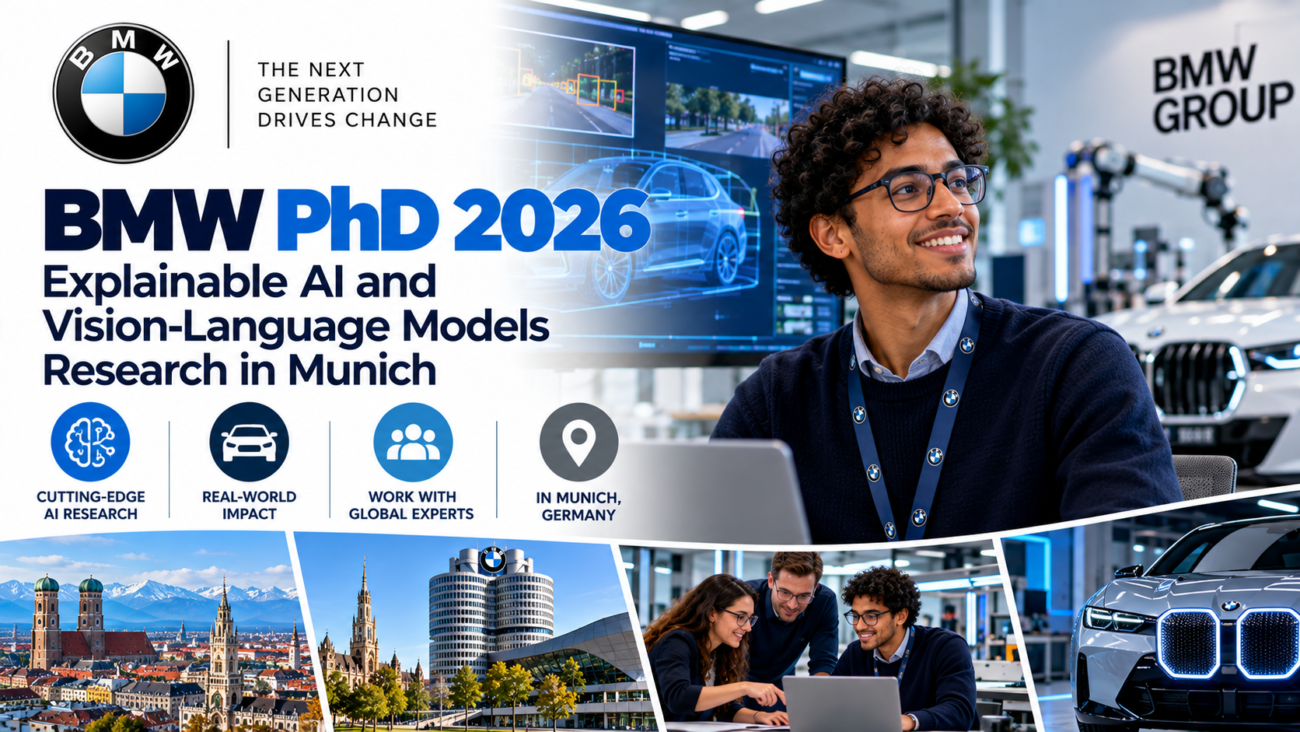
BMW PhD 2026: Explainable AI and Vision-Language Models Research in Munich
BMW PhD 2026: Explainable AI and Vision-Language Models Research in Munich. The BMW Group is offering a PhD research opportunity in Explainable Vision-Language Models (VLMs) for anomaly detection in crashworthiness analyses in Munich, Germany.
The position is part of BMW Group’s ProMotion PhD programme, which allows doctoral researchers to conduct practice-oriented research in collaboration with BMW while developing their doctoral thesis over a three-year period.
For this particular project, the PhD researcher will work on AI-based crash video evaluation using vision-language models, with a focus on developing AI and data-driven methods that can improve the accuracy and efficiency of crashworthiness assessments in automotive safety engineering.
The research combines several advanced areas of artificial intelligence and engineering, including computer vision, multimodal AI, vision-language models, geometric AI, machine learning, data analytics, physics-based simulation and CAx applications such as CAD and CAE.
The vacancy is currently listed by BMW Group in Munich and has a 36-month duration. BMW states that the position is part-time, offers attractive remuneration and includes benefits such as mentoring, professional development, flexible working arrangements and student apartment offers in Munich, subject to availability.
Important accuracy note: This is a specific BMW Group doctoral research position, not a general scholarship programme or a general admission route to a German university. The advertised research topic is specifically focused on Explainable VLMs for anomaly detection in crashworthiness analyses. BMW does not state a fixed application closing date on the vacancy page; the position is currently advertised with a start date of “from now on.” Applicants should therefore check the official vacancy before submitting an application.
🎓 BMW PhD 2026: Quick Overview
| Detail | Information |
|---|---|
| Organisation | BMW Group |
| Programme | ProMotion PhD Programme |
| PhD Topic | Explainable VLMs for Anomaly Detection in Crashworthiness Analyses |
| Field | Artificial Intelligence / Data Science / Automotive Engineering |
| Location | Munich, Germany |
| Department | Data Science |
| Company | BMW AG |
| Job ID | 195225 |
| Posting Date | 22 September 2026 |
| Duration | 36 months |
| Working Hours | Part-time |
| Start Date | From now on |
| Degree Required | Master’s degree |
| Relevant Backgrounds | Engineering, Computer Science, Mathematics or related fields |
| Key AI Areas | Computer vision, multimodal AI, vision-language models |
| Examples of Technologies | Transformers, CLIP-type architectures |
| Languages | Business-fluent English; German is an advantage |
| Research Location | Munich |
| Application Method | Online through BMW Group career portal |
| Application Deadline | No fixed deadline stated on the current vacancy |
| PhD Duration | 3 years |
The vacancy is currently published on BMW Group’s official career platform.
🏢 About BMW Group
BMW Group is a global automotive company whose activities include vehicle development, manufacturing, mobility and technology.
Artificial intelligence and data-driven engineering are increasingly important within the company’s vehicle development activities. BMW has also publicly described work involving AI in crash simulation, including a 2026 collaboration with Mistral AI aimed at improving the quality, accuracy and speed of complex engineering tasks through the use of industrial datasets and AI models.
This makes the advertised PhD topic part of a wider area of research into applying AI to engineering and vehicle development.
The specific PhD position focuses on using vision-language models and other AI approaches to analyse crash-related information and improve crashworthiness assessment.
🔬 What Is the BMW Explainable VLM PhD?
BMW PhD 2026: Explainable AI and Vision-Language Models Research in Munich
The advertised PhD is titled:
“PhD Explainable VLMs for Anomaly Detection in Crashworthiness Analyses (f/m/x)”
The researcher will contribute to AI-based crash video evaluation using vision-language models.
The goal is to develop innovative AI models and data-driven methods that can support more accurate and efficient crashworthiness assessments in automotive safety engineering.
This places the project at the intersection of:
- Artificial intelligence
- Computer vision
- Vision-language models
- Multimodal machine learning
- Automotive safety
- Crash simulation
- Data science
- Engineering simulation
- Geometric AI
- CAD/CAE
- Anomaly detection
🤖 Vision-Language Models in the Research
Vision-language models are AI systems designed to work with information from both visual and language modalities.
The BMW vacancy specifically asks applicants to have extensive knowledge of computer vision and multimodal/vision-language models, with examples including transformers and CLIP-type architectures.
In the context of this PhD, these technologies are relevant to the analysis of crash-related visual information.
The research can involve large multimodal datasets containing different forms of information, including:
- Images
- Videos
- Point clouds
- Annotated data
- Engineering information
BMW specifically identifies experience with data preprocessing, annotation workflows and large multimodal datasets as relevant preparation for the position.
🚗 Crashworthiness and Automotive Safety
BMW PhD 2026: Explainable AI and Vision-Language Models Research in Munich
Crashworthiness refers broadly to how a vehicle and its structures behave during a crash and how effectively they can protect occupants.
Crash testing and simulation generate significant amounts of engineering data.
The advertised PhD aims to use AI-based approaches to help evaluate crash behaviour and identify anomalies or relevant patterns in crash-related data.
This can potentially support more efficient engineering workflows by helping researchers and engineers analyse complex datasets and simulation results.
BMW’s current vacancy specifically connects the project to crashworthiness analyses and automotive safety engineering.
🧠 What Will the PhD Researcher Do?
According to BMW, the researcher will contribute to several technical areas.
1. Develop AI Models for Vehicle Crash Behaviour
The researcher will support the development of AI models for vehicle crash behaviour using modern geometric AI architectures.
This requires an understanding of machine learning and the representation of complex engineering data.
2. Combine Machine Learning With Physics-Based Simulation
The PhD will involve integrating:
- Machine learning
- Data analytics
- Physics-based simulations
The purpose is to improve prediction accuracy within crash-related engineering applications.
3. Develop Automated Workflows
The researcher will also contribute to automated workflows and optimisation methods for crash simulations.
This means the position combines fundamental research with practical engineering applications.
4. Research CAx Applications
Another part of the work involves AI models for CAx applications in the crash design process.
CAx can include technologies such as:
- CAD — Computer-Aided Design
- CAE — Computer-Aided Engineering
The research therefore extends beyond conventional computer vision into engineering design and simulation.
📊 Research Areas Covered
The position brings together several research disciplines.
Artificial Intelligence
Development and evaluation of AI models for engineering applications.
Computer Vision
Analysis of visual information from crash-related datasets.
Vision-Language Models
Application of multimodal models to crash video evaluation and anomaly detection.
Geometric AI
Use of AI architectures capable of working with structured geometric and engineering information.
Machine Learning
Development of predictive and analytical models.
Data Analytics
Processing and interpretation of large engineering datasets.
Physics-Based Simulation
Combining learned models with simulation-based engineering methods.
Automotive Engineering
Applying these technologies to vehicle crash behaviour and safety.
🎓 Who Can Apply?
BMW states that candidates should have a Master’s degree in Engineering, Computer Science, Mathematics or a related field.
Potentially relevant academic backgrounds therefore include:
- Computer Science
- Artificial Intelligence
- Data Science
- Mathematics
- Mechanical Engineering
- Automotive Engineering
- Electrical Engineering
- Computational Engineering
- Robotics
- Engineering Physics
- Related STEM disciplines
The strongest fit will depend on the candidate’s specific research and technical background.
💻 Required Technical Knowledge
BMW specifically identifies extensive knowledge of computer vision and multimodal/vision-language models as a requirement.
Examples given by BMW include:
- Transformers
- CLIP-type architectures
- Multimodal learning
- Computer vision
Applicants should also understand the underlying concepts rather than simply having used an AI library or model.
🗂️ Data and Dataset Experience
The position involves large multimodal datasets.
BMW therefore asks for experience with:
- Data preprocessing
- Annotation workflows
- Large datasets
- Images
- Videos
- Point clouds
Experience working with complex datasets can be particularly relevant because automotive engineering data can combine multiple forms of information.
📚 Research Experience
A track record of research contributions is an advantage.
BMW specifically identifies publications or conference presentations as examples of research contributions that would be a plus.
Applicants may therefore want to highlight:
- Master’s thesis
- Research projects
- Academic publications
- Conference presentations
- Machine-learning research
- Open-source projects
- Technical reports
- Research prototypes
- Relevant internships
🌍 Language Requirements
BMW states that candidates should have business-fluent English.
German language skills are an advantage but are not listed as a mandatory requirement for this particular vacancy.
This means applicants who do not speak German should not automatically assume that they are ineligible.
However, candidates should carefully review the official vacancy and any subsequent communication from BMW regarding language expectations.
🇩🇪 Location: Munich, Germany
The position is based in Munich, Bavaria, Germany.
BMW identifies the workplace location as Munich and states that student apartment offers are available in Munich subject to availability.
Munich is one of BMW Group’s major locations and is also home to significant research, development and corporate activities.
💶 Remuneration and Benefits
BMW PhD 2026: Explainable AI and Vision-Language Models Research in Munich
BMW does not publish a specific salary amount on the current vacancy page.
Instead, the company describes the remuneration as attractive and fair.
The advertised benefits include:
- Attractive and fair remuneration
- Annual special payments
- Vacation pay
- Christmas bonus
- Comprehensive mentoring
- Onboarding
- Personal development
- Professional development
- Flexible working hours
- Mobile working
- Student apartment offers in Munich, subject to availability
- Additional BMW Group benefits
Applicants should therefore avoid assuming a particular monthly salary unless BMW provides an amount during the recruitment process or in the employment documentation.
🎓 BMW ProMotion PhD Programme
This vacancy forms part of BMW Group’s broader ProMotion PhD programme.
BMW describes ProMotion as a programme that allows doctoral researchers to carry out their scientific research in close collaboration with BMW while gaining practical experience in future-oriented areas of the company.
The programme normally runs for three years.
BMW states that participants receive:
- Attractive remuneration
- A PhD research project
- Doctoral thesis support
- Departmental supervisors
- Mentors
- Research resources
- Training
- A PhD student network
- Practical placements
- Professional development
- Networking opportunities
- Potential career opportunities within BMW
🧑🏫 Academic and BMW Supervision
An important feature of BMW’s ProMotion programme is the combination of academic and company-based supervision.
BMW states that the university and professor are selected to match the advertised doctoral topic.
The researcher also receives support from a BMW departmental supervisor who has completed a PhD.
This creates a research environment involving both:
University supervision
and
BMW industry supervision.
The arrangement is designed to allow the researcher to focus on the scientific project while benefiting from practical research resources within BMW.
🏭 Practical Experience
The ProMotion programme also includes practical placements.
BMW states that participants can undertake:
- A one-week production placement
- A three-week orientation placement in another department
These placements are intended to expose PhD researchers to production processes and other areas of the BMW Group.
🌐 International Applicants
International applicants can apply, but there is an important immigration requirement.
BMW states that citizens of countries outside the European Union must have a valid residence or work permit for the duration of the programme.
Therefore, applicants from outside the EU should consider the immigration requirements associated with undertaking the doctoral position in Germany.
Candidates should not assume that submitting an application automatically provides a German residence or work permit.
⏳ Duration and Start Date
BMW PhD 2026: Explainable AI and Vision-Language Models Research in Munich
The advertised position has a duration of:
36 months
BMW lists the start date as:
From now on
The vacancy is advertised as a part-time position.
Unlike some graduate programmes, BMW’s general ProMotion programme does not operate around one annual fixed application window. BMW states that PhD positions can be applied for and started at different times during the year.
📅 Application Deadline
The current BMW vacancy does not specify a fixed closing date.
The official listing was published on 22 September 2026 and currently states:
Start date: From now on.
Because doctoral vacancies can be removed once a suitable candidate is found, applicants interested in this specific position should check the official BMW vacancy and apply through the BMW career portal while it remains available.
📝 How to Apply
BMW requires applications for this position to be submitted exclusively online through its career portal.
Applications sent through other channels, including email, cannot be considered.
Step 1: Review the Research Topic
Read the official vacancy carefully and determine whether your academic and research background matches:
Explainable VLMs for Anomaly Detection in Crashworthiness Analyses.
Step 2: Prepare Your Academic Information
Have details of your:
- Master’s degree
- University
- Academic specialisation
- Thesis
- Research projects
- Relevant coursework
- Research publications
ready for the application.
Step 3: Prepare Your CV
Your CV should clearly demonstrate your experience in:
- Computer vision
- Machine learning
- Multimodal AI
- Vision-language models
- Python or relevant programming
- Data processing
- Research
- Automotive or engineering applications where applicable
Step 4: Highlight Relevant Research
If you have worked with:
- Transformers
- CLIP
- Vision-language models
- Multimodal datasets
- Video understanding
- Point clouds
- Geometric deep learning
- Crash simulation
- CAD/CAE
- Anomaly detection
make those experiences easy to identify.
Step 5: Apply Online
Submit the application through the official BMW Group career portal.
BMW specifically states that applications submitted through other channels, including email, cannot be considered.
Step 6: Prepare for Interviews
If shortlisted, BMW states that candidates will receive an invitation to a video interview by email.
Applicants are advised to check their spam folder regularly.
📋 Application Checklist
Before submitting your application, prepare:
- Master’s degree
- Academic transcripts
- Updated CV
- Research experience
- Master’s thesis information
- Computer vision experience
- Machine-learning experience
- Vision-language model experience
- Multimodal AI experience
- Dataset experience
- Programming experience
- Publications, if available
- Conference presentations, if available
- English-language proficiency
- German-language skills, if available
- Relevant automotive or engineering experience
- Valid immigration/work status information if applicable
🧠 How to Strengthen Your Application
Demonstrate Actual VLM Experience
If you have worked with CLIP, transformers or other vision-language models, describe what you actually built or investigated.
For example, explain:
- The problem
- Dataset
- Model
- Training approach
- Evaluation method
- Results
- Your individual contribution
Show Research Ability
A PhD is a research position.
Your application should therefore demonstrate your ability to formulate research questions, design experiments, analyse results and communicate technical findings.
Highlight Multimodal Data Experience
BMW specifically mentions images, videos and point clouds.
If your previous projects involved multiple data modalities, make this clear.
Connect AI to Engineering
Applicants with both AI and engineering knowledge should explain how they have combined these areas.
This is particularly relevant because the PhD involves AI models, engineering simulation and automotive crashworthiness.
Mention Publications and Conferences
Publications and conference presentations are not stated as mandatory, but BMW identifies research contributions such as these as a plus.
❌ Common Mistakes to Avoid
Applicants should avoid:
- Treating this as a generic BMW graduate job.
- Applying without relevant AI or computer-vision experience.
- Claiming VLM experience without being able to explain the work.
- Ignoring the research component of the position.
- Sending the application by email.
- Assuming a published salary amount that BMW has not provided.
- Assuming German is mandatory when the current vacancy only lists it as a plus.
- Ignoring Germany’s residence/work-permit requirements.
- Submitting a CV that hides relevant technical projects.
- Failing to explain research contributions.
- Waiting too long when no fixed closing date is published.
❓ Frequently Asked Questions
What is the BMW PhD 2026 opportunity?
It is a BMW Group doctoral research position titled PhD Explainable VLMs for Anomaly Detection in Crashworthiness Analyses, based in Munich, Germany.
What does VLM mean?
VLM stands for Vision-Language Model. These models work with visual and language information and can be used for multimodal AI tasks.
What will the PhD research focus on?
The research focuses on AI-based crash video evaluation using vision-language models and related AI methods for crashworthiness assessment.
Where is the PhD located?
The position is located in Munich, Germany.
How long is the PhD?
The advertised position lasts 36 months, or three years.
Is the position full-time?
No. BMW currently lists this particular PhD position as part-time.
Is there a salary?
BMW states that the position provides attractive and fair remuneration, but the current vacancy does not publish a specific salary amount.
What degree is required?
Applicants should have a Master’s degree in Engineering, Computer Science, Mathematics or a related field.
Is computer vision experience required?
Yes. BMW specifically asks for extensive knowledge of computer vision and multimodal/vision-language models.
Are publications required?
Publications or conference presentations are described by BMW as a plus, rather than as a mandatory requirement in the published vacancy.
Is German required?
The vacancy states that business-fluent English is required and German language skills are a plus.
Can applicants from outside the European Union apply?
Yes, international applicants can apply, but BMW states that citizens of countries outside the EU must have a valid residence or work permit for the duration of the programme.
Is there a fixed application deadline?
The current vacancy does not state a fixed closing date. It is listed with a start date of from now on. Applicants should check the official BMW vacancy for current availability.
How do I apply?
Applications must be submitted online through the BMW Group career portal. BMW states that applications submitted through other channels, including email, cannot be considered.
What happens after applying?
BMW’s ProMotion application process includes online application, pre-selection, interviews and discussions concerning academic supervision before an offer is made.
📌 Key Details
- Organisation: BMW Group
- Programme: ProMotion PhD
- Position: PhD Explainable VLMs for Anomaly Detection in Crashworthiness Analyses
- Job ID: 195225
- Field: Data Science / Artificial Intelligence
- Research: Vision-language models and crashworthiness analysis
- Location: Munich, Germany
- Duration: 36 months
- Working Hours: Part-time
- Start: From now on
- Posted: 22 September 2026
- Degree: Master’s
- Relevant Fields: Engineering, Computer Science, Mathematics or related disciplines
- Technical Knowledge: Computer vision, multimodal AI and VLMs
- Examples: Transformers, CLIP-type architectures
- Dataset Experience: Images, videos and point clouds
- Research Publications: Advantage
- Language: Business-fluent English
- German: Advantage
- Remuneration: Attractive and fair; exact amount not published
- Benefits: Mentoring, development, flexible hours, mobile working, special payments and student apartment offers subject to availability
- Application: BMW online career portal
- Deadline: No fixed closing date stated
- International Applicants: Valid residence/work permit required for non-EU citizens for the programme duration
🚀 Final Thoughts
BMW PhD 2026: Explainable AI and Vision-Language Models Research in Munich
BMW PhD 2026: Explainable AI and Vision-Language Models Research in Munich. The BMW PhD 2026: Explainable AI and Vision-Language Models Research in Munich opportunity is designed for researchers interested in applying advanced AI techniques to real-world automotive engineering problems.
The project combines vision-language models, computer vision, multimodal datasets, geometric AI, machine learning, data analytics and physics-based simulation with vehicle crashworthiness research.
The position is particularly relevant to graduates with a strong background in computer science, AI, data science, mathematics or engineering who want their doctoral research to have a direct industrial application.
BMW’s ProMotion programme also provides a structured research environment involving academic supervision, BMW mentoring, research resources, professional development and practical exposure within the company.
The position is based in Munich, lasts 36 months and is currently advertised as a part-time position. BMW has not published a specific salary figure, although it states that remuneration is attractive and fair and lists additional benefits.
Because the current vacancy does not have a fixed closing date, interested researchers should review the official listing and submit their application through BMW’s online career portal while the vacancy remains available.
📲 Share This Opportunity on WhatsApp
Join The Vacancy Bridge Whatsapp Channel
https://www.whatsapp.com/channel/0029Vakee9aHFxOyCIBPJA0o
APPLY NOW ON THIS OFFICIAL PAGE
🔎 SEO Keywords
BMW PhD 2026, BMW PhD 2026 Munich, BMW PhD Germany, BMW doctoral position 2026, BMW Group PhD programme, BMW ProMotion PhD, BMW AI PhD, BMW artificial intelligence PhD, BMW computer vision PhD, BMW vision language models, BMW VLM PhD, Explainable VLMs PhD, vision language models Germany, AI PhD Germany, PhD in artificial intelligence Germany, computer vision PhD Munich, machine learning PhD Germany, automotive AI PhD, automotive research Germany, crashworthiness AI, crash simulation AI, Munich PhD opportunities, PhD jobs Germany 2026, BMW research jobs, data science PhD BMW, Vacancy Bridge
