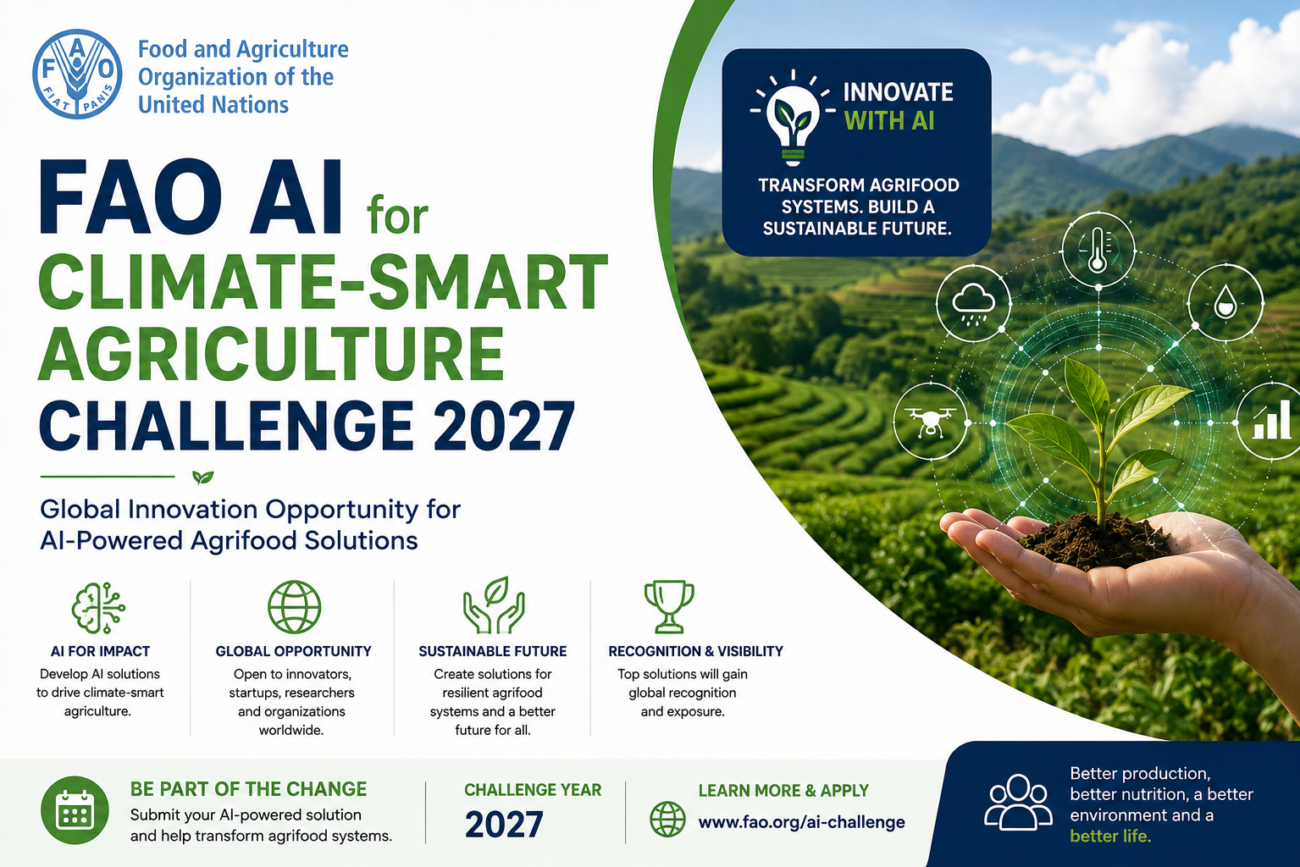
FAO AI for Climate-Smart Agriculture Challenge 2027 | Global Innovation Opportunity for AI-Powered Agrifood Solutions
The Food and Agriculture Organization of the United Nations (FAO) has launched the AI for Climate-Smart Agriculture (CSA) Challenge through its Science, Technology and Innovation (STI) Portal, inviting innovators, startups, researchers, developers, universities, agritech companies, and multidisciplinary teams to develop artificial intelligence-powered solutions that can transform climate-smart agriculture and strengthen global food systems. The initiative seeks innovative AI applications capable of improving agricultural productivity, strengthening resilience to climate change, reducing environmental impacts, and supporting sustainable agrifood systems.
The challenge forms part of FAO’s broader Digital Agriculture and AI Innovation agenda, which aims to harness artificial intelligence, digital technologies, and data-driven innovation to help countries build more efficient, inclusive, resilient, and sustainable agrifood systems. Through the STI Portal, FAO connects innovators, researchers, governments, investors, and development partners to accelerate responsible AI solutions for agriculture.
About the FAO AI for Climate-Smart Agriculture Challenge
Climate change continues to threaten food production worldwide through rising temperatures, droughts, floods, pests, soil degradation, and changing rainfall patterns. At the same time, global agriculture must produce enough food for a growing population while reducing greenhouse gas emissions and protecting natural resources.
Recognizing these challenges, FAO is promoting the responsible use of artificial intelligence to help transform agrifood systems. The AI for Climate-Smart Agriculture Challenge encourages innovators to develop practical solutions that improve farming while ensuring sustainability, resilience, and food security.
The challenge is part of FAO’s wider vision of Digital Agriculture and AI Innovation, which supports countries in adopting emerging technologies through partnerships, knowledge sharing, innovation ecosystems, and responsible governance frameworks.
About the FAO Science, Technology and Innovation (STI) Portal
The Science, Technology and Innovation (STI) Portal is FAO’s collaborative digital platform designed to connect knowledge, innovation, people, organizations, and technologies that support agrifood systems transformation.
The portal provides:
- Access to innovation resources.
- Connections with researchers and innovators.
- Knowledge-sharing opportunities.
- Learning resources.
- Technology databases.
- Networking with global partners.
- Support for evidence-based decision-making.
By bringing together stakeholders from around the world, the STI Portal helps accelerate the development and scaling of innovative agricultural technologies.
Focus Areas of the Challenge
FAO is seeking AI-powered innovations that contribute to climate-smart agriculture and sustainable food systems.
Potential solution areas include:
- Precision agriculture.
- Climate-smart farming.
- Crop monitoring.
- Pest and disease detection.
- Weather forecasting.
- Agricultural decision-support systems.
- Water resource management.
- Soil health monitoring.
- Livestock management.
- Supply chain optimization.
- Digital advisory services.
- Food security analytics.
- Sustainable resource management.
- Agricultural data platforms.
- Early warning systems.
Projects that improve productivity while strengthening resilience and reducing environmental impacts are especially encouraged.
What is Climate-Smart Agriculture?
According to FAO, Climate-Smart Agriculture (CSA) is an approach that helps transform agrifood systems by pursuing three complementary objectives:
- Sustainably increasing agricultural productivity and farmers’ incomes.
- Strengthening resilience and adaptation to climate change.
- Reducing greenhouse gas emissions wherever possible.
Rather than focusing on a single technology, CSA combines innovative practices, policies, digital tools, and scientific knowledge to help agriculture adapt to changing environmental conditions while protecting natural resources.
Who Should Participate?
The challenge is intended for a wide range of innovators and organizations working at the intersection of agriculture, technology, and sustainability.
Potential participants include:
- AI developers.
- Agritech startups.
- Technology companies.
- Universities.
- Research institutions.
- Entrepreneurs.
- Innovation hubs.
- Government agencies.
- Civil society organizations.
- Multidisciplinary innovation teams.
- Agricultural researchers.
- Data scientists.
- Software developers.
FAO encourages collaborative approaches that combine expertise from agriculture, artificial intelligence, engineering, environmental science, economics, and policy.
Why Artificial Intelligence Matters for Agriculture
Artificial intelligence has the potential to significantly improve agricultural decision-making by enabling:
- Better weather forecasting.
- Early detection of crop diseases.
- Precision irrigation.
- Optimized fertilizer use.
- Improved resource efficiency.
- Enhanced market intelligence.
- Faster data analysis.
- Reduced production costs.
- Improved resilience to climate shocks.
FAO views AI as a powerful tool that, when deployed responsibly and inclusively, can help countries achieve more sustainable and resilient agrifood systems while ensuring that innovation benefits farmers of all scales, including smallholders.
Benefits of Joining the Initiative
Although specific benefits vary by challenge activity, participation can provide opportunities to:
- Showcase innovative AI solutions.
- Connect with FAO’s global innovation ecosystem.
- Build partnerships with governments, research institutions, investors, and development organizations.
- Access international visibility.
- Collaborate with experts in digital agriculture.
- Contribute to global food security and climate resilience.
The STI Portal is designed to help innovators move from ideas and prototypes toward real-world implementation through networking and collaboration.
Why This Opportunity Matters
Agrifood systems face growing pressure from climate change, biodiversity loss, resource scarcity, and increasing food demand. FAO believes digital technologies and AI can play a central role in addressing these interconnected challenges by improving productivity, strengthening resilience, supporting evidence-based policymaking, and fostering innovation ecosystems that leave no one behind.
By participating in initiatives such as the AI for Climate-Smart Agriculture Challenge, innovators have the opportunity to contribute solutions that could improve farming practices, support rural livelihoods, and accelerate progress toward the Sustainable Development Goals (SDGs).
How to Participate
Interested innovators should:
- Visit the official FAO STI Portal challenge page.
- Review the challenge objectives and participation requirements.
- Register through the platform if required.
- Prepare and submit their AI-powered climate-smart agriculture solution according to the published guidelines.
- Monitor the portal for updates, announcements, and future innovation opportunities.
📲 Join the Vacancy Bridge WhatsApp Channel for daily updates on grants, innovation challenges, fellowships, scholarships, internships, and international funding opportunities:
https://whatsapp.com/channel/0029Vakee9aHFxOyCIBPJA0o
APPLY NOW
Disclaimer
Vacancy Bridge shares verified international innovation opportunities for informational purposes only. Vacancy Bridge is not affiliated with the Food and Agriculture Organization of the United Nations (FAO). Challenge guidelines, eligibility requirements, submission procedures, and timelines may change. Participants should always consult the official FAO Science, Technology and Innovation Portal for the latest information.
Top SEO Keywords
FAO AI Challenge 2027, AI for Climate Smart Agriculture, FAO Innovation Challenge, Climate Smart Agriculture Competition, FAO Science Technology Innovation Portal, Agritech Innovation Challenge, Artificial Intelligence Agriculture, FAO Digital Agriculture, Climate Resilient Farming, Agrifood Innovation, AI Agriculture Funding, FAO STI Portal, Sustainable Agriculture Innovation, Global AI Challenge, Vacancy Bridge.
