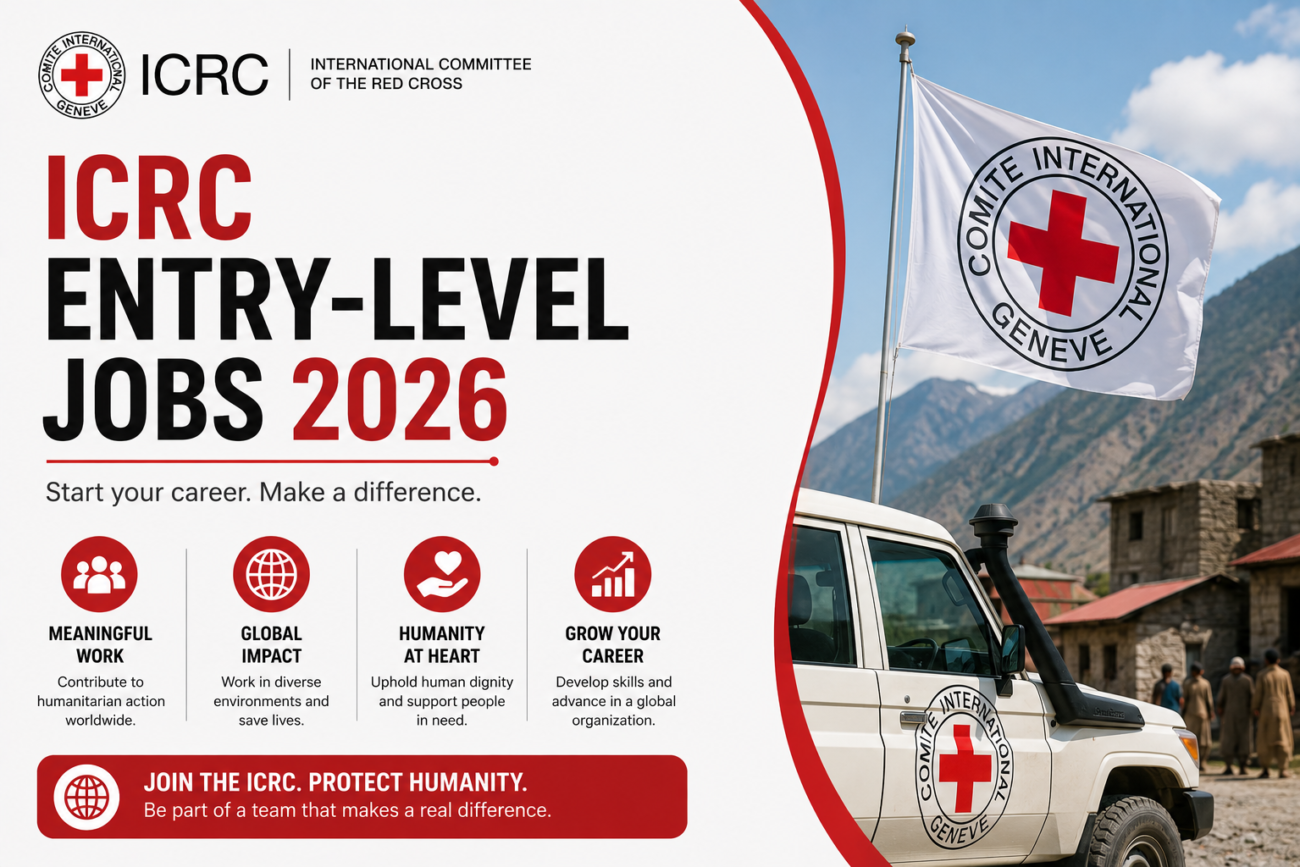
ICRC Entry-Level Jobs 2026: Requirements, Salary, Benefits and How to Apply
ICRC Entry-Level Jobs 2026: Requirements, Salary, Benefits and How to Apply. The International Committee of the Red Cross (ICRC) offers career opportunities for graduates, early-career professionals and candidates seeking to build experience in the international humanitarian sector.
Operating in more than 90 countries, the ICRC recruits professionals across humanitarian operations, communications, administration, information technology, logistics, health, law, data, human resources and many other professional areas.
For candidates at the beginning of their careers, some of the most accessible pathways include paid traineeships and associate positions, alongside locally recruited roles and selected junior professional vacancies.
The ICRC currently states that recent graduates applying for its graduate opportunities should generally have no more than one year of professional experience after graduation, or up to two years where previous traineeships are included.
For eligible graduate traineeships, the ICRC currently advertises compensation of approximately:
CHF 3,900 gross per month
with salary paid in 13 instalments per year.
🌍 ICRC Entry-Level Jobs 2026: Quick Overview
| Detail | Information |
|---|---|
| Organization | International Committee of the Red Cross (ICRC) |
| Sector | International Humanitarian Action |
| Locations | Geneva and ICRC operations worldwide |
| Entry-Level Pathways | Traineeships, Associate Positions & selected junior/local roles |
| Graduate Experience Level | Generally 0–1 year after graduation for graduate programme; up to 2 years including previous traineeships |
| Graduate Traineeship Salary | Approximately CHF 3,900 gross/month |
| Payment | 13 salary instalments per year |
| Duration | Graduate opportunities can last up to 12 months |
| Fields | Law, Communications, Operations, Finance, Logistics, HR, Data, IT and more |
| Nationality | Depends on contract and vacancy |
| Application | Online through ICRC Careers |
| Deadline | Varies by individual vacancy |
🏢 About the International Committee of the Red Cross
The International Committee of the Red Cross is one of the world’s leading humanitarian organizations.
Its mandate centres on protecting the lives and dignity of people affected by armed conflict and other situations of violence and providing humanitarian assistance to people in need.
The organization operates internationally and employs professionals from a wide variety of educational, professional and cultural backgrounds.
This creates opportunities not only for experienced humanitarian workers but also for graduates and early-career candidates interested in beginning careers in humanitarian action.
🎓 Does the ICRC Hire Recent Graduates?
Yes.
The ICRC has a dedicated career pathway for:
Students and Recent Graduates
The organization explains that recent graduates are candidates who have recently completed their studies and possess newly acquired academic or vocational skills but have limited professional experience.
For this particular pathway, the ICRC defines limited experience as:
No more than one year of professional experience since graduation
or:
Up to two years if previous traineeships are included.
Candidates fitting this profile are encouraged to look for:
Traineeships
and
Associate positions
among the ICRC’s current career opportunities.
💼 What Entry-Level Opportunities Are Available?
There is no single job called an “ICRC Entry-Level Job.”
Instead, candidates should search for vacancies appropriate to their qualifications and level of experience.
For recent graduates, opportunities can be available across departments such as:
⚖️ International Law and Policy
Potential opportunities may involve humanitarian policy, international humanitarian law, research, legal analysis and related activities.
📢 Communication and Information Management
Graduates with backgrounds in communications, journalism, media, digital communications, information management and related disciplines may find relevant opportunities.
🌍 Operations
Some graduate roles provide exposure to the operational work supporting ICRC humanitarian activities.
💰 Financial Resources
Candidates with backgrounds in accounting, economics, finance and business may find relevant opportunities.
🚚 Logistics
ICRC humanitarian operations require extensive logistics systems involving procurement, supply chains, transportation and delivery of humanitarian assistance.
👥 Human Resources
HR opportunities can involve recruitment, talent management, learning and development, administration and other people-related functions.
💻 Information Technology
Candidates with technical backgrounds may find opportunities involving information systems, digital platforms and technology supporting humanitarian operations.
📊 Data Management and Analytics
Data-related careers may involve data management, analysis and digital tools used to support humanitarian decision-making.
💰 ICRC Entry-Level Salary 2026
ICRC Entry-Level Jobs 2026: Requirements, Salary, Benefits and How to Apply
One of the most important questions for applicants is how much entry-level employees earn.
There is no single global ICRC entry-level salary.
Compensation depends on factors such as:
Type of contract
Duty station
Position
Experience
Qualifications
and applicable employment arrangements.
However, the ICRC provides a clear salary figure for its graduate traineeships.
Eligible paid traineeships currently provide approximately:
CHF 3,900 gross per month
and the ICRC states that this is paid in:
13 instalments per year.
This provides a useful official benchmark for candidates considering the ICRC’s Geneva graduate programme.
Applicants should not assume that every assistant, junior, local or field vacancy automatically pays CHF 3,900 per month.
The salary advertised in the specific vacancy takes priority.
📅 How Long Are ICRC Graduate Opportunities?
Recent graduates joining the ICRC through its graduate pathway may spend:
Up to 12 months
within one of the organization’s departments.
During this period, participants may contribute to activities such as:
Research
Evaluation
Analysis
and
Writing.
The exact responsibilities depend on the department and position.
🎁 What Benefits Does the ICRC Offer?
Benefits vary significantly depending on whether an employee holds a mobile contract, headquarters contract, resident/local contract or another employment arrangement.
For eligible employees, the ICRC advertises a broad compensation and benefits package.
🏥 Health and Insurance Benefits
Eligible employees can receive health-insurance support and other insurance protections according to their contract.
For mobile employees, the ICRC describes coverage that can include health-insurance contributions, accident insurance, repatriation insurance and additional death and disability protections.
🏠 Accommodation for Field Assignments
For employees on qualifying mobile field contracts, accommodation during assignments is arranged and fully covered by the ICRC.
✈️ Assignment Travel
For qualifying mobile employees, travel between the employee’s contractual domicile and the assignment location at the beginning and end of an assignment can be arranged and covered by the ICRC.
🏖️ Paid Leave
Eligible mobile and headquarters employees can receive between:
25 and 27.5 working days of paid leave per calendar year
depending on age and applicable conditions.
💰 Pension Benefits
For eligible employees under applicable arrangements, the ICRC provides an occupational pension plan.
The organization states that its contribution can amount to:
17% of pensionable salary
while the employee contributes 8.5%, under the relevant plan.
🎓 Training and Professional Development
Professional development is an important part of ICRC employment.
Depending on the contract, employees may participate in integration/onboarding programmes as well as organization-wide and technical training.
Graduate trainees can also receive formal and informal learning opportunities.
🤝 Support for Recent Graduates
ICRC graduate opportunities are designed to provide more than work experience.
The organization states that participants can receive:
Support and supervision
Graduates work with experienced teams and receive guidance relevant to their professional field.
Buddy Programme
An informal buddy programme helps newcomers integrate into the organization.
Training
Participants can access formal and informal professional-development opportunities.
These features can be particularly useful for graduates transitioning from university into international humanitarian work.
🎓 General Education Requirements
There is no universal academic qualification covering every ICRC vacancy.
Requirements depend on the job.
For professional positions generally, the ICRC says it looks for candidates with a solid educational background relevant to their area of expertise.
A:
University degree
or
Equivalent professional qualification
is generally required for many professional positions.
Depending on the career area, candidates could have backgrounds in:
International Relations
Law
Political Science
Development Studies
Humanitarian Studies
Economics
Finance
Accounting
Communications
Journalism
Human Resources
Information Technology
Data Science
Engineering
Public Health
Medicine
Nursing
Logistics
Supply Chain Management
and other relevant disciplines.
Applicants should always follow the educational requirements specified in the individual vacancy.
🌍 Do You Need Previous Humanitarian Experience?
Not necessarily.
The ICRC explicitly notes that not everyone who joins the organization has previous humanitarian experience.
Motivation, professional expertise, adaptability, versatility and the ability to work inclusively can also be important.
This is particularly encouraging for graduates whose academic or professional experience comes from another sector but whose skills are relevant to humanitarian operations.
However, applicants should distinguish graduate opportunities from regular professional roles.
For many standard professional positions, the ICRC generally looks for candidates with at least two years of relevant professional experience.
Graduate traineeships and associate positions are specifically designed to provide opportunities for people at earlier stages of their careers.
🗣️ Language Requirements
ICRC Entry-Level Jobs 2026: Requirements, Salary, Benefits and How to Apply
Language requirements vary by position and location.
English is widely important across ICRC operations.
For many international/mobile positions, strong English is expected, while French can be particularly valuable because a significant share of ICRC delegations operate in French-speaking environments.
Depending on the position and region, other languages such as:
Arabic
Spanish
Russian
and local languages may also strengthen an application.
Applicants should not assume that every entry-level vacancy requires multiple languages.
Always check the individual job description.
🌎 Can International Applicants Apply?
Yes, international recruitment is an important part of ICRC employment.
At its headquarters, the ICRC states that it can employ people irrespective of nationality across traineeship, permanent, temporary and consulting contracts, subject to the conditions of the particular position.
Field employment works differently.
Some positions are recruited internationally under mobile contracts, while others are resident positions recruited locally in a specific country.
Eligibility therefore depends heavily on the contract type.
Applicants should read the location and employment conditions carefully before applying.
🧭 What Are Mobile Positions?
Mobile positions involve international field assignments.
These are different from locally recruited positions.
For international mobile positions, the ICRC currently highlights requirements including:
Fluent English
English and French are the organization’s official languages, and French can be strongly recommended or required for some assignments.
Mobility
Candidates must be willing to work where humanitarian needs require their expertise.
Unaccompanied Assignments
For many mobile roles, employees must accept their first two assignments—normally at least 12 months each—without a spouse, partner, children or dependants accompanying them.
This is an important consideration for applicants considering an international field career.
🏠 Local ICRC Opportunities
The ICRC also recruits employees locally in countries where it operates.
These positions are often called:
Resident positions
or locally recruited roles.
Local opportunities can include administrative, technical, operational, logistics, communication and support functions.
Requirements and salaries for resident positions are determined according to the individual duty station and vacancy.
Therefore, candidates interested in working for the ICRC in their own country should monitor both the international ICRC careers portal and relevant local ICRC recruitment channels.
🧠 Skills the ICRC Looks For
Although technical requirements differ by job, several qualities are consistently valuable in humanitarian work.
Applicants should be able to demonstrate attributes such as:
Adaptability
Teamwork
Communication
Intercultural awareness
Professional integrity
Problem solving
Ability to work under pressure
Respect for diversity
Motivation for humanitarian work
and
Commitment to the ICRC’s humanitarian mandate.
Candidates applying for field positions may also need to demonstrate that they can work effectively in difficult, unpredictable or potentially dangerous environments.
❤️ Understanding ICRC Values
ICRC Entry-Level Jobs 2026: Requirements, Salary, Benefits and How to Apply
Applicants should understand the humanitarian principles underpinning the organization’s work.
The Red Cross and Red Crescent Movement is guided by Fundamental Principles including:
Humanity
Impartiality
Neutrality
Independence
Voluntary service
Unity
and
Universality.
Understanding these principles can help candidates explain why they want to work for the ICRC and how their own professional conduct aligns with humanitarian action.
📄 Documents You May Need
Application requirements depend on the vacancy, but candidates should generally be prepared to provide a professional:
CV or résumé
and
Cover letter or motivation information
where requested.
Some roles may require additional documents, professional licences, educational certificates, language evidence or other supporting information.
Applicants should not send unsolicited applications because the ICRC states that it only accepts applications against advertised vacancies.
✍️ How to Strengthen Your ICRC Application
A strong application should be tailored to the specific vacancy.
Candidates should explain not only what they have studied but how their knowledge and skills can contribute to humanitarian work.
For example, rather than simply writing:
“I have a degree in finance.”
an applicant could demonstrate how their financial analysis, budgeting, reporting or compliance experience could support accountable humanitarian operations.
Similarly, communications applicants should demonstrate writing, digital communication or audience-engagement experience rather than relying solely on their degree title.
Applicants should also explain their motivation for joining the ICRC.
The ICRC specifically recommends ensuring that both the CV and cover letter reflect the candidate’s motivation to join the organization.
🔍 ICRC Recruitment Process
The exact process can vary depending on the vacancy.
However, the ICRC’s normal recruitment process can include:
1. Online Application
Candidates apply to a specific vacancy through the official careers platform.
2. Application Screening
Recruiters assess applications against the requirements of the position and the organization’s values.
3. Tests
Some candidates may be invited to complete language, technical or other assessments depending on the position.
4. HR Interview
Shortlisted applicants may participate in an interview with Human Resources.
5. Technical Interview or Assessment
Candidates may then undergo a technical interview or test relevant to their professional area.
6. Selection and Hiring
Successful applicants proceed through the remaining hiring and employment formalities.
The process can differ for headquarters, field and graduate opportunities.
⚠️ Application Mistakes to Avoid
One of the biggest mistakes is applying indiscriminately to vacancies without checking the minimum qualifications.
Candidates should also avoid:
- Submitting the same generic CV for every vacancy
- Ignoring language requirements
- Applying to professional positions requiring several years of experience when seeking a graduate role
- Failing to explain motivation for humanitarian work
- Overstating professional experience
- Ignoring mobility requirements for international field positions
- Sending unsolicited applications instead of applying to advertised vacancies
- Applying through unofficial websites rather than the ICRC careers portal
Entry-level applicants should concentrate particularly on vacancies labelled traineeship, associate, graduate, assistant or other junior-level opportunities, while carefully checking the experience requirements.
💡 How Competitive Are ICRC Entry-Level Jobs?
The ICRC does not publish one overall acceptance rate for graduate or entry-level recruitment.
International humanitarian opportunities can attract applicants from many countries and academic backgrounds.
Competition will also vary considerably between roles.
Specialised language skills, relevant academic training, international exposure, volunteering, research, internships and practical experience can strengthen an application.
However, candidates should focus on relevance rather than quantity.
A smaller amount of directly relevant experience can sometimes be more valuable than unrelated work experience.
📅 Application Deadlines
There is no single deadline for:
ICRC Entry-Level Jobs 2026.
Vacancies are advertised throughout the year, and each opportunity has its own application deadline.
Some positions may remain available for several weeks, while others can have relatively short application periods.
Applicants should therefore check the ICRC careers portal regularly and consider creating a job alert for relevant categories.
📝 How to Apply for ICRC Entry-Level Jobs 2026
Applications should be made through the official ICRC careers platform.
Candidates can search vacancies by:
Keyword
Country
Region
Job location
Job category
and
Contract type.
Recent graduates should pay particular attention to traineeships and associate positions.
The ICRC does not accept unsolicited applications, so applicants should identify a suitable advertised position and submit their application directly against that vacancy.
Official ICRC Careers Portal
Use the official International Committee of the Red Cross Careers website to search current opportunities and submit applications.
🌟 Why Consider an Early-Career Role at the ICRC?
An early-career position at the ICRC can provide exposure to one of the world’s most established humanitarian organizations.
Depending on the position, graduates can gain experience in research, analysis, policy, communications, operations, finance, logistics and other functions supporting people affected by conflict and violence.
Graduate programmes also provide access to experienced colleagues, training and professional networks.
For candidates hoping to build long-term careers with international organizations, humanitarian agencies, NGOs, governments or development institutions, this experience can provide valuable professional foundations.
Final Thoughts
ICRC Entry-Level Jobs 2026: Requirements, Salary, Benefits and How to Apply
The ICRC Entry-Level Jobs 2026 offer several pathways for graduates and early-career professionals interested in humanitarian careers.
Recent graduates should particularly monitor:
Paid traineeships
and
Associate positions.
For the ICRC’s graduate programme, candidates generally have no more than one year of professional experience after graduation, or up to two years when previous traineeships are included.
Paid graduate traineeships currently provide approximately:
CHF 3,900 gross per month
paid in 13 instalments per year, with opportunities lasting up to 12 months.
However, applicants should remember that this figure does not represent a universal salary for every ICRC entry-level job. Salaries and benefits for local, mobile and other positions vary according to the vacancy and employment arrangement.
Candidates should use the official ICRC careers platform, identify vacancies matching their qualifications and submit tailored applications before the individual deadline.
📲 Get More UN & NGO Jobs on WhatsApp
Stay updated with more ICRC vacancies, United Nations jobs, NGO opportunities, graduate programmes, internships, remote jobs, fellowships and international development careers through the Vacancy Bridge WhatsApp Channel.
Join the Vacancy Bridge WhatsApp Channel: https://whatsapp.com/channel/0029Vakee9aHFxOyCIBPJA0o
APPLY ON THIS OFFICIAL PAGE
Key Details
🏢 Organization: International Committee of the Red Cross (ICRC)
🌍 Locations: Geneva and ICRC operations worldwide
🎓 Graduate Pathways: Traineeships and Associate Positions
💼 Other Opportunities: Local/resident and international/mobile positions
💰 Graduate Traineeship Salary: Approximately CHF 3,900 gross/month
💵 Salary Payments: 13 instalments per year
⏳ Graduate Programme Duration: Up to 12 months
📚 Graduate Experience: Generally 0–1 year after graduation, or up to 2 years including previous traineeships
🌐 Nationality: Depends on vacancy and contract; HQ opportunities can recruit across nationalities
📅 Deadline: Varies by vacancy
📝 Application: Online through official ICRC Careers
SEO Keywords
ICRC Entry-Level Jobs 2026, ICRC Jobs 2026, International Committee of the Red Cross Jobs, ICRC Graduate Jobs, ICRC Graduate Programme 2026, ICRC Traineeships 2026, ICRC Associate Jobs, ICRC Salary 2026, ICRC Entry Level Salary, ICRC Jobs for Recent Graduates, Red Cross International Jobs, Humanitarian Jobs 2026, International NGO Jobs 2026, NGO Entry Level Jobs, Humanitarian Graduate Jobs, ICRC Careers, ICRC Jobs Africa, ICRC Jobs for International Applicants, ICRC Internship Salary, Geneva Graduate Jobs, Humanitarian Careers for Graduates, International Development Jobs 2026, Vacancy Bridge.
