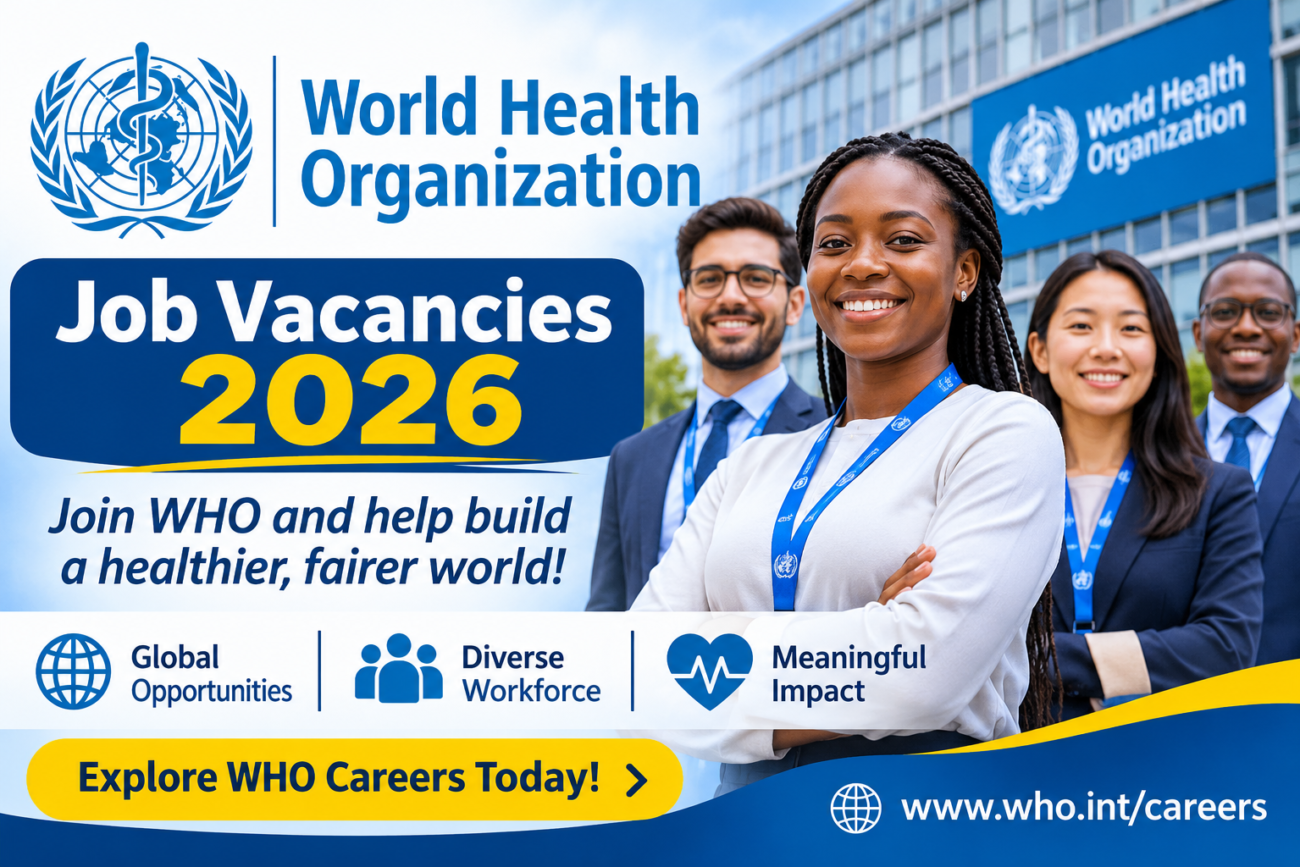
World Health Organization (WHO) Job Vacancies 2026: International Career Opportunities Across Global Health and Development
World Health Organization (WHO) Job Vacancies 2026: International Career Opportunities Across Global Health and Development. The World Health Organization (WHO) offers international career opportunities for qualified professionals interested in improving global health, strengthening healthcare systems and supporting sustainable development across countries.
As the United Nations specialised agency responsible for international public health, WHO recruits professionals across different technical, medical, administrative, operational and programme-related fields.
The organisation offers opportunities at:
- WHO Headquarters in Geneva, Switzerland.
- Regional offices across the world.
- Country offices in different countries.
- Emergency response locations.
- Other international duty stations.
WHO recruitment covers a broad range of professional backgrounds, including:
🏥 PUBLIC HEALTH
🩺 MEDICINE AND HEALTHCARE
🧬 EPIDEMIOLOGY
🌍 INTERNATIONAL DEVELOPMENT
📊 DATA AND RESEARCH
💻 INFORMATION TECHNOLOGY
📢 COMMUNICATIONS
⚙️ OPERATIONS AND ADMINISTRATION.
The organisation recruits experienced professionals, technical specialists, programme managers, medical practitioners, researchers, finance professionals, logistics specialists and administrative personnel.
Depending on the vacancy, opportunities may be available to candidates with university degrees, postgraduate qualifications, technical training or relevant professional experience.
WHO employment opportunities are advertised throughout the year, with individual vacancies having different application deadlines.
Interested candidates can explore available positions through the official WHO recruitment platform.
🚨 WHO Job Vacancies 2026: International Recruitment Opportunities
The World Health Organization recruits professionals to support its work across global health and development.
The organisation’s workforce contributes to activities involving:
- Disease prevention and control.
- Universal health coverage.
- Health emergencies.
- Maternal and child health.
- Immunisation.
- Health systems strengthening.
- Nutrition.
- Mental health.
- Environmental health.
- Health research.
- Digital health.
- Health policy and administration.
WHO offers different employment arrangements, including international professional positions, national professional positions, general service positions and consultancy opportunities.
The available positions vary according to organisational requirements, programme priorities and country-level needs.
Candidates can search the recruitment portal by job title, location, department and other available criteria.
🔎 Quick Overview
| Detail | Information |
|---|---|
| Organisation | World Health Organization (WHO) |
| Organisation Type | United Nations Specialised Agency |
| Opportunity | International Job Vacancies |
| Recruitment Year | 2026 |
| Headquarters | Geneva, Switzerland |
| Work Locations | Worldwide |
| Regional Offices | Africa, Americas, Eastern Mediterranean, Europe, South-East Asia and Western Pacific |
| Country Offices | Multiple Countries |
| Job Categories | International Professional, National Professional Officer and General Services |
| Other Opportunities | Consultants and Other Contractual Arrangements |
| Fields | Public Health, Medicine, Research, Administration, IT, Finance and More |
| Eligible Applicants | Qualified Candidates Meeting Individual Vacancy Requirements |
| Educational Requirements | Vary by Position |
| Professional Experience | Varies by Position |
| Employment Types | Fixed-Term and Temporary Appointments, Consultancy and Other Contracts |
| Salary | Based on Position, Grade, Contract and Duty Station |
| Benefits | Depend on Employment Category and Contract |
| Application Method | Online |
| Application Platform | WHO Stellis Recruitment System |
| Application Deadline | Varies by Vacancy |
| Application Status | Check Individual Live Vacancies |
🏛️ About the World Health Organization (WHO)
World Health Organization (WHO) Job Vacancies 2026: International Career Opportunities Across Global Health and Development
The World Health Organization is a specialised agency of the United Nations established in 1948.
Its mission is to promote health, keep the world safe and serve vulnerable populations.
WHO works with governments, international organisations, development partners, researchers and healthcare professionals to address public health challenges.
The organisation supports countries in developing stronger healthcare systems, preventing diseases and improving access to essential health services.
Its work covers several important global health priorities, including:
- Communicable diseases.
- Noncommunicable diseases.
- Maternal and reproductive health.
- Child and adolescent health.
- Mental health.
- Health emergencies.
- Climate change and health.
- Environmental health.
- Health financing.
- Health workforce development.
- Universal health coverage.
WHO also provides technical guidance, develops international health standards, coordinates responses to health emergencies and supports research and evidence-based policymaking.
Working with WHO therefore offers professionals an opportunity to contribute to programmes that affect populations across different countries.
🌍 Where Does WHO Recruit Staff?
WHO operates through a global network of offices and facilities.
Its recruitment activities are organised across headquarters, regional offices and country offices.
1. WHO Headquarters – Geneva, Switzerland
WHO Headquarters is located in Geneva, Switzerland.
Headquarters-based opportunities can involve:
- Global health policy.
- International health regulations.
- Research and technical guidance.
- Programme management.
- Global partnerships.
- Health emergencies.
- Finance and administration.
- Human resources.
- Communications.
- Information technology.
Professionals working at headquarters contribute to international health initiatives and coordinate activities with WHO offices around the world.
2. WHO Regional Office for Africa
The WHO Regional Office for Africa is based in Brazzaville, Republic of the Congo.
The regional office supports public health programmes across African countries.
Relevant areas include:
- Disease surveillance.
- Malaria prevention and control.
- HIV/AIDS.
- Tuberculosis.
- Immunisation.
- Maternal and child health.
- Health systems strengthening.
- Emergency preparedness.
- Nutrition.
- Environmental health.
WHO also recruits professionals for country-level assignments across Africa.
3. WHO Regional Office for the Americas
The Regional Office for the Americas is the Pan American Health Organization (PAHO), headquartered in Washington, D.C.
It coordinates regional public health initiatives and works with countries across the Americas.
Opportunities can involve:
- Public health.
- Epidemiology.
- Health systems.
- Disease prevention.
- Emergency response.
- Research.
- Health policy.
Applicants interested in PAHO opportunities should use its dedicated recruitment portal.
4. WHO Regional Office for the Eastern Mediterranean
This regional office supports countries across the Eastern Mediterranean.
Its activities include:
- Emergency response.
- Disease prevention.
- Health systems strengthening.
- Public health research.
- Health workforce development.
- Immunisation.
- Maternal and child health.
5. WHO Regional Office for Europe
The European Regional Office coordinates public health initiatives across its region.
Relevant professional areas include:
- Health policy.
- Disease prevention.
- Health economics.
- Environmental health.
- Digital health.
- Health systems.
- Emergency preparedness.
6. WHO Regional Office for South-East Asia
This office supports public health programmes across South-East Asia.
Professional opportunities can involve:
- Communicable diseases.
- Nutrition.
- Health systems development.
- Epidemiology.
- Immunisation.
- Maternal and child health.
- Research and programme management.
7. WHO Regional Office for the Western Pacific
The Western Pacific Regional Office supports public health activities across the region.
Its work includes:
- Disease surveillance.
- Health emergencies.
- Universal health coverage.
- Noncommunicable diseases.
- Health policy.
- Environmental health.
- Health systems strengthening.
💼 WHO Job Categories
WHO offers employment opportunities through three main staff categories, together with consultancy and other contractual arrangements.
Understanding these categories is important because the eligibility requirements, salary structures and employment conditions differ.
1. International Professional Staff
International Professional (IP) positions are internationally recruited roles.
These professionals work in technical, operational, managerial and leadership positions across WHO’s global network.
Depending on the position, responsibilities can involve:
- Public health programme leadership.
- International health policy.
- Disease prevention.
- Research.
- Emergency management.
- Technical cooperation.
- Global programme coordination.
- Health systems development.
International Professional staff are recruited according to their qualifications, experience and the requirements of the position.
These positions are generally associated with the P-level and higher professional grades.
Examples include:
- Public Health Officer.
- Technical Officer.
- Medical Officer.
- Epidemiologist.
- Programme Management Officer.
- Health Policy Adviser.
- Health Systems Specialist.
- Senior Technical Adviser.
International Professional staff are subject to WHO’s geographical mobility arrangements.
2. National Professional Officer Positions
World Health Organization (WHO) Job Vacancies 2026: International Career Opportunities Across Global Health and Development
National Professional Officer (NPO) positions are professional-level roles generally recruited within the country of the duty station.
These positions are particularly relevant to candidates with professional knowledge, qualifications and experience related to the local context.
Responsibilities can involve:
- National health programme coordination.
- Public health policy.
- Health research.
- Disease surveillance.
- Technical assistance.
- Government engagement.
- Programme implementation.
For example, WHO country offices may recruit National Professional Officers to support national health priorities and coordinate technical activities with government institutions.
These positions are generally classified under NO grades.
3. General Services Positions
General Services (GS) staff support WHO’s administrative, technical and operational activities.
These positions are generally locally recruited.
Potential professional areas include:
- Administration.
- Finance.
- Human resources.
- Procurement.
- Logistics.
- Information technology support.
- Records management.
- Office management.
- Travel administration.
- Programme support.
Examples of positions include:
- Administrative Assistant.
- Finance Assistant.
- Human Resources Assistant.
- Logistics Assistant.
- IT Assistant.
- Programme Assistant.
- Travel Assistant.
These opportunities may be relevant to candidates with secondary education, technical qualifications, vocational training or relevant professional experience, depending on the position.
4. Consultancy Opportunities
WHO also engages consultants to provide specialised expertise for specific assignments.
Consultants may be recruited for projects involving:
- Public health research.
- Health policy analysis.
- Programme evaluation.
- Epidemiological studies.
- Translation.
- Technical writing.
- Health systems development.
- Data analysis.
- Digital health.
- Monitoring and evaluation.
Consultancy assignments are usually time-limited and focused on clearly defined deliverables.
Importantly, consultancy contracts are not WHO staff employment contracts.
Consultants work under separate contractual arrangements and do not automatically receive the benefits available to WHO staff members.
5. Special Services Agreements
WHO also uses Special Services Agreements (SSA) for certain national or country-specific assignments.
These arrangements may cover technical, administrative and project-related support.
The conditions, duration and compensation are determined by the relevant contract.
🏥 Major Professional Fields at WHO
World Health Organization (WHO) Job Vacancies 2026: International Career Opportunities Across Global Health and Development
WHO recruits people from different academic and professional backgrounds.
Applicants should not assume that all vacancies require medical qualifications.
The organisation needs expertise across public health, research, administration, technology, finance and international development.
1. Public Health
Public health professionals contribute to programmes designed to improve population health.
Potential responsibilities include:
- Developing public health strategies.
- Supporting disease prevention programmes.
- Coordinating health interventions.
- Conducting health assessments.
- Providing technical assistance.
- Supporting national health policies.
Relevant qualifications may include public health, epidemiology, health sciences or related disciplines.
2. Medicine and Clinical Health
WHO recruits medical professionals to support its technical and clinical activities.
Relevant professional backgrounds may include:
- Medicine.
- Nursing.
- Clinical medicine.
- Laboratory medicine.
- Infectious diseases.
- Paediatrics.
- Obstetrics and gynaecology.
- Other medical specialisations.
Specific vacancies may require professional registration, clinical experience or specialist qualifications.
3. Epidemiology and Disease Surveillance
Epidemiologists and disease surveillance specialists support WHO’s work in monitoring and controlling health threats.
Responsibilities may involve:
- Analysing disease patterns.
- Monitoring outbreaks.
- Supporting surveillance systems.
- Conducting epidemiological investigations.
- Interpreting public health data.
- Developing disease prevention strategies.
Relevant qualifications may include epidemiology, public health, biostatistics, medicine or related fields.
4. Research and Data Analysis
WHO relies on research and reliable information to support evidence-based health decisions.
Professional opportunities may involve:
- Health research.
- Biostatistics.
- Data management.
- Statistical analysis.
- Monitoring and evaluation.
- Research coordination.
- Scientific writing.
- Health information systems.
Applicants with strong quantitative and analytical backgrounds may find relevant opportunities.
5. Health Systems and Policy
Health systems professionals support countries in improving healthcare delivery.
Their work can involve:
- Health financing.
- Healthcare accessibility.
- Health workforce development.
- Health policy.
- Health service delivery.
- Health system performance.
- Universal health coverage.
Relevant academic backgrounds may include health economics, public health, health policy, health administration and development studies.
6. Information Technology and Digital Health
WHO requires technology professionals to support its information systems and digital health initiatives.
Potential roles include:
- IT Officer.
- Data Analyst.
- Digital Health Specialist.
- Information Management Officer.
- Software Developer.
- Cybersecurity Specialist.
- Database Administrator.
- Systems Administrator.
Relevant qualifications may include computer science, information technology, software engineering, data science and related fields.
7. Finance and Accounting
Financial professionals support WHO’s financial management and accountability activities.
Potential responsibilities include:
- Budget preparation.
- Financial reporting.
- Accounting.
- Financial analysis.
- Internal controls.
- Procurement expenditure monitoring.
- Grant management.
Relevant qualifications may include accounting, finance, economics and business administration.
8. Human Resources
WHO recruits HR professionals to support its international workforce.
Responsibilities may include:
- Recruitment.
- Workforce planning.
- Talent management.
- Staff development.
- Employee relations.
- Human resources administration.
- Organisational development.
Relevant qualifications may include human resources management, business administration, organisational psychology and related disciplines.
9. Communications and Media
Communications professionals help WHO share public health information and engage with stakeholders.
Potential responsibilities include:
- Strategic communications.
- Media relations.
- Public information.
- Digital communications.
- Social media.
- Health communication.
- Publications.
- Advocacy.
Relevant qualifications may include communications, journalism, public relations, media studies and related fields.
10. Logistics, Procurement and Supply Chain
World Health Organization (WHO) Job Vacancies 2026: International Career Opportunities Across Global Health and Development
WHO requires operational specialists to support the delivery of essential supplies and services.
Professional activities can involve:
- Procurement.
- Supply chain management.
- Warehousing.
- Logistics.
- Transport.
- Distribution.
- Inventory management.
- Emergency supply operations.
Relevant backgrounds include logistics, procurement, supply chain management, business administration and operations management.
11. Environmental Health
WHO also recruits professionals working in environmental and occupational health.
Relevant areas include:
- Environmental health.
- Water and sanitation.
- Air pollution.
- Chemical safety.
- Occupational health.
- Climate change and health.
- Waste management.
- Environmental risk assessment.
Applicants with qualifications in environmental science, environmental health, engineering, public health and related fields may find relevant vacancies.
🎓 WHO Job Eligibility Requirements
WHO does not have one universal eligibility requirement for all vacancies.
Each position has its own educational, professional experience, language and technical requirements.
Applicants should therefore read the specific vacancy announcement before submitting an application.
However, several general requirements apply across different recruitment categories.
1. Educational Qualifications
Depending on the position, WHO may require:
- Secondary school education.
- Technical or vocational qualifications.
- Bachelor’s degree.
- Master’s degree.
- Doctoral degree.
- Professional medical qualifications.
- Specialist professional certification.
International Professional positions generally require a relevant university qualification.
More senior positions may require a master’s degree or an equivalent advanced qualification.
General Services positions may have different educational requirements.
2. Professional Experience
Professional experience requirements depend on the job grade and responsibilities.
WHO’s indicative requirements for International Professional positions include:
| Grade | Indicative Professional Experience | Educational Qualification |
|---|---|---|
| P1 | 1 Year | First University Degree |
| P2 | 2 Years | First University Degree |
| P3 | 5 Years | First University Degree |
| P4 | 7 Years | Master’s-Level Degree |
| P5 | 10 Years | Master’s-Level Degree |
| P6/D1/D2 | 15 Years | Master’s-Level Degree |
These are indicative requirements published by WHO. Individual vacancy announcements determine the actual requirements, including the type and relevance of experience accepted.
National Professional Officer positions also have grade-specific requirements.
3. Language Requirements
Language requirements vary by vacancy and duty station.
For many International Professional positions, proficiency in English or French and a good working knowledge of a second official UN language may be required.
The six official UN languages are:
- Arabic.
- Chinese.
- English.
- French.
- Russian.
- Spanish.
Some positions may require additional language skills depending on their location and responsibilities.
For General Services positions, language requirements depend on the duty station.
Applicants should carefully review the language requirements listed in the individual vacancy.
4. Technical and Professional Skills
Candidates should demonstrate the skills required for their chosen positions.
Depending on the role, these may include:
- Programme management.
- Research and analysis.
- Project coordination.
- Report writing.
- Communication.
- Data management.
- Technical expertise.
- Financial management.
- Stakeholder engagement.
- Strategic planning.
5. WHO Core Competencies
WHO uses a competency-based approach to recruitment.
Its competency framework includes values and behaviours that support effective performance across the organisation.
Applicants should demonstrate:
- Communication.
- Teamwork.
- Respecting and promoting individual and cultural differences.
- Knowing and managing yourself.
- Producing results.
- Moving forward in a changing environment.
- Creating an empowering and motivating environment.
- Building and promoting partnerships across the organisation and beyond.
The specific competencies assessed will depend on the position and its responsibilities.
🌍 Can International Applicants Apply?
World Health Organization (WHO) Job Vacancies 2026: International Career Opportunities Across Global Health and Development
Yes.
WHO recruits international professionals from its Member States and seeks a diverse workforce representing different countries and professional backgrounds.
Internationally recruited Professional positions are open to qualified candidates who satisfy the requirements of the individual vacancy.
However, not every WHO position is internationally recruited.
National Professional Officer and General Services positions are generally linked to local recruitment arrangements.
Applicants should therefore distinguish between:
International Professional positions: Internationally recruited opportunities.
National Professional Officer positions: Professional positions generally recruited in the country of the duty station.
General Services positions: Generally locally recruited support positions.
Consultancies: Project-based contractual opportunities with specific eligibility and assignment requirements.
🇿🇼 Can Zimbabweans Apply for WHO Jobs?
Yes.
Zimbabwean professionals can apply for WHO vacancies when they meet the eligibility requirements of the individual position.
Relevant candidates may include:
- Medical doctors.
- Nurses.
- Public health specialists.
- Epidemiologists.
- Laboratory professionals.
- Health researchers.
- Environmental health specialists.
- Data analysts.
- Finance professionals.
- Human resources specialists.
- Communications professionals.
- IT specialists.
- Logistics and procurement professionals.
- Programme managers.
Zimbabweans can consider internationally recruited positions as well as relevant opportunities advertised for WHO country offices.
For country-level positions, applicants should carefully review the nationality, residency and local recruitment requirements.
A Zimbabwean candidate should not assume that every international WHO vacancy is automatically open to applicants from every country.
The vacancy announcement remains the authoritative source of eligibility information.
💰 WHO Salaries and Employee Benefits
WHO offers competitive remuneration and benefits for eligible staff members.
Compensation depends on:
- Employment category.
- Job grade.
- Duty station.
- Contract type.
- Relevant employment conditions.
- Applicable salary scales.
International Professional salaries follow the United Nations common system.
National Professional Officer and General Services salaries are based on local salary scales.
WHO does not advertise one universal salary for all its vacancies.
Applicants should therefore review the remuneration information in each vacancy announcement.
1. Competitive Salary
WHO staff receive salaries according to their applicable employment category and grade.
International Professional positions use internationally established salary scales.
National Professional Officer and General Services positions use local salary scales.
2. Annual Leave
Eligible full-time International Professional, National Professional Officer and General Services staff receive:
30 DAYS OF ANNUAL LEAVE PER YEAR.
The entitlement may be calculated on a pro-rata basis depending on the employment arrangement.
3. Health Insurance
Most eligible WHO staff appointments include coverage under the WHO worldwide medical insurance scheme, including dental coverage.
The applicable conditions depend on the employment category and contract.
4. Pension Benefits
Most eligible staff appointments are covered by the United Nations Joint Staff Pension Fund.
Eligibility depends on the appointment and applicable employment rules.
5. Dependency Allowance
Eligible staff members may receive dependency allowances according to applicable rules.
6. Education Grant
Eligible staff members may receive education assistance for qualifying school and first-level university education expenses.
7. Relocation and Settling-In Support
Depending on the position and contract, benefits may include:
- Settling-in grants.
- Relocation grants.
- Home leave.
- Family visit entitlements.
- Rental subsidies.
- Hardship allowances.
- Mobility incentives.
- Repatriation or end-of-service grants.
These benefits are not automatically available to every WHO employee.
The employment offer specifies the benefits applicable to the successful candidate.
📄 WHO Employment Contract Types
WHO offers different appointment arrangements.
Understanding the differences helps candidates identify the type of opportunity they are applying for.
1. Fixed-Term Appointments
Fixed-term appointments are issued to International Professional, National Professional Officer and General Services staff.
They are generally issued for one or two years.
These appointments may be renewed depending on:
- Organisational requirements.
- Available funding.
- Programme priorities.
- Staff performance.
2. Temporary Appointments
World Health Organization (WHO) Job Vacancies 2026: International Career Opportunities Across Global Health and Development
Temporary appointments are used to meet short-term organisational and programme requirements.
They may be renewed up to a maximum of 24 months, after which a mandatory break in service applies.
3. Consultancy Contracts
Consultants are engaged to provide specialised services for specific assignments.
These contracts are time-limited and based on clearly defined deliverables.
Consultants are not WHO staff members and do not automatically receive the benefits associated with staff appointments.
4. Special Services Agreements
Special Services Agreements support specific national or country-level activities.
They may involve technical, professional or administrative assignments.
The payment arrangements and employment conditions are established in the individual contract.
📝 How to Apply for WHO Job Vacancies 2026
WHO applications are submitted through its official recruitment platform, known as:
STELLIS.
Stellis is used to publish WHO vacancies, manage candidate profiles and process applications.
Candidates should use the official WHO recruitment portal rather than relying on unofficial application websites.
Step 1 — Visit the Official WHO Careers Website
Start by visiting the official page.
Review the different employment categories and available career opportunities.
Step 2 — Access the WHO Job Search Portal
Visit the official recruitment platform.
This portal allows candidates to search available vacancies.
You can use different search criteria to identify opportunities matching your qualifications and interests.
Step 3 — Search for Suitable Vacancies
Search using relevant keywords.
Examples include:
- Public Health Officer.
- Technical Officer.
- Medical Officer.
- Epidemiologist.
- Programme Officer.
- Research Officer.
- Data Analyst.
- Finance Officer.
- Administrative Assistant.
- Communications Officer.
- Logistics Officer.
- Human Resources Officer.
- Environmental Health Specialist.
You can also search by location, department and other available filters.
Step 4 — Review the Vacancy Announcement
Open the vacancy that interests you.
Carefully examine:
- Job title.
- Duty station.
- Job grade.
- Employment category.
- Educational requirements.
- Professional experience.
- Language requirements.
- Technical competencies.
- Contract type.
- Closing date.
Only apply when you meet the essential eligibility requirements.
Step 5 — Create a WHO Candidate Profile
World Health Organization (WHO) Job Vacancies 2026: International Career Opportunities Across Global Health and Development
External applicants must create an online profile through the recruitment system.
Your profile contains information about your:
- Personal details.
- Education.
- Employment history.
- Professional experience.
- Skills.
- Languages.
- Qualifications.
A general profile can be used as a starting point for applications to multiple vacancies.
However, each application should be tailored to the particular position.
Step 6 — Prepare Your CV
Your CV should clearly demonstrate how your qualifications and professional experience match the vacancy.
Include:
- Educational qualifications.
- Professional certifications.
- Employment history.
- Technical expertise.
- Relevant achievements.
- Research experience.
- Project responsibilities.
- Language skills.
Use clear descriptions of your responsibilities and measurable achievements where appropriate.
Step 7 — Prepare a Cover Letter
Where appropriate, include a cover letter explaining your motivation for applying.
Your letter should demonstrate:
- Why you are interested in WHO.
- Why the particular position interests you.
- How your experience matches the requirements.
- What professional contribution you can make.
Avoid submitting a generic cover letter that does not address the advertised role.
Step 8 — Complete the Online Application
Fill in all required sections of the application form.
Provide accurate and complete information.
WHO may use application details and self-assessment questions to evaluate your eligibility and suitability.
Step 9 — Submit Before the Deadline
Review your application before submitting.
Make sure all required information is complete and accurate.
Applications submitted after the stated deadline will not be accepted.
Successful submissions should generate an automated acknowledgement email.
📋 WHO Job Application Checklist
Before submitting an application, prepare the following:
✅ Updated CV
Ensure your CV reflects your qualifications, employment history and professional achievements.
✅ Academic Qualifications
Prepare details of your relevant degrees, diplomas and professional training.
✅ Professional Experience
Demonstrate the experience required by the specific vacancy.
✅ Professional Certifications
Include relevant professional registrations and certifications where applicable.
✅ Language Skills
Clearly indicate your proficiency in the languages relevant to the position.
✅ Technical Skills
Highlight the technical and professional competencies required for the role.
✅ Cover Letter
Prepare a position-specific motivation letter where appropriate.
✅ Candidate Profile
Complete your WHO Stellis profile.
✅ Vacancy Reference
Keep a record of the vacancy title and reference number.
✅ Application Deadline
Confirm the closing date and time before submitting.
🎯 How to Strengthen Your WHO Job Application
World Health Organization (WHO) Job Vacancies 2026: International Career Opportunities Across Global Health and Development
WHO recruitment is competitive, particularly for internationally recruited professional positions.
Candidates should demonstrate that they can contribute to the organisation’s technical and operational objectives.
1. Tailor Your CV to the Vacancy
Avoid using exactly the same CV for every application.
Highlight the qualifications and experience that match the advertised responsibilities.
2. Demonstrate Relevant Professional Achievements
Where possible, provide measurable examples of your work.
For example, explain:
- Programmes you managed.
- Projects you coordinated.
- Research you conducted.
- Systems you improved.
- Teams you supervised.
- Results you achieved.
3. Demonstrate Technical Competence
WHO positions often require specialised knowledge.
Make sure your application clearly demonstrates the technical skills required for the position.
4. Highlight International and Cross-Cultural Experience
For internationally recruited positions, experience working with diverse teams, communities and stakeholders may be relevant.
Explain how you have collaborated across professional or cultural settings.
5. Demonstrate WHO Core Competencies
Use examples that show your ability to communicate, collaborate, produce results and adapt to changing circumstances.
6. Prepare for Competency-Based Interviews
Shortlisted candidates may be invited to participate in assessments and competency-based interviews.
Prepare examples from your professional experience that demonstrate how you have handled challenges, achieved results and worked with others.
🔎 WHO Recruitment and Selection Process
WHO uses a structured recruitment process to assess candidates.
The selection process may take several weeks or months.
Although the exact process depends on the vacancy, it generally involves:
1. Application Submission
Candidates submit their applications through the official recruitment system.
2. Eligibility Screening
Applications are reviewed against the minimum requirements and selection criteria.
3. Shortlisting
Candidates whose qualifications and experience match the position may be shortlisted.
4. Assessment
Shortlisted candidates may be required to complete one or more assessments.
5. Competency-Based Interview
Candidates under serious consideration may be invited to participate in an interview.
6. Final Selection
The organisation evaluates candidates and makes a selection decision.
7. Employment Offer
The successful candidate receives information about the position, appointment and applicable employment conditions.
WHO notes that only shortlisted candidates under serious consideration are contacted for further assessment and interviews.
⚠️ Important: Avoid WHO Recruitment Scams
Applicants should be particularly careful when searching for WHO employment opportunities online.
WHO has warned about individuals and organisations pretending to represent the organisation.
The following points are important:
- WHO does not charge application fees.
- WHO does not request money for recruitment.
- WHO does not charge registration fees for conference meetings.
- WHO does not conduct recruitment lotteries.
- WHO does not offer prizes or awards through unsolicited digital messages.
Applications should be submitted through official WHO recruitment channels.
Do not send money to individuals claiming they can secure a WHO position.
Be cautious of unofficial websites requesting payments, banking information or sensitive personal details.
If you receive a suspicious recruitment message, verify its authenticity directly with WHO.
📅 WHO Job Application Deadlines
WHO does not have one universal application deadline for all 2026 vacancies.
Each vacancy has its own closing date and time.
Some positions may remain open for a limited period, while others may have different recruitment schedules.
Candidates should regularly check the official recruitment portal for new vacancies and updates.
Applications submitted after the specified closing time will not be accepted.
🌍 Other WHO Career Development Opportunities
In addition to regular job vacancies, WHO offers several talent development opportunities.
These programmes may be relevant to students, recent graduates and early-career professionals.
1. WHO Internship Programme
The WHO Internship Programme offers students and recent graduates opportunities to gain practical experience in WHO’s technical programmes and administration.
Interns can develop knowledge in specific professional areas and gain exposure to international public health work.
2. Junior Professional Officer Programme
The Junior Professional Officer (JPO) Programme provides young professionals with practical experience in multilateral technical cooperation.
JPO positions may be available at WHO Headquarters, regional offices and country offices.
Eligibility and nationality requirements depend on the sponsoring arrangements and individual vacancy.
3. Young Professionals Programme
WHO also offers a Young Professionals Programme for young professionals from a specific list of least developed countries.
The programme provides structured opportunities to develop professional skills and gain exposure to WHO’s work.
Applicants should check the current programme requirements and eligible-country list.
4. UN Volunteers Programme
WHO engages UN Volunteers in different areas of expertise to support its work at country and regional levels.
Volunteer assignments can provide opportunities to contribute professional skills to public health and development initiatives.
❓ Frequently Asked Questions
World Health Organization (WHO) Job Vacancies 2026: International Career Opportunities Across Global Health and Development
What is the World Health Organization?
WHO is a specialised United Nations agency responsible for international public health.
It works with countries and partners to promote health, prevent disease and strengthen healthcare systems.
Are WHO jobs available in 2026?
WHO advertises vacancies throughout the year.
Candidates should check the official recruitment portal for currently available positions.
Can international applicants apply?
Yes.
Qualified international applicants can apply for internationally recruited positions when they meet the specific eligibility requirements.
Can Zimbabweans apply for WHO jobs?
Yes.
Zimbabwean professionals can apply for relevant international and country-level positions, subject to the eligibility requirements of each vacancy.
Do I need a medical degree to work for WHO?
No.
WHO recruits professionals from different disciplines, including finance, administration, IT, communications, logistics, research, public health and management.
Does WHO recruit recent graduates?
Some opportunities are available through talent programmes such as internships and certain early-career recruitment arrangements.
Regular professional vacancies may require substantial relevant experience.
What qualifications are required?
Requirements depend on the position.
Some vacancies require secondary or technical education, while professional positions may require bachelor’s, master’s or doctoral qualifications.
How many years of experience are required?
Experience requirements depend on the job grade and responsibilities.
For example, WHO’s indicative International Professional requirements range from one year for P1 to fifteen years for P6 and director-level positions.
Always check the individual vacancy announcement.
Does WHO offer remote jobs?
Work arrangements depend on the position and contract.
Some consultancy assignments may not require physical presence at the duty station, while many staff positions require work at a designated WHO office or location.
Applicants should not assume that a vacancy is fully remote unless the official announcement confirms this.
What is the WHO salary?
WHO salaries depend on the employment category, grade and duty station.
International Professional staff follow international UN salary arrangements, while National Professional Officer and General Services staff follow local salary scales.
Does WHO provide health insurance?
Most eligible staff appointments include WHO worldwide medical insurance, including dental coverage.
The specific entitlement depends on the contract.
Does WHO provide pension benefits?
Most eligible staff appointments are covered by the United Nations Joint Staff Pension Fund.
Eligibility depends on the appointment conditions.
How much annual leave do WHO employees receive?
Eligible full-time staff in the International Professional, National Professional Officer and General Services categories receive 30 days of annual leave per year.
What is Stellis?
Stellis is WHO’s online recruitment platform.
It is used to publish vacancies, manage candidate profiles and receive applications.
How do I create a WHO job application account?
Visit the official recruitment portal, select the external candidate profile option and follow the registration instructions.
Does WHO charge application fees?
No.
WHO does not charge applicants money to apply for employment.
How long does WHO recruitment take?
The selection process may take several weeks or months, depending on the vacancy and recruitment requirements.
Will WHO contact unsuccessful applicants?
WHO indicates that only shortlisted candidates under serious consideration are contacted for further assessments and interviews.
Can I apply for several WHO vacancies?
Candidates can use their general Stellis profile as a starting point for applications to multiple vacancies.
Each application should be customised to the specific position
🚀 Final Thoughts
World Health Organization (WHO) Job Vacancies 2026: International Career Opportunities Across Global Health and Development
World Health Organization (WHO) Job Vacancies 2026: International Career Opportunities Across Global Health and Development. The World Health Organization (WHO) Job Vacancies 2026 provide international career opportunities for qualified professionals interested in contributing to global health, healthcare development and humanitarian activities.
WHO recruits professionals across a wide range of fields, including:
🏥 PUBLIC HEALTH
🩺 MEDICINE AND HEALTHCARE
🧬 EPIDEMIOLOGY
📊 RESEARCH AND DATA ANALYSIS
💻 INFORMATION TECHNOLOGY
💰 FINANCE AND ACCOUNTING
📢 COMMUNICATIONS
⚙️ LOGISTICS AND OPERATIONS
and:
🌍 INTERNATIONAL DEVELOPMENT.
The organisation offers different employment arrangements, including International Professional positions, National Professional Officer roles, General Services appointments and consultancy opportunities.
Eligible staff members may receive competitive remuneration, annual leave, medical insurance, pension coverage and other benefits depending on their appointment category and contract.
The opportunities are available across WHO Headquarters, regional offices and country offices.
Importantly, candidates do not necessarily need a medical background to work for WHO.
Professionals from engineering, finance, economics, information technology, administration, communications, environmental health and other relevant disciplines can also find opportunities that match their qualifications.
Zimbabwean and other international professionals are encouraged to explore vacancies for which they meet the advertised requirements.
For interested candidates:
WHO RECRUITS THROUGHOUT THE YEAR.
Applicants should regularly check the official recruitment platform, prepare a strong professional profile and submit applications before the relevant vacancy deadlines.
📲 Get More International Jobs and Development Opportunities
Stay updated with international vacancies, United Nations jobs, NGO opportunities, paid internships, fellowships, scholarships and development-sector career opportunities through Vacancy Bridge.
Join the Vacancy Bridge WhatsApp Channel
https://whatsapp.com/channel/0029Vakee9aHFxOyCIBPJA0o
APPLY NOW ON THIS OFFICIAL PAGE
🔑 Key Details
Organisation: World Health Organization (WHO)
Organisation Type: United Nations Specialised Agency
Opportunity: International Job Vacancies
Recruitment Year: 2026
Headquarters: Geneva, Switzerland
Work Locations: Worldwide
Regional Offices: Six WHO Regions
Country Offices: Multiple Countries
Job Categories: International Professional, National Professional Officer and General Services
Other Contracts: Consultants and Special Services Agreements
Fields: Public Health, Medicine, Research, IT, Finance, Communications, Logistics and More
Eligible Applicants: Qualified International and National Candidates
Educational Requirements: Vary by Position
Experience Requirements: Vary by Position and Grade
Language Requirements: Depend on Position
Salary: Based on Grade, Contract and Duty Station
Benefits: Depend on Employment Category
Annual Leave: 30 Days for Eligible Full-Time Staff
Medical Insurance: Available for Eligible Staff
Pension: Available for Eligible Appointments
Application Platform: WHO Stellis
Application Deadline: Varies by Vacancy
Application Status: Check Live Vacancies
Application Method: Online
🔎 SEO Keywords
World Health Organization Jobs 2026, WHO Job Vacancies 2026, WHO Careers 2026, WHO Recruitment 2026, World Health Organization Careers, WHO International Jobs, WHO Jobs for International Applicants, WHO Jobs for Africans, WHO Jobs for Zimbabweans, United Nations Jobs 2026, UN Health Jobs, International Public Health Jobs, WHO Professional Jobs, WHO Medical Officer Jobs, WHO Public Health Officer Jobs, WHO Epidemiologist Jobs, WHO Technical Officer Jobs, WHO Programme Officer Jobs, WHO Administrative Jobs, WHO Finance Jobs, WHO IT Jobs, WHO Communications Jobs, WHO Logistics Jobs, WHO Environmental Health Jobs, WHO Research Jobs, WHO Country Office Vacancies, WHO Geneva Jobs, WHO Africa Jobs, WHO Regional Office Jobs, International Development Jobs 2026, Global Health Careers, UN Careers 2026, International NGO Jobs, WHO Stellis Recruitment, WHO Consultant Opportunities, Vacancy Bridge.
