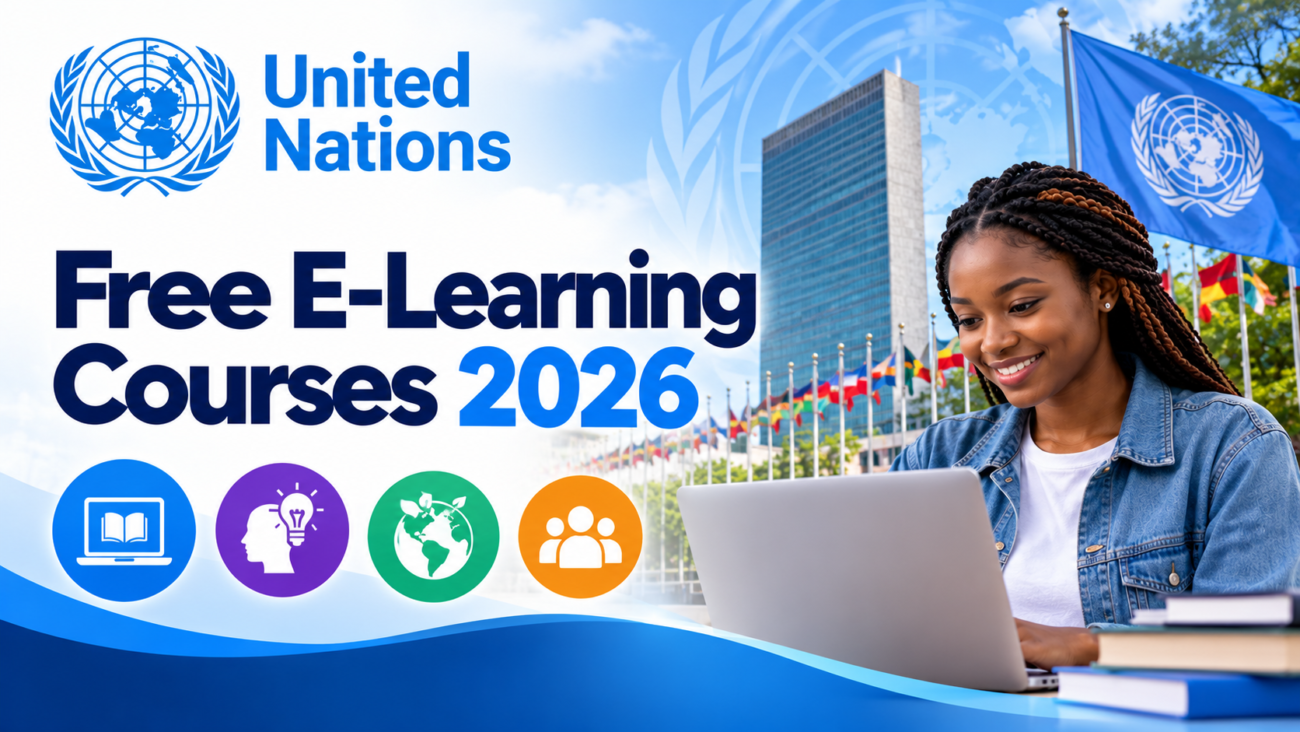
📢 Free United Nations E-Learning Courses 2026: Free Online Courses And Certificates For International Learners 🌍🎓
📢 Free United Nations E-Learning Courses 2026: Free Online Courses And Certificates For International Learners 🌍🎓. The Free United Nations E-Learning Courses 2026 provide an excellent opportunity for students, graduates, job seekers, working professionals, researchers, teachers, entrepreneurs and international development practitioners to improve their knowledge through free online training, professional development programmes and selected certificate-awarding courses.
Several organisations and learning platforms associated with the United Nations (UN) offer accessible educational opportunities covering climate change, sustainable development, human rights, gender equality, humanitarian assistance, public health, leadership, environmental protection, diplomacy, conflict prevention, education and professional skills development.
Through platforms such as UNITAR, UN CC:Learn, UNICEF Agora, UN SDG:Learn and the UN Women Training Centre, eligible learners can access training materials developed or supported by United Nations organisations.
These learning opportunities are particularly valuable for individuals interested in careers with:
🌍 UNITED NATIONS ORGANISATIONS
🤝 INTERNATIONAL NON-GOVERNMENTAL ORGANISATIONS
🌱 ENVIRONMENTAL AND CLIMATE ORGANISATIONS
🩺 HEALTHCARE AND HUMANITARIAN INSTITUTIONS
📚 EDUCATION AND RESEARCH INSTITUTIONS
💼 INTERNATIONAL DEVELOPMENT AGENCIES
🏛️ GOVERNMENT AND PUBLIC INSTITUTIONS
and:
🚀 PROFESSIONAL DEVELOPMENT AND GLOBAL CAREERS
📢 Free United Nations E-Learning Courses 2026: Free Online Courses And Certificates For International Learners 🌍🎓
The courses can help learners strengthen their understanding of global development challenges, acquire specialised skills and demonstrate commitment to lifelong learning.
Many opportunities are available through self-paced online learning, meaning participants can study from home according to their schedules.
Importantly, some courses provide free certificates after successful completion, although fees and certification conditions differ across United Nations learning platforms.
🎓 FREE UNITED NATIONS ONLINE COURSES
Selected United Nations learning platforms provide courses without tuition fees.
📜 FREE CERTIFICATES ON ELIGIBLE COURSES
Some programmes issue completion certificates after learners satisfy assessment requirements.
💻 FULLY ONLINE LEARNING
Many courses can be completed remotely using an internet-connected device.
⏰ FLEXIBLE AND SELF-PACED STUDY
Numerous courses allow participants to learn independently.
🌍 INTERNATIONAL LEARNING OPPORTUNITIES
Selected courses welcome learners from different countries and professional backgrounds.
📚 MULTIPLE SUBJECT AREAS
Training covers sustainable development, humanitarian work, climate change, gender equality, public policy and more.
💰 FREE REGISTRATION ON SELECTED PROGRAMMES
Eligible free courses do not charge tuition fees, although certification arrangements vary.
📅 COURSE AVAILABILITY: THROUGHOUT 2026
📢 Free United Nations E-Learning Courses 2026: Free Online Courses And Certificates For International Learners 🌍🎓
Some courses offer rolling enrolment, while others have specific opening and closing dates.
Official United Nations learning platforms confirm that free learning opportunities are available, including publicly accessible UNICEF Agora activities and selected free UNITAR courses.
Knowledge to lead
+2
⚠️ IMPORTANT ACCURACY NOTE
This article is based on official United Nations learning platforms and programme information reviewed on 20 October 2026.
Applicants should understand the following important details before registering.
✅ FREE COURSES: AVAILABLE THROUGH SELECTED PLATFORMS
A number of United Nations organisations provide free e-learning opportunities.
However, not every United Nations online course is free.
Some professional certificates, diploma programmes and specialist training events require payment.
📜 FREE CERTIFICATES: NOT AVAILABLE FOR EVERY COURSE
Certain courses provide free certificates after successful completion.
Other courses may offer free learning materials without issuing certificates, or may charge separately for certificate downloads.
Learners should review the certification information on each course page.
🚨 IMPORTANT UN CC:LEARN CERTIFICATE UPDATE
UN CC:Learn has announced the introduction of certificate download fees generally ranging from US$10 to US$30, while retaining free access to course content.
The changes are being introduced progressively.
Therefore, learners should not automatically assume that every UN CC:Learn certificate is still available without payment.
Knowledge Sharing Platform
🌍 INTERNATIONAL ELIGIBILITY: DEPENDS ON THE COURSE
Many free UN-affiliated courses are accessible internationally.
However, some platforms and programmes are restricted to:
- United Nations employees.
- Partner organisations.
- Government officials.
- Selected professional groups.
- Applicants meeting specific eligibility conditions.
🎓 ACADEMIC QUALIFICATIONS: GENERALLY NOT REQUIRED FOR INTRODUCTORY COURSES
Many introductory courses do not require formal university qualifications.
Specialised programmes may have additional entry requirements.
💰 SCHOLARSHIPS AND STIPENDS: NOT AUTOMATICALLY INCLUDED
Free online learning does not imply that participants receive stipends, salaries, scholarships or financial allowances.
📅 APPLICATION DEADLINES: DIFFER BY PROGRAMME
Some courses remain accessible throughout the year.
Others operate within specific training periods.
🚨 IMPORTANT DISTINCTION
These are multiple educational opportunities offered through different United Nations organisations, not one central United Nations scholarship or course programme.
Applicants must register through the official platform responsible for their selected course.
🌍 QUICK OVERVIEW
📢 Free United Nations E-Learning Courses 2026: Free Online Courses And Certificates For International Learners 🌍🎓
| DETAIL | INFORMATION |
|---|---|
| Organisation | United Nations And Associated Learning Partners |
| Opportunity | Free United Nations E-Learning Courses 2026 |
| Programme Type | Online Training And Professional Development |
| Learning Mode | Fully Online For Featured E-Learning Courses |
| Course Fees | Free On Selected Programmes |
| Certificates | Available On Eligible Courses |
| Certificate Costs | Free Or Paid Depending On Course |
| Study Duration | Varies By Programme |
| Learning Schedule | Self-Paced Or Scheduled |
| Main Subjects | Climate, SDGs, Human Rights, Gender, Humanitarian Work And More |
| Academic Level | Introductory To Advanced |
| Eligible Applicants | Depends On Individual Course |
| International Participation | Available On Many Courses |
| Zimbabwean Applicants | Eligible For Many Public Courses |
| Professional Experience | Not Generally Required For Introductory Courses |
| Course Language | English And Other Languages Depending On Course |
| Tuition Funding | Free Access On Selected Courses |
| Monthly Stipend | Not Provided For Standard Free Courses |
| Academic Degree | Not Awarded By Standard Short Courses |
| Travel Requirements | None For Fully Online Courses |
| Application Opening | Varies |
| Application Deadline | Rolling Or Course-Specific |
| Application Method | Online |
| Official Platforms | UNITAR, UNICEF Agora, UN CC:Learn, UN SDG:Learn And Others |
🏛️ ABOUT THE UNITED NATIONS
📢 Free United Nations E-Learning Courses 2026: Free Online Courses And Certificates For International Learners 🌍🎓
The United Nations is an international organisation established in 1945 to promote international cooperation, peace, security, sustainable development and human rights.
The organisation works with member states, international institutions and development partners to address major global challenges.
Its work covers:
🌍 SUSTAINABLE DEVELOPMENT
🤝 PEACE AND INTERNATIONAL SECURITY
⚖️ HUMAN RIGHTS
🌱 CLIMATE ACTION
🩺 GLOBAL HEALTH
🏫 EDUCATION
🚨 HUMANITARIAN ASSISTANCE
👩 GENDER EQUALITY
and:
🌐 INTERNATIONAL COOPERATION
To support these objectives, different United Nations entities provide educational resources, research materials and professional training opportunities.
🎯 WHY DOES THE UNITED NATIONS SUPPORT ONLINE LEARNING?
📢 Free United Nations E-Learning Courses 2026: Free Online Courses And Certificates For International Learners 🌍🎓
Training and capacity development help individuals and institutions respond to global development challenges.
Online learning can support:
- Skills Development.
- Professional Knowledge.
- Institutional Capacity Building.
- International Development Awareness.
- Humanitarian Preparedness.
- Environmental Education.
- Sustainable Development.
- Gender Equality.
- Public Policy Understanding.
- Global Cooperation.
Free digital courses can make educational resources accessible to learners who may not have the financial resources or geographical access required for classroom training.
💻 WHAT ARE THE FREE UNITED NATIONS E-LEARNING COURSES 2026?
📢 Free United Nations E-Learning Courses 2026: Free Online Courses And Certificates For International Learners 🌍🎓
United Nations e-learning courses are educational and professional development programmes delivered through online training platforms.
They help participants develop knowledge related to the work and objectives of different United Nations organisations.
Depending on the course, participants may complete:
📚 ONLINE LEARNING MODULES
🎥 EDUCATIONAL VIDEOS
📖 DIGITAL READING MATERIALS
📝 QUIZZES AND ASSESSMENTS
💻 INTERACTIVE LEARNING ACTIVITIES
📊 CASE STUDIES
🌍 GLOBAL DEVELOPMENT EXERCISES
and:
📜 CERTIFICATE REQUIREMENTS
📢 Free United Nations E-Learning Courses 2026: Free Online Courses And Certificates For International Learners 🌍🎓
Some courses are intended for beginners, while others target professionals working in specialised fields.
Participants should identify the platform, eligibility conditions and certificate arrangements before enrolling.
🌐 MAIN UNITED NATIONS ONLINE LEARNING PLATFORMS
1️⃣ UNITAR – UNITED NATIONS INSTITUTE FOR TRAINING AND RESEARCH
United Nations Institute for Training and Research (UNITAR) provides educational programmes designed to strengthen the skills of individuals, organisations and institutions.
The institute offers training in areas such as:
🌍 SUSTAINABLE DEVELOPMENT
🤝 PEACEBUILDING AND CONFLICT PREVENTION
🏛️ GOVERNANCE AND PUBLIC POLICY
🌱 ENVIRONMENTAL MANAGEMENT
📊 PROFESSIONAL DEVELOPMENT
💼 INTERNATIONAL COOPERATION
UNITAR provides both free and paid learning opportunities.
Its official catalogue identifies free, self-paced courses that are open for registration.
📚 EXAMPLES OF UNITAR FREE COURSES
✅ FOUNDATIONS OF SDG 6: CLEAN WATER AND SANITATION
An online course introducing topics connected to Sustainable Development Goal 6.
✅ CONFLICT SERIES: WHAT IS CONFLICT?
An introductory course exploring the meaning and nature of conflict.
✅ CONFLICT SERIES: CONFLICT ANALYSIS
A learning opportunity examining approaches to understanding conflict.
✅ CONFLICT SERIES: FROM CONFLICT TO PEACE
A course introducing concepts relevant to peacebuilding and conflict transformation.
✅ ARMS TRADE TREATY ANNUAL REPORTING COURSE
A specialised learning opportunity relating to treaty reporting.
These courses are listed among UNITAR’s free online learning activities.
Important: Applicants should check the individual course descriptions for certification details. A course marked free does not necessarily mean it awards a free certificate.
2️⃣ UNICEF AGORA – FREE ONLINE TRAINING
UNICEF operates Agora, an online learning platform supporting learning opportunities associated with its work.
🌍 UNICEF AGORA
The platform provides training related to:
- Humanitarian Assistance.
- Child Protection.
- Education.
- Global Development.
- Human Rights.
- Organisational Leadership.
- Project Management.
- Operational Support.
- Professional Skills.
UNICEF states that Agora is free to register for and open to UNICEF personnel, partners and members of the general public.
Its platform also provides access to certificates and digital badges associated with eligible learning activities.
🎓 WHO CAN USE UNICEF AGORA?
Potential learners include:
- University Students.
- NGO Professionals.
- Humanitarian Workers.
- Teachers.
- Development Practitioners.
- Researchers.
- Public Sector Professionals.
- Interested Members Of The Public.
Individual learning activities may have additional restrictions.
📜 ARE UNICEF AGORA CERTIFICATES FREE?
The platform supports certificates and digital badges on eligible courses.
Users should check each course to confirm whether a certificate is available and what must be completed to receive it.
3️⃣ UN CC:LEARN – CLIMATE CHANGE AND SUSTAINABILITY
UN CC:Learn provides online climate change education and learning resources.
The platform focuses on helping learners understand:
🌱 CLIMATE CHANGE SCIENCE
🌍 CLIMATE ADAPTATION
♻️ CLIMATE MITIGATION
💰 CLIMATE FINANCE
🌿 ENVIRONMENTAL SUSTAINABILITY
🏛️ CLIMATE POLICY
and:
🚀 CLIMATE ACTION
🌍 INTRODUCTORY E-COURSE ON CLIMATE CHANGE
One example is the Introductory E-Course on Climate Change.
The official course page identifies:
Learning Mode: Self-Paced.
Estimated Duration: 12 Hours.
Course Structure: Six Modules.
Subjects: Climate Science, Policy, Adaptation, Mitigation, Climate Finance And Planning.
Assessment Requirement: More Than 70% On Each Of The Six Module Quizzes For Completion.
The learning materials are accessible online. However, the platform’s newly announced certificate fees mean learners should verify whether payment is required to download a certificate.
Knowledge Sharing Platform
+1
4️⃣ UN SDG:LEARN – SUSTAINABLE DEVELOPMENT EDUCATION
UN SDG:Learn provides access to learning opportunities associated with the Sustainable Development Goals.
Courses cover topics involving:
🌍 SUSTAINABLE DEVELOPMENT
📊 OFFICIAL STATISTICS
🏛️ PUBLIC POLICY
🌱 DEVELOPMENT PLANNING
🤝 INTERNATIONAL PARTNERSHIPS
and:
📈 DEVELOPMENT DATA
📚 EXAMPLES OF FREE COURSES AVAILABLE IN 2026
Fundamental Principles Of Official Statistics And Their Relevance For Policymakers
- Study Duration: 2 Hours.
- Course Level: Introductory.
- Tuition Fee: Free.
- Certificate: Yes.
- Listed End Date: 31 December 2026.
Practical Methods To Implement And Uphold The Fundamental Principles Of Official Statistics For Producers
- Study Duration: 3 Hours.
- Course Level: Introductory.
- Tuition Fee: Free.
- Certificate: Yes.
- Listed End Date: 31 December 2026.
The platform also lists a free Introduction To Official Statistics course, but explicitly marks it as not offering a certificate.
These examples demonstrate why applicants should check certification information for every course rather than assuming all free programmes award certificates.
5️⃣ UN WOMEN TRAINING CENTRE – GENDER EQUALITY COURSES
The UN Women Training Centre provides educational resources and courses related to gender equality, women’s empowerment and inclusive development.
The training catalogue includes free self-paced modules.
Learning areas include:
👩 GENDER EQUALITY
⚖️ WOMEN’S RIGHTS
🤝 INCLUSIVE DEVELOPMENT
💼 WOMEN’S ECONOMIC EMPOWERMENT
🏛️ GENDER-RESPONSIVE POLICY
🚨 PREVENTION OF GENDER-BASED VIOLENCE
and:
🌍 GENDER EQUALITY IN HUMANITARIAN CONTEXTS
📚 EXAMPLE: IMPLEMENTING GENDER EQUALITY MARKERS
The UN Women Training Centre offers a free self-paced training module on implementing gender equality markers.
Study Duration: Approximately 50 Minutes.
Available Languages: English, French And Spanish.
Access: Online.
Course Fee: Free.
The programme introduces concepts related to gender equality coding and practical applications in development initiatives.
6️⃣ UNITED NATIONS SYSTEM STAFF COLLEGE – PROFESSIONAL TRAINING
The United Nations System Staff College (UNSSC) provides training in leadership, management, sustainable development and United Nations professional practices.
Its course catalogue includes offerings addressing:
- Leadership.
- Management.
- Sustainable Development.
- Data And Evaluation.
- Human Rights.
- Organisational Change.
- Climate And Environment.
- Professional Skills.
⚠️ IMPORTANT ACCESS RESTRICTION
Not all UNSSC courses are open to the general public.
For example, the Blue Line – Free Courses For UN Personnel programme is restricted to eligible United Nations personnel.
It is advertised for 1 January to 31 December 2026, with free access for eligible UN personnel.
Individuals outside the United Nations system should search for courses marked Everyone and verify whether the programme is free.
📚 MAIN AREAS OF FREE UNITED NATIONS E-LEARNING COURSES 2026
1️⃣ CLIMATE CHANGE AND ENVIRONMENTAL SUSTAINABILITY
Climate change education is one of the major areas covered by United Nations learning initiatives.
These courses are particularly useful for individuals interested in environmental science, climate policy, conservation and sustainable development.
🌱 CLIMATE CHANGE SCIENCE
Explore the scientific foundations of climate change, greenhouse gas emissions and global environmental challenges.
🌍 CLIMATE CHANGE ADAPTATION
Learn how communities, institutions and governments can respond to changing climatic conditions.
♻️ CLIMATE CHANGE MITIGATION
Understand approaches to reducing emissions and supporting lower-carbon development.
💰 CLIMATE FINANCE
Explore the role of financing in supporting environmental sustainability and climate action.
🌿 ENVIRONMENTAL PROTECTION
Develop awareness of environmental conservation and sustainable resource management.
🎯 WHO SHOULD CONSIDER THESE COURSES?
📢 Free United Nations E-Learning Courses 2026: Free Online Courses And Certificates For International Learners 🌍🎓
- Environmental Science Students.
- Climate Researchers.
- Agriculture Professionals.
- Conservation Officers.
- Sustainability Practitioners.
- NGO Professionals.
- Public Policy Students.
- Community Development Workers.
2️⃣ HUMAN RIGHTS AND INTERNATIONAL DEVELOPMENT
Human rights and development education can help learners understand international frameworks, social inclusion and the responsibilities of institutions.
Relevant learning areas include:
⚖️ INTERNATIONAL HUMAN RIGHTS
🏛️ DEVELOPMENT GOVERNANCE
🤝 SOCIAL INCLUSION
🌍 INTERNATIONAL COOPERATION
👥 COMMUNITY DEVELOPMENT
📜 HUMAN RIGHTS PRINCIPLES
These courses may be useful for individuals interested in international organisations, NGOs, government institutions and social development programmes.
WHO MAY BENEFIT?
Law students, social workers, researchers, development practitioners, community advocates and professionals working with vulnerable communities.
3️⃣ SUSTAINABLE DEVELOPMENT GOALS
The United Nations Sustainable Development Goals, commonly known as the SDGs, form an important part of international development education.
The SDGs comprise 17 global goals addressing major economic, social and environmental challenges.
1
No Poverty
2
Zero Hunger
3
Good Health
4
Quality Education
5
Gender Equality
6
Clean Water
7
Clean Energy
8
Decent Work
9
Innovation
10
Reduced Inequalities
11
Sustainable Cities
12
Responsible Consumption
13
Climate Action
14
Life Below Water
15
Life On Land
16
Peace And Justice
17
Partnerships
Learners can explore topics involving:
- Poverty Reduction.
- Food Security.
- Education.
- Gender Equality.
- Clean Water.
- Renewable Energy.
- Economic Development.
- Environmental Protection.
- Institutional Development.
- International Partnerships.
🎓 LEARNING BENEFITS
SDG-related courses can help learners understand how development priorities influence government policies, NGO programmes and international development projects.
They may be useful for students preparing for careers in international development, policy analysis and sustainable development.
4️⃣ HUMANITARIAN ASSISTANCE AND EMERGENCY RESPONSE
Humanitarian learning opportunities introduce subjects relevant to supporting vulnerable populations during emergencies.
Areas may include:
🚨 HUMANITARIAN PRINCIPLES
🏥 EMERGENCY RESPONSE
👶 CHILD PROTECTION
🤝 COMMUNITY SUPPORT
📋 HUMANITARIAN PROGRAMME MANAGEMENT
🌍 DEVELOPMENT AND RECOVERY
📢 Free United Nations E-Learning Courses 2026: Free Online Courses And Certificates For International Learners 🌍🎓
UNICEF Agora is one platform offering access to learning associated with humanitarian and development work.
WHO SHOULD EXPLORE THESE COURSES?
- NGO Workers.
- Humanitarian Volunteers.
- Social Workers.
- Development Students.
- Community Leaders.
- Public Health Professionals.
- Humanitarian Programme Officers.
Important: Completing an introductory humanitarian course does not automatically qualify someone for emergency deployment or professional specialist positions.
5️⃣ GENDER EQUALITY AND WOMEN’S EMPOWERMENT
United Nations gender-related learning opportunities can help individuals understand the importance of gender equality in institutions, development programmes and communities.
Relevant subjects include:
👩 WOMEN’S ECONOMIC EMPOWERMENT
Understand barriers and opportunities affecting women’s participation in economic activities.
⚖️ GENDER EQUALITY AND HUMAN RIGHTS
Explore concepts connected to equality, protection and human rights.
🏛️ GENDER-RESPONSIVE GOVERNANCE
Learn about integrating gender considerations into institutional and policy processes.
🤝 INCLUSIVE DEVELOPMENT
Explore approaches to making development activities more inclusive.
🚨 PREVENTION OF GENDER-BASED VIOLENCE
Gain introductory awareness of challenges and appropriate institutional responses.
These courses can benefit development professionals, researchers, teachers, policymakers and students.
6️⃣ PEACEBUILDING AND CONFLICT PREVENTION
UNITAR provides learning opportunities relating to peace, conflict and international cooperation.
Subjects may include:
🕊️ CONFLICT PREVENTION
🤝 PEACEBUILDING
🌍 CONFLICT ANALYSIS
🏛️ INTERNATIONAL COOPERATION
📢 DIALOGUE AND COMMUNICATION
⚖️ PEACE AND SECURITY
📢 Free United Nations E-Learning Courses 2026: Free Online Courses And Certificates For International Learners 🌍🎓
For example, UNITAR’s free introductory conflict series covers understanding conflict, analysing conflict and exploring pathways from conflict to peace.
These programmes may be especially relevant to social scientists, development practitioners and individuals interested in peace and international relations.
7️⃣ GOVERNANCE, PUBLIC POLICY AND STATISTICS
Public policy and development data are important areas of professional training.
Relevant subjects include:
📊 OFFICIAL STATISTICS
Understand the role of trustworthy statistical information in policymaking.
🏛️ PUBLIC POLICY
Explore institutional approaches to development planning and decision-making.
📈 DATA GOVERNANCE
Learn about the management and use of official statistical information.
🌍 SUSTAINABLE DEVELOPMENT MONITORING
Understand the role of evidence in tracking development progress.
💻 DIGITAL TRANSFORMATION
Explore how information systems support institutions and public services.
These courses can be useful for government employees, economists, statistics students, researchers and monitoring and evaluation professionals.
8️⃣ LEADERSHIP AND PROFESSIONAL DEVELOPMENT
Several United Nations learning institutions offer training relevant to management and professional effectiveness.
Learning areas may include:
🤝 TEAMWORK AND COLLABORATION
📋 PROJECT MANAGEMENT
📢 PROFESSIONAL COMMUNICATION
🎯 ORGANISATIONAL LEADERSHIP
📊 RESULTS-BASED MANAGEMENT
🚀 PROFESSIONAL DEVELOPMENT
Course accessibility varies, particularly where programmes are designed for UN personnel or specialist professional groups.
Learners should confirm public eligibility before registering.
🎓 WHO CAN APPLY FOR THE FREE UNITED NATIONS E-LEARNING COURSES 2026?
📢 Free United Nations E-Learning Courses 2026: Free Online Courses And Certificates For International Learners 🌍🎓
Eligibility depends on the organisation and the individual course.
However, many introductory courses are designed for a broad range of learners.
🎓 1. UNIVERSITY STUDENTS
University students can explore courses complementing their academic studies.
Relevant academic fields include:
- International Relations.
- Political Science.
- Environmental Science.
- Public Health.
- Economics.
- Education.
- Law.
- Business Management.
- Engineering.
- Agriculture.
- Social Sciences.
- Development Studies.
Students can benefit from learning about international policies, development challenges and practical professional issues.
🎓 2. RECENT GRADUATES
Graduates can use relevant training to strengthen their understanding of international development and professional practice.
For example, a graduate interested in environmental management may study climate change, while a graduate interested in NGO careers may explore humanitarian principles and project management.
💼 3. JOB SEEKERS
Individuals looking for employment can use free courses to develop knowledge and strengthen their CVs.
Relevant certificates may demonstrate a commitment to learning, particularly when the training relates to a targeted position.
However, certificates do not replace the qualifications or professional experience required for particular jobs.
🤝 4. NGO AND HUMANITARIAN PROFESSIONALS
Professionals working in civil society and development organisations may benefit from training involving:
- Programme Management.
- Sustainable Development.
- Humanitarian Assistance.
- Gender Equality.
- Community Engagement.
- Monitoring And Evaluation.
- Environmental Sustainability.
🏛️ 5. GOVERNMENT AND PUBLIC SECTOR EMPLOYEES
Government professionals can explore relevant public policy, statistics, environmental management and development planning courses.
👩🏫 6. TEACHERS AND EDUCATORS
Teachers may benefit from educational resources involving sustainability, children’s wellbeing, human rights and global citizenship.
🚀 7. ENTREPRENEURS AND COMMUNITY LEADERS
Entrepreneurs and community leaders can strengthen their understanding of sustainability, leadership, gender inclusion and development challenges.
🌍 8. INTERNATIONAL LEARNERS
Many public courses accept individuals from different countries.
Nevertheless, applicants should always check whether a particular course is restricted to United Nations personnel or another specific audience.
🇿🇼 CAN ZIMBABWEAN STUDENTS APPLY FOR FREE UNITED NATIONS COURSES?
✅ YES, ZIMBABWEAN LEARNERS CAN ACCESS MANY PUBLIC UNITED NATIONS E-LEARNING COURSES.
📢 Free United Nations E-Learning Courses 2026: Free Online Courses And Certificates For International Learners 🌍🎓
Zimbabwean students, graduates and professionals can register for courses that welcome international learners.
These include publicly accessible activities on platforms such as:
🌍 UNICEF AGORA
📚 UNITAR
🌱 UN CC:LEARN
🎓 UN SDG:LEARN
and:
👩 UN WOMEN TRAINING CENTRE
Eligibility remains dependent on the individual course.
📋 REQUIREMENTS FOR ZIMBABWEAN LEARNERS
✅ INTERNET ACCESS
A working internet connection is generally necessary for registration and online study.
✅ EMAIL ADDRESS
Learners typically need an email address to create a learning account.
✅ DIGITAL DEVICE
A computer, tablet or smartphone may be used, depending on the platform.
✅ LANGUAGE ABILITY
Participants should understand the language in which the course is delivered.
✅ COURSE-SPECIFIC ELIGIBILITY
Applicants must meet any professional, educational or organisational eligibility requirements.
✅ ASSESSMENT COMPLETION
Learners seeking certificates must satisfy the relevant completion conditions.
✅ PAYMENT VERIFICATION
Check whether the course and its certificate are both free.
Important: Zimbabwean nationality does not automatically make an applicant eligible for staff-only United Nations training programmes.
📜 FREE UNITED NATIONS ONLINE CERTIFICATES 2026
One of the main reasons learners explore United Nations e-learning platforms is the opportunity to earn certificates.
However, different learning providers use different certification systems.
1️⃣ CERTIFICATES OF COMPLETION
Certificates of completion confirm that a learner has completed the requirements of a specific course.
These requirements may include:
- Completing All Learning Modules.
- Passing Required Quizzes.
- Completing Assignments.
- Meeting Minimum Assessment Scores.
- Finishing Mandatory Activities.
2️⃣ DIGITAL BADGES
Some training platforms also issue digital badges.
UNICEF Agora, for example, supports digital badges and certificates through eligible learning activities.
Badges can provide a shareable record of achievement.
3️⃣ PROFESSIONAL DEVELOPMENT CERTIFICATES
Some programmes provide specialist professional training certificates.
Applicants should review whether these certificates are free, paid, accredited or intended for specific professional groups.
4️⃣ CERTIFICATES WITH NO FORMAL ACADEMIC CREDIT
A short-course completion certificate is not automatically equivalent to a university degree, diploma or formal academic qualification.
Learners should describe their achievements accurately on CVs and professional profiles.
💰 UNITED NATIONS E-LEARNING COURSE FEES AND BENEFITS
The cost of participation varies across different United Nations training providers.
| LEARNING PLATFORM | FREE COURSES | CERTIFICATE ARRANGEMENTS |
|---|---|---|
| UNITAR | Selected Courses | Check Each Course |
| UNICEF Agora | Free Platform Access | Certificates Or Badges On Eligible Activities |
| UN CC:Learn | Free Course Content | Certificate Fees Being Introduced |
| UN SDG:Learn | Selected Courses | Some Free Courses Award Certificates |
| UN Women Training Centre | Selected Free Modules | Check Course Requirements |
| UNSSC | Selected Free Courses | Eligibility And Certification Vary |
🎁 MAIN BENEFITS OF UNITED NATIONS ONLINE COURSES
📢 Free United Nations E-Learning Courses 2026: Free Online Courses And Certificates For International Learners 🌍🎓
✅ ACCESS TO INTERNATIONAL LEARNING RESOURCES
Learners can study materials developed or supported by United Nations institutions and partners.
✅ FLEXIBLE PROFESSIONAL DEVELOPMENT
Self-paced programmes can fit around employment, academic commitments and other responsibilities.
✅ INTERNATIONAL SUBJECT KNOWLEDGE
Participants can improve their understanding of global development, humanitarian issues and international cooperation.
✅ CERTIFICATE OPPORTUNITIES
Eligible courses provide completion certificates or digital badges.
✅ CAREER-RELEVANT LEARNING
Courses may complement the skills required for jobs in development organisations, NGOs, public institutions and related sectors.
✅ NO RELOCATION REQUIRED
Fully online courses can be completed without travelling to another country.
✅ LEARNING FOR DIFFERENT EXPERIENCE LEVELS
Platforms offer introductory resources as well as specialist professional programmes.
✅ CONTINUOUS LEARNING
Participants can explore additional courses after finishing their initial training.
⏰ COURSE DURATION AND STUDY ARRANGEMENTS
United Nations e-learning courses vary in duration.
Some introductory modules require less than one hour, while more comprehensive courses may involve several hours or weeks of study.
📅 EXAMPLES OF VERIFIED COURSE DURATIONS
| COURSE | APPROXIMATE DURATION |
|---|---|
| UN Women – Implementing Gender Equality Markers | 50 Minutes |
| UN SDG:Learn – Fundamental Principles Of Official Statistics For Policymakers | 2 Hours |
| UN SDG:Learn – Practical Methods For Official Statistics Producers | 3 Hours |
| UN CC:Learn – Introductory E-Course On Climate Change | 12 Hours |
| UNITAR Free Courses | Varies |
| UNICEF Agora Courses | Varies |
🏠 CAN LEARNERS STUDY FROM HOME?
Yes. The fully online courses featured in this article can be accessed remotely.
💻 ARE COURSES SELF-PACED?
Many are self-paced, but others may follow scheduled learning periods.
🌍 IS INTERNATIONAL TRAVEL REQUIRED?
Not for fully online e-learning courses.
📅 CAN LEARNERS START AT ANY TIME?
Some programmes allow rolling enrolment.
Others specify course dates or registration deadlines.
📝 HOW TO APPLY FOR THE FREE UNITED NATIONS E-LEARNING COURSES 2026
📢 Free United Nations E-Learning Courses 2026: Free Online Courses And Certificates For International Learners 🌍🎓
Interested learners should register through the official United Nations learning platform offering their chosen course.
The application process may vary slightly between organisations.
1️⃣ STEP ONE: VISIT AN OFFICIAL UNITED NATIONS LEARNING PLATFORM
Open one of the official learning portals listed near the bottom of this article.
Examples include:
UNITAR
UNICEF AGORA
UN CC:LEARN
UN SDG:LEARN
and:
UN WOMEN TRAINING CENTRE
2️⃣ STEP TWO: EXPLORE AVAILABLE COURSES
Search for subjects related to your interests or professional goals.
Examples include:
- Climate Change.
- Sustainable Development.
- Humanitarian Assistance.
- Gender Equality.
- Public Policy.
- Peacebuilding.
- Leadership.
- Environmental Management.
- Official Statistics.
3️⃣ STEP THREE: CHECK COURSE ELIGIBILITY
Before applying, verify whether the course is open to the public.
Some programmes are available to everyone, while others are restricted to particular organisations or professions.
4️⃣ STEP FOUR: CONFIRM THE COURSE FEES
Look for information indicating:
FREE
or:
NO TUITION FEE
Also check whether a separate fee is required to receive a certificate.
5️⃣ STEP FIVE: REVIEW CERTIFICATE AVAILABILITY
Confirm whether the course awards:
- Certificate Of Completion.
- Digital Badge.
- Participation Certificate.
- Another Form Of Recognition.
Check the assessment requirements carefully.
6️⃣ STEP SIX: CREATE AN ONLINE LEARNING ACCOUNT
Follow the registration instructions provided by the course platform.
You may need to enter:
- Full Name.
- Email Address.
- Country.
- Organisation Or Institution.
- Professional Background.
- Password.
Only provide information requested through the official platform.
7️⃣ STEP SEVEN: ENROL IN THE SELECTED COURSE
After registering, select the course and follow the available enrolment instructions.
Some programmes allow immediate access.
Others require eligibility checks or acceptance before enrolment.
8️⃣ STEP EIGHT: COMPLETE THE LEARNING MATERIALS
Work through the required online modules.
Depending on the programme, learning activities may include:
📚 READING MATERIALS
🎥 TRAINING VIDEOS
📝 ONLINE QUIZZES
📊 CASE STUDIES
💻 INTERACTIVE EXERCISES
and:
📋 COURSE ASSESSMENTS
9️⃣ STEP NINE: COMPLETE THE FINAL ASSESSMENT
If the course offers a certificate, follow the specified completion conditions.
Some programmes require a minimum quiz score.
Others may require successful completion of multiple modules.
🔟 STEP TEN: ACCESS YOUR CERTIFICATE
After successfully completing the training, check the learning dashboard for available achievements.
Depending on the platform, you may be able to:
- Download A Certificate.
- Access A Digital Badge.
- Review Course Completion.
- Save A Learning Record.
- Share An Achievement Online.
Important: Check whether certificate downloads are free before making any payment.
📋 UNITED NATIONS E-LEARNING REGISTRATION CHECKLIST
Before enrolling, make sure you have prepared the following:
- Course Selection: Identify a relevant United Nations course.
- Official Website: Confirm that the platform is legitimate.
- Eligibility: Check whether the programme welcomes public applicants.
- Internet Access: Ensure you can access online training materials.
- Email Address: Prepare an active email account.
- Digital Device: Use a suitable smartphone, tablet or computer.
- Language Requirements: Select a course delivered in a language you understand.
- Course Fees: Verify whether enrolment is free.
- Certificate Fees: Check whether certification involves payment.
- Course Duration: Review the estimated learning time.
- Registration Deadline: Confirm the closing date, if applicable.
- Assessment Conditions: Review quiz and completion requirements.
- Learning Account: Create an account through the official platform.
- Certificate Download: Save your achievement after successful completion.
🎯 HOW TO STRENGTHEN YOUR UNITED NATIONS ONLINE LEARNING EXPERIENCE
📢 Free United Nations E-Learning Courses 2026: Free Online Courses And Certificates For International Learners 🌍🎓
✅ SELECT COURSES RELATED TO YOUR CAREER GOALS
Choose subjects that support your academic interests or preferred career pathway.
For example, individuals interested in NGO careers may benefit from learning about humanitarian principles, sustainable development and project management.
✅ START WITH INTRODUCTORY COURSES
Beginners should consider foundational training before enrolling in specialised courses.
This can help build confidence and understanding.
✅ FOCUS ON RELEVANT SKILLS
Select courses that develop knowledge useful in your chosen field.
Relevant learning areas may include:
- Development Policy.
- Climate Action.
- Humanitarian Assistance.
- Gender Equality.
- Research And Statistics.
- Public Administration.
- Professional Communication.
✅ DEVELOP A CONSISTENT STUDY SCHEDULE
Set aside time to complete online modules and learning activities.
✅ TAKE NOTES DURING TRAINING
Record important concepts, definitions and practical examples.
✅ COMPLETE ALL REQUIRED ASSESSMENTS
Carefully follow the assessment instructions to qualify for a certificate where one is offered.
✅ APPLY YOUR NEW KNOWLEDGE
Use what you learn in academic projects, community initiatives, research or professional responsibilities.
✅ INCLUDE RELEVANT COURSES ON YOUR CV
Completed courses can be listed under professional training or additional qualifications.
For example:
Course: Fundamental Principles Of Official Statistics And Their Relevance For Policymakers
Provider: United Nations Statistics Division / UNITAR
Training Type: Online Professional Development
Year: 2026
Only claim successful completion or certification if you have actually achieved it.
✅ SHARE YOUR ACHIEVEMENTS PROFESSIONALLY
Relevant certificates or badges may be included on LinkedIn profiles and professional portfolios.
✅ CONTINUE LEARNING
Explore additional courses that complement your existing skills and qualifications.
⚠️ COMMON MISTAKES TO AVOID
❌ 1. ASSUMING ALL UNITED NATIONS COURSES ARE FREE
Some programmes are free, while others charge tuition fees.
❌ 2. ASSUMING EVERY FREE COURSE PROVIDES A FREE CERTIFICATE
Free access does not always include free certification.
❌ 3. IGNORING ELIGIBILITY RESTRICTIONS
Certain training programmes are restricted to United Nations employees or specific professional groups.
❌ 4. REGISTERING THROUGH UNOFFICIAL WEBSITES
Use official learning portals rather than unfamiliar intermediaries.
❌ 5. PAYING UNNECESSARY REGISTRATION FEES
Do not pay individuals who claim they can guarantee entry into publicly available free courses.
❌ 6. MISSING COURSE DEADLINES
Some courses have fixed enrolment and completion periods.
❌ 7. FAILING TO COMPLETE ASSESSMENTS
Certificates may require specific scores or completion of mandatory learning activities.
❌ 8. MISREPRESENTING CERTIFICATES
Do not describe a short training course as a university degree or professional licence.
❌ 9. EXPECTING AUTOMATIC UNITED NATIONS EMPLOYMENT
Completing a United Nations course does not guarantee employment, internship placement or selection for a UN programme.
❌ 10. IGNORING COURSE LANGUAGE REQUIREMENTS
Check that you can understand the language used in the learning materials and assessments.
📅 IMPORTANT APPLICATION DATES
| ACTIVITY | DATE OR STATUS |
|---|---|
| United Nations Free E-Learning Opportunities | Available During 2026 |
| UNITAR Self-Paced Free Courses | Selected Courses Open |
| UNICEF Agora Registration | Available Online |
| UN CC:Learn Course Access | Available Online |
| UN SDG:Learn Course Availability | Varies By Programme |
| UN Women Free Self-Paced Modules | Selected Courses Available Year-Round |
| UNSSC Blue Line 2026 | 1 January – 31 December 2026, UN Personnel Only |
| Free Official Statistics Courses Listed On UN SDG:Learn | Scheduled Through 31 December 2026 |
| General United Nations Course Deadline | No Single Universal Deadline |
| Certificate Issue Date | After Meeting Course Requirements |
Deadline reminder: These are separate learning opportunities. Applicants should check the official course pages for updated registration and completion dates.
❓ FREQUENTLY ASKED QUESTIONS
📢 Free United Nations E-Learning Courses 2026: Free Online Courses And Certificates For International Learners 🌍🎓
1. WHAT ARE THE FREE UNITED NATIONS E-LEARNING COURSES 2026?
They are online training opportunities offered or supported by different United Nations organisations and learning platforms.
They cover subjects such as sustainable development, climate change, humanitarian assistance, public policy and gender equality.
2. ARE UNITED NATIONS ONLINE COURSES REALLY FREE?
Yes. Several UN-affiliated learning platforms offer free courses.
However, not every course is free.
3. DO UNITED NATIONS COURSES PROVIDE FREE CERTIFICATES?
Some do.
Certificate availability and costs depend on the individual course.
4. CAN I EARN A UNITED NATIONS CERTIFICATE ONLINE?
Yes. Eligible courses provide completion certificates after learners satisfy the required conditions.
5. ARE THE COURSES OPEN TO INTERNATIONAL STUDENTS?
Many are available internationally, but eligibility varies.
6. CAN ZIMBABWEAN STUDENTS APPLY?
Yes. Zimbabwean learners can register for public courses that welcome international participants.
7. CAN AFRICAN STUDENTS ENROL?
Yes. Many publicly accessible courses welcome learners from African countries.
8. DO I NEED TO TRAVEL ABROAD?
No. Fully online courses can be completed remotely.
9. DO I NEED A UNIVERSITY DEGREE?
Many introductory courses do not require a university degree.
Specialist programmes may have additional conditions.
10. CAN BEGINNERS ENROL?
Yes. Several platforms offer introductory learning opportunities.
11. ARE THERE ADVANCED COURSES?
Yes. Some providers offer specialised training intended for professionals with relevant knowledge or experience.
12. HOW LONG DOES A COURSE TAKE?
Duration varies from short modules lasting less than one hour to longer professional training programmes.
13. ARE THE COURSES SELF-PACED?
Many are self-paced.
Others have scheduled study periods or deadlines.
14. CAN I STUDY USING MY SMARTPHONE?
Many platforms support mobile learning, although compatibility depends on the course.
15. CAN I STUDY FROM HOME?
Yes. The featured online courses are designed for remote participation.
16. DOES UNICEF AGORA OFFER FREE LEARNING?
Yes. UNICEF Agora provides free registration and access to its learning platform.
Individual activity eligibility should still be checked.
17. DOES UNITAR OFFER FREE ONLINE COURSES?
Yes. UNITAR lists selected free online courses, including self-paced training.
18. IS UN CC:LEARN FREE?
UN CC:Learn maintains free access to course content.
However, it has announced certificate download fees for its platform.
19. DOES UN SDG:LEARN OFFER FREE CERTIFICATES?
Selected free courses are listed as awarding certificates.
Other free courses do not provide certificates.
20. DOES UN WOMEN OFFER FREE COURSES?
Yes. The UN Women Training Centre provides selected free online learning modules.
21. ARE UNSSC COURSES OPEN TO EVERYONE?
Not all of them.
Some courses welcome public applicants, while others are restricted to UN personnel.
22. CAN I TAKE MULTIPLE COURSES?
Often yes, subject to platform rules and individual course availability.
23. CAN I ADD MY UNITED NATIONS COURSE CERTIFICATE TO LINKEDIN?
Yes. Relevant completed courses and certificates can be included on professional profiles.
Use the correct issuing organisation and credential description.
24. WILL THESE COURSES HELP ME GET A UNITED NATIONS JOB?
They may strengthen relevant knowledge and professional development.
However, they do not guarantee UN employment or replace vacancy eligibility requirements.
25. DO THE COURSES OFFER SCHOLARSHIPS?
These free e-learning courses are not necessarily scholarships.
They provide educational access rather than automatic funding.
26. WILL I RECEIVE A MONTHLY STIPEND?
Standard free online courses generally do not provide monthly stipends.
27. CAN NGO WORKERS BENEFIT FROM THESE COURSES?
Yes. NGO professionals may benefit from training relating to humanitarian work, sustainable development and programme management.
28. ARE CLIMATE CHANGE COURSES AVAILABLE?
Yes. UN CC:Learn and other UN learning initiatives offer training on climate change and environmental sustainability.
29. ARE THERE COURSES ON GENDER EQUALITY?
Yes. The UN Women Training Centre offers relevant online training.
30. CAN TEACHERS AND EDUCATORS APPLY?
Yes. Publicly accessible courses may be suitable for teachers and education professionals.
31. CAN I STUDY HUMAN RIGHTS ONLINE?
Yes. Some United Nations learning providers offer human rights-related training and educational materials.
32. ARE DIGITAL BADGES AVAILABLE?
Yes. Selected platforms, including UNICEF Agora, support digital badges for eligible learning activities.
33. DO ALL CERTIFICATES CARRY ACADEMIC CREDIT?
No. A course completion certificate does not automatically carry university academic credit.
34. IS THERE ONE APPLICATION FORM FOR ALL UNITED NATIONS COURSES?
No. Learners must register through the specific platform offering the selected course.
35. WHEN SHOULD I APPLY?
You can explore currently available courses during 2026.
Apply before any course-specific registration deadline.
🚀 FINAL THOUGHTS
📢 Free United Nations E-Learning Courses 2026: Free Online Courses And Certificates For International Learners 🌍🎓
📢 Free United Nations E-Learning Courses 2026: Free Online Courses And Certificates For International Learners 🌍🎓. The Free United Nations E-Learning Courses 2026 provide valuable opportunities for learners interested in international development, climate action, humanitarian assistance, sustainability and professional development.
Through official United Nations learning platforms, eligible participants can access educational materials covering:
🌍 SUSTAINABLE DEVELOPMENT
🌱 CLIMATE CHANGE
⚖️ HUMAN RIGHTS
👩 GENDER EQUALITY
🚨 HUMANITARIAN ASSISTANCE
🕊️ PEACEBUILDING
📊 PUBLIC POLICY AND STATISTICS
💼 PROFESSIONAL DEVELOPMENT
and:
🚀 INTERNATIONAL CAREER SKILLS
📢 Free United Nations E-Learning Courses 2026: Free Online Courses And Certificates For International Learners 🌍🎓
These opportunities can help learners strengthen their understanding of important global challenges, develop relevant professional knowledge and demonstrate continuous learning.
For Zimbabwean students, African graduates, job seekers, NGO professionals, teachers and international learners, publicly accessible courses can provide an affordable way to access development-related educational resources.
Some courses also award free completion certificates or digital badges, although applicants must verify the exact certification conditions.
Learners should carefully review the eligibility requirements, registration dates, assessment conditions and certificate costs before enrolling.
Because the courses are offered by different United Nations entities, there is no single universal application deadline.
Interested applicants should explore the official learning platforms, select appropriate programmes and begin studying when enrolment is available.
📲 JOIN THE VACANCY BRIDGE WHATSAPP CHANNEL
Discover the latest opportunities covering free online courses, United Nations training, international scholarships, internships, fellowships, NGO jobs, graduate programmes, remote work and professional development opportunities.
👉 Join Here: https://whatsapp.com/channel/0029Vakee9aHFxOyCIBPJA0o
APPLY NOW ON THIS OFFICIAL PAGE
🔑 KEY DETAILS
Organisation: United Nations And Associated Training Institutions
Opportunity: Free United Nations E-Learning Courses 2026
Programme Type: Online Education And Professional Development
Main Learning Platforms: UNITAR, UNICEF Agora, UN CC:Learn, UN SDG:Learn, UN Women Training Centre And UNSSC
Study Location: Online
International Access: Available On Many Public Courses
Course Fees: Free On Selected Programmes
Registration Fees: Free For Eligible Free Courses
Certificate Availability: Selected Courses
Certificate Fees: Free Or Paid Depending On Course
Digital Badges: Available Through Selected Platforms
Study Duration: Varies By Course
Learning Format: Self-Paced And Scheduled Online Training
Main Subjects: Sustainable Development, Climate Change, Human Rights, Gender Equality, Humanitarian Assistance, Peacebuilding, Statistics And Professional Development
Academic Qualifications: Generally Not Required For Introductory Public Courses
Professional Experience: Depends On Course
Zimbabwean Applicants: Eligible For Many Public Courses
African Applicants: Eligible For Many Public Courses
Travel Requirements: None For Fully Online Courses
Visa Requirements: None For Remote Online Learning
Monthly Stipend: Not Provided For Standard Free E-Learning Courses
Academic Credits: Not Automatically Awarded
Application Opening: Varies By Course
Application Deadline: Rolling Or Course-Specific
Application Method: Online
🔎 SEO KEYWORDS
Free United Nations Courses 2026, United Nations E-Learning Courses, UN Free Online Courses, Free UN Certificates, UNITAR Free Courses, UNICEF Agora Courses, UN CC Learn Courses, UN SDG Learn, UN Women Free Courses, Free Online Courses With Certificates, UN Online Training 2026, Free Humanitarian Courses, Free Climate Change Courses, Sustainable Development Courses, Free UN Courses For Africans, United Nations Professional Development, Vacancy Bridge.
