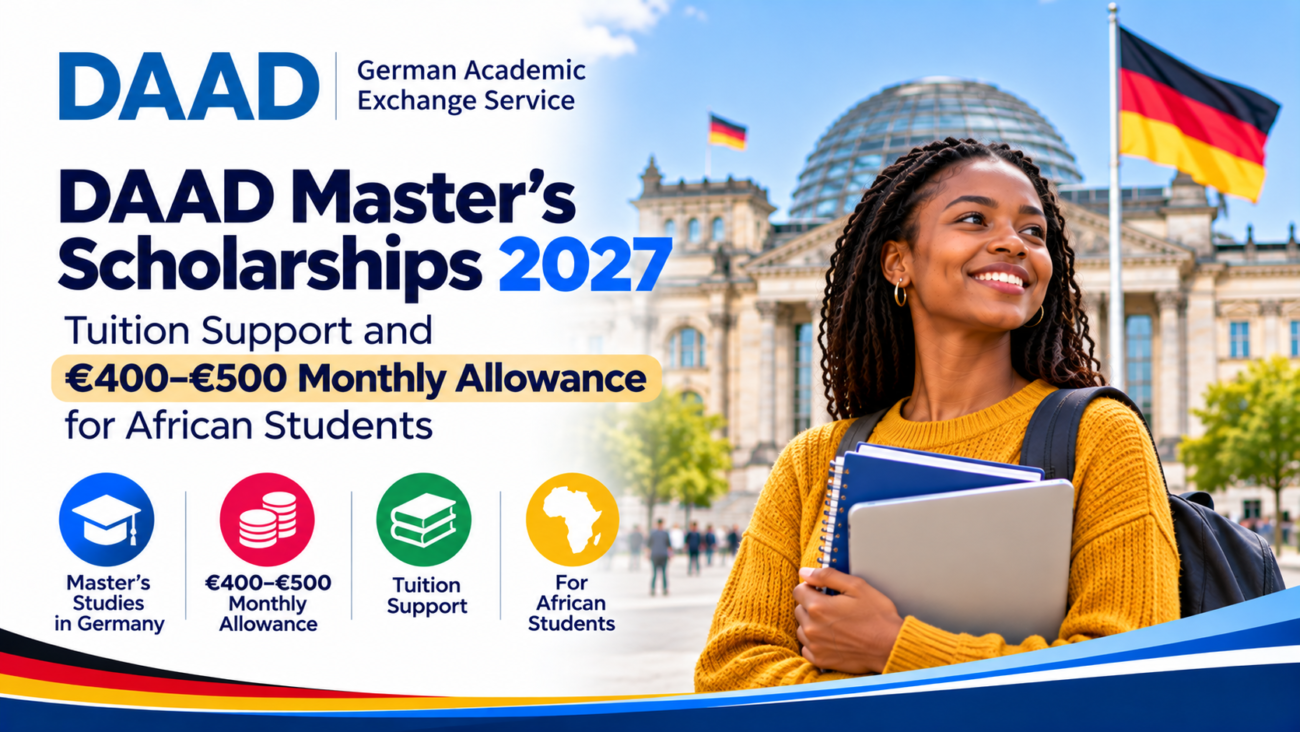
DAAD Master’s Scholarships 2027: Tuition Support and €400–€500 Monthly Allowance for African Students
DAAD Master’s Scholarships 2027: Tuition Support and €400–€500 Monthly Allowance for African Students. The German Academic Exchange Service (DAAD) is offering Master’s scholarship opportunities for students from Sub-Saharan Africa through its In-Country/In-Region Scholarship Programme for 2027. The programme supports postgraduate education at selected universities across Africa, helping graduates develop advanced professional, academic, teaching and research skills.
The scholarships are designed for qualified graduates who want to pursue development-related Master’s programmes in their home countries or in another Sub-Saharan African country. Participating institutions offer programmes in fields such as agriculture, environmental science, public health, engineering, biotechnology, education and other areas relevant to regional development.
One of the featured opportunities is the DAAD scholarship for the Master of Philosophy in Molecular Cell Biology of Infectious Diseases at the West African Centre for Cell Biology of Infectious Pathogens (WACCBIP), University of Ghana. Under this call, successful applicants may receive tuition support, a monthly scholarship of €400 or €500 depending on their funding category, an annual study and research allowance of €460, and €400 towards thesis-publication costs.
The WACCBIP scholarship call offers up to three In-Country and eight In-Region awards, subject to the availability of funding. The application deadline is 12 November 2026.
Applicants should understand that DAAD In-Country/In-Region scholarships are not general awards for any Master’s degree at any university. Funding is restricted to selected programmes and participating institutions, and each programme has its own application instructions and admission requirements.
DAAD Master’s Scholarships 2027: Quick Overview
| Opportunity Details | Information |
|---|---|
| Scholarship programme | DAAD In-Country/In-Region Scholarships |
| Funding cycle | 2027 |
| Funding organisation | German Academic Exchange Service (DAAD) |
| Supporting ministry | German Federal Ministry for Economic Cooperation and Development (BMZ) |
| Study level | Master’s degree |
| Target applicants | Graduates from Sub-Saharan Africa |
| Study location | Selected universities in Sub-Saharan Africa |
| Monthly allowance | €400 In-Country / €500 In-Region under the WACCBIP call |
| Study and research allowance | €460 annually under the WACCBIP call |
| Thesis-publication support | €400 under the WACCBIP call |
| Tuition support | Regular tuition fees, subject to the programme’s award terms |
| Travel support | Available to In-Region scholars under the WACCBIP call |
| Health insurance | Available to In-Region scholars under the WACCBIP call |
| Scholarship duration | Up to 24 months for the WACCBIP Master’s programme |
| Featured institution | University of Ghana – WACCBIP |
| Featured degree | MPhil in Molecular Cell Biology of Infectious Diseases |
| Eligible region | Sub-Saharan Africa |
| Application deadline | 12 November 2026 for the WACCBIP call |
| Application method | Online through the DAAD Portal, plus separate university admission |
Funding note: The €400–€500 monthly allowance and other figures above are taken from the WACCBIP 2027 call. Benefits and amounts can differ between participating universities and individual scholarship calls. Applicants must consult the specific call for their chosen programme.
About the DAAD In-Country/In-Region Scholarship Programme
The German Academic Exchange Service, commonly known as DAAD, is an organisation that supports international academic exchange and cooperation. It provides scholarships and other funding opportunities for students, graduates, researchers and academic professionals.
The In-Country/In-Region Scholarship Programme is designed to strengthen higher education and professional capacity in developing countries, particularly in Sub-Saharan Africa.
Rather than requiring all scholarship recipients to travel to Germany for their degrees, the programme supports postgraduate study at selected universities within applicants’ home countries or elsewhere in their region.
This approach helps strengthen African universities, develop qualified professionals and increase the availability of academic and research expertise.
The programme particularly supports individuals interested in teaching, research and professional careers that contribute to sustainable development.
Its objectives include:
- Training qualified professionals who can contribute to development-related challenges.
- Strengthening teaching and research capacity at African universities.
- Supporting the development of higher education institutions.
- Encouraging the participation of women and disadvantaged groups.
- Building academic networks and cooperation between participating institutions.
- Preparing graduates for responsible positions in their countries and regions.
The programme is supported by Germany’s Federal Ministry for Economic Cooperation and Development (BMZ).
Available DAAD Master’s Programmes for 2027
DAAD Master’s Scholarships 2027: Tuition Support and €400–€500 Monthly Allowance for African Students
DAAD’s September 2026 overview of open calls lists participating universities and postgraduate programmes in West and Central Africa, Eastern Africa and Southern Africa.
The available programmes cover several development-related academic disciplines.
West and Central Africa
The September 2026 DAAD overview includes the following programmes:
| Country | Institution | Master’s programme |
|---|---|---|
| Burkina Faso | Institut International d’Ingénierie de l’Eau et de l’Environnement (2iE) | Water and Environmental Engineering |
| Ghana | University of Ghana – WACCBIP | Molecular Cell Biology of Infectious Diseases |
| Ghana | University of Ghana – WACCI | Seed Science and Technology |
| Ghana | University for Development Studies | Agricultural Economics |
Eastern Africa
The listed opportunities include:
| Country | Institution | Master’s programme |
|---|---|---|
| Ethiopia | Jimma University | Environmental Health |
| Kenya | Chuka University | Plant Breeding |
| Kenya | Moi University | Education in Research |
| Rwanda | University of Rwanda | Electrical Power Systems |
| Tanzania | Ardhi University | Geomatics |
| Uganda | Busitema University | Climate Change and Disaster Management |
Southern Africa
The listed programmes include:
| Country | Institution | Master’s programme |
|---|---|---|
| Malawi | Lilongwe University of Agriculture and Natural Resources (LUANAR) | Aquaculture and Fisheries Science |
| Malawi | Lilongwe University of Agriculture and Natural Resources (LUANAR) | Irrigation Engineering |
| Malawi | Malawi University of Business and Applied Sciences (MUBAS) | Environmental Health |
Important: The DAAD overview identifies participating programmes and their planned study commencement periods. It does not mean that all programmes share the same application deadline, admission procedure or scholarship benefits. Applicants should open the individual programme call before applying.
Featured Opportunity: DAAD WACCBIP Master’s Scholarship 2027
DAAD Master’s Scholarships 2027: Tuition Support and €400–€500 Monthly Allowance for African Students
One of the 2027 opportunities is offered in collaboration with the West African Centre for Cell Biology of Infectious Pathogens (WACCBIP) at the University of Ghana.
The programme provides scholarships for the Master of Philosophy in Molecular Cell Biology of Infectious Diseases.
This postgraduate programme is relevant to graduates interested in molecular biology, infectious diseases, laboratory research, biomedical science and related areas.
The scholarship is intended to develop professionals who can contribute to research, teaching and the advancement of higher education in Sub-Saharan Africa.
Number of Scholarships
The WACCBIP call provides for:
- Up to three In-Country scholarships.
- Up to eight In-Region scholarships.
The awards are subject to the availability of funding from the German Federal Ministry for Economic Cooperation and Development.
Study Location
Successful candidates will study at:
West African Centre for Cell Biology of Infectious Pathogens (WACCBIP), University of Ghana, Legon, Accra, Ghana.
Scholarship Duration
The scholarship covers the standard duration of the selected Master’s programme, up to a maximum of 24 months.
Students applying for a two-year programme should indicate the full two-year period in their scholarship application.
Continuation of funding after the first year depends on an assessment of academic progress and the student’s ability to complete the programme within a reasonable period.
DAAD Master’s Scholarships 2027: Funding and Benefits
The DAAD In-Country/In-Region programme provides financial support to help successful candidates complete their postgraduate studies.
The exact benefits depend on the individual university and scholarship call. The WACCBIP 2027 call provides the following funding package.
1. Monthly Scholarship Allowance
Successful WACCBIP scholarship recipients receive a monthly allowance intended to contribute towards accommodation, food and other living expenses.
The published rates are:
| Scholarship category | Monthly allowance |
|---|---|
| In-Country scholarship | €400 |
| In-Region scholarship | €500 |
An In-Country scholarship is intended for applicants studying in their home country or in a country where they hold a residence permit.
An In-Region scholarship is intended for applicants studying in another country within their home region, outside their home country or the country for which they hold a residence permit.
The monthly rates are reviewed annually and may be adjusted.
2. Tuition Fee Support
The scholarship covers tuition fees according to the regularly charged amount specified in the award letter.
DAAD transfers the approved tuition support directly to the host institution.
However, applicants should understand that not every institutional charge is necessarily covered. Some fees may fall outside the funding agreement, and additional examination costs or fee increases may not be covered.
Applicants should review the university’s fee structure and the scholarship award terms before accepting an offer.
3. Annual Study and Research Allowance
Successful applicants receive a €460 annual study and research allowance under the WACCBIP call.
This support contributes towards academic and research-related expenses during the Master’s programme.
4. Thesis-Publication Support
The scholarship includes a one-time contribution of €400 towards thesis-publication costs.
This funding is intended to support the publication of the student’s final research work towards the end of the scholarship period.
5. Travel Allowance
Travel support is available to In-Region scholarship recipients under the WACCBIP call.
The exact flat-rate amount is specified in the individual Letter of Award.
For programmes lasting longer than 12 months, the travel allowance is generally paid in two instalments, subject to the terms of the award.
6. Health Insurance
Health insurance support is available to In-Region scholarship recipients under the WACCBIP call.
The specific arrangements and amount are provided in the Letter of Award.
7. Short-Term Research Stay in Germany
DAAD Master’s Scholarships 2027: Tuition Support and €400–€500 Monthly Allowance for African Students
Scholarship recipients enrolled in research-based or combined research and coursework Master’s programmes may be encouraged to apply for a short-term research stay in Germany lasting between three and six months.
This additional opportunity is subject to funding availability and must be indicated in the initial scholarship application.
The research stay must fit within the regular funding period of the Master’s programme.
8. Additional Training Opportunities
DAAD scholarship holders may also be invited to participate in further training opportunities, including online training activities.
These opportunities are intended to strengthen academic and professional skills beyond the core degree programme.
Important: DAAD does not necessarily pay all benefits in advance. The first monthly scholarship payment may take time to arrive after the student begins the programme. The WACCBIP call recommends that successful applicants bring sufficient funds to cover at least two months of initial expenses.
DAAD Master’s Scholarships 2027: Eligibility Requirements
Eligibility requirements differ between participating universities and individual Master’s programmes. Applicants should therefore check the specific call before preparing their applications.
For the WACCBIP 2027 Master’s scholarship, applicants must meet the following requirements.
1. Nationality or Permanent Residency
Applicants must be nationals or permanent residents of a Sub-Saharan African country.
Both In-Country and In-Region categories are available, depending on where the applicant intends to study and their home or residence status.
2. Academic Qualifications
Applicants must have successfully completed a three-year or four-year university degree, such as a Bachelor’s degree or equivalent qualification.
The qualification must have above-average academic results, normally at least Second Class Upper Division or an equivalent result.
Candidates who cannot provide evidence of the required academic performance are not eligible under the WACCBIP call.
Applicants must submit their final degree certificate. Provisional certificates are not accepted by DAAD unless the applicant is experiencing circumstances beyond their control and provides the required explanation from their institution.
3. Recency of Previous Degree
Applicants must have completed their most recent university degree no more than six years before the time of application.
Candidates should confirm that their graduation date meets this condition.
4. Language Proficiency
Applicants must demonstrate thorough knowledge of the language of instruction for their chosen programme.
The WACCBIP programme is delivered in English, so applicants should be able to study and communicate effectively in English.
Any additional language documentation required by the university should be checked separately.
5. Motivation and Commitment
Applicants must demonstrate clear motivation and strong commitment to postgraduate study.
The scholarship programme is particularly interested in candidates who intend to contribute to teaching, research and development-related work in Sub-Saharan Africa.
6. Professional and Academic Background
The WACCBIP call identifies several preferred applicant groups, including:
- Staff members of public universities.
- Candidates being considered for teaching or research staff recruitment.
- Applicants working in the public sector.
- Alumni of the DAFI programme.
- Fresh graduates, professionals and other eligible candidates.
Fresh graduates and other candidates who do not fall into the first categories are also invited to apply.
7. Previous DAAD Master’s Scholarship
Applicants who have already received a DAAD Master’s scholarship are not eligible for further DAAD Master’s funding under the WACCBIP call.
8. Additional University Admission Requirements
Meeting DAAD’s scholarship requirements does not automatically guarantee admission to the university.
Applicants must also satisfy the academic and programme-specific admission requirements of WACCBIP or their selected host institution.
Encouraged Applicants
Female applicants, refugees with recognised refugee status and candidates from marginalised regions or disadvantaged groups are especially encouraged to participate.
How to Apply for DAAD Master’s Scholarships 2027
The application process involves two important stages: submitting the DAAD scholarship application and applying separately for admission to the selected university.
Applicants should not assume that submitting one application automatically completes the other.
Step 1: Identify an Eligible Master’s Programme
Visit the official DAAD In-Country/In-Region programme page and review the 2027 open-calls overview.
Identify a participating university and a Master’s programme that matches your academic background and career objectives.
Step 2: Read the Specific Scholarship Call
DAAD Master’s Scholarships 2027: Tuition Support and €400–€500 Monthly Allowance for African Students
Download and read the full call for your selected programme.
Pay attention to:
- Academic eligibility.
- Nationality and residency requirements.
- Required documents.
- Funding benefits.
- Application deadlines.
- University admission procedures.
- Programme commencement dates.
Each participating institution may have additional requirements.
Step 3: Register on the DAAD Portal
Create an account on the official DAAD application portal.
The WACCBIP 2027 call directs applicants.
Follow the instructions provided in the portal and select the correct scholarship programme.
Step 4: Prepare and Upload the Required Documents
Prepare all mandatory documents in the required format and upload them to the relevant sections of the DAAD application portal.
Applicants should ensure that all information is accurate and that their documents are complete before submission.
Step 5: Apply Separately for University Admission
In addition to the DAAD application, candidates must apply for admission to their selected university or programme.
For the featured WACCBIP scholarship, applicants must also follow the University of Ghana’s admission procedures.
The host institution sets its own admission deadline. This deadline may differ from the DAAD scholarship deadline.
Step 6: Submit Before the Deadline
Review the entire application before submitting it.
For the WACCBIP 2027 scholarship, the DAAD application deadline is 12 November 2026.
Incomplete applications or applications submitted after the stated deadline may not be considered.
Required Documents for the DAAD WACCBIP Master’s Scholarship
DAAD Master’s Scholarships 2027: Tuition Support and €400–€500 Monthly Allowance for African Students
Applicants should prepare the following documents for the DAAD application.
1. Completed Online Application Form
The DAAD application form must be completed and submitted through the online portal.
Applicants should ensure that their personal information, academic history and programme details are correct.
2. Curriculum Vitae
A curriculum vitae in tabular format is required.
The CV should clearly present the applicant’s academic qualifications, professional experience, research background, relevant skills and other achievements.
3. DAAD Letter of Recommendation
Applicants must submit the DAAD recommendation form completed by a university teacher who can provide information about their academic qualifications.
The form must be completed, signed and, where possible, stamped.
The specific DAAD recommendation form is mandatory under the WACCBIP call.
4. Bachelor’s Degree Certificate
Applicants must provide a copy of their most recent Bachelor’s degree certificate or equivalent qualification.
The certificate must demonstrate that the applicant has completed the required three-year or four-year university degree.
Provisional certificates are not accepted under the stated requirements.
5. Academic Transcript
Applicants must submit the transcript of records for their most recent university qualification.
The transcript should show their academic results and support the academic performance requirement.
6. Letter of Motivation
Applicants must provide a motivation letter of one to two pages, containing at least 300 and no more than 1,000 words.
The letter should explain:
- Personal motivation for choosing the programme.
- Academic reasons for pursuing the degree.
- Social and professional motivations.
- The relevance of the chosen studies to the applicant’s career plans.
- A possible Master’s project or research interest.
Applicants applying for more than one Master’s programme should clearly rank their programme preferences in the motivation letter.
A maximum of three applications may be considered during the selection process.
7. Passport or National Identity Card
Applicants must provide a copy of a valid passport or national identity card.
The document must be valid at the time of application.
In-Region applicants selected for funding are responsible for ensuring that their travel documents remain valid before travelling to the host country.
Documents That May Be Submitted Later
Some documents may be provided after the initial scholarship application, where permitted by the call.
These include:
- Proof of admission to the host university.
- Semester schedule for coursework-based Master’s programmes.
- Time schedule or work plan for research-based Master’s programmes.
Proof of admission must be submitted before scholarship funding begins.
Applicants should consult the complete call document for the precise upload requirements and deadlines.
How DAAD Scholarship Applications Are Selected
The selection process involves a formal review of applications submitted through the DAAD portal and an assessment of candidates who meet the relevant scholarship and university admission requirements.
For the WACCBIP programme, the host institution and DAAD both play a role in the selection process.
Applications that meet the admission requirements and DAAD’s formal criteria are reviewed by an independent selection committee.
The committee may include international university teachers, experts from German and foreign universities, and alumni.
The assessment considers:
- Academic performance and quality.
- Extracurricular activities.
- Motivation for the chosen programme.
- Relevance of the proposed research topic, where applicable.
- The host institution’s pre-selection ranking.
Interviews may also be conducted.
The selection process for the WACCBIP call typically takes place between April and September. The final decision for the Sub-Saharan Africa region is expected approximately six months after the application process has concluded, although the schedule may change.
The final scholarship decision rests with DAAD.
Important Application Considerations
DAAD Master’s Scholarships 2027: Tuition Support and €400–€500 Monthly Allowance for African Students
Before applying, candidates should keep the following points in mind.
1. DAAD funding is programme-specific.
The scholarship does not automatically cover every Master’s programme at every African university. Applicants must choose from the participating programmes listed in the relevant call.
2. University admission is a separate process.
A DAAD scholarship application does not replace the university admission application. Applicants must complete both processes.
3. Funding amounts may differ.
The €400 and €500 monthly rates are stated in the WACCBIP call. Other participating institutions may have different funding arrangements.
4. Tuition support may not cover every charge.
DAAD may be unable to cover all fees listed by the host institution. Applicants should carefully review the fee conditions in the call and award letter.
5. Funding continuation depends on academic progress.
For the WACCBIP programme, academic performance is reviewed after the first year before continuation of funding.
6. Initial payments may take time.
Applicants should prepare enough money for their initial expenses because the first scholarship payment may not arrive immediately after their arrival.
7. Submit complete documents.
Missing certificates, incomplete recommendation forms or incorrect application information can affect an application.
Frequently Asked Questions About DAAD Master’s Scholarships 2027
1. What are the DAAD Master’s Scholarships 2027?
The DAAD Master’s Scholarships 2027 refer here to the In-Country/In-Region Scholarship Programme, which supports eligible graduates from Sub-Saharan Africa pursuing selected postgraduate programmes at participating African universities.
2. How much is the DAAD monthly allowance?
Under the WACCBIP 2027 call, the monthly scholarship is €400 for In-Country recipients and €500 for In-Region recipients.
Other DAAD programmes may have different rates.
3. Does the scholarship cover tuition fees?
Yes. The WACCBIP call provides tuition support based on the regularly charged amount specified in the award letter. However, some institutional charges, additional examination costs or fee increases may not be covered.
4. Can students from Zimbabwe apply?
Zimbabwe is in Sub-Saharan Africa. Zimbabwean nationals may therefore be eligible to apply for relevant In-Country or In-Region scholarship programmes, provided they meet the requirements of the specific participating university and call.
For the WACCBIP opportunity in Ghana, Zimbabwean applicants would generally be considered under the In-Region category if they meet the nationality, academic and other requirements.
5. Can applicants study in Germany under this scholarship?
The In-Country/In-Region programme supports selected Master’s and doctoral programmes at participating universities in applicants’ home countries or elsewhere in their region. It is not the same as DAAD scholarships for completing an entire Master’s degree in Germany.
Some research-based scholarship holders may be able to apply for an additional short-term research stay in Germany, subject to the programme conditions and funding availability.
6. What academic qualifications are required?
For the WACCBIP call, applicants must hold a completed three-year or four-year Bachelor’s degree or equivalent with at least Second Class Upper Division or an equivalent result.
7. Is work experience compulsory?
The WACCBIP call identifies university staff, public-sector candidates, potential teaching or research staff and DAFI alumni as relevant applicant groups. However, fresh graduates, professionals and other eligible candidates are also invited to apply.
Applicants should check the requirements of their chosen programme.
8. How long does the scholarship last?
The WACCBIP Master’s scholarship covers the standard duration of the programme, up to a maximum of 24 months. Funding continuation after the first year depends on academic progress.
9. Can I apply for more than one DAAD Master’s programme?
The WACCBIP call allows applicants to apply for more than one Master’s programme within the DAAD In-Country/In-Region Scholarship Programme. Applicants must clearly rank their preferences in the motivation letter. A maximum of three applications may be considered during selection.
10. Is a separate university application required?
Yes. Applicants must submit a DAAD scholarship application and separately apply for admission to the host university. The university sets its own admission deadline.
11. When is the DAAD WACCBIP scholarship deadline?
The application deadline for the WACCBIP 2027 Master’s scholarship is 12 November 2026 through the DAAD Portal.
Other participating universities may have different deadlines.
12. Does DAAD provide travel and health insurance support?
Under the WACCBIP call, travel allowance and health insurance support are available to In-Region scholarship holders. These benefits are not listed for In-Country recipients under that call.
13. Can I receive another DAAD Master’s scholarship?
Applicants who have already received a DAAD Master’s scholarship are not eligible for further Master’s funding under the WACCBIP call.
Final Thoughts
DAAD Master’s Scholarships 2027: Tuition Support and €400–€500 Monthly Allowance for African Students
DAAD Master’s Scholarships 2027: Tuition Support and €400–€500 Monthly Allowance for African Students. The DAAD In-Country/In-Region Master’s Scholarships 2027 provide an important opportunity for graduates from Sub-Saharan Africa to pursue postgraduate education at selected African universities.
Through the programme, successful applicants may receive tuition support, monthly living allowances, study and research funding, thesis-publication assistance and other benefits depending on their scholarship category and individual call.
The featured WACCBIP opportunity at the University of Ghana offers a Master’s degree in Molecular Cell Biology of Infectious Diseases, with monthly support of €400 for In-Country recipients or €500 for In-Region recipients. It also provides up to 24 months of scholarship funding, subject to academic progress and the programme’s conditions.
However, applicants should remember that the DAAD programme includes different universities, academic disciplines and funding arrangements. It is essential to select an eligible course, read its individual call and complete both the DAAD scholarship and university admission applications.
For the WACCBIP 2027 opportunity, applications close on 12 November 2026.
Interested applicants should review the official scholarship documents and begin preparing their applications early.
For more scholarships, fellowships, internships and international opportunities, join the Vacancy Bridge WhatsApp Channel:
https://whatsapp.com/channel/0029Vakee9aHFxOyCIBPJA0o
APPLY NOW ON THIS OFFICIAL PAGE
Key Details
- Opportunity: DAAD In-Country/In-Region Master’s Scholarships 2027
- Funding organisation: German Academic Exchange Service (DAAD)
- Supporting ministry: German Federal Ministry for Economic Cooperation and Development (BMZ)
- Study level: Master’s degree
- Target applicants: Graduates from Sub-Saharan Africa
- Study locations: Selected universities across Sub-Saharan Africa
- Monthly allowance: €400 In-Country / €500 In-Region under the WACCBIP call
- Tuition support: Available according to the individual scholarship call
- Annual study and research allowance: €460 under the WACCBIP call
- Thesis-publication support: €400 under the WACCBIP call
- Travel allowance: In-Region recipients under the WACCBIP call
- Health insurance: In-Region recipients under the WACCBIP call
- Featured institution: University of Ghana – WACCBIP
- Featured programme: MPhil in Molecular Cell Biology of Infectious Diseases
- Scholarship duration: Up to 24 months under the WACCBIP call
- Application deadline: 12 November 2026 for WACCBIP
- Application method: DAAD Portal and separate university admission application
SEO Keywords
DAAD Master’s Scholarships 2027, DAAD scholarships 2027 for African students, DAAD In-Country In-Region Scholarships, DAAD scholarships Sub-Saharan Africa, DAAD scholarship €400 monthly, DAAD scholarship €500 monthly, fully funded Master’s scholarships Africa, DAAD tuition support, scholarships for African graduates 2027, University of Ghana DAAD scholarship, WACCBIP DAAD scholarship 2027, Master’s scholarships in Ghana, postgraduate scholarships Africa, international scholarships for African students, DAAD application deadline 2026.
