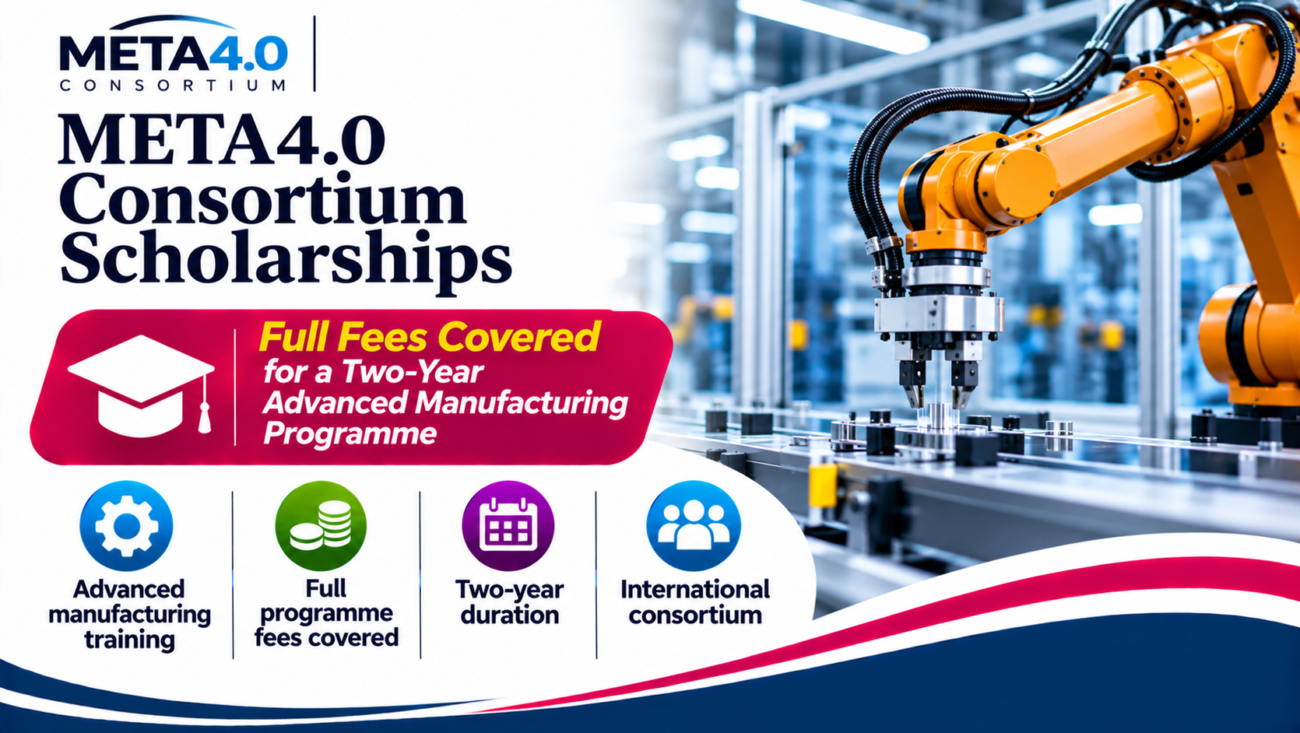
META4.0 Consortium Scholarships 2027–2029: Two Years of Advanced Manufacturing Master’s Programme Fees Covered in Europe
META4.0 Consortium Scholarships 2027–2029: Two Years of Advanced Manufacturing Master’s Programme Fees Covered in Europe. The META4.0 Erasmus Mundus Joint Master in Manufacturing 4.0 is inviting applications for its 2027–2029 intake, offering competitive consortium scholarships to outstanding international students pursuing advanced manufacturing studies across Europe.
The two-year, English-taught master’s programme brings together six universities in France, Italy, Germany, Norway and Slovenia. Selected scholarship recipients can receive coverage of participation costs for all four semesters, including tuition fees, laboratory and library costs, other mandatory programme expenses and an insurance package.
The programme is open to applicants of all nationalities, including Zimbabweans. Candidates generally need a relevant bachelor’s degree in mechanical engineering, materials science and engineering, or potentially mechatronics, together with a strong academic record, mathematics preparation and proof of English proficiency.
Applications for the 2027–2029 intake opened on 15 November 2026 and close on 15 February 2027 at 23:59 Central European Time (Paris time). meta4.0 Erasmus Mundus+2
Scholarship and programme overview
| Detail | Information |
|---|---|
| Programme | META4.0 Joint Master in Manufacturing 4.0 |
| Scholarship | META4.0 Consortium Scholarship |
| Academic level | Master’s degree |
| Duration | Two years (four semesters) |
| Academic credits | 120 ECTS |
| Study format | Full-time, international mobility |
| Teaching language | English |
| Host countries | France, Italy, Germany, Norway and Slovenia |
| Participating universities | Six |
| Scholarship coverage | Participation costs for the full two-year programme |
| Additional coverage | Insurance package, including health insurance under applicable regulations |
| Eligible nationalities | All nationalities |
| Application opening | 15 November 2026 |
| Application deadline | 15 February 2027, 23:59 Paris time |
| Programme commencement | Early September 2027 |
| Application method | Online |
Important funding distinction: The META4.0 Consortium Scholarship is not the same as an Erasmus Mundus scholarship. The 2027–2029 application portal lists consortium scholarships and self-funded admission as the funding routes. The programme’s current information does not promise a monthly living allowance, accommodation payment or travel stipend under the consortium award. meta4.0 Erasmus Mundus+2
1. About the META4.0 Joint Master programme
META4.0 Consortium Scholarships 2027–2029: Two Years of Advanced Manufacturing Master’s Programme Fees Covered in Europe
The META4.0 Consortium offers an international master’s programme titled Manufacturing 4.0 by Intelligent and Sustainable Technologies.
The programme prepares graduates for advanced manufacturing industries undergoing digital transformation and sustainability transitions.
Its central areas of specialisation are:
- Digital Manufacturing.
- Clean Manufacturing.
- Sustainable Manufacturing.
- Smart Manufacturing.
Students combine theoretical engineering education with practical laboratory activities, industrial exposure, specialist training and a five-month work placement linked to the final master’s thesis.
The programme is designed to develop engineers and scientific professionals who can contribute to modern manufacturing, materials engineering, automation, industrial digitalisation and sustainable production. meta4.0+1
2. What does the META4.0 Consortium Scholarship cover?
The consortium scholarship may be awarded to the strongest applicants based on the quality of their applications and academic merit.
For the 2027–2029 intake, the official programme information identifies the following benefits.
Participation costs covered
Full two-year programme participation costs
Four semesters of eligible mandatory programme expenses
Tuition fees
Laboratory costs
Library costs
Other mandatory programme participation costs
Insurance package, including health insurance
The programme’s standard two-year tuition fees are:
| Student classification | Standard programme fees |
|---|---|
| Programme-country students | €9,000 |
| Partner-country students | €18,000 |
The fees are waived for META4.0 Consortium Scholarship recipients from all countries. Zimbabwean applicants are classified under the partner-country fee category, meaning the standard published fee applicable to them is €18,000 over two years.
The scholarship therefore provides substantial tuition and participation-cost support. However, the consortium does not currently publish a guaranteed cash value for every award. meta4.0
What is not confirmed as covered?
Applicants should budget separately for expenses that are not expressly included in the consortium scholarship description.
These include:
- International flights and other travel to Europe.
- Accommodation and rent.
- Meals and daily living expenses.
- Books and personal study materials.
- Personal expenses.
- Other costs not classified as mandatory programme participation expenses.
The programme’s fee information specifically identifies accommodation, travel, meals, books and copies as expenses outside the standard tuition fees.
Do not assume that the consortium scholarship provides the €1,400 monthly living allowance sometimes associated with Erasmus Mundus funding. That allowance belongs to a different scholarship arrangement, and the 2027–2029 intake’s published funding information does not promise it. meta4.0+2
3. The six universities participating in META4.0
META4.0 Consortium Scholarships 2027–2029: Two Years of Advanced Manufacturing Master’s Programme Fees Covered in Europe
The master’s programme is jointly delivered by six European higher education institutions across five countries.
4. What will students study?
The META4.0 programme is a two-year master’s degree worth 120 ECTS credits, divided into four semesters.
Students begin with foundational manufacturing and materials engineering before selecting a specialist manufacturing pathway in the second year.
Year 1: Core manufacturing and materials engineering
60 ECTS
Semester 1 – Fundamentals of manufacturing processes
Location: Saint-Étienne, France | 30 ECTS
The first semester introduces students to production engineering and manufacturing technologies.
Subjects include:
- Production Engineering.
- High Temperature Processes.
- Manufacturing Technologies.
- Additive Manufacturing.
- Metalworking Processes.
- Laser-Matter Interaction.
- Computing and Modelling.
- Materials Science.
- Research Methods.
Students also receive introductory French-language training and participate in practical and interdisciplinary activities.
Semester 2 – Fundamentals of materials
Location: Turin, Italy | 30 ECTS
Students move to Italy for advanced study in materials engineering and technologies used in modern manufacturing.
Topics include:
- Metals for Advanced Manufacturing.
- Materials and Design.
- Materials Forming.
- Surface Science and Technology.
- Failure Analysis: Methods and Practice.
The semester develops knowledge of material structures, properties, manufacturing behaviour and performance.
Year 2: Choose a manufacturing specialisation
META4.0 Consortium Scholarships 2027–2029: Two Years of Advanced Manufacturing Master’s Programme Fees Covered in Europe
30 ECTS
During the third semester, students specialise in one of four pathways.
Specialisation 1: Digital Manufacturing – Norway
This pathway focuses on digital technologies used to modernise manufacturing operations.
Topics include:
- Modelling and simulation.
- Flexible automation.
- Artificial intelligence.
- Industrial communications.
- Digital manufacturing project work.
Specialisation 2: Clean Manufacturing – Slovenia
This pathway examines technologies and engineering methods that support cleaner industrial processes.
Topics include:
- Advanced machining processes.
- Quality engineering.
- Additive technologies.
- Micromanufacturing.
- Energy conversion systems.
- Laser processing technology.
Specialisation 3: Sustainable Manufacturing – France
This pathway explores how manufacturing processes and products can become more sustainable.
Topics include:
- Material durability.
- Surface integrity.
- Wear and material removal.
- Materials characterisation.
- Component repair using additive technologies.
- Responsible engineering.
Specialisation 4: Smart Manufacturing – Germany
This pathway explores connected, intelligent manufacturing systems.
Topics include:
- Instrumentation and sensors.
- Efficient process chains.
- Digital manufacturing.
- Machining technologies.
- Composite-based hybrid technologies.
- Information technology for evaluating material flows.
The consortium notes that the Chemnitz specialisation may currently operate as a credit-mobility track rather than a degree-awarding route, pending national accreditation. Applicants should confirm the qualification arrangements before selecting this pathway. meta4.0+1
Semester 4: Industrial placement and master’s thesis
30 ECTS
The final semester is dedicated to a five-month work placement and master’s thesis.
Students can undertake the placement in:
- An industrial organisation.
- An applied research environment.
- A partner university research laboratory.
- An associated partner organisation.
- Another company or institution offering a suitable research or engineering project.
The thesis is based on the placement and addresses a relevant manufacturing or engineering challenge. meta4.0
5. What degree will graduates receive?
The META4.0 programme offers multiple national master’s degrees, depending on the student’s study choices and specialisation.
The consortium identifies the following degree routes:
| Institution | Master’s qualification |
|---|---|
| École Centrale de Lyon | Mechanical Engineering |
| Polytechnic University of Turin | Materials Engineering for Industry 4.0 |
| Norwegian University of Science and Technology | Sustainable Manufacturing |
| University of Ljubljana | Mechanical Engineering |
| Mines Saint-Étienne | Materials Science and Engineering |
| Chemnitz University of Technology | Advanced Manufacturing* |
*The Chemnitz pathway is currently subject to the programme’s accreditation arrangements. Students following it may receive a transcript of records rather than a separate diploma from Chemnitz.
Graduates receive a degree from École Centrale de Lyon, a degree from Polytechnic University of Turin, and a third degree depending on their specialisation and the applicable degree-awarding arrangements.
A joint diploma supplement is also issued in accordance with the relevant European regulations. meta4.0
6. Who is eligible to apply?
META4.0 Consortium Scholarships 2027–2029: Two Years of Advanced Manufacturing Master’s Programme Fees Covered in Europe
The programme accepts applicants of all nationalities, but the academic requirements are specialised.
Academic qualification
Applicants must hold a Bachelor of Science or Bachelor of Engineering degree equivalent to at least 180 ECTS credits.
The degree must have:
- An average grade of B or higher on the ECTS grading scale.
- At least three years of university-level study.
- A relevant academic background in one of the accepted disciplines.
The eligible academic backgrounds are:
- Mechanical Engineering.
- Materials Science and Engineering.
- Potentially Mechatronics.
Other closely related degrees should not automatically be considered eligible. Applicants with qualifications in industrial engineering, chemical engineering, manufacturing technology or other related disciplines should contact the programme to establish whether their specific curriculum qualifies.
Mathematics requirement
Applicants must demonstrate at least 135 face-to-face teaching hours in mathematics or related subjects.
Accepted areas include:
- Mathematics.
- Statistics and probability.
- Applied mathematics.
- Optimisation.
- Numerical analysis.
- Differential equations.
- Numerical methods.
- Scientific computing techniques.
Applicants must provide evidence of these hours through academic transcripts or other university documentation.
The consortium allows applicants to prepare a calculation of their mathematics teaching hours, including details of the subjects studied and supporting evidence. meta4.0
Final-year undergraduate students
Students who are completing their bachelor’s degrees can apply conditionally.
However, they must provide confirmation that they have graduated by 31 July 2027.
The academic prerequisites must be satisfied by the time of administrative enrolment. meta4.0
7. English-language requirements
The programme is taught entirely in English. Applicants must demonstrate at least B2-level English proficiency using an accepted test or qualifying official university documentation.
The published minimum scores include:
| English test | Minimum requirement |
|---|---|
| IELTS Academic | 6.5 overall, with at least 6.0 in each component |
| TOEFL | Approximately 600 paper-based, 250 computer-based or 95 internet-based |
| Cambridge English | B2 level or Cambridge English First (FCE), Grade A or B |
| TOEIC | 800 |
Test results must not be older than two years at the time of application. meta4.0
Can Zimbabwean applicants use English as their language of instruction?
This is an important point for Zimbabwean applicants.
The programme allows certain applicants to use an official university letter confirming that their previous education was taught in English instead of submitting a language test.
However, the programme’s published list of countries eligible for this exemption does not include Zimbabwe.
Therefore, Zimbabwean applicants should plan to submit an accepted English-language test unless the consortium confirms an alternative exemption in writing.
Do not assume that having studied in English in Zimbabwe automatically removes the test requirement. meta4.0
8. Can Zimbabweans and other African students apply?
All nationalities accepted
Yes. The 2027–2029 application portal explicitly states that applications are open to candidates of all nationalities.
This includes applicants from Zimbabwe and other African countries.
The scholarship selection is based on academic merit and application quality rather than a restricted list of eligible nationalities. However, the consortium applies a nationality-diversity rule: no more than 10% of students on the main admission list may come from the same nationality. meta4.0 Erasmus Mundus+1
For Zimbabwean applicants, the main considerations are:
- Having a relevant engineering or science bachelor’s qualification.
- Achieving at least a B average or equivalent.
- Demonstrating the required 135 mathematics teaching hours.
- Providing an accepted English-language certificate.
- Preparing a strong motivation video.
- Submitting all supporting documents in English.
The programme is particularly relevant to graduates interested in advanced industrial technologies, materials engineering, manufacturing systems and sustainable production.
9. Required application documents
META4.0 Consortium Scholarships 2027–2029: Two Years of Advanced Manufacturing Master’s Programme Fees Covered in Europe
Applicants must complete the online application in English and upload the supporting documents requested by the consortium.
The official application guidance identifies the following documents:
| Required document | Details |
|---|---|
| Curriculum vitae | Must use the Europass CV template |
| Passport photograph | Recent passport-style photograph |
| Passport copy | Identification, photograph, nationality, date of birth, issue and expiry details, and signature |
| Degree certificates | Bachelor’s degree certificate or official graduation confirmation |
| Academic transcripts | Full university academic records, including grades and grading scale |
| English proficiency evidence | Accepted test certificate or qualifying official university letter |
| Mathematics evidence | Proof of at least 135 face-to-face hours of relevant mathematics teaching |
| Proof of residence | Document less than three months old showing the applicant’s name and address |
| META4.0 questionnaire | Mandatory 12-question questionnaire |
| Recommendation letter | One academic or professional reference letter |
| Motivation video | Video or narrated PowerPoint presentation, maximum three minutes |
Documents not originally issued in English must be accompanied by English translations. meta4.0
Important: The three-minute motivation video
META4.0 Consortium Scholarships 2027–2029: Two Years of Advanced Manufacturing Master’s Programme Fees Covered in Europe
The META4.0 application requires a motivation video.
Applicants can submit either:
- A short video showing themselves speaking; or
- A PowerPoint presentation recorded with voice narration.
The maximum duration is three minutes, and the file must be uploaded in MP4 format with a maximum size of 70 MB.
A written covering letter is not accepted as a replacement for the video. meta4.0
The mandatory META4.0 questionnaire
The application includes a 12-question questionnaire containing four scenarios.
The questionnaire is not directly graded as part of the 100-point assessment. However, it may allow the jury to award up to five additional points to an exceptional candidate who demonstrates qualities relevant to the programme. meta4.0
10. How to apply for the META4.0 Consortium Scholarship
Applications are submitted through the consortium’s dedicated online portal.
Step 1: Review the programme requirements
Confirm that your degree, academic results, mathematics background and English proficiency meet the admission conditions.
Step 2: Prepare your Europass CV
Use the official Europass template and ensure that your education, research, employment and professional experience are clearly presented.
Step 3: Gather your academic records
Obtain your degree certificates, complete transcripts and evidence of your mathematics teaching hours.
If you are in your final year, arrange an official letter confirming your expected graduation date.
Step 4: Prepare your English-language evidence
Arrange an accepted English test certificate. If you believe you qualify for an exemption, contact the programme before submitting your application.
Step 5: Obtain a recommendation letter
Request a reference from a university professor or employer. The letter must be in English, signed, printed on institutional letterhead and bear the institution’s stamp.
Step 6: Prepare your motivation video
Record a maximum three-minute presentation explaining your motivation, academic interests, professional aspirations and reasons for choosing META4.0.
Step 7: Complete the questionnaire
Answer the 12 mandatory questions and the four scenarios carefully.
Step 8: Register on the application portal
Create your account on the official META4.0 application platform.
Step 9: Complete the online application
Enter your personal and academic information and upload the required supporting documents.
Step 10: Submit before the deadline
Review the application carefully and submit it by 15 February 2027 at 23:59 Paris time.
Applicants should submit only one application per open call. meta4.0 Erasmus Mundus+1
11. How are applications assessed?
The consortium uses a multi-stage selection process.
Stage 1: Eligibility screening
The admissions team checks:
- Whether the applicant has the required degree level.
- Whether the academic background is relevant.
- Whether the application is complete.
- Whether documents are provided in English.
- Whether the application was submitted before the deadline.
Stage 2: Initial academic pre-scoring
Eligible applications are initially assessed using:
- Relevance of the bachelor’s degree.
- Cumulative undergraduate academic score.
- Ranking of the university where the degree was obtained.
Stage 3: Shortlist evaluation
The top 100 applications are assessed more closely by two independent evaluators from different consortium universities.
The assessment considers:
| Assessment area | What is evaluated |
|---|---|
| Academic achievement and potential | Degree suitability, grades, distinctions, research, publications and English proficiency |
| CV and experience | Academic competencies, professional experience, volunteering and international exposure |
| Motivation video | Motivation, aspirations and personal values |
| META4.0 questionnaire | Relevant personal qualities that may qualify for bonus points |
A third evaluation may also be conducted randomly to help maintain consistency.
Stage 4: Main and reserve lists
The consortium ranks applicants and prepares a main list and a reserve list.
Some candidates may be invited to an interview in English, although interviews are not compulsory for every applicant.
Students on the main list may receive:
- A META4.0 Consortium Scholarship; or
- Admission as self-funded students.
The consortium does not guarantee a scholarship to every admitted student. meta4.0
12. Application deadline and important dates
Applications open
15 February 2027
Application deadline
23:59 Central European Time – Paris
| Programme milestone | Date |
|---|---|
| Applications open | 15 November 2026 |
| Applications close | 15 February 2027 |
| Potential interviews | March 2027 |
| Admission results | By 24 March 2027 |
| Student confirmation period | 25 March–1 April 2027 |
| Graduation deadline for final-year applicants | 31 July 2027 |
| Programme commencement | Early September 2027 |
Information webinars
The consortium has also announced two English-language information webinars:
- 17 December 2026 at 18:00 CET.
- 12 January 2027 at 13:00 CET.
These sessions introduce the programme and provide advice on preparing a stronger application.
Applicants can register through the official application information page. meta4.0
13. How competitive is the scholarship?
META4.0 Consortium Scholarships 2027–2029: Two Years of Advanced Manufacturing Master’s Programme Fees Covered in Europe
META4.0 Consortium Scholarships are awarded to the strongest applicants based on academic merit and application quality.
The programme uses a detailed selection process, so applicants should not rely only on meeting the minimum admission requirements.
A strong application should demonstrate:
Relevant academic preparation: Your bachelor’s degree should closely match the programme’s engineering and materials-science focus.
Strong academic results: A B average or higher is required, but stronger academic performance can help applicants during selection.
Mathematics preparation: Clearly document the required 135 face-to-face teaching hours. Missing or unclear mathematics evidence can affect eligibility.
Research and professional experience: Relevant projects, industrial placements, laboratory work, publications and engineering employment can strengthen the application.
Clear motivation: Explain how the programme connects to your long-term engineering or manufacturing career.
A strong motivation video: Use the three minutes to communicate your academic interests, professional goals and reasons for applying.
Complete documentation: Make sure that every required document is submitted in English and follows the specified format.
Applicants should also remember that the consortium limits the representation of any single nationality to no more than 10% of the main admission list. meta4.0
14. Practical application advice for Zimbabwean engineering graduates
META4.0 Consortium Scholarships 2027–2029: Two Years of Advanced Manufacturing Master’s Programme Fees Covered in Europe
Zimbabwean applicants should pay particular attention to the following issues before applying.
Check degree equivalency. A Zimbabwean bachelor’s degree must be assessed as equivalent to at least 180 ECTS. The programme must also consider the subject content, not simply the degree title.
Calculate your mathematics hours. Review your undergraduate transcripts and module descriptions. Prepare a clear breakdown of mathematics-related face-to-face teaching hours, supported by official academic documentation.
Arrange an English test. Zimbabwe is not on the published list of countries whose English-medium university education automatically qualifies for the language-test exemption. Plan to provide an accepted test certificate unless the consortium confirms otherwise.
Request official transcripts early. Universities may take time to issue complete academic records and certified copies.
Use the Europass CV format. The programme specifically requires this format, so a conventional CV should not be submitted as a substitute.
Prepare your video carefully. A three-minute presentation should communicate your academic background, reasons for choosing advanced manufacturing and what you hope to contribute to the field.
Plan for living costs. Even with a consortium scholarship, accommodation, meals and travel are not automatically covered. Make sure you have a realistic financial plan for studying in several European countries.
Contact the admissions team about borderline degrees. Applicants with chemical engineering, industrial engineering or other related qualifications should obtain written clarification before investing time in the application.
15. Frequently asked questions
1. What is the META4.0 Consortium Scholarship worth?
The consortium has not published a guaranteed cash value for every 2027–2029 award. The scholarship covers participation costs for all four semesters, including tuition, laboratory and library costs, other mandatory programme costs and the applicable insurance package.
2. Is the scholarship fully funded?
It covers the specified programme participation costs, but the published information does not guarantee a monthly living allowance, accommodation, meals or international travel.
3. Can Zimbabweans apply?
Yes. The 2027–2029 application portal accepts candidates of all nationalities, including Zimbabweans.
4. Do I need a bachelor’s degree?
Yes. Applicants generally need a Bachelor of Science or Engineering degree equivalent to 180 ECTS in Mechanical Engineering, Materials Science and Engineering, or potentially Mechatronics.
5. Can chemical engineering graduates apply?
Chemical Engineering is not expressly listed among the standard eligible degree fields. Applicants should contact the consortium with their degree title, transcript and course descriptions to establish whether their academic background can be considered.
6. Is work experience compulsory?
The published eligibility requirements do not specify a minimum number of years of employment. However, relevant professional, research and volunteering experience may strengthen an application.
7. Is IELTS compulsory for Zimbabweans?
The programme accepts several English-language tests. Zimbabwe is not on the published list of countries eligible for the English-medium education exemption, so Zimbabwean applicants should plan to provide an accepted test certificate unless the consortium confirms an alternative.
8. How many universities are involved?
Six universities in France, Italy, Germany, Norway and Slovenia participate in the programme.
9. How long is the programme?
The master’s programme lasts two years, consists of four semesters and carries 120 ECTS credits.
10. Will students receive a monthly stipend?
The published 2027–2029 consortium scholarship information does not promise a monthly stipend. Applicants should not assume that living expenses are included.
11. Is the Erasmus Mundus scholarship available for 2027–2029?
The current 2027–2029 application information identifies META4.0 Consortium Scholarships and self-funded admission. It does not advertise the Erasmus Mundus monthly scholarship for this intake. Applicants should not rely on older Erasmus Mundus scholarship amounts from previous programme editions.
12. What is the deadline?
Applications close on 15 February 2027 at 23:59 Paris time.
13. Can final-year undergraduate students apply?
Yes. They may apply conditionally, provided they complete their degree and confirm graduation by 31 July 2027.
14. Does the programme include an internship?
Yes. The fourth semester includes a five-month work placement linked to the master’s thesis.
JOIN THE VACANCY BRIDGE WHATSAPP CHANNEL
https://whatsapp.com/channel/0029Vakee9aHFxOyCIBPJA0o
APPLY NOW ON THIS OFFICIAL PAGE
Final thoughts
META4.0 Consortium Scholarships 2027–2029: Two Years of Advanced Manufacturing Master’s Programme Fees Covered in Europe
META4.0 Consortium Scholarships 2027–2029: Two Years of Advanced Manufacturing Master’s Programme Fees Covered in Europe. The META4.0 Consortium Scholarship offers an opportunity for academically strong engineering graduates to pursue a specialised two-year master’s degree in advanced manufacturing across five European countries.
The programme combines manufacturing engineering, materials science, digital technologies, sustainability, industrial mobility and a five-month work placement. Its consortium scholarships can remove tuition and other specified mandatory participation costs for the full two-year programme.
For Zimbabwean graduates, the opportunity is particularly relevant to those with backgrounds in mechanical engineering, materials science and engineering, or potentially mechatronics. However, applicants must pay close attention to the 135-hour mathematics requirement and English-language testing conditions.
The scholarship does not automatically cover living expenses, accommodation or international travel, so applicants should plan their finances accordingly.
Applications for the 2027–2029 intake are open, with a deadline of 15 February 2027. Interested graduates should begin preparing their academic transcripts, Europass CV, recommendation letter, mathematics evidence and motivation video well in advance.
SEO keywords
META4.0 Consortium Scholarships 2027, META4.0 Erasmus Mundus 2027–2029, Manufacturing 4.0 master’s scholarship, advanced manufacturing scholarships Europe, engineering scholarships for international students, European manufacturing master’s programme, fully funded engineering master’s Europe, materials science scholarships, mechanical engineering scholarships, scholarships for Zimbabwean engineering graduates, sustainable manufacturing master’s, digital manufacturing postgraduate programme.
