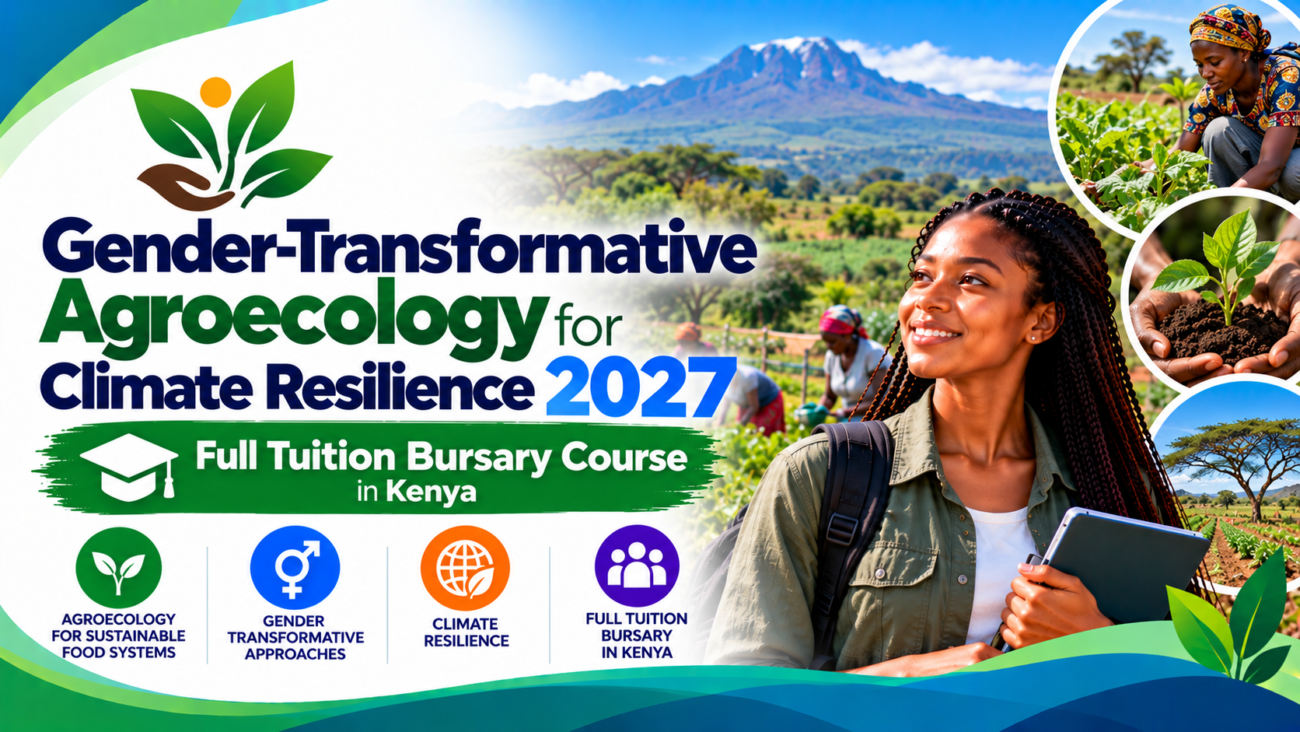
Gender-Transformative Agroecology for Climate Resilience 2027: Full Tuition Bursary Course in Kenya
Gender-Transformative Agroecology for Climate Resilience 2027: Full Tuition Bursary Course in Kenya. Applications are open for the Gender-Transformative Agroecology for Climate Resilience 2027 course, a six-day in-person programme co-delivered by the Coady Institute and Seed Savers Network Kenya. The training will take place from 8–13 March 2027 at the Seed Savers Network Training Center in Gilgil, Kenya, bringing together practitioners interested in agroecology, climate resilience, gender justice, equitable food systems and community-led development.
Accepted participants will receive:
🎓 FULL TUITION BURSARIES
covering the listed course tuition of:
CAD 1,500
as well as:
🏡 ACCOMMODATION
and:
🍽️ THREE MEALS PER DAY
during the course period. Participants are responsible for their own travel to Kenya, visa expenses, insurance and other transportation-related costs.
Applications are scheduled to close on:
📅 1 NOVEMBER 2026
or earlier if the programme reaches its maximum enrolment of:
26 PARTICIPANTS.
⚠️ Important Accuracy Note
This opportunity should not be advertised as a completely fully funded international fellowship.
The programme does provide:
FULL TUITION BURSARIES
and covers:
ACCOMMODATION + THREE MEALS DAILY
for accepted participants.
However, participants are responsible for costs including:
✈️ AIRFARE
🛂 VISA FEES
🏥 TRAVEL CANCELLATION & EMERGENCY MEDICAL INSURANCE
and:
🚐 OTHER TRANSPORTATION COSTS.
The course has:
NO GEOGRAPHIC RESTRICTIONS
but all participants must arrange their own travel to Kenya and must be able to participate in English.
🌱 Quick Overview
| Detail | Information |
|---|---|
| Programme | Gender-Transformative Agroecology for Climate Resilience |
| Organisers | Coady Institute & Seed Savers Network Kenya |
| Year | 2027 |
| Location | Gilgil, Kenya |
| Venue | Seed Savers Network Training Center |
| Format | In Person + Short Online Preparatory Module |
| In-Person Dates | 8–13 March 2027 |
| Arrival | Participants should arrive before course start |
| Duration | 6 Days In Person |
| Online Module Opens | 8 February 2027 |
| Course Language | English |
| Tuition | CAD 1,500 |
| Accepted Participants | Full Tuition Bursary |
| Accommodation | Covered |
| Meals | Three Per Day Covered |
| Flights | Not Covered |
| Visa Costs | Not Covered |
| Insurance | Not Covered |
| Maximum Cohort | 26 Participants |
| Geographic Restrictions | None |
| Deadline | 1 November 2026 or Earlier if Full |
🌍 What Is the Gender-Transformative Agroecology for Climate Resilience Course?
Gender-Transformative Agroecology for Climate Resilience 2027: Full Tuition Bursary Course in Kenya
The course explores the relationship between:
AGROECOLOGY
GENDER TRANSFORMATION
and:
COMMUNITY CLIMATE RESILIENCE.
Agroecology is approached not simply as a method of agricultural production but as:
A SCIENCE
A PRACTICE
and:
A SOCIAL MOVEMENT.
The programme recognises that agriculture is closely connected with:
ECOLOGICAL SYSTEMS
SOCIAL RELATIONS
CULTURE
POWER
and:
COMMUNITY KNOWLEDGE.
Participants will examine how more sustainable food systems can be developed while also addressing inequalities that affect who controls:
LAND
SEEDS
RESOURCES
KNOWLEDGE
and:
DECISION-MAKING.
👩 What Does “Gender-Transformative” Mean?
A gender-transformative approach goes beyond simply including women in existing agricultural systems.
Instead, it seeks to examine and change:
UNEQUAL POWER RELATIONS
SOCIAL NORMS
INSTITUTIONS
and:
STRUCTURAL BARRIERS
that create inequality.
The course therefore connects climate resilience with the idea that genuinely sustainable food systems require both:
🌱 ECOLOGICAL TRANSFORMATION
and:
⚖️ SOCIAL TRANSFORMATION.
This approach is consistent with wider international evidence showing that gender inequalities influence access to natural resources, agricultural services and climate-resilience opportunities.
🌦️ Why Climate Resilience Is Central
Gender-Transformative Agroecology for Climate Resilience 2027: Full Tuition Bursary Course in Kenya
Climate change can create serious challenges for farming communities through:
DROUGHT
UNPREDICTABLE RAINFALL
FLOODING
SOIL DEGRADATION
CROP LOSS
and:
FOOD INSECURITY.
Agroecological approaches can help communities strengthen their ability to adapt by improving:
SOIL HEALTH
BIODIVERSITY
LOCAL SEED SYSTEMS
WATER MANAGEMENT
and:
FARMER KNOWLEDGE.
The course therefore explores how community-led agricultural approaches can contribute to:
ADAPTATION
MITIGATION
and:
LONG-TERM RESILIENCE.
🏫 About the Coady Institute
The Coady Institute is based at St. Francis Xavier University in Canada and focuses on leadership, community development and citizen-led approaches to social change.
Its educational programmes emphasise:
COMMUNITY-DRIVEN DEVELOPMENT
ASSET-BASED APPROACHES
and:
PRACTICAL LEADERSHIP.
The Institute states that it has worked with community leaders from more than:
150 COUNTRIES.
🌾 About Seed Savers Network Kenya
The Seed Savers Network Kenya works with farmers and communities to strengthen:
SEED SOVEREIGNTY
AGROECOLOGY
BIODIVERSITY
and:
COMMUNITY-LED FOOD SYSTEMS.
The organisation also works with farmer networks and Seed Ambassadors, whose practical experience forms an important part of the course learning process.
Its current work includes community-led agroecology and farmers’ rights initiatives in Kenya.
📚 What Will Participants Learn?
The course aims to help participants develop foundational knowledge and practical skills in:
CLIMATE CHANGE
COMMUNITY CLIMATE RESILIENCE
AGROECOLOGY
GENDER-TRANSFORMATIVE PRACTICE
PARTICIPATORY METHODS
and:
COMMUNITY-LED ADVOCACY.
Gender-Transformative Agroecology for Climate Resilience 2027: Full Tuition Bursary Course in Kenya
By the end of the programme, participants should be able to understand how agroecology can contribute to:
CLIMATE ADAPTATION
and:
CLIMATE MITIGATION.
🌱 Agroecology as Science, Practice and Movement
Participants will explore agroecology from several perspectives.
It can function as:
A SCIENTIFIC APPROACH
by examining relationships between farming systems and ecosystems.
It can also function as:
A PRACTICAL APPROACH
through methods used directly by farmers.
And it can operate as:
A MOVEMENT
that promotes:
FOOD SOVEREIGNTY
FARMER KNOWLEDGE
and:
SOCIAL JUSTICE.
⚖️ Gender-Transformative Approaches
Participants will analyse how gender-transformative approaches can strengthen resilience by addressing:
POWER RELATIONS
SOCIAL NORMS
and:
DECISION-MAKING STRUCTURES.
The aim is to understand why environmental resilience and social equity cannot always be separated.
🤝 Participatory and Community-Led Methods
A major part of the course focuses on practical tools for working with communities.
Participants will explore:
STRENGTHS-BASED APPROACHES
FEMINIST APPROACHES
and:
PARTICIPATORY METHODS.
These can help practitioners avoid imposing solutions and instead work with communities to identify:
LOCAL KNOWLEDGE
EXISTING ASSETS
and:
COMMUNITY PRIORITIES.
📣 Advocacy and Policy
The course also explores:
COMMUNITY-LED ADVOCACY
and how it can help create an enabling environment for:
AGROECOLOGY
and:
SEED SOVEREIGNTY.
Gender-Transformative Agroecology for Climate Resilience 2027: Full Tuition Bursary Course in Kenya
Participants will consider how communities and organisations can influence:
POLICY
LEGISLATION
and:
INSTITUTIONAL PRACTICE.
🚜 Hands-On Learning in Kenya
This is not purely a classroom course.
The six-day programme is designed around:
PRACTICAL
PARTICIPATORY
and:
EXPERIENTIAL LEARNING.
Activities will take place at the Seed Savers Network Training Center and on:
NEARBY FARMS.
This gives participants an opportunity to connect concepts with real farming practices.
👨🌾 Learning From Farmers and Seed Ambassadors
Lead farmers and:
SEED AMBASSADORS
from the Seed Savers Network will contribute directly to the course.
Participants will therefore learn from people with first-hand experience of:
AGROECOLOGICAL PRACTICES
SEED SYSTEMS
FOOD SOVEREIGNTY
and:
NAVIGATING UNEQUAL FOOD SYSTEMS.
💻 Mandatory Online Preparatory Module
Before travelling to Gilgil, accepted participants must complete a short:
SELF-PACED ONLINE MODULE.
The module opens on:
📅 8 FEBRUARY 2027.
It covers introductory concepts relating to:
CAUSES OF CLIMATE CHANGE
CLIMATE IMPACTS
ADAPTATION
MITIGATION
and:
RESILIENCE.
🖥️ No Live Online Sessions
The preparatory module is:
ASYNCHRONOUS.
There are no live online sessions during this component.
Participants complete the material independently before arriving in Kenya.
💻 Technology Requirement
Applicants should have access to:
THE INTERNET
and one of the following:
DESKTOP COMPUTER
LAPTOP
TABLET
or:
SMARTPHONE
to complete the online module.
🎯 Who Can Apply?
The course is designed for people interested in the intersection of:
CLIMATE RESILIENCE
and:
EQUITABLE FOOD SYSTEMS
at community level.
Applicants can come from a wide variety of professional and community backgrounds.
👨🌾 Farmers
Farmers interested in:
AGROECOLOGY
SEED SYSTEMS
FOOD SOVEREIGNTY
and:
CLIMATE RESILIENCE
are encouraged to consider the programme.
🤝 NGO and Nonprofit Staff
The course is suitable for staff working with:
NGOs
NONPROFITS
and:
CIVIL SOCIETY ORGANISATIONS.
🏛️ Government Professionals
Professionals working in:
GOVERNMENT
and:
PUBLIC POLICY
are also among the intended participants.
📰 Journalists
The programme specifically welcomes people working in:
JOURNALISM.
This may be particularly relevant for journalists covering:
CLIMATE CHANGE
AGRICULTURE
FOOD SYSTEMS
or:
GENDER.
⚖️ Legal Professionals
People working in:
LAW
are also eligible, especially where their work relates to:
LAND
SEEDS
ENVIRONMENTAL GOVERNANCE
FOOD SYSTEMS
or:
COMMUNITY RIGHTS.
🎓 Academics
Academics interested in engaging more closely with:
GRASSROOTS CHANGE MAKERS
are also welcomed.
🌍 Are There Geographic Restrictions?
No.
The official course page states that there are:
NO GEOGRAPHIC RESTRICTIONS FOR PARTICIPATION.
Gender-Transformative Agroecology for Climate Resilience 2027: Full Tuition Bursary Course in Kenya
This means qualified applicants can apply from:
AFRICA
ASIA
EUROPE
THE AMERICAS
and other regions.
However, participants must make their own arrangements to travel to:
KENYA.
🇿🇼 Can Zimbabweans Apply?
Yes.
There are no geographic restrictions, so applicants from:
🇿🇼 ZIMBABWE
may apply if they meet the programme requirements and can cover their travel-related expenses.
Zimbabwean candidates working in:
AGRICULTURE
CLIMATE RESILIENCE
COMMUNITY DEVELOPMENT
GENDER JUSTICE
FOOD SECURITY
ENVIRONMENTAL POLICY
or:
AGROECOLOGY
may find the programme especially relevant.
🗣️ English Requirement
The course is delivered in:
ENGLISH.
Applicants therefore need sufficient English proficiency to:
PARTICIPATE IN DISCUSSIONS
COMPLETE COURSE MATERIALS
and:
ENGAGE IN GROUP ACTIVITIES.
🎓 How Much Is the Course?
The listed tuition fee is:
CAD 1,500.
However:
ACCEPTED PARTICIPANTS RECEIVE FULL TUITION BURSARIES.
This means selected participants do not have to personally pay the CAD 1,500 tuition charge.
🏡 Is Accommodation Covered?
Yes.
Accommodation is covered for accepted participants.
The current programme information also indicates support around the course period, including the day before and after the training in the accompanying course announcement.
🍽️ Are Meals Covered?
Yes.
Participants receive:
THREE MEALS DAILY
during the covered course period.
✈️ Are Flights Covered?
No.
Participants are responsible for:
AIRFARE TO KENYA
and any other travel expenses associated with reaching the programme venue.
🛂 Are Visa Fees Covered?
No.
Visa costs are the responsibility of the:
PARTICIPANT.
International applicants should therefore check:
KENYA ENTRY REQUIREMENTS
early enough to complete any necessary travel authorisation.
🏥 Is Travel Insurance Covered?
No.
Participants must arrange and pay for:
TRAVEL CANCELLATION INSURANCE
and:
EMERGENCY MEDICAL INSURANCE.
🚌 Transport From Nairobi
The accompanying course announcement states that:
TWO BUS OPTIONS
will be provided from:
NAIROBI
to the:
SEED SAVERS NETWORK TRAINING CENTER
with further details to be shared with participants.
Applicants should still budget for their broader travel costs.
📅 Important Dates
Online Module Opens
📅 8 FEBRUARY 2027.
The preparatory module must be completed before the in-person training begins.
In-Person Course
📅 8–13 MARCH 2027.
The course takes place over:
6 DAYS
in Gilgil, Kenya.
Application Deadline
📅 1 NOVEMBER 2026.
However:
⚠️ APPLICATIONS MAY CLOSE EARLIER
if the maximum cohort of:
26 PARTICIPANTS
is reached.
Applicants should therefore avoid waiting until the final day.
📌 Attendance Requirement
Participants are required to attend:
ALL SIX DAYS
to complete the course.
Applicants should only apply if they can fully participate.
👩🏫 Course Facilitators
The 2027 course facilitators are:
MARIAN TURNIAWAN — COADY INSTITUTE
WAMBUI WAKAHIU — SEED SAVERS NETWORK
and:
TABITHA MUNYIRI — SEED SAVERS NETWORK.
Farmers and Seed Ambassadors from the SSN network will also contribute to the learning experience.
🌱 Learning Outcome 1 — Understand Climate Resilience
Participants should be able to describe key concepts relating to:
CLIMATE CHANGE
COMMUNITY CLIMATE RESILIENCE
and:
AGROECOLOGY.
⚖️ Learning Outcome 2 — Analyse Gender and Power
Participants will examine how gender-transformative approaches can address:
STRUCTURAL INEQUALITIES
and strengthen community resilience by transforming:
POWER RELATIONS
NORMS
and:
DECISION-MAKING PROCESSES.
🤝 Learning Outcome 3 — Apply Participatory Methods
Gender-Transformative Agroecology for Climate Resilience 2027: Full Tuition Bursary Course in Kenya
Participants should develop practical experience with:
PARTICIPATORY
COMMUNITY-LED
STRENGTHS-BASED
and:
FEMINIST APPROACHES.
📣 Learning Outcome 4 — Understand Advocacy
The course also explores how:
COMMUNITY-LED ADVOCACY
can create stronger policy environments for:
AGROECOLOGY
and:
SEED SOVEREIGNTY.
📝 How to Apply
Step 1 — Review Your Fit
Consider whether your work or interests connect to:
CLIMATE RESILIENCE
AGROECOLOGY
GENDER JUSTICE
COMMUNITY DEVELOPMENT
or:
FOOD SYSTEMS.
Step 2 — Confirm Your Availability
You must be able to attend:
8–13 MARCH 2027
in Kenya.
Step 3 — Budget for Travel
Although tuition, accommodation and meals are supported, applicants must budget for:
FLIGHTS
VISAS
INSURANCE
and:
TRANSPORTATION.
Step 4 — Confirm Internet Access
You need internet access and a suitable device to complete the:
MANDATORY ONLINE MODULE.
Step 5 — Apply Through Coady Institute
Complete the official programme application while places remain available.
Step 6 — Apply Before the Deadline
Submit before:
📅 1 NOVEMBER 2026
and preferably earlier because applications may close once the cohort reaches:
26 PARTICIPANTS.
📋 Application Checklist
Before applying, confirm:
✅ Interest in Climate Resilience
Recommended.
✅ Interest in Agroecology
Recommended.
✅ Community / Food Systems Connection
Relevant.
✅ English Proficiency
Required.
✅ Internet Access
Required.
✅ Device for Online Learning
Required.
✅ Online Module
Must be completed.
✅ Six-Day Attendance
Required.
✅ Travel to Kenya
Participant responsibility.
✅ Visa Costs
Participant responsibility.
✅ Travel Insurance
Participant responsibility.
✅ Application Deadline
1 November 2026 or earlier if full.
🎯 How to Strengthen Your Application
🌱 Explain Your Practical Connection to Agroecology
Do not simply say:
“I am interested in sustainable agriculture.”
Explain how your work connects to:
FARMERS
SEEDS
FOOD SYSTEMS
CLIMATE
or:
COMMUNITY DEVELOPMENT.
⚖️ Demonstrate Interest in Gender Justice
Gender-Transformative Agroecology for Climate Resilience 2027: Full Tuition Bursary Course in Kenya
The course is not simply an agricultural training programme.
A strong applicant should understand that the programme also examines:
POWER
INEQUALITY
and:
GENDER RELATIONS.
🤝 Show Community-Level Experience
The programme strongly values:
COMMUNITY-LED ACTION.
Applicants with experience engaging directly with:
FARMERS
COMMUNITY ORGANISATIONS
WOMEN’S GROUPS
YOUTH GROUPS
or:
LOCAL DEVELOPMENT INITIATIVES
should clearly describe that experience.
🌦️ Connect Your Work to Climate Resilience
Explain how the knowledge from the course could help strengthen:
ADAPTATION
FOOD SECURITY
AGRICULTURAL RESILIENCE
or:
COMMUNITY CAPACITY.
📣 Explain How You Will Use the Training
Describe how you could apply the learning after the course through:
TRAINING
PROGRAMME DESIGN
POLICY
ADVOCACY
RESEARCH
or:
COMMUNITY PRACTICE.
⚠️ Common Application Mistakes
Avoid:
- Calling the programme fully funded without explaining travel exclusions
- Assuming airfare is included
- Assuming visa fees are covered
- Ignoring the mandatory online module
- Applying without being able to attend all six days
- Treating the course as purely technical agriculture training
- Ignoring its gender-transformative focus
- Providing no connection to community development
- Waiting until 1 November when the 26 places may already be filled
❓ Frequently Asked Questions
Gender-Transformative Agroecology for Climate Resilience 2027: Full Tuition Bursary Course in Kenya
What is the Gender-Transformative Agroecology for Climate Resilience course?
It is a six-day programme exploring how:
AGROECOLOGY
GENDER-TRANSFORMATIVE PRACTICE
and:
COMMUNITY-LED ACTION
can support more equitable and climate-resilient communities.
Who organises the course?
It is co-delivered by:
COADY INSTITUTE
and:
SEED SAVERS NETWORK KENYA.
Where will it take place?
📍 GILGIL, KENYA
at the:
SEED SAVERS NETWORK TRAINING CENTER.
When is the course?
📅 8–13 MARCH 2027.
How long is the programme?
The in-person training lasts:
6 DAYS.
There is also a short mandatory online module beforehand.
When does the online module open?
📅 8 FEBRUARY 2027.
Is the online module live?
No.
It is:
SELF-PACED AND ASYNCHRONOUS.
How much is tuition?
The listed course tuition is:
CAD 1,500.
Do accepted participants pay tuition?
No.
Accepted participants receive:
FULL TUITION BURSARIES.
Is accommodation included?
Yes.
ACCOMMODATION IS COVERED.
Are meals included?
Yes.
THREE MEALS PER DAY ARE COVERED.
Are flights covered?
No.
Participants pay their own travel costs.
Are visa fees covered?
No.
Is insurance covered?
No.
Travel cancellation and emergency medical insurance are the participant’s responsibility.
Can international applicants apply?
Yes.
There are:
NO GEOGRAPHIC RESTRICTIONS.
Can Zimbabweans apply?
Yes.
Zimbabwean applicants can apply because there are no geographic restrictions.
Is English required?
Yes.
The programme is delivered in:
ENGLISH.
How many participants will be admitted?
The programme has an enrolment cap of:
26 PARTICIPANTS.
What is the application deadline?
📅 1 NOVEMBER 2026
or earlier if all 26 places are filled.
🚀 Final Thoughts
Gender-Transformative Agroecology for Climate Resilience 2027: Full Tuition Bursary Course in Kenya
Gender-Transformative Agroecology for Climate Resilience 2027: Full Tuition Bursary Course in Kenya. The Gender-Transformative Agroecology for Climate Resilience 2027 course offers an excellent opportunity for people working at the intersection of:
🌱 AGROECOLOGY
🌦️ CLIMATE RESILIENCE
⚖️ GENDER JUSTICE
🤝 COMMUNITY DEVELOPMENT
and:
🍲 EQUITABLE FOOD SYSTEMS.
The programme will take place from:
📅 8–13 MARCH 2027
at the:
📍 SEED SAVERS NETWORK TRAINING CENTER IN GILGIL, KENYA.
Accepted participants receive:
🎓 FULL TUITION BURSARIES
for the:
CAD 1,500 COURSE FEE
as well as:
🏡 ACCOMMODATION
and:
🍽️ THREE MEALS DAILY.
Applicants should remember that they remain responsible for:
✈️ TRAVEL
🛂 VISA COSTS
and:
🏥 INSURANCE.
The programme is open internationally with:
NO GEOGRAPHIC RESTRICTIONS
and welcomes farmers, NGO and civil-society staff, government professionals, journalists, legal professionals and academics.
Applications close on:
📅 1 NOVEMBER 2026
but may close sooner once the maximum cohort of:
26 PARTICIPANTS
has been reached.
📲 Join the Vacancy Bridge WhatsApp Channel
Get agriculture training opportunities, climate programmes, African fellowships, agroecology courses, scholarships, grants, internships, UN opportunities and international development programmes through Vacancy Bridge.
👉 Join here: https://whatsapp.com/channel/0029Vakee9aHFxOyCIBPJA0o
APPLY NOW ON THIS OFFICIAL PAGE
🔑 Key Details
Programme: Gender-Transformative Agroecology for Climate Resilience
Organisers: Coady Institute & Seed Savers Network Kenya
Location: Gilgil, Kenya
Venue: Seed Savers Network Training Center
Dates: 8–13 March 2027
Duration: 6 Days In Person
Online Module Opens: 8 February 2027
Programme Format: In Person + Online Preparation
Language: English
Geographic Restrictions: None
Maximum Cohort: 26 Participants
Tuition: CAD 1,500
Tuition Bursary: Full for Accepted Participants
Accommodation: Covered
Meals: Three Per Day Covered
Flights: Not Covered
Visa Fees: Not Covered
Travel Insurance: Not Covered
Emergency Medical Insurance: Not Covered
Farmers: Eligible
NGO / Nonprofit Staff: Eligible
Civil Society Professionals: Eligible
Government Professionals: Eligible
Journalists: Eligible
Legal Professionals: Eligible
Academics: Eligible
Full Attendance: Required
Deadline: 1 November 2026 or Earlier if Cohort Fills
🔎 SEO Keywords
Gender Transformative Agroecology for Climate Resilience 2027, Agroecology Course Kenya 2027, Coady Institute Agroecology Course, Seed Savers Network Kenya Training, Agroecology Training Africa 2027, Climate Resilience Course Kenya, Gender Transformative Agriculture Course, Gender and Agroecology Training, Climate Smart Agriculture Training Kenya, Full Tuition Bursary Kenya 2027, Agriculture Course With Accommodation, Seed Savers Network Gilgil Kenya, Coady Institute Courses 2027, Agroecology Fellowship Africa, Sustainable Agriculture Training Africa, Food Systems Training Kenya, Climate Resilience Training Africa, Gender Justice Agriculture Africa, Community Development Course Kenya, Farmer Training Kenya 2027, Agroecology Course for NGOs, Climate Course for African Professionals, Gender Transformative Food Systems, Seed Sovereignty Training Africa, Agroecology and Climate Change Course, Community Led Climate Resilience, Sustainable Food Systems Training, Kenya Agriculture Opportunities 2027, Agriculture Scholarships Africa 2027, Agroecology Opportunities Zimbabwe, Climate Training for Zimbabweans, International Agroecology Course 2027, Gilgil Kenya Training Program, Coady Institute Scholarship, Full Tuition Bursary Africa, Climate Resilience Fellowship Africa, Gender Equality Agriculture Training, Food Security Training Africa, Seed Sovereignty Course Kenya, Vacancy Bridge.
