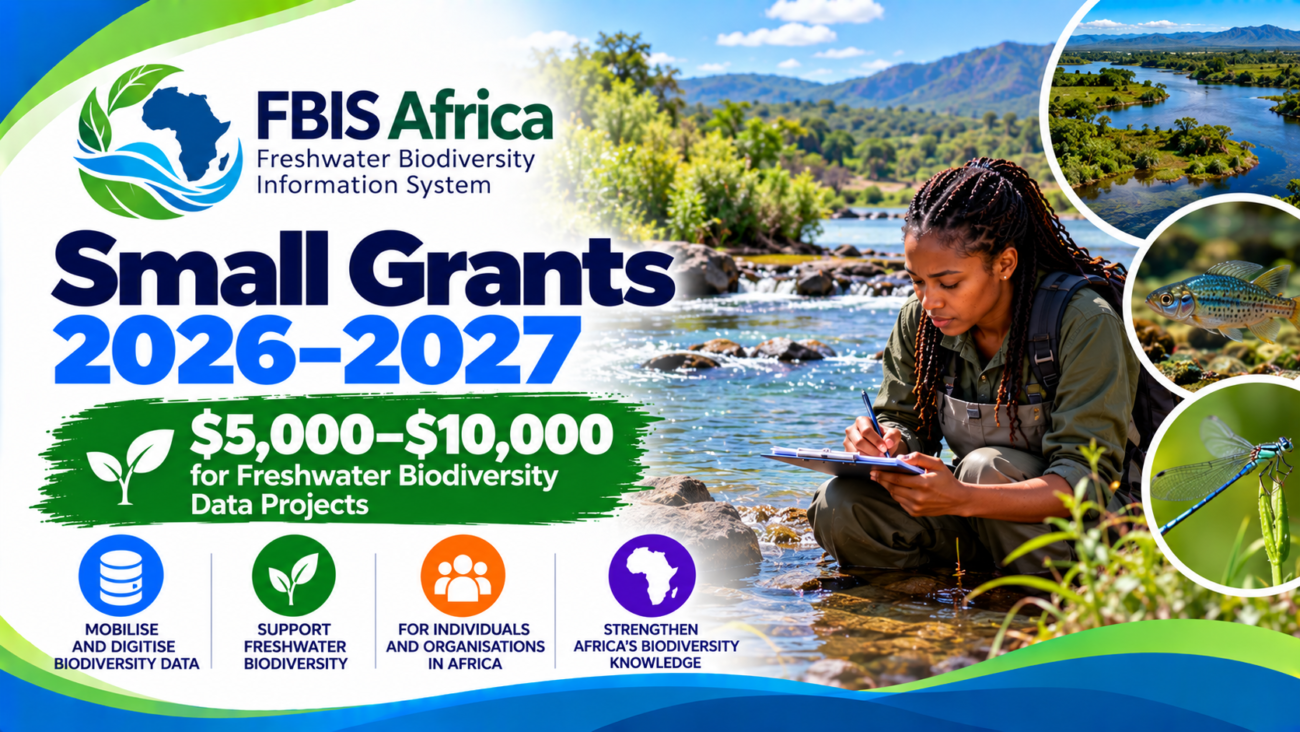
FBIS Africa Small Grants 2026–2027: $5,000–$10,000 for Freshwater Biodiversity Data Projects
FBIS Africa Small Grants 2026–2027: $5,000–$10,000 for Freshwater Biodiversity Data Projects. The FBIS Africa project has announced a new small-grants opportunity offering between US$5,000 and US$10,000 to suitable individuals and organisations working with freshwater biodiversity data in Africa. The funding will support projects that mobilise, digitise and make existing freshwater biodiversity occurrence records more accessible, particularly datasets considered important for improving knowledge of freshwater species and ecosystems across the continent.
The call creates an opportunity for researchers, biodiversity specialists, universities, museums, conservation organisations, data custodians and other suitable applicants who hold valuable freshwater biodiversity information that has not yet been fully digitised or mobilised.
💰 US$5,000–US$10,000
will be available through the small-grants programme for successful projects.
⚠️ Important Accuracy Note
The information supplied for this opportunity confirms that the FBIS Africa project will award small grants of:
US$5,000–US$10,000
for the mobilisation and digitisation of existing freshwater biodiversity occurrence datasets in Africa.
However, the announcement provided does not specify:
- Application deadline
- Exact eligible countries
- Number of grants available
- Project duration
- Detailed eligibility criteria
- Application documents
- Application portal
- Funding disbursement arrangements
Applicants should therefore check the full official call when it becomes available before submitting an application.
🌍 FBIS Africa Small Grants: Quick Overview
| Detail | Information |
|---|---|
| Programme | FBIS Africa Small Grants |
| Region | Africa |
| Funding | US$5,000–US$10,000 |
| Main Focus | Freshwater Biodiversity Data |
| Primary Activity | Dataset Mobilisation & Digitisation |
| Data Type | Freshwater Biodiversity Occurrence Records |
| Target Data | Priority Existing Datasets |
| Applicants | Suitable Individuals or Organisations |
| Researchers | Potentially Relevant |
| Universities | Potentially Relevant |
| Conservation Organisations | Potentially Relevant |
| Museums / Collections | Potentially Relevant |
| New Field Data Collection | Not Specified |
| Application Deadline | Not Provided in Announcement |
| Project Duration | Not Provided |
| Number of Awards | Not Provided |
🌊 What Is the FBIS Africa Small Grants Opportunity?
FBIS Africa Small Grants 2026–2027: $5,000–$10,000 for Freshwater Biodiversity Data Projects
The grant programme focuses on improving access to existing information about:
FRESHWATER BIODIVERSITY IN AFRICA.
Many valuable biodiversity records may already exist in:
RESEARCH DATABASES
MUSEUM COLLECTIONS
UNIVERSITY ARCHIVES
SPREADSHEETS
FIELD-SURVEY RECORDS
INSTITUTIONAL DATABASES
or:
OTHER DATASETS.
However, some of these records may not yet be properly:
DIGITISED
STANDARDISED
MOBILISED
or:
MADE ACCESSIBLE FOR WIDER USE.
The FBIS Africa small grants are intended to help address this challenge.
📊 What Are Freshwater Biodiversity Occurrence Records?
Biodiversity occurrence records document where organisms have been:
OBSERVED
COLLECTED
or:
RECORDED.
In freshwater ecosystems, these records may relate to species found in environments such as:
🌊 RIVERS
🏞️ LAKES
💧 WETLANDS
🏔️ STREAMS
🌿 FLOODPLAINS
and other inland freshwater ecosystems.
Depending on the dataset, occurrence records may include information such as:
SPECIES NAME
LOCATION
DATE OF OBSERVATION
COORDINATES
COLLECTOR OR OBSERVER
and:
SOURCE COLLECTION.
The exact information required by FBIS Africa should be confirmed in the full grant guidelines.
💰 How Much Funding Is Available?
FBIS Africa Small Grants 2026–2027: $5,000–$10,000 for Freshwater Biodiversity Data Projects
Successful applicants can receive between:
US$5,000
and:
US$10,000.
The exact amount awarded to each project may depend on the:
DATASET
SCOPE OF DIGITISATION
PROJECT ACTIVITIES
and:
APPROVED BUDGET.
The announcement supplied does not specify whether every successful project will receive the full US$10,000.
Applicants should therefore regard:
US$10,000
as the upper grant amount rather than a guaranteed award.
🎯 What Will the Grants Support?
The announcement specifically identifies:
MOBILISATION
and:
DIGITISATION
of priority existing freshwater biodiversity datasets.
This means projects should focus primarily on:
EXISTING DATA
rather than assuming that the programme funds completely new biodiversity surveys.
💻 Dataset Digitisation
Digitisation may involve converting biodiversity information from formats such as:
PAPER RECORDS
ARCHIVE DOCUMENTS
SPECIMEN LABELS
LEGACY DATABASES
or:
UNSTRUCTURED DIGITAL FILES
into more useful digital records.
🌐 Data Mobilisation
Data mobilisation can involve preparing existing records so they can be:
DISCOVERED
SHARED
ANALYSED
and:
USED MORE WIDELY.
This may require tasks such as:
DATA CLEANING
STANDARDISATION
QUALITY CONTROL
TAXONOMIC VERIFICATION
GEOGRAPHIC INFORMATION CLEAN-UP
and:
DATABASE PREPARATION,
FBIS Africa Small Grants 2026–2027: $5,000–$10,000 for Freshwater Biodiversity Data Projects
depending on the final programme requirements.
🌿 Why Freshwater Biodiversity Data Matters
Freshwater ecosystems contain important biodiversity but can face pressures from:
POLLUTION
HABITAT LOSS
CLIMATE CHANGE
WATER EXTRACTION
INVASIVE SPECIES
and:
LAND-USE CHANGE.
Better biodiversity information can support stronger decisions in areas such as:
CONSERVATION PLANNING
SPECIES ASSESSMENT
ENVIRONMENTAL MANAGEMENT
RESEARCH
and:
POLICY.
Making historical and existing datasets accessible can therefore significantly increase their value.
🗂️ What Types of Datasets May Be Relevant?
Based on the stated purpose of the grant, potentially relevant datasets could include existing records relating to freshwater:
🐟 FISH
🐸 AMPHIBIANS
🦀 AQUATIC INVERTEBRATES
🌱 AQUATIC PLANTS
🪲 FRESHWATER INSECTS
🦐 CRUSTACEANS
🐌 MOLLUSCS
and other freshwater-associated species.
However, the supplied announcement does not list specific taxonomic groups.
Applicants should therefore consult the complete FBIS Africa call before assuming their dataset qualifies.
👤 Who Can Apply?
The announcement states that grants will be awarded to suitable:
INDIVIDUALS
or:
ORGANISATIONS.
This potentially creates opportunities for a broad range of data holders.
Possible applicants could include:
🎓 RESEARCHERS
🏛️ UNIVERSITIES
🧪 RESEARCH INSTITUTES
🏺 NATURAL-HISTORY COLLECTIONS
🌱 CONSERVATION ORGANISATIONS
🤝 NGOs
📊 BIODIVERSITY DATA SPECIALISTS
and:
🧑🔬 INDEPENDENT SPECIALISTS
FBIS Africa Small Grants 2026–2027: $5,000–$10,000 for Freshwater Biodiversity Data Projects
where they satisfy the final programme criteria.
The full eligibility conditions have not been provided in the announcement supplied.
🏛️ Universities and Research Institutions
Universities may hold significant amounts of biodiversity data from:
STUDENT THESES
FACULTY RESEARCH
LONG-TERM MONITORING
FIELD COURSES
and:
RESEARCH PROJECTS.
Datasets like these may become valuable candidates for mobilisation if they fit FBIS Africa’s priorities.
🏺 Museums and Biological Collections
Museums and research collections can hold biodiversity records that have accumulated over many years.
Where these records remain:
PAPER-BASED
or:
PARTIALLY DIGITISED,
small-grant support could potentially help unlock their scientific value.
🌱 NGOs and Conservation Organisations
Conservation organisations may also hold historical freshwater data gathered through:
BIODIVERSITY SURVEYS
CONSERVATION PROJECTS
WETLAND PROGRAMMES
ENVIRONMENTAL MONITORING
or:
COMMUNITY-BASED CONSERVATION INITIATIVES.
👩🔬 Individual Researchers
The announcement explicitly refers to:
INDIVIDUALS
as potential grant recipients.
Researchers who personally manage or have legitimate access to significant existing freshwater datasets may therefore be able to apply, subject to the full eligibility conditions.
🌍 Is the Grant Africa-Focused?
Yes.
The programme specifically concerns:
FRESHWATER BIODIVERSITY OCCURRENCE RECORDS IN AFRICA.
Projects should therefore have a clear connection to freshwater biodiversity datasets from the African continent.
🇿🇼 Can Zimbabwean Researchers Apply?
Potentially.
The announcement describes the programme as an Africa-focused initiative and does not provide a country exclusion list.
Researchers or organisations in Zimbabwe holding important existing freshwater biodiversity datasets could therefore find the call relevant.
However, the detailed country-eligibility rules have not been supplied and should be checked once the full application guidance is available.
📚 What Could Make a Dataset a Priority?
The announcement uses the phrase:
PRIORITY EXISTING FRESHWATER BIODIVERSITY DATASETS.
It does not provide a formal definition of “priority.”
Applicants may therefore eventually need to demonstrate why their dataset is important.
Factors that could potentially strengthen the case include:
UNIQUE RECORDS
HISTORICAL RECORDS
POORLY DOCUMENTED REGIONS
THREATENED SPECIES
UNDERREPRESENTED TAXA
HIGH-BIODIVERSITY AREAS
or:
DATASETS USEFUL FOR CONSERVATION DECISION-MAKING.
FBIS Africa Small Grants 2026–2027: $5,000–$10,000 for Freshwater Biodiversity Data Projects
These are examples of how applicants might frame value; the definitive priorities must come from FBIS Africa’s full call.
🔍 Questions Applicants Should Be Ready to Answer
A strong proposal may need to explain:
WHAT DATASET DO YOU HOLD?
HOW MANY RECORDS DOES IT CONTAIN?
WHICH SPECIES OR TAXA ARE INCLUDED?
WHICH COUNTRIES OR FRESHWATER SYSTEMS DOES IT COVER?
WHAT FORMAT IS IT CURRENTLY IN?
WHY IS THE DATASET IMPORTANT?
WHY HAS IT NOT YET BEEN MOBILISED?
and:
WHAT WILL THE GRANT ENABLE YOU TO COMPLETE?
🧹 Data Quality
Digitising biodiversity records is not simply:
COPYING INFORMATION INTO A SPREADSHEET.
Strong projects may need careful quality-control processes to identify:
DUPLICATES
MISSPELLINGS
INVALID COORDINATES
TAXONOMIC CHANGES
MISSING DATES
or:
OTHER DATA-QUALITY ISSUES.
🗺️ Geographic Information
Occurrence data becomes particularly useful when records can be linked to reliable:
LOCATIONS
or:
GEOGRAPHIC COORDINATES.
Older collections may only provide written place names, which can make mobilisation more challenging.
Applicants should consider how much work may be required to:
GEOREFERENCE HISTORICAL RECORDS.
FBIS Africa Small Grants 2026–2027: $5,000–$10,000 for Freshwater Biodiversity Data Projects
🧬 Taxonomic Quality
Species names can change over time.
Historical records may use:
OLDER TAXONOMIC NAMES
or:
SYNONYMS.
Projects may therefore need taxonomic expertise to ensure records are correctly interpreted.
📈 Potential Benefits of Successful Data Mobilisation
A successfully digitised dataset can support:
SPECIES-DISTRIBUTION RESEARCH
BIODIVERSITY MAPPING
CONSERVATION PRIORITISATION
THREAT ASSESSMENTS
ENVIRONMENTAL IMPACT STUDIES
CLIMATE-CHANGE RESEARCH
and:
FRESHWATER POLICY.
💡 Preparing a Strong Grant Concept
FBIS Africa Small Grants 2026–2027: $5,000–$10,000 for Freshwater Biodiversity Data Projects
Before applications open or before submitting, potential applicants should begin documenting their datasets.
Step 1 — Identify the Dataset
Clearly establish:
WHO OWNS OR CUSTODIES THE DATA
and:
WHAT THE DATASET CONTAINS.
Step 2 — Estimate the Number of Records
Determine approximately how many occurrence records require:
DIGITISATION
or:
MOBILISATION.
Step 3 — Assess Current Format
Is the data currently held in:
PAPER FORM
EXCEL
ACCESS DATABASES
PDFs
MUSEUM CATALOGUES
or another format?
Step 4 — Assess Data Quality
Identify likely problems involving:
TAXONOMY
COORDINATES
DATES
and:
DUPLICATES.
FBIS Africa Small Grants 2026–2027: $5,000–$10,000 for Freshwater Biodiversity Data Projects
Step 5 — Explain Biodiversity Importance
Explain why the dataset should be considered:
A PRIORITY.
Step 6 — Create a Work Plan
Break mobilisation into realistic stages such as:
DATA ENTRY
CLEANING
TAXONOMIC REVIEW
GEOREFERENCING
QUALITY CONTROL
and:
FINAL DATA PREPARATION.
Step 7 — Prepare a Budget
The available grant range is:
US$5,000–US$10,000.
Applicants should prepare a realistic budget linked directly to dataset mobilisation.
📋 Preparation Checklist
Potential applicants should prepare:
✅ Dataset Description
What does the dataset contain?
✅ Number of Records
Estimate the scale.
✅ Taxonomic Scope
Which organisms are represented?
✅ Geographic Scope
Which countries, rivers, lakes or wetlands?
✅ Current Data Format
Paper or digital?
✅ Data Ownership
Clarify permissions and custodianship.
✅ Digitisation Needs
Clearly identified.
✅ Data Quality Needs
Clearly identified.
✅ Project Team
Identify people with the necessary expertise.
✅ Work Plan
Prepare realistic activities.
✅ Budget
Between US$5,000 and US$10,000 where appropriate.
✅ Conservation Value
Explain why mobilisation matters.
🎯 How to Strengthen an Application
🌊 Demonstrate the Dataset’s Importance
FBIS Africa Small Grants 2026–2027: $5,000–$10,000 for Freshwater Biodiversity Data Projects
Do not simply write:
“We have freshwater biodiversity data.”
Explain:
WHY THE DATA IS UNIQUE
WHAT INFORMATION IT ADDS
and:
WHO COULD USE IT.
📊 Quantify the Dataset
Where possible, state:
NUMBER OF RECORDS
NUMBER OF SPECIES
YEARS COVERED
and:
GEOGRAPHIC AREA.
🗃️ Clearly Explain the Mobilisation Problem
Describe what currently prevents the dataset from being useful.
For example:
PAPER-ONLY RECORDS
INCONSISTENT FORMATS
UNSTANDARDISED NAMES
or:
MISSING GEOREFERENCING.
🌍 Connect the Work to Conservation
Explain how accessible data could support:
FRESHWATER CONSERVATION
BIODIVERSITY MONITORING
RESEARCH
or:
POLICY.
💰 Keep the Budget Focused
Avoid adding activities unrelated to the central purpose of:
DIGITISING AND MOBILISING EXISTING DATA.
⚠️ Common Application Mistakes to Avoid
Potential applicants should avoid:
- Treating US$10,000 as guaranteed funding
- Proposing an unrelated conservation project
- Focusing mainly on new field surveys when the call concerns existing datasets
- Failing to identify the actual dataset
- Failing to demonstrate ownership or permission to mobilise the records
- Underestimating taxonomic and geographic data-cleaning needs
- Providing no estimate of the number of records
- Failing to explain why the dataset is a priority
- Inventing an application deadline
- Assuming every African individual or organisation automatically qualifies before reading the full guidelines
❓ Frequently Asked Questions
FBIS Africa Small Grants 2026–2027: $5,000–$10,000 for Freshwater Biodiversity Data Projects
What is the FBIS Africa Small Grants Programme?
It is a funding opportunity supporting the:
MOBILISATION AND DIGITISATION OF EXISTING FRESHWATER BIODIVERSITY OCCURRENCE DATASETS IN AFRICA.
How much funding is available?
Grants will range from:
💰 US$5,000–US$10,000.
Is US$10,000 guaranteed?
No.
The announcement states that grants will range between US$5,000 and US$10,000.
Who can apply?
The announcement states that suitable:
INDIVIDUALS
and:
ORGANISATIONS
can receive funding.
Detailed eligibility conditions have not been provided in the paragraph supplied.
What type of data is targeted?
Priority existing:
FRESHWATER BIODIVERSITY OCCURRENCE RECORDS.
Is the grant for collecting entirely new data?
The supplied announcement specifically focuses on:
MOBILISING / DIGITISING EXISTING DATASETS.
It does not state that new field-data collection is a primary funding purpose.
Can universities apply?
Potentially, if they satisfy the programme’s final criteria.
Can researchers apply?
Yes, potentially, because the announcement explicitly includes suitable individuals.
Can NGOs apply?
Potentially, subject to the full eligibility conditions.
Can museums apply?
Potentially, especially where they hold relevant freshwater biodiversity occurrence collections, subject to the official rules.
Can Zimbabwean applicants apply?
Potentially.
The programme concerns African freshwater biodiversity, but the detailed country eligibility list has not been supplied.
What is the deadline?
The paragraph supplied does:
NOT STATE AN APPLICATION DEADLINE.
Applicants should consult the official FBIS Africa call before applying.
How long can projects run?
The supplied announcement does:
NOT SPECIFY THE PROJECT DURATION.
How many grants will be awarded?
The announcement supplied does:
NOT STATE THE NUMBER OF AWARDS.
🚀 Final Thoughts
FBIS Africa Small Grants 2026–2027: $5,000–$10,000 for Freshwater Biodiversity Data Projects
FBIS Africa Small Grants 2026–2027: $5,000–$10,000 for Freshwater Biodiversity Data Projects. The FBIS Africa Small Grants 2026–2027 present a useful funding opportunity for individuals and organisations holding important freshwater biodiversity information that has not yet been fully:
DIGITISED
STANDARDISED
or:
MOBILISED.
Successful applicants can receive between:
💰 US$5,000 AND US$10,000
to work on priority existing freshwater biodiversity occurrence datasets from Africa.
The opportunity could be particularly relevant to:
🎓 UNIVERSITIES
🔬 RESEARCHERS
🏺 MUSEUMS & COLLECTIONS
🌱 CONSERVATION ORGANISATIONS
🤝 NGOs
and:
📊 BIODIVERSITY DATA SPECIALISTS
with valuable freshwater records that could support future:
CONSERVATION
RESEARCH
BIODIVERSITY ASSESSMENT
and:
ENVIRONMENTAL DECISION-MAKING.
The central purpose of the grant is clear:
TURN EXISTING FRESHWATER BIODIVERSITY INFORMATION INTO MORE ACCESSIBLE AND USEFUL DATA.
Applicants should begin identifying their priority datasets, estimating the number of records involved, documenting their current format and preparing a realistic digitisation and mobilisation plan.
Because the supplied announcement does not yet provide the deadline, full eligibility rules or application process, prospective applicants should confirm these details from the complete FBIS Africa grant call before submitting.
📲 Join the Vacancy Bridge WhatsApp Channel
Get African research grants, biodiversity funding, conservation grants, environmental opportunities, fellowships, scholarships, internships, UN opportunities and international funding calls through Vacancy Bridge.
👉 Join here: https://whatsapp.com/channel/0029Vakee9aHFxOyCIBPJA0o
APPLY NOW ON THIS OFFICIAL PAGE
🔑 Key Details
Funder / Programme: FBIS Africa
Opportunity: Small Grants for Freshwater Biodiversity Data Mobilisation
Region: Africa
Grant Amount: US$5,000–US$10,000
Main Purpose: Mobilisation and Digitisation of Existing Freshwater Biodiversity Data
Data Type: Freshwater Biodiversity Occurrence Records
Priority: Existing Priority Datasets
Eligible Applicants: Suitable Individuals & Organisations
Universities: Potentially Relevant
Researchers: Potentially Relevant
Museums / Collections: Potentially Relevant
Conservation Organisations: Potentially Relevant
New Field Surveys: Not Identified as Primary Purpose in Supplied Announcement
Deadline: Not Specified in Supplied Announcement
Project Duration: Not Specified
Number of Grants: Not Specified
Full Application Requirements: Awaiting / Not Included in Supplied Information
🔎 SEO Keywords
FBIS Africa Small Grants, FBIS Africa Grants 2026, FBIS Africa Grants 2027, Freshwater Biodiversity Grants Africa, Freshwater Biodiversity Funding Africa, $10000 Biodiversity Grant Africa, Biodiversity Data Grant Africa, Freshwater Data Mobilisation Grant, Biodiversity Digitisation Funding, Africa Biodiversity Data Funding, Freshwater Research Grants Africa, Conservation Grants Africa 2026, African Biodiversity Funding 2027, Freshwater Biodiversity Occurrence Records, Species Occurrence Data Africa, Biodiversity Database Grants, Research Data Digitisation Grant, Museum Biodiversity Digitisation Funding, University Research Grants Africa, Conservation Organisation Grants Africa, Freshwater Ecology Grants, Aquatic Biodiversity Grants Africa, Biodiversity Informatics Africa, African Freshwater Research Funding, Freshwater Fish Data Africa, Aquatic Invertebrate Data Africa, Wetland Biodiversity Grants, River Biodiversity Funding Africa, Lake Biodiversity Research Africa, Biodiversity Data Mobilisation, Biodiversity Data Digitisation, Conservation Data Grants, African Environmental Grants, Research Grants for African Scientists, Small Grants for Researchers Africa, Small Grants for Conservation Organisations, Biodiversity Grant for Individuals Africa, FBIS Africa Application, FBIS Africa Funding Opportunity, Vacancy Bridge.
