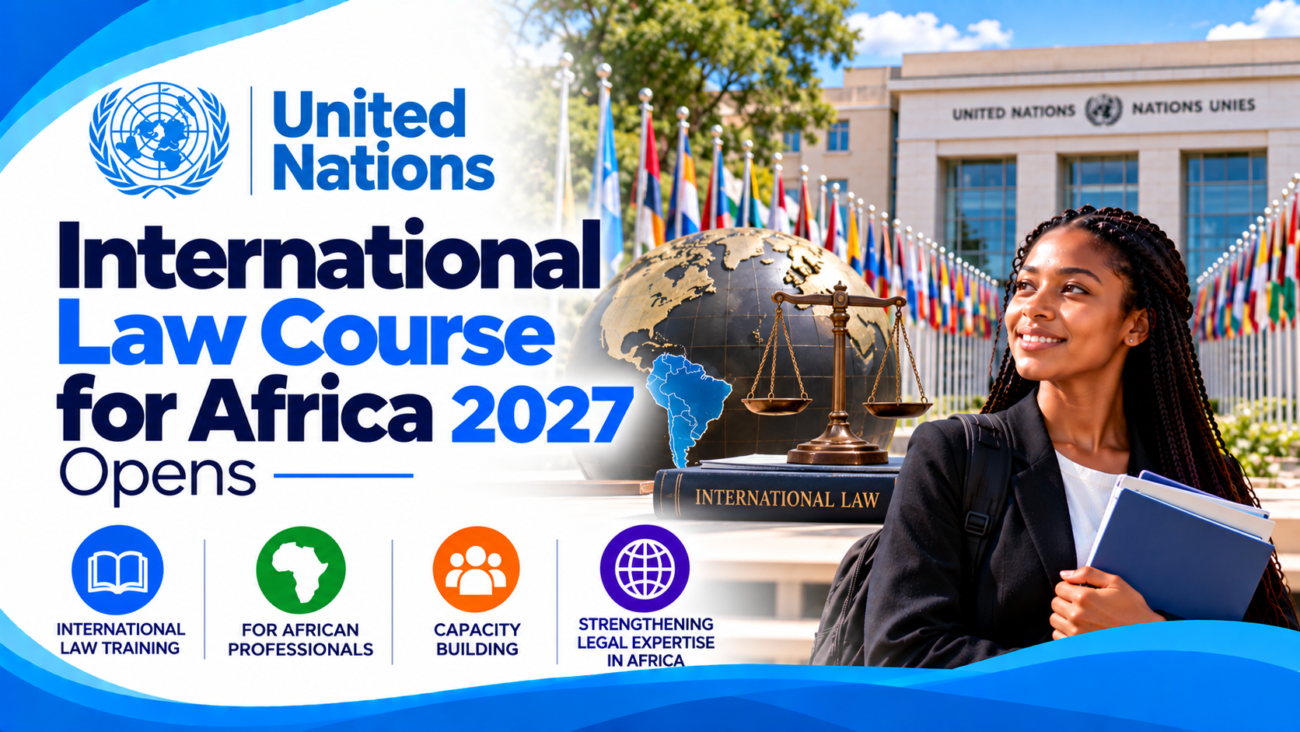
United Nations International Law Course for Africa 2027 Opens
United Nations International Law Course for Africa 2027 Opens. The United Nations Regional Course in International Law for Africa 2027 is now open for applications from qualified legal professionals across African UN Member States. The course will be held in person in Addis Ababa, Ethiopia, from 15 March to 7 April 2027 at the facilities of the United Nations Economic Commission for Africa (ECA) and will be conducted entirely in English. Applications close on 30 October 2026.
The programme is organised by the Codification Division of the United Nations Office of Legal Affairs, in cooperation with the Government of Ethiopia, the African Union and the United Nations Economic Commission for Africa. It is designed for professionals who already have a legal background and practical experience in international law.
⚠️ Important Accuracy Note
This programme is officially called the:
UNITED NATIONS REGIONAL COURSE IN INTERNATIONAL LAW FOR AFRICA
It is not primarily intended for current students or complete beginners.
Applicants must have:
A LEGAL BACKGROUND
and:
PROFESSIONAL EXPERIENCE IN INTERNATIONAL LAW.
The United Nations FAQ explicitly says the course is designed for professionals who already have practical experience in the field; students are not the target group.
The course includes both:
FELLOWSHIP-FUNDED PARTICIPANTS
and a limited number of:
SELF-FUNDED PARTICIPANTS.
For fellowship recipients, the United Nations covers travel, accommodation, meals, medical insurance, participation in the course and training materials, and also provides a modest stipend for other living expenses.
🌍 United Nations Regional Course in International Law for Africa 2027: Quick Overview
| Detail | Information |
|---|---|
| Organiser | UN Office of Legal Affairs – Codification Division |
| Programme | United Nations Regional Course in International Law for Africa |
| Year | 2027 |
| Location | Addis Ababa, Ethiopia |
| Venue | UN Economic Commission for Africa |
| Format | In Person |
| Course Dates | 15 March–7 April 2027 |
| Language | English |
| Participants | Up to 30 |
| Main Target Group | Legal Professionals |
| Professional Experience | Required in International Law |
| Students | Not the Intended Target Group |
| Eligible Countries | UN Member States in the African Group |
| Fellowship Places | Available |
| Self-Funded Places | Limited |
| Travel for Fellows | Covered |
| Accommodation for Fellows | Covered |
| Meals for Fellows | Covered |
| Medical Insurance for Fellows | Covered |
| Training Materials | Covered |
| Living Stipend | Modest Stipend for Fellowship Recipients |
| Application Fee | None |
| Deadline | 30 October 2026 |
🏛️ About the United Nations Regional Course
United Nations International Law Course for Africa 2027 Opens
The Regional Courses in International Law are organised under the United Nations Programme of Assistance in the Teaching, Study, Dissemination and Wider Appreciation of International Law.
The programme was created to strengthen knowledge of:
INTERNATIONAL LAW
and support professionals who work in areas where international legal rules affect:
GOVERNMENT
DIPLOMACY
PEACE & SECURITY
HUMAN RIGHTS
INTERNATIONAL ORGANISATIONS
and:
REGIONAL COOPERATION.
The Africa course is organised jointly with major regional institutions, including the African Union and ECA.
🎯 What Is the Purpose of the Course?
The Regional Course gives qualified professionals the opportunity to deepen their understanding of:
CORE AREAS OF INTERNATIONAL LAW
and:
THE LEGAL WORK OF THE UNITED NATIONS.
Historically, the programme has been particularly relevant to:
GOVERNMENT OFFICIALS
LEGAL ADVISERS
ACADEMICS
DIPLOMATS
NGO PROFESSIONALS
and:
INTERNATIONAL ORGANISATION STAFF
working in international law.
📚 Course Content
The exact 2027 timetable can vary, but recent UN Regional Courses for Africa have covered a broad range of core international-law topics.
These include:
INTRODUCTION TO INTERNATIONAL LAW
LAW OF TREATIES
STATE RESPONSIBILITY
LAW OF INTERNATIONAL ORGANISATIONS
DIPLOMATIC & CONSULAR LAW
INTERNATIONAL PEACE & SECURITY
PEACEFUL SETTLEMENT OF INTERNATIONAL DISPUTES
LAW & INSTITUTIONS OF THE AFRICAN UNION
INTERNATIONAL HUMAN RIGHTS LAW
LAW OF THE SEA
INTERNATIONAL HUMANITARIAN LAW
INTERNATIONAL CRIMINAL LAW
INTERNATIONAL ENVIRONMENTAL LAW
INTERNATIONAL TRADE LAW
and:
INTERNATIONAL INVESTMENT LAW.
These topics formed part of recent official Africa-course curricula and provide a strong indication of the programme’s scope.
🗣️ Teaching Method
The course is delivered through:
INTERACTIVE SEMINARS
and:
DISCUSSIONS
led by experienced international-law scholars and practitioners.
The structure is designed to encourage:
EXCHANGE OF IDEAS
PRACTICAL DISCUSSION
and:
COMPARISON OF LEGAL EXPERIENCES
across different African jurisdictions.
📜 Certificate
Participants who successfully complete the Regional Course in its entirety receive:
A CERTIFICATE.
Attendance for the full programme is important because the United Nations requires selected candidates to confirm that they can attend:
THE ENTIRE COURSE.
🎓 Who Can Apply?
Applicants must satisfy several important criteria.
1. Legal Background
Candidates must have:
A LEGAL BACKGROUND.
This normally makes the programme most relevant to people with education or professional training in law.
2. Professional Experience in International Law
United Nations International Law Course for Africa 2027 Opens
Candidates must also have:
PROFESSIONAL EXPERIENCE IN THE FIELD OF INTERNATIONAL LAW.
This is a key eligibility condition.
The programme is therefore not intended simply for someone interested in international law without practical professional exposure.
3. English Fluency
The 2027 course will be conducted in:
ENGLISH.
Applicants must therefore be fluent in the language of instruction.
4. Full Attendance
Selected participants must certify that they are able to attend:
FROM 15 MARCH TO 7 APRIL 2027
and complete the whole course.
🌍 Which Countries Are Eligible?
The course is open to candidates from United Nations Member States that are members of the:
AFRICAN GROUP.
This makes the programme relevant to eligible professionals from countries across the African continent.
🇿🇼 Can Zimbabweans Apply?
Yes.
Zimbabwe is a UN Member State within the African regional group, so eligible Zimbabwean legal professionals can apply provided they meet the professional and language requirements.
A Zimbabwean applicant should therefore demonstrate:
✅ Legal background
✅ Professional experience in international law
✅ English fluency
and:
✅ Availability for the full course in Addis Ababa.
👩 Are Women Encouraged to Apply?
Yes.
The United Nations explicitly states that:
FEMALE CANDIDATES ARE STRONGLY ENCOURAGED TO APPLY.
Gender balance is one of the considerations used during selection.
🏢 Can Government Officials Apply?
Yes.
Government officials are among the traditional target groups for the Regional Course.
This may include professionals working in:
MINISTRIES OF FOREIGN AFFAIRS
MINISTRIES OF JUSTICE
ATTORNEY-GENERAL OFFICES
DIPLOMATIC SERVICES
and other government bodies dealing with international legal matters.
🎓 Can Academics Apply?
Yes.
The official FAQ confirms that the programme is also open to:
ACADEMICS
engaged in international-law activities.
🌐 Can NGO Professionals Apply?
Yes.
Professionals from:
NON-GOVERNMENTAL ORGANISATIONS
and similar institutions engaged in international-law work can also apply.
🌍 Can Intergovernmental Organisation Staff Apply?
Yes, in principle.
Professionals from:
INTERGOVERNMENTAL ORGANISATIONS
working in relevant international-law activities may apply.
🚫 Can Current UN Staff Apply?
No.
The United Nations FAQ says:
CURRENT UNITED NATIONS STAFF MEMBERS ARE NOT ELIGIBLE.
🎓 Can Current Students Apply?
Generally:
NO.
The UN FAQ is explicit that the Regional Course is intended for:
PROFESSIONALS WHO ALREADY HAVE PRACTICAL INTERNATIONAL-LAW EXPERIENCE.
Students seeking introductory legal training should therefore look for other UN learning opportunities.
💰 Is the Programme Fully Funded?
For participants who receive a fellowship, the programme covers the principal participation costs.
The fellowship covers:
✈️ TRAVEL
🏨 ACCOMMODATION
🍽️ MEALS
🏥 MEDICAL INSURANCE
📚 TRAINING MATERIALS
and:
🎓 PARTICIPATION IN THE COURSE.
Fellowship recipients also receive:
A MODEST STIPEND
for other living expenses.
✈️ Travel
The United Nations covers travel for participants selected for:
FELLOWSHIP FUNDING.
🏨 Accommodation
Accommodation is provided:
WITHOUT CHARGE
for fellowship recipients.
🍽️ Meals
Meals are also covered for fellowship participants.
🏥 Medical Insurance
The fellowship covers:
MEDICAL INSURANCE.
However, participants should note that some medical facilities may require:
ADVANCE PAYMENT
for treatment, and the fellowship stipend may not cover those upfront medical payments.
💵 Stipend
Fellowship recipients receive a:
MODEST LIVING STIPEND.
The amount is not fixed publicly in the current 2027 announcement.
The UN explains that stipend rates are determined under United Nations regulations and can change according to factors such as:
LOCAL LIVING COSTS
and:
USD EXCHANGE RATES.
Therefore, Vacancy Bridge should not advertise an invented fixed stipend amount.
💳 Is There an Application Fee?
No.
The United Nations states:
NO APPLICATION OR SELECTION FEE IS CHARGED.
The UN also warns that it does not seek applicants’:
BANK ACCOUNT INFORMATION
during the application process.
⚠️ Scam Warning
Applicants should be cautious about anyone claiming that they must pay to:
APPLY
BE SHORTLISTED
or:
SECURE A FELLOWSHIP.
The official UN process is:
FREE.
💼 Self-Funded Participants
The Regional Course also includes a limited number of:
SELF-FUNDED PLACES.
Self-funded participants go through:
THE SAME SELECTION PROCESS
and are assessed according to:
THE SAME SELECTION CRITERIA
as fellowship applicants.
They attend the same lectures, participate in the same activities and receive:
THE SAME CERTIFICATE.
However, self-funded participants must pay their own:
TRAVEL
ACCOMMODATION
MEDICAL INSURANCE
and:
LIVING EXPENSES.
Training materials are still provided.
👥 How Many Participants Are Selected?
United Nations International Law Course for Africa 2027 Opens
The course accommodates up to:
30 PARTICIPANTS.
This includes both:
FELLOWSHIP RECIPIENTS
and:
A LIMITED NUMBER OF SELF-FUNDED PARTICIPANTS.
🏆 How Are Candidates Selected?
The United Nations considers several factors.
These include:
QUALIFICATIONS
SCOPE OF PROFESSIONAL DUTIES
RELEVANCE OF THE COURSE TO THE APPLICANT’S WORK
and:
GENDER BALANCE.
🎯 Professional Relevance Matters
Applicants should clearly explain how international law affects their existing work.
For example, strong relevance may exist where an applicant works on:
TREATIES
HUMAN RIGHTS
INTERNATIONAL COOPERATION
PEACE & SECURITY
DIPLOMACY
TRADE
ENVIRONMENT
HUMANITARIAN LAW
or:
INTERNATIONAL DISPUTES.
🏛️ Does Your Government Have to Nominate You?
No.
Applicants do not have to send their application through their government.
However, the sponsoring institution must complete certain sections of the application form.
🏢 Who Can Nominate Non-Government Applicants?
Candidates who are not government officials may be nominated by:
THE INSTITUTION THEY WORK FOR
or:
AN INSTITUTION WITH WHICH THEY ARE AFFILIATED.
This means academics and NGO professionals do not need government nomination.
📝 How to Apply
The United Nations provides an official:
APPLICATION FORM
for the 2027 Regional Course.
Step 1 — Confirm Eligibility
Make sure you have:
✅ A legal background
✅ Professional international-law experience
✅ English fluency
✅ African Group nationality eligibility
and:
✅ Availability for the entire course.
Step 2 — Download the Official Application Form
Use the official UN Regional Course page.
The 2027 application form is available in:
ENGLISH.
Step 3 — Complete Your Candidate Sections
Provide accurate details about:
EDUCATION
EMPLOYMENT
INTERNATIONAL-LAW EXPERIENCE
and:
CURRENT PROFESSIONAL RESPONSIBILITIES.
Step 4 — Obtain Institutional Endorsement
Your sponsoring or affiliated institution must complete the required parts of the application.
Step 5 — Explain Professional Relevance
Demonstrate how the course will contribute directly to your current or future professional duties.
Step 6 — Confirm Full Attendance
Applicants selected for the programme must be able to attend:
15 MARCH–7 APRIL 2027
without leaving before completion.
Step 7 — Submit Before the Deadline
The application deadline is:
📅 30 OCTOBER 2026.
📋 Application Checklist
Before submitting, confirm:
✅ Legal Background
Required.
✅ Professional Experience
International-law experience required.
✅ African Group Eligibility
Required.
✅ English Fluency
Required.
✅ Full Attendance
Required.
✅ Application Form
Completed.
✅ Institutional Sections
Completed by sponsoring or affiliated institution.
✅ Professional Relevance
Clearly explained.
✅ Funding Preference
Understand fellowship versus self-funded arrangements.
✅ Deadline
30 October 2026.
🎯 How to Strengthen Your Application
⚖️ Make Your International-Law Experience Specific
United Nations International Law Course for Africa 2027 Opens
Avoid simply writing:
“I am interested in international law.”
Instead, explain your actual work involving:
TREATIES
LEGAL ADVICE
HUMAN RIGHTS
DIPLOMATIC MATTERS
REGIONAL ORGANISATIONS
or:
INTERNATIONAL AGREEMENTS.
💼 Link the Course to Your Job
Selection considers how relevant the training is to your professional duties.
Explain:
WHAT YOU CURRENTLY DO
and:
HOW THE COURSE WILL IMPROVE THAT WORK.
📚 Highlight Continuing Professional Development
Show that the course will build on experience you already have rather than serving as your first exposure to international law.
🏛️ Get Strong Institutional Support
Where your institution is required to complete part of the form, make sure it clearly supports your participation and understands why the programme matters to your work.
👩 Female Candidates
Because women are strongly encouraged to apply, qualified female lawyers and international-law professionals should consider the opportunity seriously.
⚠️ Common Application Mistakes
Avoid:
- Applying as a current student with no professional experience
- Claiming the programme is open to complete beginners
- Assuming every participant receives a fellowship
- Inventing a stipend amount
- Assuming self-funded participants receive travel and accommodation
- Ignoring the English-language requirement
- Failing to secure institutional completion of required form sections
- Applying without proving international-law experience
- Missing the 30 October deadline
- Paying someone to submit or “secure” the fellowship
- Assuming government nomination is mandatory
- Planning to attend only part of the course
❓ Frequently Asked Questions
United Nations International Law Course for Africa 2027 Opens
Is the UN International Law Course for Africa 2027 open?
Yes.
Applications for the 2027 United Nations Regional Course in International Law for Africa are currently open.
Where will it take place?
🇪🇹 ADDIS ABABA, ETHIOPIA.
What are the course dates?
📅 15 MARCH–7 APRIL 2027.
Is the course online?
No.
It is:
IN PERSON.
What language will be used?
ENGLISH.
How many participants are admitted?
Up to:
30 PARTICIPANTS.
Is the course fully funded?
Some selected participants receive:
UN FELLOWSHIPS
covering travel, accommodation, meals, medical insurance, training and a modest stipend.
There are also limited self-funded places.
Is accommodation covered?
Yes, for fellowship recipients.
Accommodation is provided:
WITHOUT CHARGE.
Is travel covered?
Yes, for fellowship recipients.
Are meals covered?
Yes, for fellowship recipients.
Is medical insurance covered?
Yes, for fellowship recipients.
Is there a stipend?
Yes.
Fellowship participants receive:
A MODEST STIPEND
for other living expenses.
How much is the stipend?
The UN does not publish one fixed 2027 figure on the current programme page.
The amount varies according to UN regulations and local conditions.
Can students apply?
The programme is not intended for students without professional experience.
The UN says it is designed for professionals with practical experience in international law.
Can academics apply?
Yes.
Can NGO professionals apply?
Yes, provided they are professionally engaged in relevant international-law activities.
Can government lawyers apply?
Yes.
Can current UN staff apply?
No.
Are women encouraged to apply?
Yes.
FEMALE CANDIDATES ARE STRONGLY ENCOURAGED.
Can Zimbabweans apply?
Yes, if they satisfy the legal-background, professional-experience and English requirements.
Do I need government nomination?
No.
Government nomination is not compulsory.
What is the application fee?
THERE IS NO APPLICATION FEE.
What is the deadline?
📅 30 OCTOBER 2026.
🚀 Final Thoughts
United Nations International Law Course for Africa 2027 Opens
United Nations International Law Course for Africa 2027 Opens. The United Nations Regional Course in International Law for Africa 2027 is a valuable professional-development opportunity for African lawyers, legal advisers, academics, diplomats, government officials and other professionals who already work with:
⚖️ INTERNATIONAL LAW
🕊️ PEACE & SECURITY
🌍 INTERNATIONAL COOPERATION
🏛️ REGIONAL INSTITUTIONS
🧑⚖️ HUMAN RIGHTS
and:
📜 TREATY LAW.
The programme will be held:
🇪🇹 IN ADDIS ABABA, ETHIOPIA
from:
📅 15 MARCH TO 7 APRIL 2027
and will be conducted in:
ENGLISH.
Up to:
30 PARTICIPANTS
will be admitted.
Selected fellowship recipients receive support covering:
✈️ TRAVEL
🏨 ACCOMMODATION
🍽️ MEALS
🏥 MEDICAL INSURANCE
📚 TRAINING MATERIALS
and:
💵 A MODEST LIVING STIPEND.
The key eligibility point is that applicants must already have:
A LEGAL BACKGROUND
and:
PROFESSIONAL EXPERIENCE IN INTERNATIONAL LAW.
The course is therefore best suited to professionals rather than current students seeking an introductory qualification.
Applications close on:
📅 30 OCTOBER 2026.
📲 Join the Vacancy Bridge WhatsApp Channel
Get United Nations training opportunities, international law programmes, fellowships, scholarships, internships, graduate opportunities, UN jobs, grants and free online courses through Vacancy Bridge.
👉 Join here: https://whatsapp.com/channel/0029Vakee9aHFxOyCIBPJA0
APPLY NOW ON THIS OFFICIAL PAGE
🔑 Key Details
Organiser: United Nations Office of Legal Affairs – Codification Division
Programme: United Nations Regional Course in International Law for Africa
Year: 2027
Location: Addis Ababa, Ethiopia
Venue: United Nations Economic Commission for Africa
Format: In Person
Dates: 15 March–7 April 2027
Language: English
Participants: Up to 30
Eligibility: Legal Background + Professional Experience in International Law
Eligible Region: UN Member States in the African Group
Current Students Without Professional Experience: Not Intended Target Group
Female Candidates: Strongly Encouraged
Government Officials: Eligible
Academics: Eligible
NGO Professionals: Eligible
Current UN Staff: Not Eligible
Fellowship Travel: Covered
Accommodation: Covered for Fellows
Meals: Covered for Fellows
Medical Insurance: Covered for Fellows
Training Materials: Covered
Living Stipend: Modest Stipend for Fellows
Self-Funded Places: Limited
Application Fee: None
Deadline: 30 October 2026
🔎 SEO Keywords
United Nations International Law Course Africa 2027, UN Regional Course International Law Africa 2027, United Nations Regional Course International Law, UN Law Course Africa 2027, International Law Training Africa, UN International Law Fellowship Africa, United Nations Legal Training 2027, Addis Ababa International Law Course, UN International Law Course Ethiopia, UN Office of Legal Affairs Course 2027, United Nations Codification Division Course, International Law Course for African Lawyers, International Law Fellowship for Africans, UN Fellowship Africa 2027, International Law Training for Government Officials, International Law Training for Lawyers, International Law Training for Diplomats, Human Rights Law Course Africa, International Humanitarian Law Training Africa, Treaty Law Course Africa, Law of the Sea Training Africa, International Criminal Law Course Africa, African Union Law Training, International Trade Law Course Africa, International Investment Law Training Africa, United Nations Fellowship Fully Funded Africa, UN Course Travel Accommodation Covered, United Nations Course Addis Ababa 2027, UN International Law Course Deadline, UN International Law Course 30 October 2026, Zimbabwe United Nations Law Course, International Law Opportunities Zimbabwe, UN Legal Fellowship Zimbabwe, African Lawyers Fellowship 2027, International Law Professional Development Africa, United Nations Training Opportunities 2027, UN Fellowships for African Professionals, Vacancy Bridge.
