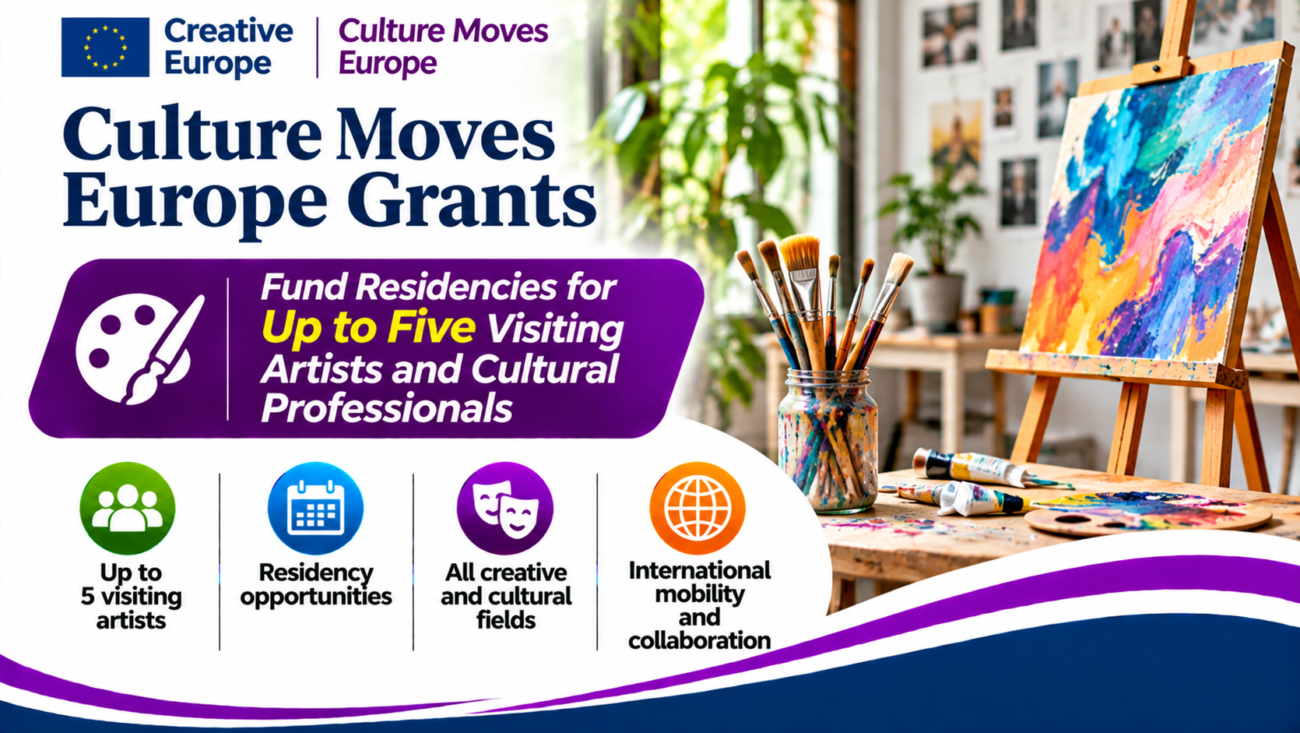
Culture Moves Europe Grants 2026–2027 Fund Residencies for Up to Five Visiting Artists and Cultural Professionals
Culture Moves Europe Grants 2026–2027 Fund Residencies for Up to Five Visiting Artists and Cultural Professionals. Cultural organisations, museums, foundations, creative businesses and eligible independent cultural professionals can apply for Culture Moves Europe Residency Grants 2026–2027 to host international artists and cultural professionals for collaborative residency projects.
Funded by the European Union’s Creative Europe programme and implemented by the Goethe-Institut, the initiative supports cultural mobility, artistic exchange and international cooperation across eligible European countries.
The current call allows successful hosts to welcome between one and five visiting artists or cultural professionals for a shared residency project. Funding contributes towards hosting costs, accommodation, mentoring, participants’ daily expenses and international travel.
The programme covers seven cultural sectors: architecture, cultural heritage, design and fashion design, literature, music, performing arts and visual arts.
Applications opened on 15 October 2026 and close on 18 January 2027 at 23:59 Central European Time (CET). Organisations must first apply to become approved residency hosts. Successful applicants then move to a second stage in which they select and confirm their visiting residents. Culture and Creativity+3
1. Culture Moves Europe Residency Grants 2026–2027: Key Details
| Detail | Information |
|---|---|
| Programme | Culture Moves Europe |
| Funding action | Call for Residency Hosts 2026–2027 |
| Funding source | European Union Creative Europe programme |
| Implementing organisation | Goethe-Institut |
| Funding type | Residency and cultural mobility grants |
| Number of residents | 1–5 artists or cultural professionals per project |
| Eligible applicants | Legally registered entities in Creative Europe countries |
| Eligible sectors | Seven cultural and creative sectors |
| Host allowance | €50 per day, per resident |
| Resident daily allowance | €30 per day, per resident |
| Travel allowance | €400 or €800, depending on distance |
| Residency duration | 21–90 days |
| Earliest residency start | 12 April 2027 |
| Latest residency end | 31 March 2028 |
| Application opening | 15 October 2026 |
| Application deadline | 18 January 2027, 23:59 CET |
| First-stage results | By 9 March 2027 |
| Second-stage resident selection | 9 March–31 July 2027 |
| Application platform | Goethe-Application Portal (GAP) |
2. About Culture Moves Europe
Culture Moves Europe is a European cultural mobility scheme that supports artists, cultural professionals and organisations through individual mobility and residency funding.
The programme is funded through the European Union’s Creative Europe initiative and implemented by the Goethe-Institut.
Its wider purpose is to make international cultural exchange more accessible, encourage creative cooperation and strengthen connections between cultural sectors in participating countries.
The programme supports two main funding actions:
- Individual Mobility Action: Funding for individual artists and cultural professionals, including groups, to travel to another eligible Creative Europe country and carry out a cultural project.
- Residency Action: Funding for eligible legal entities that want to host international artists and cultural professionals through a structured residency project.
This article focuses on the 2026–2027 Residency Hosts call. The residency action is designed to help cultural organisations develop international programmes while giving visiting artists opportunities to research, create, learn, connect and explore new cultural environments.
3. How Much Funding Is Available?
Culture Moves Europe Grants 2026–2027 Fund Residencies for Up to Five Visiting Artists and Cultural Professionals
The Culture Moves Europe residency grant has two main components:
- Financial support paid to the host organisation for each resident and each residency day.
- Financial support for each visiting artist or cultural professional, including daily and travel allowances.
The current 2026–2027 call specifies the following rates.
3.1 Hosting allowance: €50 per day, per resident
Host organisation funding
Per resident, per residency day
€50
Contribution towards the host’s residency implementation costs.
The host receives €50 for each participating resident for every eligible residency day.
The allowance contributes towards costs such as:
- Accommodation.
- Professional mentoring.
- Workspace and facilities.
- Equipment and materials.
- Other costs associated with implementing the residency.
For example, a host organisation welcoming five residents for a 30-day residency would have a basic hosting allowance calculated as:
\[ 5 \times 30 \times €50 = €7,500 \]
This is an illustrative calculation, not a guaranteed award. The final grant depends on the approved residency arrangements and eligible participants. Culture and Creativity
3.2 Daily allowance for visiting residents: €30 per day
Resident support
Per visiting artist or cultural professional, per day
€30
Contribution towards daily expenses during the residency.
Each selected resident receives a daily allowance of €30.
This support contributes towards personal expenses during the residency, including daily living costs.
For a 30-day residency, the basic daily allowance would amount to €900 per resident.
3.3 International travel allowance
The programme also provides a travel allowance based on the distance between the resident’s place of departure and the host location.
| One-way travel distance | Travel allowance |
|---|---|
| Below 5,000 km | €400 |
| 5,000 km or more | €800 |
The distance is calculated automatically by the application form using a one-way straight-line measurement.
The allowance supports international mobility to the residency location. Culture and Creativity
3.4 Additional financial top-ups
Additional support is available for residents who meet the relevant conditions.
| Top-up | Amount | Who may qualify |
|---|---|---|
| Green mobility | €400 | Residents using qualifying sustainable travel |
| Overseas Countries and Territories / Outermost Regions | €175 | Residents meeting the relevant geographical criteria |
| Family support | €200 per child | Residents travelling with eligible children under 18 |
| Visa support | €120 | Residents who require a visa for the residency |
These additional amounts are conditional. They are not automatically paid to every resident. Culture and Creativity
3.5 Accessibility support
The call also provides additional support for residents with accessibility needs.
Depending on the residency duration category, fixed accessibility support may be available at:
- €375.
- €675.
- €1,200.
Additional eligible support may include:
- Personal assistance.
- Sign-language interpretation.
- Air travel for distances below 600 km where necessary.
The host must request applicable top-ups and accessibility support during the second application phase when completing the residency information card. These requests cannot be added later. Culture and Creativity+1
4. Who Can Apply for Culture Moves Europe Residency Grants?
Culture Moves Europe Grants 2026–2027 Fund Residencies for Up to Five Visiting Artists and Cultural Professionals
The 2026–2027 call is open to legally registered entities based in Creative Europe countries.
The applicant must be able to implement the proposed residency project and provide suitable accommodation, working facilities and professional artistic guidance.
Eligible applicants can include:
- Non-profit organisations.
- Non-governmental organisations.
- Cultural centres.
- Museums.
- Foundations.
- Public cultural institutions.
- Companies.
- Creative businesses.
- Eligible self-employed cultural professionals registered as legal entities.
Both newly established and well-established entities can apply, provided they satisfy the requirements.
Applicants must be active in at least one of the programme’s eligible cultural sectors. Culture and Creativity+1
4.1 Legal registration requirement
The applicant must be legally registered and based in a Creative Europe country.
The organisation must provide proof of its legal status during the first application phase.
An informal artistic collective without the required legal registration cannot automatically apply in its own name. It would need to apply through an eligible registered entity.
4.2 Operational capacity
Applicants must demonstrate that they can deliver the proposed residency.
They should be able to provide:
- Appropriate and safe accommodation.
- Suitable workspace or creative facilities.
- Equipment and resources adapted to the residents’ disciplines.
- At least one professional mentor.
- Organisational support throughout the residency.
The host must be able to support the visiting residents for the entire agreed residency period. Call for Residency Hosts 2026-2027
5. Which Countries Are Eligible?
The residency action operates across the countries participating in the European Union’s Creative Europe programme.
The host organisation must be registered and based in an eligible Creative Europe country.
The visiting residents must be legally residing in Creative Europe countries other than the host’s country.
This means the call supports cross-border cultural exchange rather than a residency involving only local artists from the host’s own country.
Can Zimbabwean organisations apply?
Zimbabwe is not a Creative Europe participating country for this call.
Therefore, a Zimbabwe-based organisation cannot apply as the residency host under the 2026–2027 Residency Hosts programme unless it has an eligible legally registered entity based in a participating Creative Europe country that independently meets the requirements.
Can Zimbabwean artists participate?
The residents must be legally residing in a Creative Europe country different from the host’s country.
A Zimbabwean artist living in Zimbabwe would not meet this residency call’s resident-country requirement simply because they wish to travel to Europe.
However, a Zimbabwean artist who is legally resident in an eligible Creative Europe country may potentially qualify as a resident, subject to the programme’s other eligibility conditions.
This distinction is important: nationality and legal country of residence are not interchangeable for this call. Culture and Creativity+1
6. Eligible Cultural and Creative Sectors
The programme supports residency projects in seven cultural sectors.
6.1 Architecture
Projects may explore architecture, spatial design, urban environments, sustainable buildings and new approaches to the built environment.
Potential activities include:
- Architectural research.
- Collaborative design projects.
- Sustainable architecture.
- Community-centred spatial planning.
- Cross-border architectural practice.
6.2 Cultural heritage
Residencies can support research and creative work relating to tangible and intangible cultural heritage.
Possible activities include:
- Heritage documentation.
- Traditional knowledge and cultural practices.
- Heritage interpretation.
- Preservation and conservation approaches.
- Cultural storytelling.
6.3 Design and fashion design
This category covers creative work in product design, visual design, fashion, textiles and related disciplines.
Residencies may support:
- Collaborative design development.
- Experimental materials.
- Sustainable fashion.
- Textile innovation.
- Design research and prototyping.
6.4 Literature
Literary projects can include creative writing, literary research, translation-related work and cross-cultural literary exchange where aligned with the call’s eligible sector.
6.5 Music
Music-related residencies may involve:
- Composition.
- Performance development.
- Sound research.
- Collaborative music production.
- Music education and experimentation.
6.6 Performing arts
This category includes creative disciplines such as theatre, dance and related performance practices.
Projects may focus on:
- Choreography.
- Theatre development.
- Collaborative performance.
- Experimental performance methods.
- Cross-cultural artistic exchange.
6.7 Visual arts
Visual arts residencies may involve:
- Painting.
- Sculpture.
- Photography.
- Installation art.
- Digital visual practices.
- Artistic research and experimentation.
The proposed residency must be relevant to the host entity’s activities and clearly connected to at least one eligible sector.
7. What Should a Residency Project Achieve?
Culture Moves Europe Grants 2026–2027 Fund Residencies for Up to Five Visiting Artists and Cultural Professionals
The residency project must address at least two of five programme objectives.
Applicants should choose objectives that fit the proposed creative activities and explain how the residency will achieve them.
7.1 Explore
The residency can provide an opportunity to investigate a subject, research a new concept or experiment with a creative approach.
For example, a visual artist might investigate how urban environments influence contemporary art.
7.2 Create
The project can bring artists together to develop new artistic or cultural work.
This may involve a collaborative creative process that produces a new performance, artwork, design or other cultural output.
7.3 Learn
The residency can help participants strengthen their professional or artistic competencies through non-formal learning, collaboration or specialist mentoring.
7.4 Connect
The project can create professional networks, encourage international cooperation and strengthen relationships between cultural practitioners.
7.5 Transform
The residency can support creative work that contributes to societal change in line with the values and principles of the New European Bauhaus.
Applicants must select at least two objectives and demonstrate how they will be reflected in the activities and expected outcomes. Culture and Creativity+1
8. How Many Artists Can a Host Organisation Invite?
A successful applicant can host between one and five artists or cultural professionals.
All selected residents must participate in the same residency project:
- At the same host location.
- During the same dates.
- For the same duration.
The organisation cannot use one approved project to host unrelated residents in separate periods with different residency schedules.
The proposed project must therefore be designed around a shared residency experience.
For example, a cultural centre could host five visiting visual artists for a 45-day collaborative programme, with all five participants attending the residency during the same period.
The host must provide at least one mentor who can guide residents throughout the residency. Culture and Creativity+1
9. Residency Duration and Eligible Dates
For the 2026–2027 call, the official application checklist specifies a residency duration of 21 to 90 days.
Projects must begin no earlier than 12 April 2027 and finish no later than 31 March 2028.
| Residency requirement | Rule |
|---|---|
| Minimum duration | 21 days |
| Maximum duration | 90 days |
| Earliest start date | 12 April 2027 |
| Latest completion date | 31 March 2028 |
| Number of residents | 1–5 |
| Residency schedule | All residents attend together |
| Host location | Country where the entity is registered |
Applicants should ensure that their proposed dates are compatible with the call’s permitted period and that all participants can attend for the full duration.
10. What Must the Host Organisation Provide?
Culture Moves Europe Grants 2026–2027 Fund Residencies for Up to Five Visiting Artists and Cultural Professionals
The grant is designed to help organisations implement a meaningful international residency, not simply provide visiting artists with financial support.
The host is expected to create an environment in which participants can develop their work and engage with the local cultural context.
10.1 Safe accommodation
The host must arrange appropriate accommodation for all residents.
Accommodation can be provided at the organisation’s premises or rented elsewhere.
10.2 Suitable workspace
Residents must have access to a working environment adapted to their artistic or professional disciplines.
Depending on the project, this could include:
- Studio space.
- Rehearsal facilities.
- Workshops.
- Creative laboratories.
- Equipment.
- Digital production facilities.
10.3 Professional mentoring
At least one mentor must guide residents throughout the residency.
The mentor should have relevant professional experience and be able to support participants’ creative development.
10.4 Artistic guidance and support
The host should provide the professional environment, resources and support needed for residents to carry out their individual or collective projects.
10.5 A meaningful international exchange
The residency should offer opportunities for interaction with the host’s local cultural environment and professional networks.
The proposal should explain how the residency benefits both the visitors and the host organisation. Call for Residency Hosts 2026-2027+1
11. Required Application Documents
The first application phase focuses on the proposed residency and the legal status and capacity of the host organisation.
The following supporting documents must be uploaded.
| Document | Requirement |
|---|---|
| Proof of legal registration | Evidence that the applicant is a legally registered entity in a Creative Europe country |
| Organisational portfolio | Portfolio, description or promotional report presenting the entity’s activities |
| Mentor CV or biography | CV or short biography for each proposed mentor |
| Residency project proposal | Description of the proposed residency and its objectives |
The organisational portfolio and mentor information must be provided in PDF format and in English. Call for Residency Hosts 2026-2027+1
11.1 Proof of legal entity registration
The organisation must provide official evidence of its legal status.
The document should establish that the applicant is registered and based in a participating Creative Europe country.
11.2 Organisational portfolio
Applicants must provide a portfolio, description or promotional report that presents their activities.
This should help evaluators understand:
- The organisation’s cultural work.
- Its experience in the relevant sector.
- Its creative or professional activities.
- Its capacity to implement the proposed residency.
11.3 Mentor CV or biography
The applicant must provide a CV or short biography for each mentor.
The document should demonstrate the mentor’s professional experience and suitability to guide participating residents.
11.4 Resident documents: Second application phase
Organisations selected during the first phase must proceed to the second phase and submit a residency information card for each chosen participant.
The required information includes:
- Official national identification.
- Short CV.
- Artistic or creative portfolio.
- Proof of legal residence in a Creative Europe country other than the host’s country.
The resident documents are therefore required at the later selection stage, not as a substitute for the host organisation’s first-phase application. Culture and Creativity
12. How Applications Are Evaluated
Culture Moves Europe Grants 2026–2027 Fund Residencies for Up to Five Visiting Artists and Cultural Professionals
Eligible applications are assessed by two independent evaluators.
The assessment considers whether the proposed residency is relevant to the applicant’s work and the objectives of Culture Moves Europe.
The evaluation also examines the potential long-term benefits of the project and its contribution to the local and wider cultural ecosystem.
Important considerations include:
- Quality and relevance of the proposed residency.
- Clear objectives and expected results.
- Ability to host the proposed number of residents.
- Suitability of accommodation and workspace.
- Quality of professional mentoring.
- Potential for long-term benefits.
- Opportunities for international exchange.
- Sustainability and environmental considerations.
The organisation must demonstrate that the project can be delivered successfully and that the residency will provide genuine value to both the visiting participants and the host. Culture and Creativity+1
13. How to Apply for Culture Moves Europe Residency Grants
The application process has two phases.
- Confirm the organisation’s eligibilityCheck that the entity is legally registered in a Creative Europe country and active in at least one eligible cultural sector.
- Develop the residency conceptDesign a project that can host between one and five international artists or cultural professionals. Select at least two of the five programme objectives.
- Plan the residency dates and facilitiesEnsure the project lasts between 21 and 90 days, takes place in the host’s country and falls within the permitted 2027–2028 period.
- Identify a professional mentorAppoint at least one mentor who can guide the residents throughout the project.
- Prepare the supporting documentsObtain proof of legal registration, prepare the organisational portfolio and collect the mentor’s CV or short biography.
- Create an account on the Goethe-Application PortalRegister as an Organisation/Enterprise and select the Culture Moves Europe funding option for the 2026–2027 call for residency hosts.
- Complete the first-stage applicationComplete the application form in English, describe the proposed residency and upload the supporting documents.
- Submit by 18 January 2027Review the application carefully and submit it before the official deadline.
- Wait for the first-stage selection resultResults are communicated through the Goethe-Application Portal. Successful host applicants can proceed to the second phase.
- Select the visiting residentsChoose between one and five eligible artists or cultural professionals and submit the residency information card for each participant.
- Complete the grant arrangementsThe final grant is calculated based on the confirmed residents, travel plans, residency duration and applicable top-ups. The host then concludes a grant agreement with the Goethe-Institut.
14. Application Deadline and Important Dates
The current Culture Moves Europe Residency Hosts call follows this schedule.
| Event | Date |
|---|---|
| Call opens | 15 October 2026 |
| First-phase application deadline | 18 January 2027, 23:59 CET |
| First-phase results | By 9 March 2027 |
| Second-phase resident selection | 9 March–31 July 2027 |
| Earliest residency start | 12 April 2027 |
| Latest residency completion | 31 March 2028 |
Applications open
The 18 January 2027 deadline is for organisations applying to become residency hosts. It is not the deadline for individual artists to submit a separate application for a place in an already approved residency.
Only successful hosts proceed to the second phase, where they select their visiting participants.
15. Practical Advice for Organisations Preparing an Application
Design a clear residency concept
Avoid submitting a general description of your organisation’s activities.
Explain what the residents will do, why the project is necessary and how the proposed activities will achieve at least two of the programme objectives.
Demonstrate the organisation’s capacity
Provide evidence that the organisation has the space, facilities, experience and personnel needed to host international participants.
Choose a suitable mentor
The mentor should have relevant professional expertise and sufficient availability to support the residents throughout the residency.
Make the international dimension meaningful
Explain why bringing artists or cultural professionals from other Creative Europe countries will benefit the project.
Include realistic residency dates
All residents must attend during the same period. Choose dates that allow sufficient preparation, mentoring and creative work.
Consider accessibility from the beginning
Culture Moves Europe Grants 2026–2027 Fund Residencies for Up to Five Visiting Artists and Cultural Professionals
Identify potential accessibility requirements and make relevant requests during the second phase. The programme states that applicable accessibility support and top-ups cannot be requested later.
Explain the long-term value
Show how the residency could strengthen professional networks, encourage future collaborations or contribute to the development of the host’s local cultural environment.
Prepare documents in English
The organisational portfolio and mentor CVs must be submitted in English as PDFs. The application form must also be completed in English. Culture and Creativity+1
16. Frequently Asked Questions
1. How many artists can a Culture Moves Europe residency host welcome?
A successful host can welcome between one and five artists or cultural professionals for one shared residency project.
2. How much funding does the host organisation receive?
The host receives a hosting allowance of €50 per day, per resident.
3. Do visiting artists receive financial support?
Yes. Each resident receives a €30 daily allowance and a travel allowance of €400 or €800, depending on the one-way travel distance. Eligible top-ups may also be available.
4. Can a host organisation invite five artists?
Yes. The call permits between one and five residents, provided they all participate in the same residency project, at the same time and for the same duration.
5. Can an individual artist apply as a host?
An individual can apply only if they meet the call’s legal-entity requirement and are legally registered and based in a Creative Europe country.
6. Can a Zimbabwean organisation apply?
A Zimbabwe-based organisation cannot apply as a host under this call because Zimbabwe is not a participating Creative Europe country. An eligible legal entity based in a Creative Europe country must submit the application.
7. Can Zimbabwean artists participate?
Artists must be legally residing in a Creative Europe country different from the host’s country. A Zimbabwean artist living in Zimbabwe does not meet this requirement merely by holding Zimbabwean nationality and wishing to travel to Europe.
8. Which cultural sectors are eligible?
The seven sectors are architecture, cultural heritage, design and fashion design, literature, music, performing arts and visual arts.
9. How long can a residency last?
The 2026–2027 call allows residency projects lasting 21 to 90 days.
10. Must the residency take place in the host’s country?
Yes. The project must take place in the country where the host entity is legally registered.
11. Is a mentor compulsory?
Yes. At least one mentor must be available to provide professional guidance throughout the residency.
12. What are the five residency objectives?
The objectives are to explore, create, learn, connect and transform. Applicants must address at least two.
13. What documents are required?
The first-phase application requires proof of legal registration, an organisational portfolio or activity description, and a CV or short biography for each mentor.
14. Is the application completed in English?
Yes. The application form and the required organisational and mentor documents must be provided in English. Applicants may use translation tools; English-language fluency is not assessed.
15. What is the application deadline?
The deadline is 18 January 2027 at 23:59 CET.
16. When will organisations know whether they have been selected?
The first-phase results are expected through the Goethe-Application Portal by 9 March 2027.
17. Does the host choose the residents before applying?
No. The first phase selects residency hosts. Successful applicants then proceed to the second phase to choose and confirm their residents.
18. Can accessibility support be requested after the grant is awarded?
No. Applicable top-ups and accessibility support must be requested when completing the residency information card during the second phase.
JOIN THE VACANCY BRIDGE WHATSAPP CHANNEL
https://whatsapp.com/channel/0029Vakee9aHFxOyCIBPJA0o
APPLY NOW ON THIS OFFICIAL PAGE
17. Final Summary
Culture Moves Europe Grants 2026–2027 Fund Residencies for Up to Five Visiting Artists and Cultural Professionals
Culture Moves Europe Grants 2026–2027 Fund Residencies for Up to Five Visiting Artists and Cultural Professionals. Culture Moves Europe Residency Grants 2026–2027 provide financial support to eligible cultural organisations and legal entities that want to host international artists and cultural professionals.
Successful hosts can welcome one to five visiting residents for a shared project lasting between 21 and 90 days.
The grant includes:
- €50 per day, per resident for the host organisation.
- €30 per day, per resident as a daily allowance.
- €400 or €800 in travel support, depending on distance.
- Additional eligible top-ups for green mobility, family, visa and accessibility needs.
The programme covers architecture, cultural heritage, design and fashion design, literature, music, performing arts and visual arts.
Applicants must be legally registered in a Creative Europe country, provide suitable accommodation and workspace, and appoint at least one mentor. The residency must address at least two of the programme’s five objectives: explore, create, learn, connect or transform.
The first-stage application deadline is 18 January 2027 at 23:59 CET. Successful host organisations will then select their visiting residents during the second phase.
The opportunity is designed for eligible European-based host entities. Zimbabwe-based organisations cannot apply as hosts under the current call, and residents must be legally residing in a Creative Europe country other than the host’s country.
For cultural organisations seeking to develop international networks, support creative exchange and welcome visiting artists, the programme offers a practical route to fund a structured international residency.
SEO Keywords
Culture Moves Europe Grants 2026, Culture Moves Europe Residency Grants, Culture Moves Europe 2027, artist residency grants Europe, cultural mobility funding, European Union creative grants, Goethe-Institut residency funding, artist residency funding 2027, grants for cultural organisations, international artist residency, creative Europe funding, visual arts residency grants, performing arts funding, music residency grants, cultural exchange opportunities Europe
