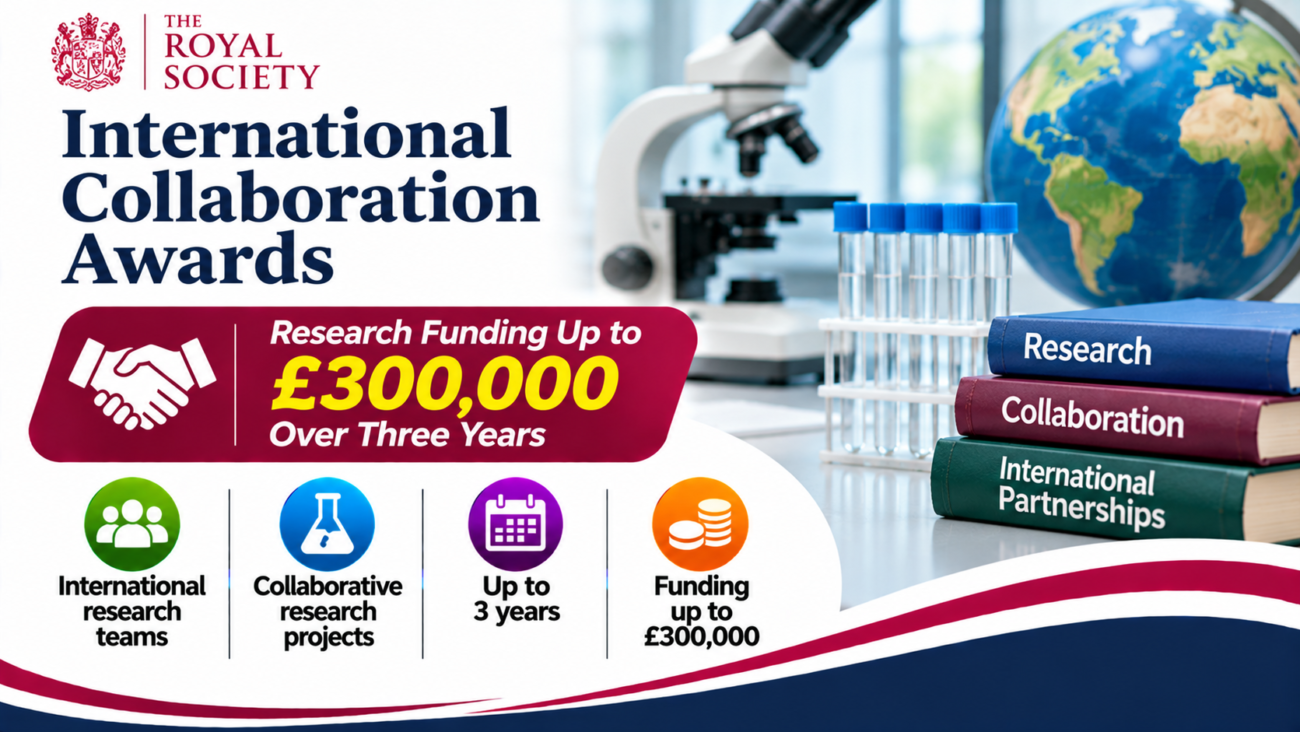
Royal Society International Collaboration Awards Offer Research Teams Up to £300,000 Over Three Years
Royal Society International Collaboration Awards Offer Research Teams Up to £300,000 Over Three Years. The Royal Society International Science Partnerships Fund (ISPF) International Collaboration Awards are offering research funding of up to £300,000 over three years to support partnerships between newly independent researchers based in the United Kingdom and eligible international research collaborators.
The 2026 funding round is specifically open to UK research partnerships with institutions and researchers in Brazil and South Africa. Projects must address development challenges in eligible countries and meet the requirements for Official Development Assistance (ODA) funding.
The awards aim to help emerging research leaders establish sustainable international collaborations, develop innovative scientific solutions and strengthen research capacity through knowledge-sharing, training and the exchange of researchers.
Funding can support research expenses, travel and subsistence, research assistance, and technical or non-technical training. The programme is particularly relevant to early-career independent researchers working in natural sciences, including biological sciences, biomedical sciences, chemistry, engineering, mathematics and physics.
Applications opened on 13 October 2026 and close on 3 December 2026 at 15:00 UK time. The Royal Society expects to announce decisions by 31 May 2027, with awards commencing between November and December 2027. Royal Society+2
1. Royal Society International Collaboration Awards 2026: Key Details
| Detail | Information |
|---|---|
| Funding organisation | The Royal Society |
| Funding programme | International Science Partnerships Fund (ISPF) |
| Award | International Collaboration Awards |
| Funding round | Brazil and South Africa (ODA) |
| Maximum funding | £300,000 |
| Duration | Three years |
| Annual funding ceiling | £100,000 |
| Eligible partnership | UK-based researcher collaborating with a researcher in Brazil or South Africa |
| Applicant career stage | Newly independent research leaders |
| Research fields | Natural sciences |
| Development requirement | ODA-eligible research |
| Eligible costs | Research expenses, travel, subsistence, research assistance and training |
| Application opening | 13 October 2026 |
| Application deadline | 3 December 2026, 15:00 UK time |
| Expected decisions | By 31 May 2027 |
| Expected award start | November–December 2027 |
| Application platform | Royal Society Flexi-Grant |
| Official application page | Royal Society International Collaboration Awards |
The £300,000 is the maximum amount that may be requested from the Royal Society over the three-year award period. It is not a guaranteed payment to every applicant or a personal grant for either researcher. Royal Society+1
2. About the Royal Society International Collaboration Awards
The Royal Society is the United Kingdom’s national academy of sciences. It supports scientific excellence through research funding, international partnerships, policy advice and recognition of scientific achievement.
The International Collaboration Awards form part of the UK Government’s International Science Partnerships Fund (ISPF).
The fund supports international scientific cooperation by bringing together research expertise, strengthening research and innovation capabilities, and encouraging partnerships that address shared global challenges.
The International Collaboration Awards are designed for newly independent researchers who have started building their own research groups and are ready to lead collaborative research programmes with international partners.
The programme has three central objectives:
- Develop sustainable partnerships: Build mutually beneficial relationships between research groups in the UK and overseas.
- Support high-quality research: Enable emerging research leaders to investigate challenging scientific questions and develop new approaches.
- Strengthen research capacity: Share knowledge, skills and expertise while supporting the development of researchers and their teams.
The current funding round focuses on UK partnerships with Brazil and South Africa, with projects required to meet ODA eligibility conditions. Royal Society+1
3. How Much Funding Is Available?
Maximum award
Funding over three years
£300,000
Up to £100,000 per year
The amount requested must be justified by the proposed research activities and eligible costs.
Research partnerships can request up to £300,000 from the Royal Society over three years.
The funding is intended to cover costs directly associated with delivering the collaborative research programme.
3.1 Research expenses
The grant can support eligible research expenses required to carry out the proposed scientific work.
These may include:
- Laboratory consumables.
- Research materials.
- Scientific testing and analysis.
- Small equipment items within the applicable funding limits.
- Other justified research-related expenditure.
3.2 Travel and subsistence
The award can support eligible travel and subsistence costs for the applicants and members of their research teams.
This enables researchers to visit partner institutions, participate in collaborative activities, exchange knowledge and undertake research-related travel.
3.3 Research assistance
The funding can contribute towards the cost of employing research staff who are directly involved in delivering the project.
The research proposal and budget should explain the responsibilities of these staff members and why their involvement is necessary.
3.4 Technical and non-technical training
The award can also support training activities that strengthen the ability of the research teams to conduct, manage, share and apply high-quality research.
Training may address technical research methods as well as wider professional and organisational capabilities. Royal Society+2
4. Important: What the £300,000 Does Not Cover
The International Collaboration Awards are research collaboration grants, not personal fellowships or salary awards.
The Royal Society’s current funding guidance excludes several costs.
| Expense | Funding position |
|---|---|
| Principal Investigator salary | Not eligible |
| Co-Investigator salary or time | Not eligible |
| PhD studentships and fees | Not eligible |
| Equipment costing more than £25,000 | Not eligible under the general funding guidance |
| Estate costs | Not eligible |
| Indirect costs and overheads | Not eligible for the UK host |
| Eligible direct research staff costs | May be supported |
| Research consumables | May be supported |
| Travel and subsistence | May be supported |
| Eligible training | May be supported |
The funding guidance provides for eligible direct costs at 100% for UK and overseas host organisations, subject to the scheme’s rules and cost categories.
The current 2026 scheme notes also allow the overseas organisation in the DAC-listed partner country to request a contribution towards overheads of up to 20% of its eligible direct costs. This is a specific provision for the overseas partner, not a general overhead allowance for the UK institution.
Applicants should work with their institutional research and finance offices to prepare the budget and verify each proposed cost. Royal Society+2
5. Which Countries Are Eligible for the 2026 Round?
The current application round is restricted to partnerships between UK-based researchers and overseas research partners in:
- Brazil
- South Africa
Projects involving these countries must meet the Royal Society’s Official Development Assistance requirements.
The funding round is not an unrestricted international collaboration grant. Researchers cannot assume that a partnership with any country will qualify simply because the proposed research addresses a global challenge.
The Royal Society may expand the countries covered in future rounds, but the current call specifically identifies Brazil and South Africa. Royal Society+1
Can Zimbabwean researchers participate?
This is an important distinction for researchers in Zimbabwe.
Zimbabwe is not one of the two overseas partner countries named for the current 2026 round. The required overseas lead applicant must be based in Brazil or South Africa, while the other lead applicant must be based in the UK.
Therefore, a Zimbabwe-based researcher cannot qualify as the overseas lead applicant for this particular call simply by proposing a UK–Zimbabwe partnership.
The call is designed around UK–Brazil or UK–South Africa partnerships. Zimbabwean researchers or institutions should contact the Royal Society to establish whether a Zimbabwean institution could participate in a wider project as an additional collaborator or beneficiary. Such participation should not be assumed to be eligible without confirmation.
A project may benefit other ODA-eligible developing countries, but the required lead partnership must still meet the countries and institutional conditions of the call. Royal Society+1
6. Who Can Apply? Eligibility Requirements
The scheme is aimed at newly independent research leaders who are building their own research groups.
It requires a partnership between a UK-based lead applicant and an overseas lead applicant based in Brazil or South Africa.
Both researchers must satisfy the eligibility requirements.
6.1 UK-based lead researcher
The UK lead applicant must:
- Be a newly independent researcher.
- Be based at an eligible UK research institution.
- Be building their own research group.
- Be ready to lead and direct the collaborative research programme.
- Hold a permanent or fixed-term independent academic research post, or a named independent research fellowship, for the duration of the award.
- Have access to their own laboratory or research facilities.
- Have the ability to recruit research staff and students.
6.2 Overseas lead researcher
Royal Society International Collaboration Awards Offer Research Teams Up to £300,000 Over Three Years
The overseas lead applicant must:
- Be based in Brazil or South Africa.
- Be a newly independent researcher building their own research group.
- Be ready to lead and direct the collaborative research programme.
- Hold a qualifying independent academic research post or named independent research fellowship for the full grant period.
- Have access to appropriate research facilities.
- Have the ability to recruit research staff and students.
6.3 Research experience
The 2026 scheme notes state that applicants would typically be expected to have:
- A minimum of three years and a maximum of eight years of active research experience since completing their PhD by the application date; or
- No more than five years of an independent research career.
Career breaks and time spent outside the research environment may be taken into consideration under the Society’s eligibility policy.
The research-experience guidance is intended to identify researchers who are established enough to lead independent groups but are still at an emerging research-leadership stage. Royal Society+1
6.4 Who is not eligible?
The scheme is not intended for:
- Postdoctoral researchers who do not hold an eligible independent research appointment.
- Researchers whose salaries are paid by a grant for which another person is the principal investigator.
- Researchers who cannot demonstrate that they are building their own research groups.
- Applicants who cannot maintain the required independent academic appointment or fellowship for the full award period.
The scheme notes also state that applicants may not submit more than one application to this call or hold more than one active ISPF International Collaboration Award. Royal Society+1
7. Eligible Host Institutions
The UK host organisation must fall within the Royal Society’s eligible institutional categories.
These include:
- Higher Education Institutions.
- UK Research Council-supported Research Institutes.
- Eligible UK-based Independent Research Organisations.
- Public Sector Research Establishments.
The overseas host must be an eligible higher education institution or not-for-profit research institute in the partner country.
The research must be conducted through eligible institutions, and the lead researchers must be based at their respective institutions for the duration of the award.
Applicants should confirm institutional eligibility with their research offices before developing the final application. Royal Society+1
8. Which Research Areas Are Supported?
The Royal Society supports research within its remit of natural sciences.
For the 2026 Brazil and South Africa round, projects must also directly and primarily address development challenges in one or more of five priority areas.
8.1 Health
Projects may investigate scientific challenges relevant to improving health and well-being in developing countries.
Potential research directions include:
- Biomedical research.
- Disease-related biological mechanisms.
- Public health technologies with a natural-sciences research basis.
- Scientific approaches to improving health outcomes.
8.2 Energy
Research may address energy access, efficiency, generation, storage and other scientific challenges affecting developing countries.
Potential areas include:
- Renewable energy technologies.
- Energy storage.
- Materials for energy applications.
- Energy efficiency.
- Engineering solutions for energy systems.
8.3 Climate
Projects may address scientific and technological challenges related to climate change.
Examples include:
- Climate-related environmental research.
- Scientific approaches to adaptation.
- Climate monitoring technologies.
- Engineering solutions for climate resilience.
8.4 Food
Research may investigate challenges affecting food production, food security and agricultural systems.
Potential areas include:
- Agricultural science.
- Plant biology.
- Food-related biotechnology.
- Scientific approaches to improving agricultural productivity.
- Research into environmental factors affecting food systems.
8.5 Nature and Environment
Royal Society International Collaboration Awards Offer Research Teams Up to £300,000 Over Three Years
Projects may focus on environmental and ecological challenges affecting developing countries.
Examples include:
- Biodiversity research.
- Environmental science.
- Ecosystem-related research.
- Pollution and environmental monitoring.
- Scientific approaches to sustainable resource use.
These are illustrative areas, not a guarantee that every project within a broad topic will qualify. The proposal must fall within the Royal Society’s natural-sciences remit and satisfy the development objectives of the call. Royal Society
9. Official Development Assistance Requirements
ODA eligibility is one of the most important requirements of the current funding round.
The programme is financed through the UK Government’s Official Development Assistance budget.
This means the proposed research must directly and primarily address development challenges affecting eligible developing countries.
The economic development and welfare of developing countries must be the main objective of the research.
A proposal is not automatically ODA-eligible simply because it has potential benefits for developing countries.
What must the research demonstrate?
Applicants should explain:
- Which developing countries will directly benefit.
- What development challenge the research addresses.
- How the research could contribute to economic development or welfare.
- Why the proposed scientific work is necessary.
- How the results will be used by intended beneficiaries.
- How the research will contribute to reducing poverty.
- How gender inequality has been considered in the project.
The Royal Society states that ODA eligibility is an essential criterion. Applications that fail to demonstrate compliance will not be eligible for funding. Royal Society+1
10. Equitable International Research Partnerships
The Royal Society expects applicants to develop genuine, equitable partnerships.
This means that the UK and overseas partners should jointly design the research and agree on how responsibilities, resources and benefits will be shared.
The scheme places emphasis on:
Fair research leadership
Both partners should have meaningful opportunities to contribute to the research agenda, management and decision-making.
Fair allocation of resources
The budget should reflect the work and responsibilities of each partner, including differences in institutional capacity and available infrastructure.
Local research capacity development
The project should create opportunities for researchers and other team members in the overseas partner institution to strengthen their scientific and professional capabilities.
Shared research outcomes
The partners should agree on how publications, data, intellectual property and other research outputs will be managed and recognised.
Sustainable collaboration
The proposal should explain how the partnership could continue beyond the three-year award.
The Royal Society also expects successful applicants to develop a management plan covering responsibilities, financial management, risks, data management, intellectual property and publications. Royal Society
11. Research Capacity Strengthening
Research capacity development is a core component of this funding programme.
Applicants should demonstrate how the collaboration will strengthen the ability of researchers and institutions to conduct, manage, share and apply high-quality research.
Capacity-building activities may include:
- Technical research training.
- Professional development.
- Training in research management.
- Scientific networking.
- Knowledge exchange.
- Technical assistance.
- Learning through collaborative research.
- Training for postgraduate students and research staff.
- Development of institutional research systems.
The Royal Society expects applicants to identify existing capacity gaps and explain how the proposed activities will address them.
Capacity-building activities should strengthen existing institutional systems rather than create unnecessary parallel structures.
The application should also explain who will benefit from training and how opportunities will be shared fairly across the research team. Royal Society
12. Gender Equality Requirements
Applicants must include a Gender Equality Statement as part of the application.
The statement should explain how the project has considered its potential impact on gender inequalities during its design, implementation and expected outcomes.
Applicants should consider:
- Whether the research has different implications for people of different genders.
- Whether women and other underrepresented groups can participate fairly.
- Whether project activities could unintentionally reinforce existing inequalities.
- How research opportunities and capacity-building activities will be distributed.
- Whether the research could contribute to reducing gender inequalities.
The statement must meet the minimum standard required by the relevant UK Government policy.
The Royal Society indicates that failure to meet the minimum requirements can make an application automatically unfundable. Royal Society+1
13. How Applications Are Assessed
Applications are assessed by the Royal Society’s International Collaboration Awards Panel.
Following eligibility checks, proposals are initially reviewed by two panel members with appropriate subject expertise.
Shortlisted applications are then discussed at a panel meeting, where funding recommendations are made.
The assessment considers:
| Assessment area | What the panel examines |
|---|---|
| Development impact | Whether the research directly addresses development challenges in eligible countries |
| Scientific quality | Importance, originality and scientific merit of the proposal |
| Research feasibility | Whether the research plan is clearly defined and achievable |
| Applicant track record | Researchers’ ability to lead and deliver the work |
| Capacity strengthening | Potential to develop individual and institutional research capability |
| Research environment | Suitability of the host departments and institutions |
| Partnership quality | Complementary expertise, mutual benefit and equitable collaboration |
| Beneficiary engagement | Whether the research can reach intended users and influence policy or practice |
| Gender equality | Whether the gender equality statement meets the required standard |
The Royal Society publishes the following historical success rates for eligible applications:
| Financial year | Eligible applications | Offers | Success rate |
|---|---|---|---|
| 2023/24 | 63 | 19 | 30.2% |
| 2024/25 | 262 | 27 | 10.3% |
| 2025/26 | 240 | 20 | 8.3% |
These figures show that the scheme is competitive. The latest published success rate is 8.3%, based on eligible applications and offers in 2025/26. Royal Society+1
14. Required Application Information and Supporting Statements
The application is completed through the Royal Society’s Flexi-Grant system.
Both lead applicants are expected to contribute to the proposal.
The application includes sections covering:
- Eligibility criteria.
- UK lead applicant career summary.
- Overseas lead applicant career summary.
- Research proposal.
- Data management and data sharing.
- Use of animals in research, where applicable.
- Use of human patients or tissue, where applicable.
- ODA compliance.
- Gender equality statement.
- Financial details.
- Contact information.
- Applicant declarations.
14.1 Departmental support statements
The application requires supporting statements from:
- The UK lead applicant’s Head of Department.
- The overseas lead applicant’s Head of Department.
If either lead applicant is themselves the Head of Department, the statement must come from the person to whom they report, such as a Head of School, Head of Faculty or Dean.
14.2 Ethical approvals
Where the research involves human participants, patients or tissue, applicants must provide evidence that the necessary ethical approval has been obtained or will be sought.
Similar supporting documentation is required where the proposed work involves animals.
14.3 Research proposal
The research proposal should explain the scientific question, research objectives, methods, work plan and expected outcomes.
It must demonstrate why the international partnership is necessary and how the combined expertise of the two research groups will strengthen the work.
14.4 Financial information
The budget should be developed jointly by the UK and overseas partners.
Each cost must be justified and connected to the proposed research activities.
The applicants should work with their institutions’ finance and research offices to ensure that all costs comply with Royal Society rules. Royal Society+1
15. How to Apply for the Royal Society International Collaboration Awards
Applications must be submitted online through the Royal Society’s Flexi-Grant platform.
The UK-based lead applicant initiates the application and invites the overseas lead researcher to contribute.
Follow these steps:
Step 1: Confirm that the partnership meets the country requirements
Establish that the lead applicants are based in the UK and either Brazil or South Africa.
Step 2: Check both researchers’ eligibility
Confirm that both researchers are newly independent, building their own groups and hold qualifying independent academic posts or named fellowships for the duration of the award.
Step 3: Develop the research idea jointly
Agree on the scientific objectives, research methods, responsibilities and expected outcomes.
The proposal should address one or more of the five priority areas: health, energy, climate, food, or nature and environment.
Step 4: Confirm ODA eligibility
Identify the developing-country beneficiaries and explain how the project will primarily contribute to their economic development and welfare.
Step 5: Prepare the budget
Work with both institutions’ research and finance offices to develop a justified three-year budget.
Step 6: Prepare the supporting information
Develop the research proposal, ODA compliance statement, gender equality statement, capacity-strengthening plan and other required application information.
Step 7: Register on Flexi-Grant
Open the Royal Society’s grant management system and create an account if you do not already have one.
Step 8: Initiate the application
The UK lead applicant starts the application and invites the overseas lead applicant through the system.
Step 9: Obtain departmental support statements
Invite the relevant Heads of Department to complete their supporting statements through Flexi-Grant.
Step 10: Complete the application and submit
Ensure that all application sections and participant contributions are complete.
Step 11: Secure institutional approval
The application must be approved by the UK host organisation before the deadline. The Royal Society recommends completing participant contributions at least five working days before submission to allow time for institutional approval.
Step 12: Submit by 3 December 2026
The application must reach the Royal Society by 15:00 UK time on the closing date.
16. Application Deadline and Important Dates
The Royal Society has published the following schedule for the Brazil and South Africa 2026 round.
| Event | Date |
|---|---|
| Application opening | 13 October 2026 |
| Application deadline | 3 December 2026, 15:00 UK time |
| Expected funding decision | By 31 May 2027 |
| Expected award commencement | November–December 2027 |
| Award duration | Three years |
Deadline approaching
Applicants should not wait until 3 December to obtain institutional approval. The Royal Society recommends that all supporting participants complete their contributions at least five working days before the deadline.
The UK host organisation’s approver must approve the completed application by the submission deadline. Royal Society
17. Application Advice for African Researchers and Institutions
Although the current round is not open to Zimbabwe-based researchers as overseas lead applicants, it offers useful opportunities for eligible South African research institutions and their UK partners.
Researchers and institutions interested in the scheme should consider the following.
Identify a research challenge with clear development relevance
The research must address a genuine development challenge, rather than simply describe a scientific topic that may have indirect benefits for developing countries.
Build an equitable partnership
The proposal should demonstrate that the UK and overseas partners have jointly developed the research and will share responsibilities and benefits fairly.
Include a practical capacity-building plan
Explain how the collaboration will strengthen the overseas research group’s ability to conduct and manage high-quality research.
Prepare a strong ODA statement
Identify the intended developing-country beneficiaries and demonstrate how the project will directly contribute to their economic development and welfare.
Address gender equality
Prepare the required Gender Equality Statement carefully. Failure to meet the minimum standard can make the application unfundable.
Obtain institutional approval early
The UK host organisation’s research office and the overseas partner’s institutional leadership should be involved in the application process well before the deadline.
18. Frequently Asked Questions
1. How much funding does the Royal Society International Collaboration Award provide?
The current 2026 Brazil and South Africa round provides up to £300,000 over three years, equivalent to a maximum of £100,000 per year.
2. Is the £300,000 paid directly to researchers?
No. The award supports eligible research and collaboration costs through the host institutions. It is not a personal payment to the two lead researchers.
3. Which countries are eligible for the current round?
The current call supports UK partnerships with researchers in Brazil or South Africa.
4. Can researchers from Zimbabwe apply?
A Zimbabwe-based researcher cannot serve as the overseas lead applicant under the current call’s UK–Brazil or UK–South Africa partnership requirement. Zimbabwean researchers should contact the Royal Society to establish whether their institution could participate in another capacity in an eligible partnership.
5. Can postdoctoral researchers apply?
Not simply by virtue of holding a postdoctoral position. Both lead applicants must be newly independent researchers building their own groups and must hold qualifying independent academic research appointments or named fellowships.
6. How much research experience is required?
The scheme notes typically expect three to eight years of active research experience after completing a PhD, or no more than five years of an independent research career. Career breaks may be taken into account.
7. Does the grant pay the researchers’ salaries?
No. Principal Investigator and Co-Investigator salaries or time are not eligible costs. The applicants must already hold qualifying independent appointments or fellowships.
8. Which research areas are supported?
Research must fall within the Royal Society’s natural-sciences remit and address development challenges in health, energy, climate, food, or nature and environment.
9. Is the grant available for social science research?
The current call is focused on natural sciences. Social sciences and humanities are not supported under the published scheme notes unless otherwise stated.
10. Does the project need to be ODA-eligible?
Yes. ODA compliance is essential. Developing countries on the OECD DAC list must be the direct and primary intended beneficiaries of the research.
11. Can the grant cover travel?
Yes. Eligible travel and subsistence costs for the applicants and members of their teams can be included.
12. Can the grant employ research assistants?
Yes. Contributions towards eligible research staff costs may be included, but the lead researchers’ own salaries cannot be charged to the award.
13. How long does the award last?
The award lasts three years.
14. What is the application deadline?
The deadline is 3 December 2026 at 15:00 UK time.
15. When will decisions be announced?
The Royal Society expects decisions by 31 May 2027.
16. When are successful projects expected to begin?
Awards are expected to commence between November and December 2027.
17. Where do researchers submit applications?
Applications are submitted through the Royal Society’s Flexi-Grant system.
18. Is institutional approval required?
Yes. The completed application must receive approval from the UK host organisation by the deadline.
20. Final Summary
Royal Society International Collaboration Awards Offer Research Teams Up to £300,000 Over Three Years
Royal Society International Collaboration Awards Offer Research Teams Up to £300,000 Over Three Years.The Royal Society International Collaboration Awards provide up to £300,000 over three years to support collaborative research between newly independent UK-based researchers and eligible partners in Brazil or South Africa.
The 2026 funding round is designed to strengthen international research networks, support scientific innovation and develop the research capacity of emerging research leaders.
Projects must fall within the natural sciences and address development challenges in one or more of five priority areas: health, energy, climate, food, or nature and environment.
The funding can support research expenses, travel and subsistence, research assistance and training. However, it does not pay the lead researchers’ salaries, and the project must satisfy strict ODA and equitable-partnership requirements.
The scheme is not a general international grant for individual researchers. Both lead applicants must be newly independent research leaders with qualifying appointments and the ability to direct their own research groups.
Applications opened on 13 October 2026 and close on 3 December 2026 at 15:00 UK time. Decisions are expected by 31 May 2027, with successful projects scheduled to begin in November or December 2027.
Researchers interested in the opportunity should review the official scheme notes, identify an eligible partner, develop their proposal jointly and obtain institutional approval well before the deadline.
SEO Keywords
Royal Society International Collaboration Awards 2026, Royal Society research grants, £300,000 research grants, International Science Partnerships Fund, ISPF International Collaboration Awards, UK South Africa research collaboration, UK Brazil research grants, international research funding, early-career research leader grants, natural sciences research funding, ODA research grants, research collaboration grants Africa, South African research funding, international science partnerships, research capacity strengthening grants.
