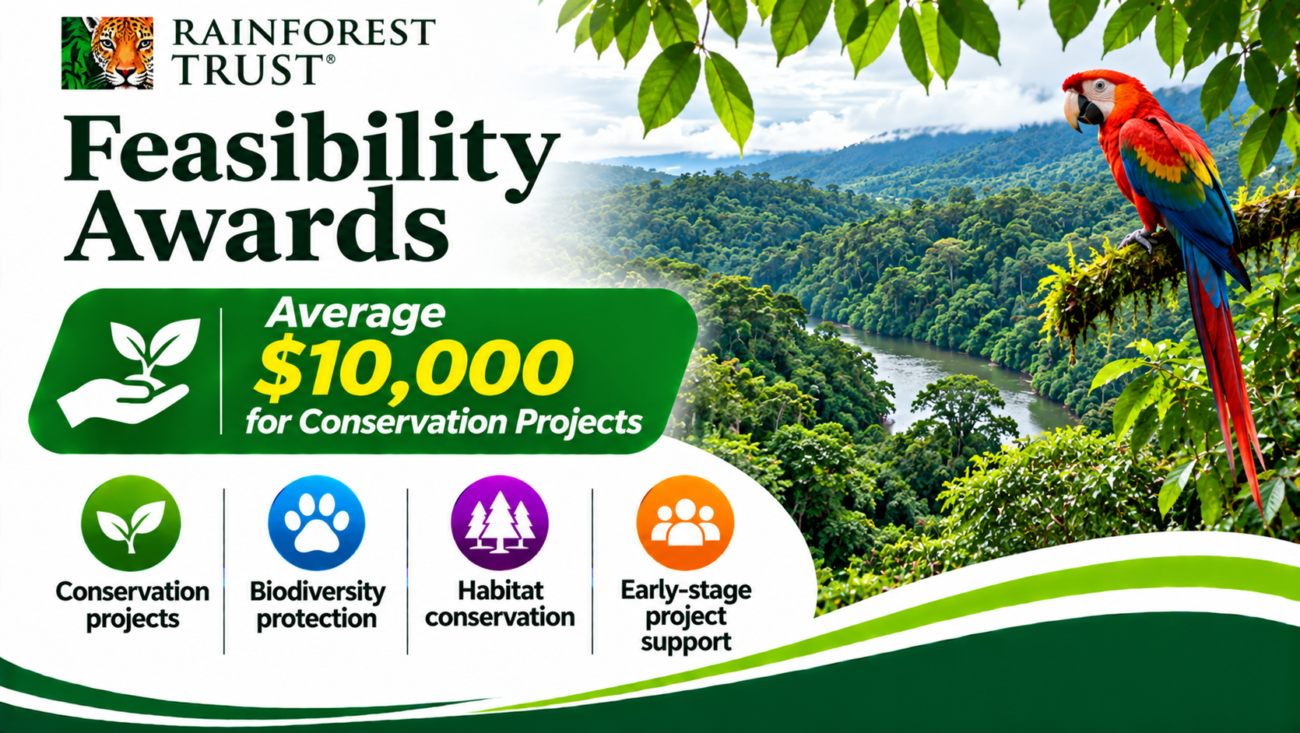
Rainforest Trust Feasibility Awards Average US$10,000 for Conservation Projects: How NGOs Can Apply
Rainforest Trust Feasibility Awards Average US$10,000 for Conservation Projects: How NGOs Can Apply. Non-governmental organisations working to protect endangered species, forests and other threatened ecosystems can seek funding through the Rainforest Trust Feasibility Awards, which provide an average of US$10,000 to help assess whether proposed sites can be established or expanded as protected or conserved areas.
The funding supports early-stage conservation work that addresses specific information gaps before an organisation proceeds with a larger protected-area project. Examples include conducting field surveys to establish whether Critically Endangered or Endangered species occur at a proposed site, assessing land tenure, investigating legal protection options and evaluating community and government support.
Unlike individual scholarships or research fellowships, these awards are intended for eligible conservation organisations. Applicants must be legally registered non-governmental organisations authorised to operate in the country where the proposed conservation project will take place.
Applications for Feasibility Awards are accepted on a rolling basis throughout the year. There is no fixed annual deadline for submitting a concept note. Rainforest Trust reviews concept notes within approximately one to two months and invites successful applicants to prepare a more detailed application.
The programme is particularly relevant to conservation organisations working in tropical and subtropical regions, including eligible projects in Africa.
1. Rainforest Trust Feasibility Awards: Key Details
| Detail | Information |
|---|---|
| Funding organisation | Rainforest Trust |
| Grant programme | Feasibility Awards |
| Funding type | Conservation project grant |
| Average award | US$10,000 |
| Exceptional funding | Awards exceeding US$20,000 may be considered |
| Eligible applicants | Legally registered non-governmental organisations |
| Geographic focus | Primarily tropical and subtropical regions |
| Project focus | Assessing the feasibility of creating or expanding protected or conserved areas |
| Eligible activities | Species surveys, legal protection assessments, land-tenure assessments and related feasibility work |
| Application deadline | Rolling; concept notes accepted throughout the year |
| Concept-note review | Approximately 1–2 months |
| Application process | Concept note followed by a detailed application if invited |
| Application fee | No fee or paid intermediary is required |
The concept-note link above should be accessed through the official Rainforest Trust funding page, which provides the current submission form.
The US$10,000 figure is an average, not a guaranteed award or a fixed amount for every successful applicant. In exceptional circumstances, Rainforest Trust may consider Feasibility Awards exceeding US$20,000. Rainforest Trust
2. About Rainforest Trust
Rainforest Trust Feasibility Awards Average US$10,000 for Conservation Projects: How NGOs Can Apply
Rainforest Trust is an international conservation organisation that works with local partners to protect threatened habitats and biodiversity.
Established in 1988, the organisation supports the creation and expansion of protected and conserved areas on land and at sea. Its conservation approach focuses on protecting important habitats, safeguarding threatened species and supporting local communities.
Rainforest Trust works with non-profit organisations, Indigenous Peoples and communities to establish conservation areas that can be managed sustainably over the long term.
Its funding supports two broad categories of conservation work:
- Feasibility Awards: Funding to investigate whether a proposed site can realistically become a protected or conserved area.
- Protected or Conserved Area Creation Awards: Funding to establish or expand protected and conserved areas through recognised conservation mechanisms.
The Feasibility Awards can therefore serve as an initial funding opportunity for organisations that need to gather essential information before seeking support for a larger conservation project. Rainforest Trust
3. What Are the Rainforest Trust Feasibility Awards?
Feasibility Awards help conservation organisations determine whether a proposed area has the ecological, legal, social and practical conditions necessary for long-term protection.
Before an area can be formally protected, an organisation may need to establish whether it contains threatened species, whether the land can legally be protected, whether local communities support the proposal and which conservation mechanism would be appropriate.
These investigations can require specialist expertise, fieldwork, consultations and legal assessments.
Rainforest Trust provides Feasibility Awards to help address these information gaps.
The funding is intended as a preparatory step towards a potential Protected or Conserved Area Creation Award. It is not simply a general research grant: the feasibility work should have a clear connection to the future creation or expansion of a protected or conserved area. Rainforest Trust
4. How Much Funding Is Available?
The average Feasibility Award is US$10,000.
However, the actual amount depends on the proposed project and the funding requirements accepted by Rainforest Trust.
| Funding information | Amount |
|---|---|
| Average Feasibility Award | US$10,000 |
| Exceptional awards | More than US$20,000 may be considered |
| Guaranteed award | No |
| Fixed maximum published for Feasibility Awards | No universal fixed maximum stated |
The organisation should prepare a realistic project budget showing the costs of obtaining the information needed to determine whether the proposed site can be protected.
For example, a feasibility project might require:
- Field surveys for threatened species.
- Land-tenure investigations.
- Legal assessments.
- Consultations with local communities.
- Engagement with government authorities.
- Technical assessments of the proposed conservation site.
The final funding decision rests with Rainforest Trust. Applicants should not assume that submitting a US$10,000 budget will automatically result in an award of that amount. Rainforest Trust
5. What Activities Can the Feasibility Awards Support?
The programme supports investigations that address specific barriers to creating or expanding protected and conserved areas.
5.1 Threatened-species field surveys
A conservation organisation may need to establish whether a proposed site contains populations of Critically Endangered or Endangered species.
A feasibility project could support fieldwork to investigate:
- Whether threatened species occur at the proposed site.
- Their presence and abundance.
- The importance of the site to their survival.
- Whether habitat loss is a significant threat.
- Whether protecting the area could contribute to species conservation.
The findings can help establish the conservation value of the proposed area.
5.2 Legal protection assessments
An organisation may need to understand the legal procedures required to establish a protected area.
Feasibility funding can support investigations into:
- National protected-area designation procedures.
- Applicable land and conservation legislation.
- Legal pathways for establishing long-term protection.
- Requirements for acquiring or securing land rights.
- Possible conservation arrangements.
This work helps determine whether a proposed site can realistically obtain lasting legal protection.
5.3 Land-tenure assessments
Understanding land ownership and existing rights is essential before establishing a protected area.
A feasibility project may investigate:
- Current land ownership.
- Existing land-use rights.
- Land-tenure disputes.
- Whether landowners are willing to participate.
- Whether land acquisition or another protection mechanism is practical.
5.4 Community and government consultations
Long-term conservation requires support from relevant authorities and the people connected to the proposed site.
Feasibility work can therefore assess:
- Government interest in the conservation proposal.
- Local community support.
- Indigenous Peoples’ interests and rights, where applicable.
- Potential concerns about land use.
- Opportunities for community participation.
- The consent processes needed before implementation.
5.5 Assessing land acquisition opportunities
Where private land purchase is being considered, feasibility work can help determine whether landowners are willing to sell and whether the proposed purchase could contribute to a larger conservation outcome.
These activities must be connected to a credible plan for establishing or expanding a protected or conserved area. Rainforest Trust
6. Who Is Eligible to Apply?
The most important eligibility requirement is that the applicant must be a legally registered non-governmental organisation authorised to conduct work in the country where the project will take place.
Rainforest Trust does not describe these awards as grants for individual researchers, students or private applicants.
The organisation must demonstrate that it has the legal status and capacity to implement the proposed conservation work.
6.1 Eligible applicants
Potential applicants include:
- Legally registered conservation NGOs.
- Non-profit environmental organisations.
- Biodiversity conservation organisations.
- NGOs working with Indigenous Peoples.
- Organisations partnering with local communities.
- Conservation organisations with experience in protected-area establishment or expansion.
Indigenous Peoples and local communities are important partners in Rainforest Trust’s conservation model. However, the official application process specifies that the project implementer must be a legally registered NGO authorised to work in the project country. Rainforest Trust
6.2 Can individuals apply?
No. The official application criteria require an eligible non-governmental organisation as the project implementer.
An individual conservationist or researcher would therefore need to work through an eligible registered NGO rather than submit a personal application.
6.3 Can organisations outside the United States apply?
Yes. The programme works with conservation partners internationally.
The key requirements concern the applicant organisation’s legal registration, authority to operate in the project country and the suitability of the proposed conservation project.
7. Geographic Eligibility: Can Zimbabwean NGOs Apply?
Rainforest Trust Feasibility Awards Average US$10,000 for Conservation Projects: How NGOs Can Apply
Zimbabwean conservation organisations may be relevant applicants because the programme’s primary geographic focus includes tropical and subtropical regions.
Rainforest Trust states that its primary focus is on tropical and subtropical ecosystems. However, it also says that strong proposals from outside these regions may be considered if they meet the other criteria.
For an organisation based in Zimbabwe, the proposed project would need to demonstrate that it meets the conservation requirements and that the applicant is legally authorised to conduct the work in the relevant project area.
Potentially relevant conservation contexts could include:
- Forest and woodland habitats.
- Wetland ecosystems.
- Habitats supporting threatened wildlife.
- Areas important for biodiversity conservation.
- Sites containing habitats significant for climate mitigation.
These are examples of possible project contexts, not confirmation that every project in these categories will qualify.
Important: Being based in Zimbabwe does not automatically make an organisation eligible. Rainforest Trust assesses the proposed site, conservation value, legal protection pathway, community and government support, and long-term management arrangements. Rainforest Trust
8. Mandatory Project Selection Criteria
Rainforest Trust publishes specific criteria that apply to all projects seeking support.
A proposal must demonstrate that it can contribute to the creation or expansion of a protected or conserved area.
8.1 The main objective must be area protection
The primary objective must be creating or expanding a protected or conserved area.
A project that only conducts general environmental research without a clear protection outcome is unlikely to meet this requirement.
8.2 The proposed area must currently be unprotected
The proposed site must not already have the relevant formal protection status.
Rainforest Trust recommends using the World Database of Protected Areas to help determine whether formal protection already exists.
8.3 The site must have significant conservation value
The proposed area must meet at least one of the organisation’s stated conservation priorities:
- Protect globally significant populations of Critically Endangered or Endangered species.
- Protect large areas of tropical or subtropical high-integrity forests.
- Protect tropical or subtropical habitats that are critical for mitigating global climate change, such as peat swamps, mangroves and páramo.
8.4 The project implementer must be legally registered
The organisation must be legally registered as an NGO and authorised to conduct conservation work in the country of the proposed project.
8.5 Government and community support must be demonstrated
The project must demonstrate support from relevant government authorities, Indigenous Peoples and/or local communities.
Relevant Free, Prior and Informed Consent (FPIC) must have been or must be properly conducted.
8.6 A lasting legal protection mechanism must be established
The proposed protection mechanism should result in a change in the legal status of the area during the project.
This mechanism should address important threats to biodiversity and, where applicable, carbon storage.
8.7 A sustainable management system must be in place
The project must demonstrate that a management system, including a management plan and committee, exists or will be established.
This system should ensure positive and sustained conservation outcomes.
8.8 Resource extraction must be controlled
The project must establish or plan limits on resource extraction to prevent unsustainable use of the proposed protected area. Rainforest Trust
9. What Types of Projects Are More Competitive?
In addition to the mandatory requirements, Rainforest Trust publishes preferred criteria that can strengthen a conservation proposal.
These include:
Strong conservation track record: Organisations with experience establishing or expanding protected or conserved areas may be better positioned to demonstrate implementation capacity.
Sustainable financing: Proposals should explain how the protected area will be financed and managed over the long term.
Community livelihoods: Projects that support sustainable livelihoods through appropriate subsistence activities, employment, community enterprises or environmental incentives align with the organisation’s preferred approach.
Effective governance: The proposed management arrangements should be legitimate, democratic, equitable and accountable.
Government support: Evidence that relevant regional or national authorities support the proposed protection mechanism can strengthen a proposal.
Community leadership: For projects involving Indigenous Peoples and local communities, Rainforest Trust favours meaningful community participation and, where appropriate, community-led management and land ownership.
These are preferred criteria, not substitutes for the mandatory project requirements. Rainforest Trust
10. What Does Rainforest Trust Not Fund?
Rainforest Trust Feasibility Awards Average US$10,000 for Conservation Projects: How NGOs Can Apply
Organisations should understand the exclusions before preparing a concept note.
Rainforest Trust focuses on direct conservation action aimed at establishing or expanding sustainably managed protected and conserved areas.
Its official funding guidance states that it cannot fund:
| Excluded activity or cost | Explanation |
|---|---|
| Fixed-rate overhead costs | General overhead charged at a fixed percentage is not supported |
| Long-term ecological monitoring or research | Ongoing monitoring and long-term research are outside the funding scope |
| Large-scale habitat restoration | Activities such as large-scale tree planting are excluded |
Rainforest Trust notes that itemised expenditures may be considered even though fixed-rate overhead costs are not supported.
This distinction is important for NGOs preparing project budgets. The proposal should focus on the specific feasibility work needed to move towards protected-area creation or expansion, rather than general organisational operating expenses. Rainforest Trust
11. Application Deadlines and Funding Availability
The Feasibility Awards operate on a rolling application basis.
This means organisations can submit concept notes throughout the year rather than waiting for one annual competition.
| Application stage | Timing |
|---|---|
| Concept-note submission | Accepted anytime |
| Concept-note review | Approximately 1–2 months |
| Detailed application | By invitation after a successful concept note |
| Feasibility Award funding | Rolling throughout the year |
| Fixed annual deadline for Feasibility Awards | None published |
Do not confuse Feasibility Awards with larger conservation grants
Rainforest Trust also offers Protected or Conserved Area Creation Awards.
For these separate awards, the application schedule depends on the funding amount:
- Awards below US$250,000: accepted on a rolling basis.
- Awards of US$250,000 and above: deadlines of 1 March, 1 July and 1 October each calendar year.
The organisation recommends submitting a concept note approximately four months before the deadline for a Protected or Conserved Area Creation Award of US$250,000 or more.
These larger-grant deadlines should not be mistaken for the Feasibility Awards application schedule. Rainforest Trust
12. How to Apply for Rainforest Trust Feasibility Awards
The application process begins with a concept note.
Organisations cannot simply submit a full application without first going through the concept-note stage.
- Confirm organisational eligibilityEnsure that your organisation is legally registered as an NGO and authorised to conduct conservation work in the country where the project will take place.
- Review the project selection criteriaConfirm that the proposed project aims to create or expand a protected or conserved area and meets the conservation, legal and community requirements.
- Identify the information gapDetermine what must be investigated before the proposed site can be protected. This could involve species surveys, land-tenure assessments, legal research or stakeholder consultations.
- Prepare a concept noteExplain the proposed site, conservation importance, information gap, feasibility activities and how the results could support protected-area creation or expansion.
- Submit the concept note onlineUse the concept-note submission form linked from Rainforest Trust’s official funding page. Concept notes are accepted throughout the year.
- Wait for the initial reviewRainforest Trust indicates that concept notes are reviewed within approximately one to two months.
- Prepare a detailed application if invitedIf the concept note is successful, a Rainforest Trust staff member will contact the organisation and invite it to submit a detailed application through the online portal.
- Work with Rainforest Trust to refine the proposalThe organisation describes its application process as collaborative and may provide guidance on project structure and proposal language.
Rainforest Trust
Official concept-note submission
Start from the official funding page.
13. How to Prepare a Strong Conservation Concept Note
A strong concept note should show that the proposed feasibility work is necessary, realistic and directly connected to long-term conservation.
Although Rainforest Trust provides its own submission process and requirements, organisations can prepare by addressing the following issues.
13.1 Clearly identify the proposed conservation site
Describe:
- The site’s name and location.
- Its size and boundaries.
- Its current legal protection status.
- The surrounding land-use context.
- The ecosystems and habitats present.
Include appropriate geographical information and mapping where available.
13.2 Explain the conservation importance
Identify the species, ecosystems or habitats that make the site important.
Where relevant, provide evidence of threatened species, high-integrity forest or climate-critical habitats.
13.3 Explain the information gap
State precisely what is not yet known.
For example:
- Whether a threatened species is present.
- Whether land ownership can be established.
- Whether the site can be protected under existing legislation.
- Whether communities support the proposal.
- Whether land acquisition is possible.
13.4 Describe the feasibility activities
Explain how the organisation will obtain the missing information.
Provide a clear work plan and identify the specialists or partners who will carry out the activities.
13.5 Demonstrate community and government engagement
Explain which government authorities, community representatives and Indigenous Peoples need to be consulted.
Describe how the organisation will secure appropriate support and carry out FPIC processes where applicable.
13.6 Show the pathway to long-term protection
The concept note should explain what the organisation intends to do if the feasibility study demonstrates that the proposed site can be protected.
This is essential because Feasibility Awards are intended to prepare projects for possible protected or conserved area creation or expansion.
13.7 Prepare a realistic budget
The budget should be linked directly to the feasibility activities.
Explain the expected costs and avoid relying on fixed-rate overhead charges, which Rainforest Trust does not fund. Rainforest Trust
14. Frequently Asked Questions
1. How much does Rainforest Trust provide through Feasibility Awards?
The average award is US$10,000. In exceptional circumstances, awards exceeding US$20,000 may be considered.
2. Is US$10,000 guaranteed to every successful applicant?
No. US$10,000 is the average award size, not a guaranteed payment. Funding is assessed according to the proposed project and its requirements.
3. Can individuals apply?
No. The project implementer must be a legally registered NGO authorised to work in the country of the proposed project.
4. Can Zimbabwean NGOs apply?
Potentially, yes. Zimbabwean organisations can explore the programme if they meet the registration, authorisation and project selection requirements. The proposed project must also demonstrate the required conservation value and long-term protection pathway.
5. Can an organisation apply from outside the tropics?
Rainforest Trust’s primary focus is tropical and subtropical regions. However, it states that strong proposals from outside these areas may be considered if they meet the other requirements.
6. Is there an application deadline?
There is no fixed annual deadline for Feasibility Awards. Concept notes are accepted throughout the year.
7. How long does it take to receive feedback?
Rainforest Trust indicates that concept notes are reviewed within approximately one to two months. This is the initial review period, not a guarantee of final funding approval.
8. What happens after submitting a concept note?
If the concept note is successful, Rainforest Trust contacts the organisation and invites it to submit a detailed application through its online portal.
9. Can the grant fund wildlife surveys?
Yes. Field surveys to establish the presence and abundance of Critically Endangered or Endangered species are examples of activities that Feasibility Awards can support.
10. Can the grant fund general environmental research?
Not necessarily. The work must address a specific information gap connected to the creation or expansion of a protected or conserved area. Long-term ecological monitoring or research is excluded.
11. Can the funding support tree planting?
Large-scale habitat restoration, including large-scale tree planting, is listed among the activities Rainforest Trust cannot fund.
12. Can the grant cover NGO administrative overheads?
Fixed-rate overhead costs are not supported. Rainforest Trust does indicate that itemised expenditures may be considered.
13. Does the organisation need government and community support?
Yes. The project must demonstrate support from relevant government authorities, Indigenous Peoples and/or local communities, with appropriate Free, Prior and Informed Consent processes.
14. Is a consultant required to apply?
No. Rainforest Trust explicitly states that applicants do not need to pay a consultant or intermediary. Applications must be submitted directly by eligible organisations.
15. Can a Feasibility Award lead to a larger conservation grant?
Yes. Feasibility Awards are intended to address information gaps before an organisation applies for a Protected or Conserved Area Creation Award. However, receiving a Feasibility Award does not guarantee future funding. Rainforest Trust
JOIN THE VACANCY BRIDGE WHATSAPP CHANNEL
https://whatsapp.com/channel/0029Vakee9aHFxOyCIBPJA0o
APPLY NOW ON THIS OFFICIAL PAGE
16. Final Summary
Rainforest Trust Feasibility Awards Average US$10,000 for Conservation Projects: How NGOs Can Apply
Rainforest Trust Feasibility Awards Average US$10,000 for Conservation Projects: How NGOs Can Apply. Rainforest Trust Feasibility Awards provide an opportunity for eligible conservation NGOs to obtain financial support for early-stage work needed to establish or expand protected and conserved areas.
With an average award of US$10,000, the programme can help organisations investigate threatened-species populations, assess land tenure, explore legal protection mechanisms and evaluate community and government support.
The programme is particularly relevant to organisations working in tropical and subtropical ecosystems, including eligible conservation projects in Zimbabwe and other African countries.
However, funding is not available to individuals. Applicants must be legally registered NGOs authorised to work in the country where the conservation project will take place.
There is no fixed annual application deadline. Concept notes are accepted throughout the year and reviewed within approximately one to two months. Organisations with successful concept notes are invited to submit a more detailed application.
For conservation organisations seeking to protect threatened wildlife, forests and climate-critical habitats, the Feasibility Awards can provide an important first step towards establishing lasting conservation areas.
SEO Keywords
Rainforest Trust Feasibility Awards, Rainforest Trust grants 2026, US$10,000 conservation grants, conservation funding for NGOs, biodiversity conservation grants, wildlife conservation funding, protected area grants Africa, environmental grants Zimbabwe, conservation grants for African NGOs, endangered species conservation funding, rainforest protection grants, feasibility study grants, protected area creation funding, tropical forest conservation grants, environmental NGO funding opportunities.
