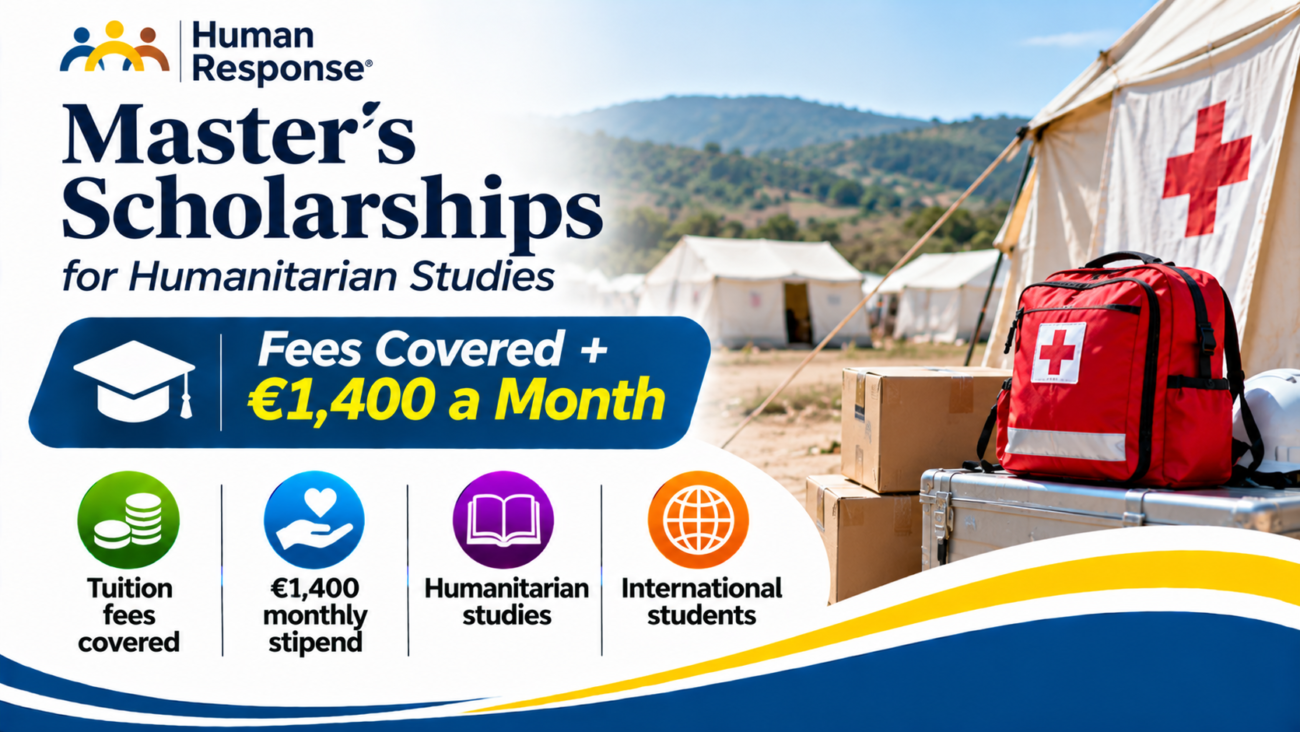
Human Response Erasmus Mundus Master’s Scholarships 2027–2029: Tuition Waiver and €1,400 Monthly Stipend for Humanitarian Studies
Human Response Erasmus Mundus Master’s Scholarships 2027–2029: Tuition Waiver and €1,400 Monthly Stipend for Humanitarian Studies. Applications are open for the 2027–2029 Erasmus Mundus Joint Master in Coordinated Humanitarian Response, Health and Displacement, known as Human Response. The international master’s programme prepares graduates and professionals to manage humanitarian programmes, respond to health emergencies and address the challenges associated with conflict, forced displacement and climate-related disasters.
The programme offers 15 Erasmus Mundus scholarships per edition. Successful scholarship recipients receive €1,400 per month for the 24-month programme, pay no programme fees and receive 24 months of insurance.
The master’s degree is delivered through a partnership of European and African universities, with study periods in Portugal, Norway and Uganda. Students also participate in a mandatory summer school and undertake dissertation research in a humanitarian context through the consortium’s academic and associated partner network.
The scholarship application round for the 2027–2029 edition closes on 7 January 2027. Applicants from all nationalities, including Zimbabwe, can apply if they meet the academic, English-language and documentation requirements.
There is no application fee. However, applicants should understand that the €1,400 monthly scholarship is the only additional scholarship payment: students must plan carefully for international travel, accommodation, visa and other costs. humanresponse.eu+3
1. Human Response Erasmus Mundus Scholarship 2027–2029: Key Details
| Detail | Information |
|---|---|
| Programme | Erasmus Mundus Joint Master in Coordinated Humanitarian Response, Health and Displacement |
| Short name | Human Response |
| Degree level | Master’s |
| Intake | 2027–2029 |
| Duration | 24 months |
| Total credits | 120 ECTS |
| Teaching language | English |
| Scholarships | 15 per edition |
| Monthly scholarship | €1,400 |
| Total over 24 months | €33,600 |
| Tuition/programme fees | Waived for scholarship recipients |
| Insurance | 24 months provided |
| Application fee | None |
| Eligible nationalities | All nationalities |
| Minimum academic qualification | Bachelor’s degree equivalent to 180 ECTS |
| Main study locations | Portugal, Norway and Uganda |
| Application deadline | 7 January 2027 |
| Application method | Online |
2. About the Human Response Master’s Programme
Human Response Erasmus Mundus Master’s Scholarships 2027–2029: Tuition Waiver and €1,400 Monthly Stipend for Humanitarian Studies
The Human Response programme was developed to strengthen professional capacity in humanitarian action, public health, displacement and crisis response.
Humanitarian emergencies are becoming increasingly complex. Armed conflict, forced displacement, natural disasters, climate change and public health emergencies require professionals who can coordinate assistance across different organisations, governments and communities.
Human Response brings together European and African universities to develop a multidisciplinary approach to these challenges.
The programme combines academic teaching with practical learning, research, internships and exposure to organisations working in humanitarian contexts.
Its main objectives include:
- Developing professional skills in humanitarian programme management.
- Strengthening public health knowledge in emergency settings.
- Improving humanitarian coordination and operational planning.
- Understanding forced displacement and the relationship between humanitarian and development assistance.
- Supporting locally led responses to crises.
- Developing research skills for humanitarian policy and practice.
- Promoting cooperation between African and European institutions.
The qualification is a two-year postgraduate programme at EQF Level 7, equivalent to 120 ECTS credits.
3. What Does the Erasmus Mundus Scholarship Cover?
Erasmus Mundus scholarship
Monthly financial support
€1,400
For 24 months
Programme fees
Waived
Insurance
24 months
Total monthly payments
€33,600
The consortium allocates 15 Erasmus Mundus scholarships per edition in accordance with Erasmus Mundus guidelines.
Successful scholarship recipients receive the following benefits.
3.1 Monthly stipend of €1,400
Each scholarship holder receives €1,400 per month.
Over the full 24-month programme, this represents a total of:
\[ €1,400 \times 24 = €33,600 \]
The consortium states that no additional scholarship payments are made.
The monthly allowance is intended to support students during the programme’s international study and mobility periods. humanresponse.eu+1
3.2 Full programme-fee waiver
Students awarded the Erasmus Mundus scholarship do not pay programme fees.
This is a significant benefit because self-funded students are listed as paying €16,000 for the two-year master’s programme.
3.3 Insurance for 24 months
The programme provides 24 months of insurance to all students, including scholarship holders and self-funded students.
Applicants should review the insurance arrangements and confirm what coverage is included before travelling.
3.4 Important: When do scholarship payments begin?
The scholarship does not begin paying before the student arrives for the start of programme activities.
The consortium advises that the first payment may take approximately three weeks to one month after arrival in Lisbon.
Successful applicants should therefore prepare sufficient money for their initial travel and settling-in expenses.
Students are also responsible for providing the consortium with the necessary bank-account details and ensuring that their accounts remain available throughout the programme and its different mobility periods. humanresponse.eu
4. Costs That Students Must Still Prepare For
Although Erasmus Mundus scholarship recipients do not pay programme fees, the consortium identifies several expenses that students must plan for.
| Expense | Funding position |
|---|---|
| Programme fees | Waived for Erasmus Mundus scholarship holders |
| Monthly living support | €1,400 scholarship |
| Insurance | 24 months provided |
| International travel between study locations | Students must budget for travel |
| Accommodation | Students must budget for housing |
| Food and daily living expenses | Students must budget for these |
| Local transportation | Students must budget for this |
| Visa and residence permits | Student’s responsibility |
| Initial expenses before first payment | Student must prepare funds |
The programme’s application information specifically warns students to plan for travel between countries, accommodation, daily living expenses and visa or residence-permit costs.
The €1,400 monthly scholarship is therefore important financial support, but applicants should not interpret it as a separate travel allowance with additional payments on top. humanresponse.eu
5. Who Can Apply for the Human Response Scholarship?
Human Response Erasmus Mundus Master’s Scholarships 2027–2029: Tuition Waiver and €1,400 Monthly Stipend for Humanitarian Studies
The programme is open to applicants of all nationalities who meet the admission requirements.
It is designed for graduates and professionals interested in humanitarian action, public health, displacement, development and crisis management.
5.1 Academic qualification
Applicants must hold a bachelor’s degree equivalent to 180 ECTS credits.
Candidates who have not completed a bachelor’s degree by the application date should check the programme’s current admission instructions carefully. The published application requirements specify the bachelor’s qualification as an admission requirement.
5.2 Academic background
Human Response is multidisciplinary and brings together subjects such as:
- Public health.
- Social sciences.
- Sociology.
- Development studies.
- Public policy.
- Management.
- Social work.
- Humanitarian studies.
- Research methodology.
Applicants should demonstrate how their academic background relates to humanitarian response, health, displacement or the programme’s wider objectives.
The selection criteria consider both the level and relevance of the applicant’s previous qualification. humanresponse.eu+2
5.3 Professional and research experience
Professional experience is considered during selection.
The programme is relevant to people interested in developing careers in humanitarian organisations, emergency response, public health, displacement support, development agencies and related fields.
Research experience is also assessed, although it carries a smaller weighting than academic qualification, professional experience and the statement of purpose.
5.4 Nationality
There is no nationality restriction stated on the current scholarship application page.
Applicants from African countries, Europe, Asia, the Americas and other regions can apply if they satisfy the admission requirements.
6. Can Zimbabweans Apply?
Yes. Zimbabwean applicants can apply for the Human Response Erasmus Mundus Master’s and compete for the available scholarships.
The programme welcomes candidates from all nationalities, and Zimbabwe is not excluded by the published application rules.
Zimbabwean applicants should pay particular attention to:
- Having a bachelor’s qualification equivalent to 180 ECTS.
- Providing complete academic transcripts and degree certificates.
- Meeting the accepted English-language requirements or qualifying for an exemption.
- Obtaining two signed and dated recommendation letters.
- Preparing a strong statement of purpose.
- Providing a valid passport and photograph.
Applicants should also plan for the international mobility requirements, including travel and visa arrangements for Portugal, Norway, Uganda and the location of their final research activities. humanresponse.eu+1
7. English Language Requirements
English proficiency is mandatory unless an applicant qualifies for one of the exemptions listed by the consortium.
The current 2027–2029 application page accepts the following English-language tests and minimum scores:
| Test | Minimum requirement |
|---|---|
| TOEFL iBT, MyBest or at-home | 92 overall out of 120 |
| IELTS Academic | 6.5 overall, with no individual score below 5.5 |
| PTE Academic | 76 overall out of 90 |
| Cambridge C1 Advanced | Minimum overall score of 180 |
| Cambridge C2 Proficiency | Minimum overall score of 180 |
| Duolingo English Test | 135 overall, with no component below 100 |
The consortium states that English tests must have been taken within the permitted validity period of two years and five months before the application date, unless the issuing organisation applies a shorter validity period. humanresponse.eu
7.1 Who is exempt from submitting an English test?
The programme identifies three exemption routes.
Applicants educated in an English-official-language country
Applicants may be exempt if they come from a country where English is an official language and completed their secondary education in that country. Evidence of completed secondary education must be provided.
Applicants with International Baccalaureate or IGCSE education
Candidates who completed secondary education certified by the International Baccalaureate or the corresponding IGCSE level can qualify for an exemption by providing proof.
Applicants whose entire bachelor’s degree was taught in English
Candidates can be exempt if the language of instruction throughout their entire bachelor’s programme was English.
The language must be clearly indicated on the diploma or transcripts. Alternatively, applicants can provide a signed official letter from the university’s Academic Registrar, Examinations Office or equivalent records office. humanresponse.eu
7.2 English-language guidance for Zimbabwean applicants
Zimbabwean applicants who completed their secondary education in Zimbabwe may be able to use the English-official-language exemption, provided they supply the required evidence of completion.
Applicants who do not meet that exemption can use the alternative route based on their entire bachelor’s degree having been taught in English, with the required university documentation.
If neither exemption applies, applicants should take one of the accepted tests and meet the minimum score.
The consortium also reserves the right to invite candidates for an interview to assess their English proficiency. humanresponse.eu
8. What Will Students Study?
The Human Response programme is structured around four semesters, a mandatory summer school and international mobility.
The curriculum combines humanitarian action, public health, management, social support, research and practical experience.
The programme totals 120 ECTS credits and is taught in English. humanresponse.eu+1
8.1 Semester One: Iscte, Portugal
The first semester takes place at Iscte – University Institute of Lisbon.
It provides an introduction to humanitarian action and its theoretical, organisational and operational foundations.
The semester carries 30 ECTS credits and includes:
Mandatory courses
- Concepts, Fundamentals and Challenges in Humanitarian Action.
- Public Health in Humanitarian Action.
- Management in Humanitarian Action.
- Research Methodology.
Elective courses
- Project Management in Humanitarian Action.
- Participatory Evaluation in Humanitarian Action.
- Environmental Risk and Societal Resilience.
Students develop an understanding of humanitarian principles, programme management, public health and research approaches.
8.2 Semester Two: Norwegian University of Science and Technology, Norway
Human Response Erasmus Mundus Master’s Scholarships 2027–2029: Tuition Waiver and €1,400 Monthly Stipend for Humanitarian Studies
The second semester takes place at the Norwegian University of Science and Technology (NTNU).
It focuses on global health, innovation, entrepreneurship, humanitarian design and advanced research methods.
The semester carries 30 ECTS credits.
Mandatory courses
- Advancing Perspectives in Public Health.
- Innovation in Global Health.
- Humanitarian Design and Technology.
Elective courses
- Qualitative Research Methods.
- Statistical and Epidemiological Methods.
This stage helps students develop more specialised knowledge of health systems, humanitarian innovation and research methods. humanresponse.eu+1
8.3 Mandatory Summer School
Between the second and third semesters, students participate in a mandatory two-week summer school worth six ECTS credits.
The summer school provides direct exposure to institutions and organisations involved in delivering life-saving assistance in countries affected by humanitarian emergencies.
Activities include:
- Workshops with associated partners.
- Field visits.
- Group work.
- Presentations on specific assignments.
- Research methodology sessions.
- Presentation and discussion of dissertation projects.
For the 2027–2029 edition, the programme’s published schedule identifies Greece in June 2027 as the second intake’s summer-school location.
8.4 Semester Three: Makerere University, Uganda
The third semester takes place at Makerere University in Uganda.
It focuses on social support, displacement, development studies and the practical challenges of working in highly volatile environments.
The semester carries 24 ECTS credits and includes:
- Environment, Climate Change and Natural Resources.
- Conflict, Security and Development.
- Advanced Counselling in Social Work.
- Fieldwork or internship.
Students gain exposure to humanitarian and development responses in contexts affected by conflict, displacement and climate-related disasters.
Makerere University also provides internship opportunities through the programme. humanresponse.eu+1
8.5 Semester Four: Dissertation and Research
The final semester carries 30 ECTS credits and is dedicated to the master’s dissertation.
Students are placed across universities and associated partners in different regions, including:
- Europe.
- Africa.
- Asia.
- The Middle East.
- South America.
The dissertation enables students to investigate a relevant humanitarian issue and develop research experience in a practical context.
The consortium’s network includes 23 associated partners that contribute to the programme’s international research and practice environment.
9. Participating Universities and Partner Institutions
Human Response Erasmus Mundus Master’s Scholarships 2027–2029: Tuition Waiver and €1,400 Monthly Stipend for Humanitarian Studies
Human Response brings together seven full university partners across Europe and Africa.
| Institution | Country | Main contribution |
|---|---|---|
| Iscte – University Institute of Lisbon | Portugal | Coordination and humanitarian action foundations |
| Norwegian University of Science and Technology (NTNU) | Norway | Global health, research and humanitarian innovation |
| Makerere University | Uganda | Social support, displacement and internships |
| University of Cape Verde | Cape Verde | Humanitarian coordination and disaster response |
| University of Santiago | Cape Verde | Local policy and disaster/displacement responses |
| National and Kapodistrian University of Athens | Greece | Migration, refugees, human rights and education |
| University of Rovuma | Mozambique | Local coordination, conflict and internal displacement |
The consortium also includes 23 associated partners, including public institutions, humanitarian organisations, universities and civil-society organisations.
This network helps connect academic learning with the practical realities of humanitarian response. humanresponse.eu
10. Required Application Documents
Applicants must upload all mandatory documents through the online application platform.
The official application page warns that applications missing any mandatory document will not be considered eligible.
Prepare the following:
| Document | Requirement |
|---|---|
| Valid passport | Clear copy of a current passport |
| Photograph | Recent photograph |
| Academic diplomas | Certificates for previously completed degrees |
| Academic transcripts | Full transcript of records showing courses and grades |
| English proficiency | Accepted test certificate or qualifying exemption evidence |
| Curriculum vitae | Updated CV |
| Statement of purpose | Mandatory PDF document |
| Recommendation letters | Two signed and dated letters |
humanresponse.eu
10.1 Valid passport
Provide a copy of a valid passport. This is particularly important because the programme involves study and research mobility across several countries.
10.2 Academic diplomas
Upload certificates for previously completed degrees.
Applicants with qualifications from Zimbabwean universities should ensure that the documents are clear and complete.
10.3 Academic transcripts
The transcript must show the courses completed and grades obtained.
The consortium refers to the transcript of records or diploma supplement.
10.4 English proficiency evidence
Upload the certificate for one of the accepted tests, including the validation code where applicable.
If applying for an exemption, provide the required supporting evidence instead.
10.5 Curriculum vitae
Prepare an updated CV that explains your academic background, employment history, research experience, volunteering and relevant humanitarian activities.
10.6 Statement of purpose
The statement of purpose must be submitted as a PDF.
It should explain why you want to study humanitarian response, how your academic and professional background relates to the programme, and how the qualification supports your future goals.
10.7 Two recommendation letters
Applicants must provide two recommendation letters.
Both letters must be signed and dated.
Ask referees who can provide meaningful evidence of your academic ability, professional experience, research skills or suitability for postgraduate study.
11. How Applicants Are Selected
Meeting the minimum eligibility requirements does not guarantee admission or a scholarship.
The consortium assesses eligible applicants against six selection criteria, with a total weighting of 100%.
| Selection criterion | Weight |
|---|---|
| Level of academic qualification | 30% |
| Relevance of academic qualification | 15% |
| Relevance and level of research experience | 5% |
| Relevance and level of professional experience | 20% |
| Statement of purpose | 20% |
| Fit with programme goals and representation in the selected cohort | 10% |
| Total | 100% |
Academic qualifications carry the greatest weighting, followed by professional experience and the statement of purpose.
This means applicants should not focus only on their degree certificates. They should also explain how their experience and motivation connect with the programme’s humanitarian objectives.
The consortium may also invite candidates for an interview to assess their English proficiency. humanresponse.eu
12. How to Apply for the Human Response Erasmus Mundus Scholarship
Human Response Erasmus Mundus Master’s Scholarships 2027–2029: Tuition Waiver and €1,400 Monthly Stipend for Humanitarian Studies
Applications are submitted online through the Iscte Fénix+ platform.
Follow these steps:
Step 1: Review the official programme requirements
Visit the Human Response application page and read the eligibility criteria, scholarship conditions and document instructions.
Step 2: Confirm your academic eligibility
Ensure that you hold a bachelor’s degree equivalent to at least 180 ECTS credits.
Step 3: Check your English-language eligibility
Determine whether you qualify for an exemption or need to submit an accepted English-language test result.
Step 4: Prepare your academic documents
Scan your degree certificates and complete academic transcripts.
Step 5: Prepare your CV
Update your CV to include relevant education, work experience, research, volunteering and humanitarian involvement.
Step 6: Write your statement of purpose
Prepare a clear statement explaining your motivation, relevant background and professional objectives.
Step 7: Request two recommendation letters
Contact your academic or professional referees and ensure that both letters are signed and dated.
Step 8: Prepare your passport copy and photograph
Ensure that the passport is valid and that the photograph is suitable for the application.
Step 9: Create an account on the application portal
Open the official Iscte Fénix+ application platform and follow the registration instructions.
Step 10: Upload all mandatory documents
Check every upload before submitting. Missing documents can make an application ineligible.
Step 11: Submit before 7 January 2027
The scholarship round closes on 7 January 2027. Do not wait until the final hours to complete your application.
13. Application Deadline and Important Dates
Human Response Erasmus Mundus Master’s Scholarships 2027–2029: Tuition Waiver and €1,400 Monthly Stipend for Humanitarian Studies
The official Human Response website confirms that scholarship applications for the 2027–2029 edition are open.
| Event | Date |
|---|---|
| Scholarship application opening | Open |
| Scholarship application deadline | 7 January 2027 |
| Programme duration | 2027–2029 |
| Programme length | 24 months |
| First study location | Lisbon, Portugal |
| Second study location | Norway |
| Third study location | Uganda |
| Summer school for this intake | Greece, June 2027 |
The application page does not provide a confirmed final date for every selection and enrolment stage. Applicants should monitor the official website and their application email for updates. humanresponse.eu+1
14. Important Rules Applicants Should Understand
14.1 Previous Erasmus Mundus scholarship recipients cannot receive another
The consortium states that students who have already benefited from an Erasmus Mundus Joint Master scholarship are not eligible to apply for an additional Erasmus Mundus scholarship.
Applicants with a previous EMJM award should carefully review this restriction before submitting an application. humanresponse.eu
14.2 No application fee
Applicants do not need to pay an application fee.
Use the official portal and avoid anyone claiming to guarantee admission or a scholarship in exchange for payment.
14.3 Only 15 scholarships are available per edition
The consortium allocates 15 scholarships per edition under Erasmus Mundus guidelines.
The scholarship is competitive, and satisfying the minimum admission requirements does not guarantee funding.
14.4 Scholarship payments begin after arrival
Students should prepare for the initial period in Lisbon before the first scholarship payment arrives.
The consortium estimates that payment begins approximately three weeks to one month after arrival and the start of programme activities.
14.5 Students are responsible for their visa arrangements
Applicants must plan for the visa and residence-permit requirements of the countries where they will study or conduct research.
The programme specifically identifies visa application fees, taxes, proof of means of subsistence and related travel expenses as student responsibilities. humanresponse.eu
15. Frequently Asked Questions
Human Response Erasmus Mundus Master’s Scholarships 2027–2029: Tuition Waiver and €1,400 Monthly Stipend for Humanitarian Studies
1. Is the Human Response Master’s fully funded?
The 15 Erasmus Mundus scholarship recipients per edition receive €1,400 per month, a waiver of programme fees and 24 months of insurance. However, students must budget for international travel, accommodation, visa and other expenses. The scholarship is substantial support, but applicants should not assume that every additional expense is separately reimbursed.
2. How much is the monthly scholarship?
The scholarship provides €1,400 per month for 24 months.
3. What is the total scholarship value?
The monthly payments total €33,600 over two years. The programme-fee waiver and 24 months of insurance are additional benefits.
4. How many scholarships are available?
The consortium allocates 15 Erasmus Mundus scholarships per edition.
5. Can Zimbabweans apply?
Yes. The programme is open to all nationalities, including Zimbabweans, provided applicants meet the academic, English-language and documentation requirements.
6. What degree is required?
Applicants must have a bachelor’s degree equivalent to 180 ECTS credits.
7. Is IELTS compulsory?
No. Applicants can submit one of the accepted English tests or provide evidence that they qualify for an exemption.
8. Can Zimbabwean applicants qualify for an English-test exemption?
Potentially, yes. The consortium exempts applicants who completed secondary education in a country where English is an official language, provided they supply evidence. It also accepts qualifying evidence that the entire bachelor’s programme was taught in English.
9. Is there an application fee?
No. Applications to Human Response do not require an application fee.
10. Where will students study?
Students study at Iscte in Portugal, NTNU in Norway and Makerere University in Uganda. They also attend a mandatory summer school and undertake dissertation research through the partner network.
11. Does the scholarship cover accommodation?
The scholarship provides €1,400 monthly for living expenses. The programme does not list a separate accommodation allowance.
12. Does the programme provide health insurance?
Yes. The consortium provides 24 months of insurance to all students.
13. When does the scholarship payment start?
Payments begin after the selected student arrives in Lisbon and programme activities commence. The first payment may take approximately three weeks to one month.
14. Can someone who previously received an Erasmus Mundus scholarship apply?
They cannot receive an additional Erasmus Mundus Joint Master scholarship under the published rules.
15. What is the application deadline?
The scholarship application deadline for the 2027–2029 edition is 7 January 2027.
16. Can working professionals apply?
The programme considers professional experience during selection. Applicants should demonstrate how their experience relates to humanitarian action, public health, displacement or the programme’s wider goals.
JOIN THE VACANCY BRIDGE WHATSAPP CHANNEL
https://whatsapp.com/channel/0029Vakee9aHFxOyCIBPJA0o
APPLY NOW ON THIS OFFICIAL PAGE
17. Final Summary
Human Response Erasmus Mundus Master’s Scholarships 2027–2029: Tuition Waiver and €1,400 Monthly Stipend for Humanitarian Studies
Human Response Erasmus Mundus Master’s Scholarships 2027–2029: Tuition Waiver and €1,400 Monthly Stipend for Humanitarian Studies. The Human Response Erasmus Mundus Joint Master 2027–2029 offers an international postgraduate opportunity for graduates and professionals interested in humanitarian action, public health, displacement and crisis response.
The programme provides 15 competitive Erasmus Mundus scholarships per edition. Successful recipients receive:
- €1,400 per month for 24 months.
- €33,600 in total monthly scholarship payments.
- A full programme-fee waiver.
- 24 months of insurance.
Students study across Portugal, Norway and Uganda, participate in a mandatory summer school and complete dissertation research through the consortium’s international partner network.
The programme is open to applicants worldwide, including Zimbabweans, who hold a bachelor’s degree equivalent to 180 ECTS and meet the English-language and documentation requirements.
The scholarship application deadline is 7 January 2027. There is no application fee, but applicants must submit a valid passport, academic certificates, transcripts, English-language evidence or exemption documents, a CV, a statement of purpose and two signed recommendation letters.
For graduates seeking advanced training in humanitarian coordination, health emergencies, displacement and international development, Human Response offers a distinctive opportunity to study within a European-African university partnership.
SEO Keywords
Human Response Erasmus Mundus Scholarship 2027, Human Response Master’s 2027–2029, Erasmus Mundus humanitarian scholarship, humanitarian studies master’s scholarship, €1,400 monthly scholarship, fully funded humanitarian master’s, public health humanitarian response master’s, scholarships for Zimbabwean students, Erasmus Mundus scholarships for Africans, humanitarian action postgraduate programme, displacement studies scholarship, international development master’s scholarship, humanitarian management training, master’s scholarships in Portugal Norway Uganda.
