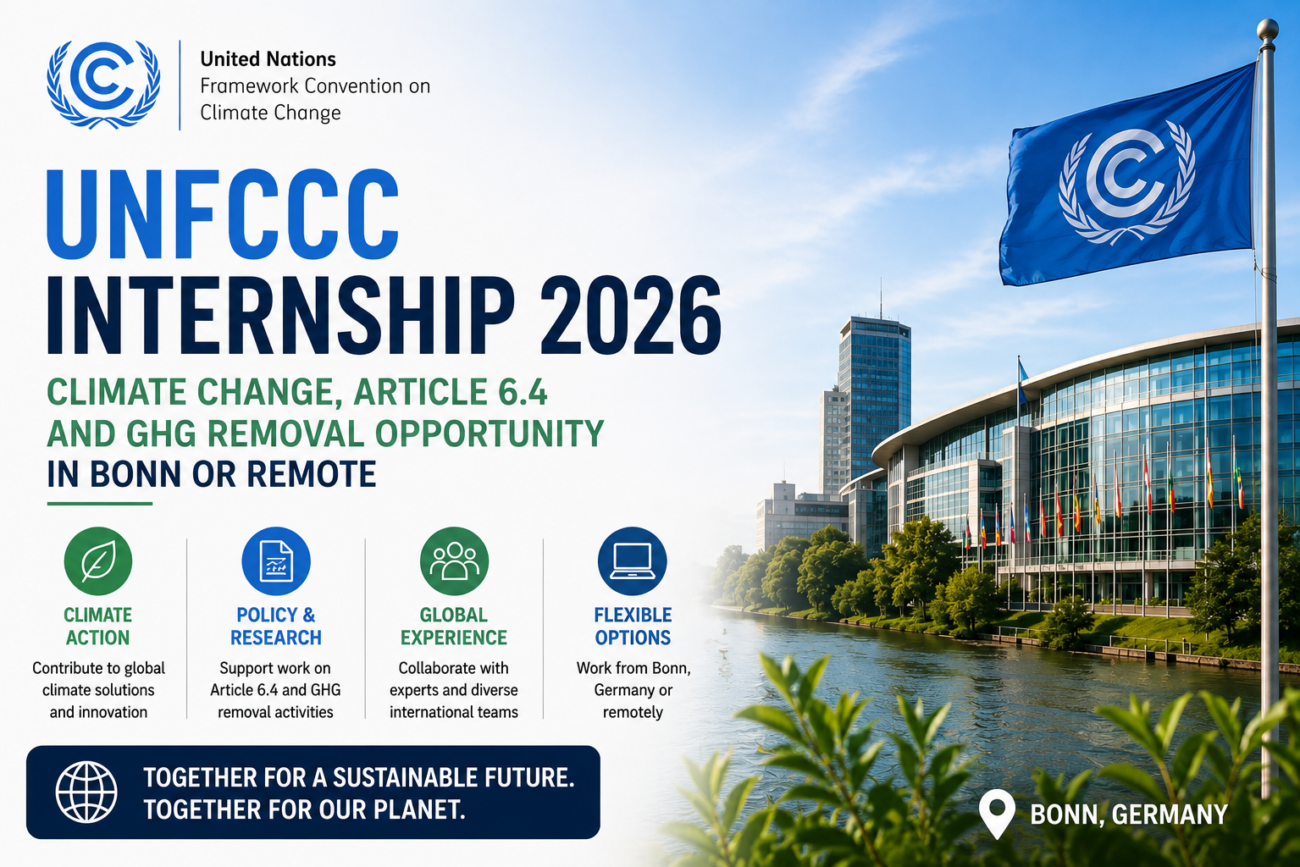
UNFCCC Internship 2026: Climate Change, Article 6.4 and GHG Removal Opportunity in Bonn or Remote
UNFCCC Internship 2026: Climate Change, Article 6.4 and GHG Removal Opportunity in Bonn or Remote. The United Nations Framework Convention on Climate Change (UNFCCC) offered a specialized 2026 internship with its Mitigation Division – Regulatory Framework Implementation Team, providing students with practical exposure to climate-change mitigation, greenhouse-gas removals and methodologies under Article 6.4 of the Paris Agreement.
The six-month internship was designed for students in engineering, environmental sciences, economics and related disciplines and combined technical research, data analysis, methodological work and support to climate experts. The official announcement listed the modality as on-site/remote, although the selected candidate was expected to work initially from the UNFCCC premises in Bonn, Germany, with remote work potentially forming part of the assignment depending on internship-permit arrangements.
Important update: Applications for this particular intake closed on 27 April 2026, so as of August 2026 it should be presented as a closed 2026 opportunity/reference for future UNFCCC internships, not as currently accepting applications.
🎓 UNFCCC Internship 2026 at a Glance
| Detail | Information |
|---|---|
| Organization | UNFCCC / UN Climate Change |
| Division | Mitigation Division |
| Team | Regulatory Framework Implementation |
| Announcement | 26/Intern15/Mitigation/RFI |
| Location | Bonn, Germany / remote component possible |
| Duration | 6 months |
| Expected start | October 2026 |
| Schedule | Full-time, 40 hours per week |
| Focus | Article 6.4, GHG removals, emission reductions and methodologies |
| Eligible level | Final-year Bachelor’s, Master’s/graduate or PhD students |
| Relevant fields | Engineering, Environmental Sciences, Economics and related disciplines |
| Language | Working knowledge of English |
| Funding | Unpaid |
| Deadline | 27 August 2026 |
These details come directly from the official 2026 UNFCCC internship announcement.
About UNFCCC
The United Nations Framework Convention on Climate Change, commonly known as UNFCCC or UN Climate Change, is at the centre of the international political process for addressing climate change.
The secretariat supports the implementation of the Convention, Kyoto Protocol and Paris Agreement, including substantive and organizational support for international climate negotiations and the implementation of commitments made by countries.
For students interested in climate policy and international environmental governance, an internship with UNFCCC therefore provides exposure to an institution directly involved in the global response to climate change.
About the 2026 Internship
This internship sits within UNFCCC’s Mitigation Division, specifically the Regulatory Framework Implementation (RFI) subdivision.
The RFI subdivision supports the development of regulatory guidelines, standards and policies relating to:
- Greenhouse-gas estimations
- Climate-change mitigation actions
- Technical assessment of projects
- Programmes of activities
- Entity competence
- Regulatory and constituted bodies
It also provides technical and substantive advice to relevant bodies and contributes to the climate negotiation process.
For this internship, the work is particularly focused on methodological issues surrounding Article 6.4 and greenhouse-gas removal activities.
🌱 What Is Article 6.4 of the Paris Agreement?
Article 6.4 establishes a mechanism under the Paris Agreement that can facilitate international cooperation on reducing greenhouse-gas emissions.
UNFCCC now refers to it as the Paris Agreement Crediting Mechanism.
Its development includes rules and standards dealing with methodologies, greenhouse-gas removals, transparency, activity registration and other components of the mechanism.
In 2024, Parties took note of standards covering the development and assessment of Article 6.4 methodologies and requirements for activities involving removals. Further guidance continued in 2025.
The subject remains highly active in 2026. The Article 6.4 Supervisory Body held its 22nd meeting in Bonn from 27–30 July 2026, with another meeting scheduled for 5–9 October 2026.
That makes this internship particularly relevant for students who want exposure to the evolving technical architecture of international carbon markets.
🔬 What Would the UNFCCC Intern Do?
The intern supports the work programme of the Mitigation Division relating to Article 6.4 methodologies and greenhouse-gas removal activities.
1. Conduct Research
A major part of the internship involves desk research on methodological aspects of removal activities and emission reductions.
This gives the intern an opportunity to examine technical questions surrounding climate mitigation and carbon-removal activities.
2. Collect and Analyse Data
The intern supports the:
- Collection
- Compilation
- Organization
- Analysis
of information related to standards for greenhouse-gas removals and emission reductions.
Particular attention is given to evaluating the potential and trends associated with removal activities and related standards.
3. Prepare Written Outputs
The internship also involves helping prepare written materials relating to these technical subjects.
Strong research writing and communication skills are therefore particularly important.
4. Support Article 6.4 Experts
Interns can work alongside subject-matter specialists and Article 6.4 mechanism experts involved in methodological research and standards for greenhouse-gas removals.
This is one of the strongest professional-development elements of the assignment.
5. Support Events
The intern assists with organizing events related to:
Article 6.4 methodologies + GHG removal activities.
The Article 6.4 process involves significant engagement between experts, Parties and stakeholders, including meetings and technical discussions.
🎓 Who Was Eligible to Apply?
The 2026 announcement established clear academic eligibility requirements.
At the time of application and throughout the internship, applicants needed to meet one of two conditions.
They had to be:
1. Enrolled in a graduate programme — such as a second university degree, Master’s, equivalent qualification or higher degree such as a PhD;
OR
2. Enrolled in the final academic year of a first university degree — at least Bachelor’s level or equivalent.
The institution must be a recognized university.
This means the opportunity was particularly relevant to current students, rather than graduates who were no longer enrolled.
📚 Preferred Academic Fields
UNFCCC specifically identified university studies in:
- Engineering
- Environmental Sciences
- Economics
- Related disciplines
as relevant to the internship.
Courses covering areas such as climate change, greenhouse-gas estimation and sustainable development were preferred.
Applicants from other fields could also be considered where their academic background was combined with substantial relevant experience.
🧠 Skills Required
In addition to academic eligibility, UNFCCC required candidates to demonstrate several important competencies.
English
A working knowledge of English, both oral and written, was required.
Writing
Applicants needed excellent written communication skills.
This makes sense given the internship’s substantial research and technical-documentation component.
Communication
Strong overall communication skills were required.
Multicultural Teamwork
Candidates needed to be comfortable working in a multicultural and multidisciplinary environment.
These skills are particularly relevant because UNFCCC operates in an international environment involving experts, governments and stakeholders from around the world.
💰 Is the UNFCCC Internship Paid?
No.
This is one of the most important details applicants should understand.
The official 2026 announcement explicitly states that:
UNFCCC secretariat internships are not remunerated.
The selected intern is responsible for costs associated with the internship, including medical insurance. Interns are also not considered UNFCCC staff members.
UNFCCC’s general internship information likewise states that interns are not financially remunerated and that costs relating to travel, visas, accommodation and living expenses are the responsibility of the intern or their sponsoring institution.
Applicants therefore need to consider the financial implications carefully, particularly if they are required to spend time in Bonn.
🇩🇪 Bonn or Remote?
The vacancy was officially advertised with the modality:
On-site / Remote
However, this needs to be interpreted carefully.
The official announcement says the selected candidate was expected to perform the assignment on-site at UNFCCC premises in Bonn, Germany.
At the same time, the candidate might require a permit to undertake the internship in Bonn. In some cases, this could restrict the on-site component to a maximum of approximately three months, requiring part of the six-month internship to be completed remotely.
Therefore, this was not simply a guaranteed work-from-anywhere internship.
A more accurate description is:
Six-month UNFCCC internship in Bonn with the possibility of a remote component depending on internship-permit arrangements.
💻 Requirements for Remote Work
Candidates completing any portion of the internship outside Bonn needed their own appropriate computer equipment.
The requirements included:
- Laptop or desktop computer
- Windows 10 or newer, or an updated Mac
- Reliable high-speed internet
- Regularly updated antivirus software
- Updated web browser
- Enabled operating-system updates
- Mobile phone for multifactor authentication
UNFCCC would provide an Office 365 licence, enabling the intern to use official email, SharePoint, OneDrive, Word, Excel and other necessary applications.
⏳ Internship Duration and Working Hours
The assignment was designed to last:
6 months
The expected starting date was October 2026, although exact dates depended on the selected candidate’s availability, organizational requirements and, for on-site work, the internship permit.
The internship was:
Full-time – 40 hours per week
This is therefore a substantial professional commitment rather than a casual part-time placement.
🌍 Why This Internship Is Valuable
For students interested in climate careers, this internship combines several rapidly developing areas:
Climate Change + Carbon Markets + GHG Removals + Research + International Climate Policy
It can be particularly relevant to students hoping to build careers in:
- Climate policy
- Carbon markets
- Climate finance
- Environmental economics
- Carbon accounting
- Greenhouse-gas inventories
- Carbon-removal technologies
- Environmental engineering
- Climate research
- Sustainable development
- International environmental governance
- Paris Agreement implementation
The technical focus on Article 6.4 is especially noteworthy because implementation of the Paris Agreement Crediting Mechanism continues to evolve.
In June 2026, for example, the Article 6.4 Methodological Expert Panel was considering options for implementing provisions of the standard governing activities involving removals under the Article 6.4 mechanism.
📝 How Applications Were Submitted
Applicants meeting the eligibility requirements were required to use the UNFCCC online application system.
The 2026 announcement required candidates to:
- Complete the online application
- Include a cover letter
- Attach the necessary documents demonstrating eligibility
Because of the volume of applications, UNFCCC stated that only candidates under serious consideration would be contacted for assessment.
📅 Application Deadline and Current Status
The application deadline was:
27 August 2026
The announcement number was:
26/Intern15/Mitigation/RFI
and the expected start date was June 2026.
🚨 Current status: CLOSED
Because it is now August 2026, candidates can no longer submit applications for this specific internship.
However, UNFCCC recruits interns for different divisions throughout the year, so students interested in similar opportunities should monitor the official careers portal.
How to Prepare for Future UNFCCC Internships
Students interested in similar opportunities can strengthen their profiles by developing expertise in areas such as:
Climate science | GHG accounting | Environmental economics | Carbon markets | Paris Agreement | Sustainable development | Environmental engineering | Climate policy | Data analysis
Academic research projects related to climate mitigation or greenhouse-gas emissions can also be particularly relevant.
Candidates should also become familiar with Article 6 of the Paris Agreement, especially Articles 6.2 and 6.4.
Final Thoughts
The UNFCCC Mitigation Division Internship 2026 offered students a highly specialized opportunity to gain practical exposure to some of the technical issues underpinning international climate action.
The intern would support research and analysis relating to Article 6.4 methodologies, greenhouse-gas removals, emission reductions and methodological standards, while working with specialists involved in implementing the Paris Agreement.
Key Details
🌍 Organization: UNFCCC / UN Climate Change
🔬 Focus: Article 6.4, GHG removals & emission reductions
🇩🇪 Location: Bonn, Germany, with possible remote component
⏳ Duration: 6 months
🕐 Schedule: Full-time, 40 hours/week
🎓 Eligibility: Final-year Bachelor’s or currently enrolled graduate/Master’s/PhD students
📚 Fields: Engineering, Environmental Sciences, Economics & related fields
💰 Stipend: None – internship is unpaid
📅 Deadline: 27 August 2026
While this specific opportunity has closed, similar UNFCCC internships can appear throughout the year.
Apply Now On This Official Page!
📲 Get more climate jobs, UN internships, fellowships and international opportunities:
Join the Vacancy Bridge WhatsApp Channel
SEO Keywords
UNFCCC Internship 2026, UNFCCC Internship Bonn, UNFCCC Remote Internship, Climate Change Internship 2026, Article 6.4 Internship, GHG Removal Internship, Greenhouse Gas Internship, UN Climate Change Internship, United Nations Climate Internship, Environmental Science Internship, Climate Policy Internship, Carbon Market Internship, Paris Agreement Internship, Environmental Engineering Internship, Climate Research Internship, UN Internships 2026, UNFCCC Careers, Carbon Removal Internship, Sustainable Development Internship, Vacancy Bridge.
