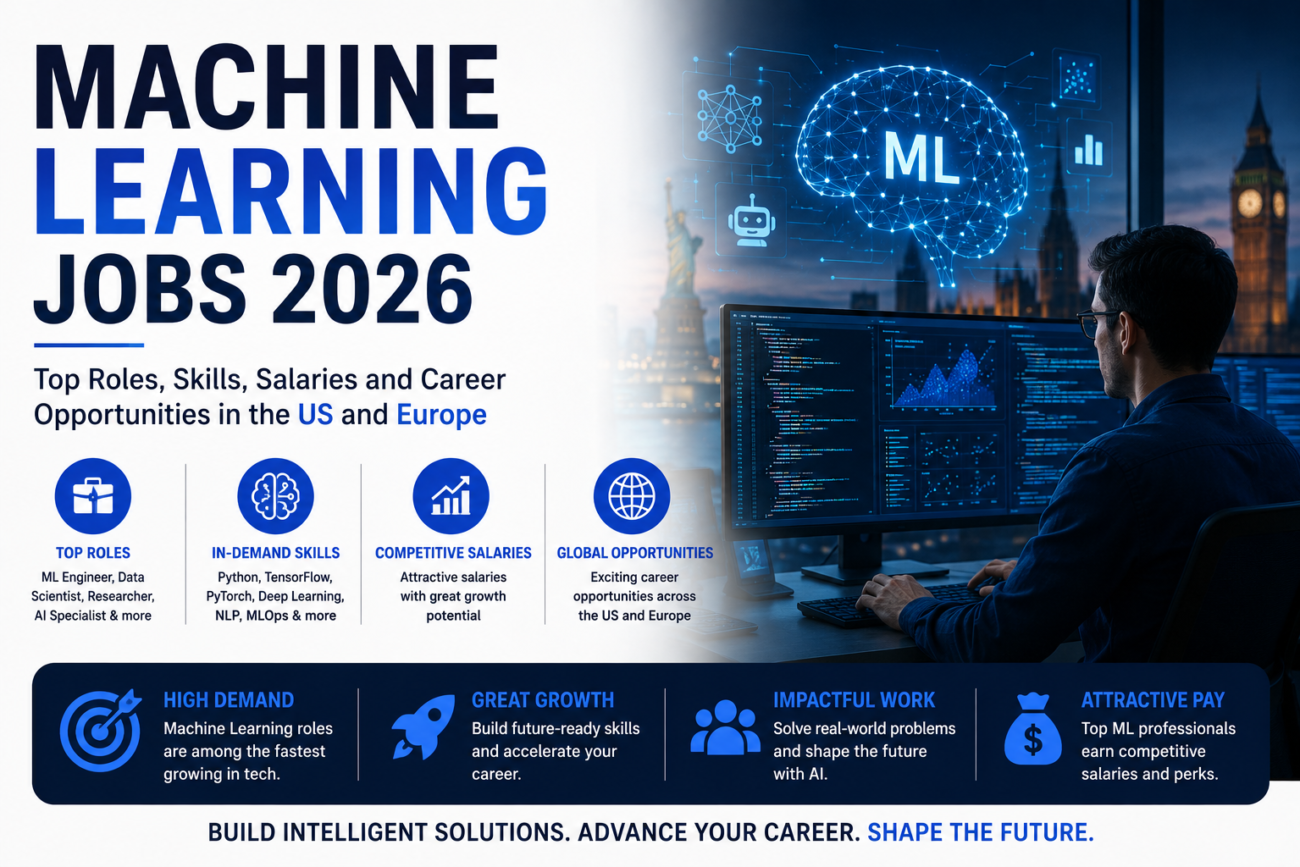
🤖 Machine Learning Jobs 2026: Top Roles, Skills, Salaries and Career Opportunities in the US and Europe
🤖 Machine Learning Jobs 2026: Top Roles, Skills, Salaries and Career Opportunities in the US and Europe. Machine learning is one of the fastest-growing areas of the global technology job market in 2026, creating career opportunities across artificial intelligence, data science, software engineering, robotics, healthcare, finance, cybersecurity and cloud computing.
Demand is being driven by companies integrating generative AI, large language models (LLMs), AI agents, predictive analytics and automation into everyday products and business operations.
The World Economic Forum ranks AI and Machine Learning Specialists among the three fastest-growing jobs globally through 2030, alongside Big Data Specialists and FinTech Engineers. Its survey found that 86% of employers expect AI and information-processing technologies to transform their businesses by 2030.
In the United States, the latest Bureau of Labor Statistics projections provide another strong signal: employment of data scientists is projected to increase 33.5% between 2024 and 2034, compared with just 3.1% for employment overall. )
For students, graduates and experienced technology professionals, 2026 is therefore an important time to develop machine-learning skills.
Machine Learning Careers 2026 at a Glance
| Area | 2026 Outlook |
|---|---|
| Machine Learning Engineering | Very strong |
| AI Engineering | Very strong |
| Data Science | Strong |
| Generative AI / LLM Engineering | Rapidly developing |
| MLOps | Growing |
| AI Research | Strong but highly specialized |
| Computer Vision | Strong in specialized industries |
| NLP | Increasingly integrated with generative AI |
| AI Product Engineering | Growing |
| Robotics & Autonomous Systems | Specialized growth |
| US data scientist median wage | $112,590 |
| US data scientist projected growth | 33.5% through 2034 |
| Typical entry education for US data scientists | Bachelor’s degree |
The BLS reports a 2024 median annual wage of $112,590 for data scientists, with about 23,400 openings projected annually through 2034.
Why Machine Learning Careers Are Growing
🤖 Machine Learning Jobs 2026: Top Roles, Skills, Salaries and Career Opportunities in the US and Europe
AI has moved beyond experimental technology.
Businesses are incorporating machine learning into:
Search engines | Recommendation systems | Fraud detection | Healthcare | Banking | Manufacturing | Cybersecurity | Marketing | Autonomous vehicles | Logistics | Software development | Customer service
Generative AI has accelerated this transition even further.
Organizations increasingly want to integrate LLMs and AI agents into existing applications and business processes.
That requires engineers who understand not only how to train models but also how to build reliable software around AI systems and deploy them into production.
The BLS explicitly says increased adoption of AI, including generative AI, is expected to fuel strong growth in computer and mathematical occupations.
🚀 Top Machine Learning Jobs in 2026
🤖 Machine Learning Jobs 2026: Top Roles, Skills, Salaries and Career Opportunities in the US and Europe
Machine learning is not one occupation. It includes multiple career paths requiring different levels of mathematics, programming, research and software-engineering expertise.
1. Machine Learning Engineer
Machine Learning Engineer remains one of the central AI careers.
ML engineers build systems capable of learning from data and generating predictions or decisions.
Their work can involve:
- Developing machine-learning models
- Preparing training datasets
- Creating data pipelines
- Training and evaluating models
- Optimizing model performance
- Integrating models into applications
- Deploying models
- Monitoring production performance
Strong programming and software-engineering skills are increasingly important because companies need models that function reliably in real applications.
Important skills
Python | PyTorch | TensorFlow | Scikit-learn | SQL | Statistics | Algorithms | APIs | Cloud | Docker | Git
Knowledge of software engineering can provide a major advantage over candidates who understand ML theory but cannot build production systems.
2. AI Engineer
The title AI Engineer has become increasingly prominent as generative AI adoption expands.
These professionals often focus less on developing fundamental machine-learning algorithms and more on building applications using existing AI models.
They might create:
- AI assistants
- Enterprise copilots
- Search systems
- AI agents
- Document-analysis platforms
- Recommendation systems
- Automated business workflows
Relevant technologies can include:
Python | LLM APIs | Retrieval-Augmented Generation (RAG) | Vector databases | AI agents | Model evaluation | Cloud platforms
This career path can be particularly accessible to experienced software engineers moving into AI.
3. Data Scientist
Data science remains closely connected to machine learning.
Data scientists use statistics, programming, modelling and data analysis to extract useful information from large datasets.
Their responsibilities can include:
- Data cleaning
- Statistical modelling
- Machine learning
- Experimentation
- Predictive modelling
- Visualization
- Business analysis
- Communicating insights
The employment outlook is particularly strong in the United States.
BLS projects approximately 82,500 additional data scientist jobs between 2024 and 2034, representing 33.5% growth.
The occupation is projected to grow more than 10 times faster than overall US employment on a percentage basis.
💰 Data Scientist Salary in the US
The official BLS median annual wage was:
$112,590 per year
in May 2024.
Actual 2026 job offers can be considerably higher or lower depending on location, experience, employer, specialization and total compensation.
4. Generative AI / LLM Engineer
One of the newest career categories involves Large Language Models and Generative AI.
LLM engineers build applications around models capable of generating and understanding language, images, code and other content.
Typical responsibilities can include:
Prompt and context design
RAG systems
Agentic workflows
Model evaluation
Fine-tuning
API integration
Vector search
AI safety and guardrails
Inference optimization
Strong software-engineering skills are particularly useful because most organizations are not building foundation models themselves.
Instead, they need engineers capable of turning existing models into useful products.
5. MLOps Engineer
Building a model is only the beginning.
Organizations also need infrastructure that allows models to operate reliably in production.
This creates demand for Machine Learning Operations – MLOps – Engineers.
MLOps combines:
Machine Learning + DevOps + Cloud Infrastructure.
Skills can include:
Docker | Kubernetes | AWS | Azure | Google Cloud | CI/CD | Model Monitoring | Python | Infrastructure as Code
MLOps engineers may handle model deployment, monitoring, versioning, pipelines and production infrastructure.
This career can be particularly suitable for cloud or DevOps engineers wanting to move into machine learning.
6. Machine Learning Research Scientist
Research Scientist is one of the most technically demanding AI careers.
Researchers work on developing or improving machine-learning methods rather than simply implementing existing techniques.
Potential areas include:
- Deep learning
- Reinforcement learning
- Foundation models
- Computer vision
- Natural-language processing
- Robotics
- Multimodal AI
- AI reasoning
- Model efficiency
These roles often require substantially stronger mathematical foundations than application-oriented AI engineering.
Graduate qualifications can also be important.
The BLS projects computer and information research scientist employment to increase 19.7% from 2024 to 2034 in the United States.
7. Computer Vision Engineer
Computer Vision Engineers develop systems capable of understanding images and video.
Applications include:
Autonomous vehicles | Medical imaging | Manufacturing | Agriculture | Security | Robotics | Satellite imagery
Important skills can include:
Python | PyTorch | OpenCV | Deep Learning | CNNs | Transformers | Image Processing
Computer vision increasingly intersects with multimodal AI, where models work across text, images, video and audio.
8. Natural Language Processing Engineer
NLP professionals build technologies capable of processing human language.
Traditional applications include:
- Translation
- Search
- Sentiment analysis
- Classification
- Information extraction
- Speech and language systems
Generative AI has dramatically expanded this area.
Modern NLP roles increasingly involve LLMs, transformers, embeddings, retrieval systems and AI agents.
9. AI Product Engineer
The rise of generative AI is creating another increasingly important category:
AI Product Engineer
These engineers focus on building useful applications around AI capabilities.
They combine:
Software engineering + AI + product development.
Instead of spending months training a model from scratch, an AI product engineer might combine an existing foundation model with databases, APIs, user interfaces and business systems to create a complete application.
For software engineers seeking to enter AI without pursuing a PhD, this can be an attractive path.
10. Robotics and Autonomous Systems Engineer
Machine learning is also central to robotics and autonomous systems.
Engineers can work on:
- Autonomous vehicles
- Industrial robots
- Drones
- Warehouse automation
- Agricultural robotics
- Intelligent manufacturing systems
The World Economic Forum identifies robotics and automation alongside AI and information processing as major forces reshaping global employment through 2030.
🇺🇸 Machine Learning Careers in the United States
The United States remains one of the world’s largest AI employment markets.
Major technology centres include:
San Francisco Bay Area | Seattle | New York | Boston | Austin | Los Angeles
But AI employment increasingly extends beyond traditional technology companies.
Industries recruiting ML professionals include:
Technology | Banking | Insurance | Healthcare | Pharmaceuticals | Defence | Automotive | Retail | Consulting | Energy | Manufacturing
The BLS’s July 2026 analysis says AI adoption is expected to increase demand for workers trained in computer science, programming, software development and data analysis.
Software development itself also remains strong.
BLS projects 267,700 additional software developer jobs between 2024 and 2034, representing growth of approximately 15.8%. The 2024 median wage was $133,080.
This matters because many machine-learning careers sit at the intersection of software development and data science.
🇪🇺 Machine Learning Careers in Europe
Europe is also investing heavily in developing AI capabilities and talent.
The European Commission says it wants to increase the number of AI experts by training and attracting more researchers and professionals, while also increasing AI skills across the wider workforce.
Major European AI employment centres include cities such as:
London | Paris | Berlin | Amsterdam | Munich | Dublin | Zurich | Stockholm | Barcelona
European opportunities can be found across technology companies, financial institutions, research organizations, startups, automotive manufacturers, healthcare companies and universities.
The EU’s regulatory environment is also creating demand for professionals who understand the intersection between:
AI + Technology + Risk + Governance + Regulation
Under the EU AI Act, AI literacy is an explicit policy objective, and providers and deployers have obligations to take measures supporting appropriate AI literacy among personnel dealing with AI systems.
This means European AI careers will not be limited to pure engineering.
Roles involving AI governance, model risk, compliance, responsible AI and AI assurance are also likely to become increasingly relevant.
💰 Machine Learning Salaries in 2026
There is no reliable single salary for “machine learning jobs.”
Compensation depends heavily on:
- Country
- City
- Employer
- Experience
- Technical specialization
- Academic qualifications
- Seniority
- Equity/stock compensation
- Industry
Official US occupational data provide useful benchmarks.
| Related US Occupation | Median Annual Wage |
|---|---|
| Software Developer | $133,080 |
| Information Security Analyst | $124,910 |
| Data Scientist | $112,590 |
These are 2024 BLS median wages, not promised 2026 ML-engineer salaries. They provide authoritative benchmarks for closely related occupations.
Specialized ML engineers and AI researchers at major technology companies can earn considerably more when bonuses and equity are included.
European salaries are harder to summarize because compensation varies substantially between countries.
For example, salaries in Switzerland or London can differ considerably from those in Southern or Eastern Europe.
Candidates should therefore compare compensation using the specific country, city and employer rather than treating Europe as one salary market.
🧠 Top Machine Learning Skills Employers Want in 2026
🤖 Machine Learning Jobs 2026: Top Roles, Skills, Salaries and Career Opportunities in the US and Europe
Technical requirements vary, but several capabilities appear repeatedly across ML careers.
Python
Python remains the dominant general-purpose programming language across machine learning and data science.
A strong ML candidate should be comfortable writing production-quality Python rather than only using notebooks.
SQL
Machine learning depends on data.
SQL remains fundamental for retrieving, transforming and analyzing structured data.
Machine Learning Fundamentals
Candidates should understand:
Supervised learning | Unsupervised learning | Regression | Classification | Clustering | Feature engineering | Model evaluation
Understanding why an algorithm works is more valuable than simply knowing how to call a library.
Deep Learning
Important concepts include:
Neural networks | Transformers | Attention | Embeddings | Optimization
PyTorch
PyTorch is widely used in modern AI research and engineering.
TensorFlow remains relevant as well, particularly in existing production systems.
Generative AI
Increasingly useful capabilities include:
LLMs | RAG | Embeddings | Vector databases | AI agents | Evaluation | Fine-tuning
Cloud Computing
Machine-learning workloads increasingly run on cloud infrastructure.
Knowledge of:
AWS | Microsoft Azure | Google Cloud
can therefore strengthen employability.
MLOps
Understanding how to deploy and monitor models separates production ML engineers from candidates who can only train models locally.
Software Engineering
This may be one of the most underestimated skills.
Production machine learning requires:
Git | APIs | Testing | Data structures | System design | Databases | CI/CD | Containers
Companies ultimately need AI systems that work reliably—not just impressive experiments.
🎓 Do You Need a Master’s or PhD?
Not for every machine-learning job.
BLS identifies a Bachelor’s degree as the typical entry-level education for data scientists, although it notes that some employers require or prefer Master’s or doctoral qualifications.
The importance of postgraduate education depends on the career.
For an AI Product Engineer, strong software-development skills and practical AI experience may matter more than having a PhD.
For a Machine Learning Research Scientist, advanced academic training can be considerably more important.
A useful general distinction is:
Applied AI/ML engineering → practical engineering skills are critical.
Frontier ML research → advanced mathematics and postgraduate research experience become much more important.
Can Someone Without a Computer Science Degree Enter Machine Learning?
🤖 Machine Learning Jobs 2026: Top Roles, Skills, Salaries and Career Opportunities in the US and Europe
Yes, but they still need the required technical skills.
Machine learning attracts professionals from:
Computer Science | Mathematics | Statistics | Physics | Engineering | Economics | Data Science
Engineering graduates can be particularly well positioned because they often already have quantitative, modelling and problem-solving skills.
Someone transitioning from another STEM discipline should typically prioritize:
Python → SQL → Statistics → Machine Learning → Deep Learning → Projects → Deployment
The goal should be demonstrating actual capability rather than simply collecting online certificates.
📁 Build a Machine Learning Portfolio
For early-career applicants, projects can provide evidence that they can turn theoretical knowledge into working systems.
A portfolio might include:
Predictive ML project
Train and evaluate a model using a real dataset.
Computer vision project
Build an image-classification or object-detection application.
Generative AI project
Create a RAG system that answers questions using a collection of documents.
Deployment project
Take a model beyond a notebook and deploy it through an API or cloud platform.
MLOps project
Demonstrate model tracking, deployment and monitoring.
Strong projects should explain:
Problem → Data → Approach → Evaluation → Deployment → Limitations
This demonstrates engineering judgment rather than simply copying code.
⚠️ Don’t Learn Only Prompt Engineering
Generative AI has created significant interest in prompt engineering.
Understanding how to communicate effectively with AI models is useful.
But relying exclusively on prompting is risky as a long-term technical career strategy.
Prompts are becoming easier for models themselves to optimize.
Stronger career foundations include:
Programming + Statistics + ML fundamentals + Software engineering + Data + AI systems
Prompting then becomes one skill within a broader toolkit.
Will AI Replace Machine Learning Engineers?
AI will automate portions of machine-learning work just as it is automating conventional software development.
It can already help engineers:
- Generate code
- Analyse datasets
- Write tests
- Explain models
- Debug pipelines
- Create documentation
- Prototype applications
But organizations still need people to determine:
Which problem should we solve?
What data can legally and ethically be used?
How should performance be measured?
Is the model biased?
Is the system secure?
What happens when the model fails?
Can it operate reliably at scale?
Those questions involve technical expertise, context, judgment and accountability.
The employment evidence currently points toward growth rather than disappearance. The World Economic Forum ranks AI and Machine Learning Specialists among the fastest-growing occupations through 2030, while BLS expects AI adoption to contribute to strong growth in several US computer and mathematical occupations.
How to Start a Machine Learning Career in 2026
🤖 Machine Learning Jobs 2026: Top Roles, Skills, Salaries and Career Opportunities in the US and Europe
A practical progression for beginners is:
1. Learn Python
Become comfortable with functions, classes, data structures and libraries.
2. Learn SQL
Understand databases and data manipulation.
3. Study mathematics
Focus particularly on statistics, probability and linear algebra.
4. Learn classical machine learning
Understand algorithms and model evaluation.
5. Learn deep learning
Study neural networks and modern architectures.
6. Learn generative AI
Understand transformers, LLMs, RAG and agents.
7. Build projects
Create systems that demonstrate actual capability.
8. Learn deployment
Use APIs, containers and cloud platforms.
9. Build a public portfolio
GitHub can provide employers with evidence of your work.
10. Apply broadly
Don’t search only for “Machine Learning Engineer.”
Consider:
AI Engineer | Data Scientist | Applied Scientist | AI Developer | MLOps Engineer | Data Engineer | Software Engineer – AI | Research Engineer | AI Product Engineer
Where Is Machine Learning Heading?
Machine learning is increasingly becoming part of mainstream software engineering rather than remaining a separate niche.
The next stage of AI adoption is likely to require professionals capable of connecting models with:
Software + Data + Cloud + Business Processes + Security + Governance
That favors engineers with broad technical capabilities.
Europe provides a particularly interesting example. The European Commission is simultaneously seeking to expand AI expertise and emphasizing AI literacy as part of implementation of its regulatory framework.
This creates opportunities not only for people developing models but also for professionals who can deploy, evaluate, govern and secure AI systems.
Final Thoughts
🤖 Machine Learning Jobs 2026: Top Roles, Skills, Salaries and Career Opportunities in the US and Europe
The outlook for machine learning jobs in 2026 remains strong.
The World Economic Forum places AI and Machine Learning Specialists among the fastest-growing occupations globally through 2030.
In the United States, data-science employment is projected to expand by 33.5% between 2024 and 2034, adding approximately 82,500 jobs, while software-development employment is projected to add approximately 267,700 jobs.
Europe is simultaneously investing in attracting and developing AI expertise as businesses adapt to both rapid technological development and the EU’s evolving AI regulatory framework.
For job seekers, the strongest strategy is to build a combination of:
Machine Learning + Software Engineering + Data + Cloud + Generative AI
Rather than learning one AI tool, develop the ability to design, build, evaluate, deploy and maintain complete AI systems.
🚀 Key Career Paths
🤖 Machine Learning Engineer
🧠 AI Engineer
📊 Data Scientist
💬 LLM / Generative AI Engineer
☁️ MLOps Engineer
🔬 AI Research Scientist
👁️ Computer Vision Engineer
📝 NLP Engineer
💻 AI Product Engineer
🤖 Robotics Engineer
The people most likely to benefit from the AI employment boom will not simply be those who know how to use AI—they will be those who understand how AI works, how to build with it and how to deploy it responsibly at scale.
📲 Get more AI and technology jobs, paid internships, graduate programmes, scholarships and international opportunities:
Join the Vacancy Bridge WhatsApp Channel
APPLY ON THIS OFFICIAL PAGE
SEO Keywords
Machine Learning Jobs 2026, AI Jobs 2026, Machine Learning Engineer Salary, Machine Learning Jobs USA, Machine Learning Jobs Europe, Artificial Intelligence Careers, AI Engineer Jobs, Data Scientist Jobs 2026, Generative AI Jobs, LLM Engineer Jobs, MLOps Jobs, Machine Learning Careers, AI Research Jobs, Computer Vision Jobs, NLP Engineer Jobs, AI Jobs USA, AI Jobs Europe, Machine Learning Skills 2026, Artificial Intelligence Salary, Tech Careers 2026, Vacancy Bridge.
