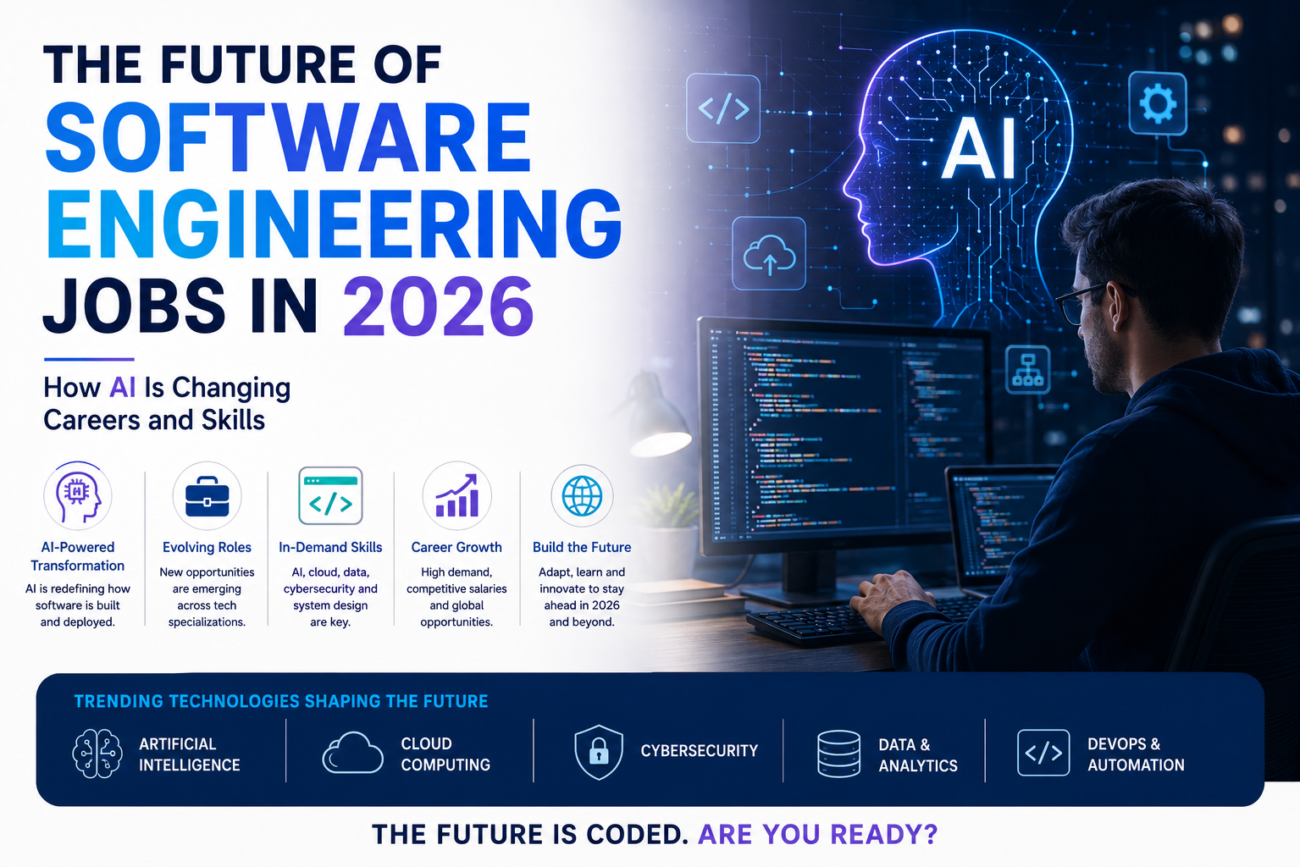
💻 The Future of Software Engineering Jobs in 2026: How AI Is Changing Careers and Skills
💻 The Future of Software Engineering Jobs in 2026: How AI Is Changing Careers and Skills. Artificial intelligence is transforming software engineering in 2026, but the evidence does not support the simple claim that AI is eliminating software developers.
Instead, the profession is being reorganized.
AI coding assistants and increasingly autonomous coding agents can now generate code, create tests, debug applications, explain unfamiliar repositories, refactor software and help developers build prototypes much faster. That is reducing the value of some routine coding tasks while increasing demand for engineers who can design systems, validate AI-generated code, integrate AI into products, understand security and architecture, and solve complex business problems.
The U.S. Bureau of Labor Statistics (BLS) projects employment of software developers to increase 15.8% between 2024 and 2034, adding approximately 267,700 jobs. The BLS specifically identifies the growing adoption of AI as one factor expected to increase demand for computer and mathematical professionals.
So the more accurate headline for 2026 is:
AI is changing software engineering faster than it is eliminating it.
The bigger risk for developers may not be AI itself, but failing to adapt to a profession in which AI-assisted development is rapidly becoming normal.
Software Engineering Jobs in 2026 – Quick Outlook
| Area | 2026 Outlook |
|---|---|
| 💻 Software Development | Strong demand, but changing rapidly |
| 🤖 AI Engineering | High-growth opportunity |
| 📊 Data Science | Very strong projected growth |
| 🔐 Cybersecurity | Very strong demand |
| ☁️ Cloud/Infrastructure | Important as AI systems scale |
| 🧠 AI-assisted coding | Becoming a core developer capability |
| 🏗️ Architecture/System Design | Increasingly valuable |
| 🧪 Testing & Verification | More important with AI-generated code |
| 🌐 Basic web development | Greater automation pressure |
| 👶 Entry-level coding | Becoming more competitive |
BLS expects overall employment of software developers, quality assurance analysts and testers to grow about 15% from 2024–2034, with roughly 129,200 openings per year on average.
Is AI Replacing Software Engineers?
Not entirely—but it is replacing some of their tasks.
That distinction matters.
Software engineering consists of much more than typing code.
Engineers:
- Understand requirements
- Design architecture
- Make technical trade-offs
- Write and review code
- Test systems
- Debug failures
- Protect applications
- Integrate services
- Work with databases
- Communicate with stakeholders
- Maintain production systems
AI can increasingly perform portions of this work.
Research from Anthropic illustrates how far coding automation has already progressed. Its analysis of 500,000 coding-related interactions found that 79% of Claude Code conversations were classified as automation, compared with 21% categorized as augmentation.
That does not mean 79% of software engineering jobs can be automated.
It means developers are already allowing specialized coding agents to perform substantial coding tasks rather than merely asking AI for advice.
🤖 AI Is Becoming a Software Engineering Tool
💻 The Future of Software Engineering Jobs in 2026: How AI Is Changing Careers and Skills
The first generation of generative AI tools mainly helped programmers complete individual lines or snippets of code.
The next generation is considerably more capable.
Modern coding agents can increasingly work across multiple files and perform chains of related development tasks.
A developer might ask an AI system to:
Create an authentication feature, add tests, update the database schema, identify errors and prepare the implementation for review.
Instead of generating only one function, the agent may work through several steps.
This is pushing software development toward a new workflow:
Human defines the problem → AI generates implementation → Human evaluates, tests and improves it.
The developer therefore moves higher up the abstraction layer.
📉 Which Software Engineering Tasks Face the Most AI Pressure?
Not every area of development faces the same degree of disruption.
Anthropic’s analysis found particularly high AI use involving JavaScript and HTML, with user-interface and user-experience tasks among common coding applications. The researchers suggested that jobs centered around relatively simple applications and user interfaces could encounter disruption earlier than some backend-oriented work.
Tasks under increasing pressure include:
Boilerplate code
AI can generate repetitive application structures quickly.
Basic websites
Simple websites and landing pages increasingly require much less manual coding.
Simple CRUD applications
Standard create/read/update/delete applications are easier for coding agents to generate.
Basic tests
AI can produce unit-test templates and test cases.
Code documentation
Models can explain functions and generate documentation.
Simple debugging
Common errors can often be identified automatically.
Code translation
AI can convert code between languages and frameworks.
These tasks will not disappear completely, but companies may need fewer human hours to perform them.
👶 The Entry-Level Developer Challenge
Junior software engineering may experience some of the biggest changes.
Historically, junior developers learned through relatively straightforward tasks:
- Fixing small bugs
- Creating basic interfaces
- Writing tests
- Building simple APIs
- Updating documentation
- Refactoring small components
AI can now perform many of those tasks rapidly.
That creates an unusual problem.
If AI does the junior work, how does someone become senior?
Companies will need to rethink developer training.
Entry-level engineers, meanwhile, may need to arrive with more capability than previous generations.
Knowing only basic syntax may no longer be enough.
Junior candidates increasingly benefit from demonstrating that they can use AI tools while still understanding what the generated code actually does.
🧠 The Developer Is Becoming an AI Supervisor
One of the biggest changes is the movement from:
Writing every line → Directing and validating software creation
Developers increasingly need to describe requirements clearly enough for AI systems to act on them.
But accepting generated code without reviewing it creates significant risks.
AI-generated software can contain:
- Security vulnerabilities
- Incorrect assumptions
- Performance problems
- Hallucinated APIs
- Poor architecture
- Unnecessary dependencies
- Subtle logical errors
The valuable engineer is therefore not simply the person who generates the most code.
It is the engineer capable of determining whether that code is correct, secure, maintainable and appropriate.
🏗️ System Design Is Becoming More Valuable
💻 The Future of Software Engineering Jobs in 2026: How AI Is Changing Careers and Skills
AI makes implementation cheaper.
That can make architecture more important.
Someone still needs to decide:
What should we build?
Which database should we use?
How should services communicate?
How should authentication work?
How will the system scale?
What happens when something fails?
What information can the AI access?
How do we secure customer data?
These are engineering judgment questions.
World Economic Forum analysis published in January 2026 reported that 65% of surveyed developers expected their roles to be redefined in 2026, with work moving away from routine coding toward architecture, integration and AI-enabled decision-making.
🤖 AI Engineering Is Becoming a Major Career Path
Traditional software engineers are increasingly moving into AI-related positions.
One important emerging title is:
AI Engineer
AI engineers typically do not spend all their time developing foundation models from scratch.
Instead, they build applications around existing models and AI infrastructure.
Relevant skills can include:
Python
APIs
Large Language Models
Retrieval-Augmented Generation (RAG)
Vector databases
AI agents
Evaluation
Prompt/context engineering
Cloud infrastructure
Data pipelines
Model monitoring
AI security
For existing software developers, this is potentially one of the most natural transitions into the AI economy.
📊 Data Science Remains a Strong Career
AI is also increasing the importance of data.
The BLS currently projects employment of data scientists to grow 33.5% between 2024 and 2034, substantially faster than overall employment.
Organizations need professionals who can:
- Collect data
- Clean datasets
- Analyse information
- Build models
- Evaluate results
- Interpret patterns
- Communicate findings
AI may automate portions of data analysis, but companies still need professionals capable of understanding whether the analysis makes sense.
🔐 Cybersecurity Could Become Even More Important
💻 The Future of Software Engineering Jobs in 2026: How AI Is Changing Careers and Skills
AI can generate software faster.
Unfortunately, faster software creation can also mean faster creation of vulnerabilities.
At the same time, attackers are gaining access to increasingly sophisticated automation.
This makes cybersecurity particularly important.
BLS projects employment of information security analysts to grow 28.5% from 2024 to 2034.
For developers worried about AI disruption, cybersecurity therefore represents another potentially attractive specialization.
Skills can include:
Application security | Cloud security | Identity management | Network security | Secure coding | Threat modelling | Incident response
☁️ Cloud Engineering Still Matters
AI applications require substantial infrastructure.
Someone has to deploy them.
Someone has to monitor them.
Someone has to control costs.
Someone has to keep them available.
Cloud and platform skills therefore remain important.
Developers can strengthen their profiles through experience with technologies and concepts involving:
AWS | Microsoft Azure | Google Cloud | Docker | Kubernetes | CI/CD | Infrastructure as Code | Observability
AI may write configuration files, but engineers still need to understand the production environment those configurations control.
🧪 Testing Becomes More Important, Not Less
Imagine that an AI agent can generate thousands of lines of code in minutes.
That sounds productive.
But it creates another question:
Who verifies those thousands of lines?
AI-assisted development increases the importance of testing and evaluation.
Developers need strong knowledge of:
- Unit testing
- Integration testing
- End-to-end testing
- Performance testing
- Security testing
- Code review
Future software engineering may involve less time manually producing code and more time proving that automatically generated software works correctly.
📚 What Programming Languages Should Developers Learn in 2026?
💻 The Future of Software Engineering Jobs in 2026: How AI Is Changing Careers and Skills
Programming languages still matter.
AI has not made them irrelevant.
Strong options include:
Python
Particularly useful for AI, machine learning, data engineering, automation and backend development.
JavaScript / TypeScript
Still fundamental to web applications and full-stack development.
Java
Widely used in enterprise applications and large systems.
C#
Important within Microsoft’s enterprise and cloud ecosystem.
C++
Relevant to high-performance systems, robotics, embedded computing and AI infrastructure.
SQL
Extremely valuable because almost every serious application involves data.
But developers should avoid becoming overly focused on syntax.
AI is increasingly good at syntax.
Human advantage comes from understanding:
Algorithms + Data Structures + Architecture + Databases + Networking + Security + Business Requirements
🎓 Do Computer Science Degrees Still Matter?
Yes, although hiring is becoming increasingly skills-oriented.
A computer science degree provides foundations in areas such as:
Algorithms | Operating systems | Computer architecture | Networking | Databases | Mathematics | Software engineering
Those fundamentals become especially useful when AI-generated code fails.
Someone who knows only how to prompt a model may struggle to identify why an application is slow, insecure or architecturally flawed.
At the same time, evidence suggests demonstrable AI capability is becoming more valuable to employers. Research summarized by the World Economic Forum in 2026 found that showing AI skills could improve hiring prospects, including for candidates without advanced degrees.
The strongest combination may therefore be:
Fundamentals + Practical projects + AI proficiency
💰 Software Engineering Salaries
Software engineering remains a relatively high-paying profession.
According to the U.S. Bureau of Labor Statistics, the median annual wage for software developers was:
$133,080 per year
as of May 2024.
That is roughly:
$11,090 per month
before taxes.
Actual compensation varies enormously according to:
Country | Company | Experience | Specialization | Location | Equity | Bonuses
Engineers specializing in AI infrastructure, machine learning, cybersecurity and distributed systems can command substantially different compensation from general software developers.
🚀 Fast-Growing Technology Careers
💻 The Future of Software Engineering Jobs in 2026: How AI Is Changing Careers and Skills
Current BLS projections provide useful insight into where technology employment may be heading.
| Occupation | Projected U.S. Growth 2024–2034 |
|---|---|
| Data Scientists | 33.5% |
| Information Security Analysts | 28.5% |
| Operations Research Analysts | 21.5% |
| Computer & Information Research Scientists | 19.7% |
| Software Developers | 15.8% |
| All Occupations | 3.1% |
These projections challenge the idea that AI automatically means fewer technology jobs.
BLS explicitly expects AI adoption to help drive demand for workers who can develop, implement and use AI-based systems.
The Rise of the Full-Stack AI Developer
One potentially powerful career profile for 2026 and beyond combines conventional software engineering with AI.
A full-stack AI developer might understand:
Frontend development
↓
Backend APIs
↓
Databases
↓
Cloud deployment
↓
LLM integration
↓
AI agents
↓
Evaluation and monitoring
That person can take an AI product from concept to production.
This breadth can be extremely valuable to startups and smaller technology teams.
🌍 Remote Software Engineering Jobs
Software engineering remains one of the professions most compatible with remote work.
Developers can potentially work for companies outside their home countries without permanently relocating.
However, candidates should remember:
Remote does not always mean worldwide.
A vacancy labelled “Remote – USA,” for example, may require US work authorization or residency.
Candidates looking for international remote opportunities should search for terms such as:
Worldwide Remote | Global Remote | Work From Anywhere | EMEA Remote | Africa Remote
and verify the employment conditions carefully.
Will “Vibe Coding” Replace Developers?
💻 The Future of Software Engineering Jobs in 2026: How AI Is Changing Careers and Skills
AI-assisted application building—sometimes called vibe coding—has dramatically lowered the barrier to creating simple software.
People with limited programming experience can now describe an application and have AI generate much of it.
This will undoubtedly affect some development work.
But there is an enormous difference between:
“Build me a booking application.”
and operating a production system containing sensitive customer information, millions of transactions and complex integrations.
Security, reliability, auditability and scalability remain major considerations. Recent analysis of the enterprise software market similarly notes that these concerns limit how quickly companies can replace established systems with casually AI-generated alternatives.
AI makes software creation easier.
It does not make serious software engineering unnecessary.
The New Software Engineer Skill Stack
A competitive developer in 2026 should think in layers.
Layer 1 — Programming Fundamentals
Algorithms, data structures, databases, networking and operating systems.
Layer 2 — Software Engineering
Git, testing, debugging, architecture, APIs and design patterns.
Layer 3 — Cloud
Deployment, containers, CI/CD, monitoring and infrastructure.
Layer 4 — AI
LLMs, coding agents, RAG, model APIs, evaluation and AI application development.
Layer 5 — Human Skills
Communication, leadership, critical thinking and business understanding.
The fifth layer is increasingly important.
When AI can generate implementation options, human engineers need to decide which option is actually appropriate.
What Should Students Learn Now?
Students preparing for software careers should not stop learning programming because AI can write code.
That would be similar to abandoning mathematics because calculators exist.
Instead:
Learn to code without AI.
Understand how programs actually work.
Then:
Learn to code with AI.
Use AI to accelerate development while checking its output.
Then:
Build complete products.
A portfolio containing functioning applications is much more convincing than a list of programming languages.
Finally:
Learn to solve problems.
Companies ultimately hire engineers to solve business and technical problems—not simply to produce lines of code.
⚠️ AI Is Also Affecting Technology Hiring
There is legitimate uncertainty around the labour-market effects of AI.
Some companies have linked layoffs or workforce reductions to AI-driven efficiency, although economists caution that AI is often only one factor alongside broader cost-cutting and economic conditions. Recent reporting also suggests AI may suppress hiring in certain roles even when it does not directly trigger layoffs.
Software engineers therefore should not interpret positive long-term projections as meaning every developer role is safe.
The market is becoming more demanding.
Routine implementation is becoming cheaper.
Higher-value engineering expertise is becoming more important.
Will Software Engineering Still Be a Good Career in 2030?
Current evidence suggests:
Yes—but it will be a different career.
BLS projects software developers to add approximately 267,700 US jobs between 2024 and 2034, representing one of the largest numerical increases among occupations.
Software will also continue spreading into:
Healthcare | Finance | Manufacturing | Agriculture | Transportation | Energy | Education | Robotics | Government
And AI itself requires enormous amounts of software engineering.
The paradox is that technology capable of writing software may simultaneously increase society’s demand for software.
If software becomes cheaper to create, more organizations may build it.
Final Thoughts
💻 The Future of Software Engineering Jobs in 2026: How AI Is Changing Careers and Skills
The future of software engineering in 2026 is neither:
“AI will replace every programmer”
nor:
“Nothing is changing.”
The reality sits between those extremes.
AI is already automating meaningful portions of software-development work. Anthropic’s coding-agent research found a high proportion of automation-oriented interactions, particularly around coding tasks.
At the same time, official U.S. labour projections remain strongly positive. Software developer employment is projected to grow 15.8% from 2024 to 2034, compared with just 3.1% for employment overall.
The profession is therefore moving from:
Coder → AI-assisted engineer → System designer and problem solver
Developers who understand AI, architecture, cloud infrastructure, cybersecurity, data and business problems are likely to be better positioned than developers whose value rests primarily on manually producing routine code.
🚨 Key Takeaways
🤖 AI will automate coding tasks, not necessarily entire software-engineering careers.
📈 Software developer employment is projected to grow 15.8% from 2024–2034 in the US.
💰 US software developers had a median annual wage of $133,080 in May 2024.
🔐 Cybersecurity employment is projected to grow 28.5%.
📊 Data scientist employment is projected to grow 33.5%.
🧠 Architecture, problem-solving and technical judgment are becoming more valuable.
👶 Entry-level developers may face greater pressure as AI automates simpler coding work.
🚀 AI engineering is emerging as an important career pathway for existing developers.
🎓 Programming fundamentals still matter—but developers also need AI fluency.
The future belongs less to people who can merely write code and more to those who can use software and AI to solve difficult problems reliably, securely and at scale.
📲 Get more graduate programmes, internships, jobs, scholarships and international opportunities:
Join the Vacancy Bridge WhatsApp Channel
APPLY ON THIS OFFICIAL PAGE
SEO Keywords
Future of Software Engineering Jobs 2026, Software Engineering Jobs 2026, AI Software Engineering, AI Replacing Programmers, Future of Programming Jobs, AI Engineer Jobs 2026, Software Developer Careers, Software Engineer Salary 2026, Coding Jobs and AI, Artificial Intelligence Careers, Machine Learning Jobs, Remote Software Engineering Jobs, AI Coding Tools, Software Developer Job Outlook, Cybersecurity Jobs 2026, Data Science Jobs 2026, Programming Careers, Tech Jobs 2026, Future of Coding, AI Skills for Developers, Software Engineering Skills 2026, Technology Careers, Vacancy Bridge.
