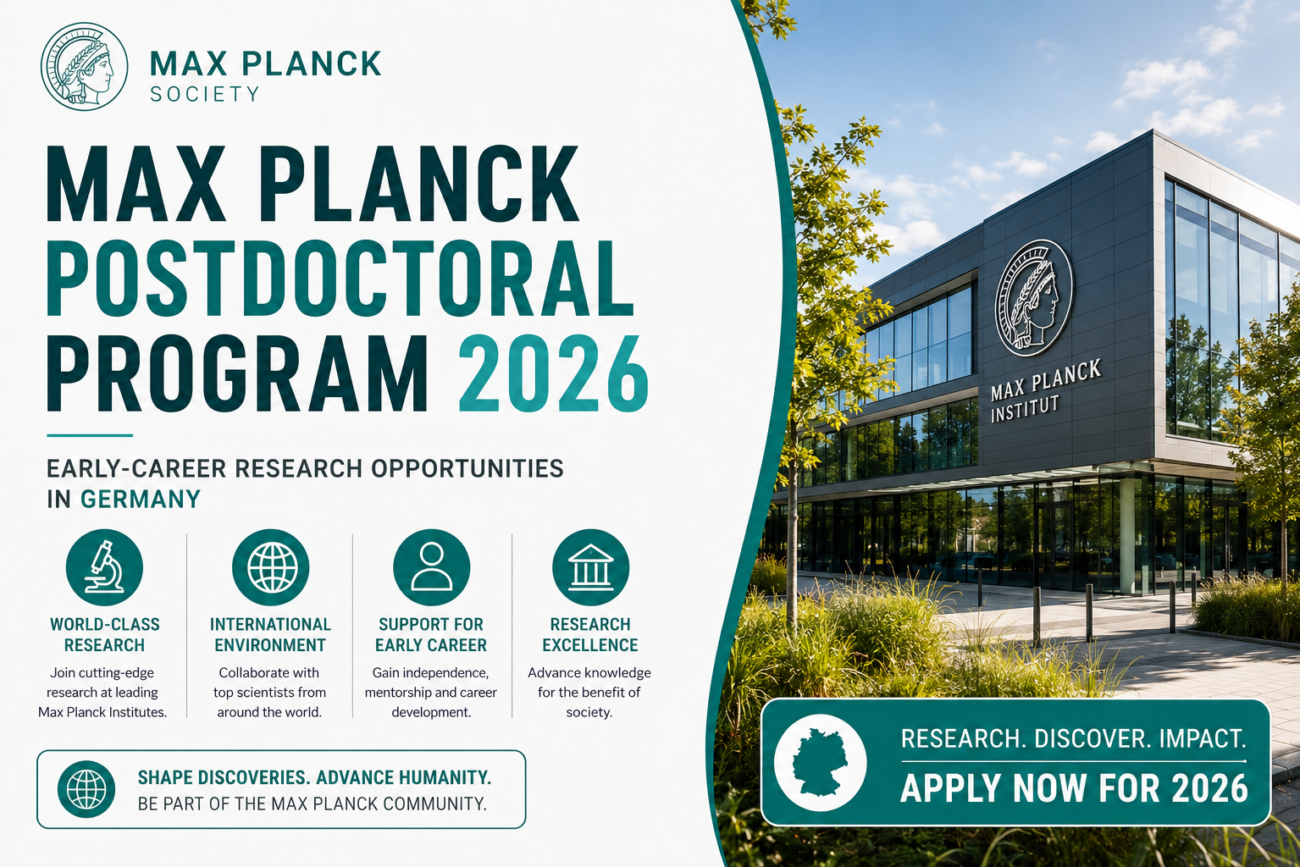
Max Planck Postdoctoral Program 2026: Early-Career Research Opportunities in Germany
Max Planck Postdoctoral Program 2026: Early-Career Research Opportunities in Germany. The Max Planck Society is opening the next call for its Max Planck Postdoc Program on 1 September 2026, offering outstanding early-career researchers from around the world an opportunity to join one of Europe’s leading scientific research organizations.
The programme brings together postdoctoral vacancies from participating Max Planck Institutes, allowing researchers to explore positions across a wide range of scientific disciplines through one centralized application platform.
Successful candidates receive a secured employment contract of at least three years, together with structured mentoring, career-development opportunities, coaching and access to the Planck Academy.
Applications are welcomed from researchers of all nationalities and backgrounds, and there is no formal age limit.
Applicants should hold a PhD or be close to completing their doctorate and must satisfy the requirements of the specific postdoctoral position they select.
🔬 Max Planck Postdoc Program 2026: Quick Overview
| Detail | Information |
|---|---|
| Organization | Max Planck Society |
| Programme | Max Planck Postdoc Program |
| Application Round | September 2026 |
| Call Opens | 1 September 2026 |
| Application Window | Approximately 6 weeks |
| Positions | Project-specific postdoctoral research positions |
| Contract Duration | At least 3 years |
| Applicants | Early-career researchers worldwide |
| Nationalities | All nationalities welcome |
| Disciplines | All disciplines, depending on advertised positions |
| Age Limit | No formal age limit |
| Qualification | PhD or close to completion |
| Salary | Based on applicable TVöD/public-sector conditions and individual position |
| Application Language | English |
| Application | Online through Max Planck Postdoc Program portal |
🏛️ About the Max Planck Society
The Max Planck Society for the Advancement of Science is one of Germany’s leading research organizations.
Its institutes conduct fundamental research across a broad range of fields, including:
Biology
Medicine
Chemistry
Physics
Astronomy
Computer Science
Mathematics
Engineering-related sciences
Cognitive Science
Social Sciences
Humanities
and many interdisciplinary research areas.
The Society operates around 85 Max Planck Institutes and research facilities, providing researchers with access to internationally recognized scientific environments, specialist infrastructure and global research networks.
For early-career researchers who have completed a doctorate, the Max Planck Society provides several routes into postdoctoral research.
One of the most structured is the Max Planck Postdoc Program.
🌍 What Is the Max Planck Postdoc Program?
The Max Planck Postdoc Program is a centralized recruitment and career-development initiative for outstanding early-career researchers.
Rather than applying for one general fellowship, candidates apply to specific research positions offered by principal investigators at participating Max Planck Institutes.
Available positions are bundled together and advertised through a central portal.
Calls are normally launched twice each year:
1 March
and
1 September.
Each application round remains open for approximately:
Six weeks.
The next application opportunity begins:
1 September 2026.
🎓 Who Can Apply?
The programme targets:
Excellent early-career researchers who hold a PhD from disciplines worldwide.
Applications are welcomed from candidates of:
All nationalities
and
All backgrounds.
International researchers are explicitly encouraged to apply.
Candidates must meet the academic and technical requirements specified for the particular postdoctoral vacancy.
🎂 Is There an Age Limit?
No.
The Max Planck Society states that the Postdoc Program has:
No formal age limit.
Selection focuses instead on academic qualifications, research potential and the requirements of the particular position.
This means researchers should concentrate on whether their academic profile and career stage match the advertised project rather than their chronological age.
🎓 Can You Apply Before Your PhD Is Completed?
Yes.
Applicants do not necessarily need to possess their final PhD diploma at the moment they submit the application.
Researchers who are:
Close to completing their doctorate
may apply.
However, the completed PhD documentation must be provided within a reasonable timeframe, and individual projects may impose additional conditions.
Applicants nearing completion should therefore carefully review the requirements of each vacancy.
🌎 Are International Researchers Eligible?
Yes.
The programme is explicitly international.
The Max Planck Society states that it seeks talented and motivated scientists worldwide, with national and international applicants equally welcome.
This makes the September 2026 round particularly relevant to researchers seeking postdoctoral opportunities in Germany.
International applicants should nevertheless check the location of each position because participating institutes and research projects vary between application rounds.
🔬 Which Research Fields Are Available?
The Max Planck Society covers an exceptionally broad scientific spectrum.
The exact vacancies available change with each application round because individual principal investigators submit project-specific postdoctoral positions.
Research opportunities can fall within the Society’s three broad scientific sections:
🧪 Biology and Medicine
Potential research areas can include:
Molecular Biology
Cell Biology
Genetics
Neuroscience
Immunology
Biomedicine
Evolution
Ecology
Microbiology
and related fields.
⚛️ Chemistry, Physics and Technology
Potential areas include:
Physics
Chemistry
Astronomy
Astrophysics
Materials Science
Computer Science
Mathematics
Quantum Science
Artificial Intelligence
and other scientific and technological disciplines.
🧠 Human Sciences
Positions can also be available across areas such as:
Cognitive Science
Psychology
Human Behaviour
Economics
Law
Social Sciences
History
Anthropology
and related interdisciplinary research.
Applicants should use the central portal to identify positions matching their research expertise.
💻 Current September 2026 Research Opportunities
The September 2026 application portal already lists multiple project-specific postdoctoral opportunities.
Examples include research involving:
Artificial Intelligence and Language Models
Projects include areas related to NLP, behavioural evaluation and long-range language understanding.
NeuroAI
Research opportunities include work examining ways to improve the alignment between large language models and the human brain.
Astronomy and Astrophysics
Current opportunities include research on:
Exoplanet atmosphere modelling
Exoplanet direct imaging
and
High-redshift quasars using Euclid, JWST and the Large Binocular Telescope.
Cognitive Neuroscience
Another September 2026 project investigates:
The role of cognitive maps in learning, memory and decision-making.
These examples demonstrate the range of highly specialized research projects available through the programme.
The full vacancy list should always be checked because projects and participating institutes can change between application rounds.
🧠 Example: Cognitive Neuroscience Postdoctoral Position
Max Planck Postdoctoral Program 2026: Early-Career Research Opportunities in Germany
One currently listed September 2026 position is based at the:
Max Planck Institute for Human Cognitive and Brain Sciences
in:
Leipzig, Germany.
The project investigates:
The role of cognitive maps in learning, memory and decision-making.
It offers a:
Fully funded three-year postdoctoral position
for an exceptional early-career researcher.
Relevant backgrounds can include:
Cognitive Neuroscience
Psychology
Biology
Computer Science
Physics
or related fields.
Candidates should demonstrate an excellent academic track record, strong research potential and the ability to work both independently and collaboratively.
⏳ Contract Duration
One of the most attractive features of the Max Planck Postdoc Program is employment security.
The programme provides:
A guaranteed contract duration of at least three years.
A multi-year contract gives researchers time to develop substantial research projects, produce publications and strengthen their academic profiles.
Individual vacancies may provide additional details concerning expected start dates and employment arrangements.
💰 Max Planck Postdoc Salary 2026
The programme does not advertise one universal salary that applies identically to every postdoctoral researcher.
The Max Planck Society states that payment depends on:
Personal circumstances
Qualifications
and the applicable:
TVöD guidelines
—the German collective agreement for public-sector employment.
Benefits are generally aligned with public-service employment conditions.
Candidates should therefore avoid relying on unofficial websites that advertise one fixed salary for every Max Planck postdoctoral position.
The exact remuneration and employment conditions should be confirmed from the individual vacancy and eventual employment offer.
🎁 Benefits of the Max Planck Postdoc Program
Max Planck Postdoctoral Program 2026: Early-Career Research Opportunities in Germany
The programme offers considerably more than research funding.
📑 At Least Three Years of Contract Security
Selected researchers receive a secured contract lasting at least three years.
This provides a stronger degree of career stability than many shorter postdoctoral appointments.
🤝 Targeted Mentoring
Researchers receive access to a structured mentoring programme.
Importantly, mentors can come from:
Other research institutes
or
Industry.
This allows postdocs to receive career perspectives beyond their immediate research group.
🧭 Career Workshop
Within approximately two years, postdoctoral researchers participate in career development designed to help them explore pathways in:
Academia
Industry
or
Entrepreneurship.
This is particularly valuable for researchers who have not yet decided whether their long-term career will remain in academia.
🎓 Planck Academy
Researchers gain access to career-development and coaching opportunities through the:
Planck Academy.
These programmes can help participants strengthen leadership, communication and other professional capabilities.
👨🔬 Structured Supervision
The programme includes guidelines for mentoring and supervision intended to maintain strong standards across participating research environments.
👨👩👧 Family and Dual-Career Support
The Max Planck Society complements the programme with support relating to:
Family
and
Dual careers.
These services can be particularly important for international researchers relocating with partners or families.
🚀 Entrepreneurship Support
Researchers interested in translating research into commercial applications can also explore Max Planck’s resources related to:
Industry careers
and
Spin-offs.
📚 What Qualifications Are Required?
There is no single academic profile that fits every vacancy.
Requirements depend on the specific research project.
Generally, applicants should demonstrate:
A PhD or near-completed PhD
in a discipline relevant to the advertised project.
Strong candidates will typically also demonstrate:
Research excellence
Relevant methodological expertise
Publication experience
Scientific independence
Ability to collaborate
Strong communication skills
and
Clear alignment with the proposed research project.
More specialized positions may require particular programming languages, laboratory techniques, computational methods, datasets or theoretical expertise.
📄 Application Documents
The Max Planck Society uses a centralized application system.
Applicants upload their main application information and documents in:
English.
The application normally includes:
📄 Curriculum Vitae
Candidates should provide an up-to-date academic CV.
📚 Publication List
Relevant publications should be clearly included with the CV where required.
🔬 Summary of Previous Research Experience
Applicants explain their previous research activities and relevant expertise.
✍️ Motivation / Statement of Interest
Candidates explain why they are interested in the specific postdoctoral position.
👥 References
Depending on the requirements of the vacancy, applicants may need to provide the email addresses of:
2–3 referees
who can provide recommendation letters.
Individual positions can request additional materials, so applicants must read the specific vacancy carefully.
📝 Can You Apply for More Than One Position?
Yes.
Researchers can apply for:
Multiple Max Planck Postdoc Program positions.
The application system is designed to make this easier.
After submitting an application, candidates can duplicate much of the information in their application form and then make the necessary position-specific changes.
This can save considerable time when several research projects match a candidate’s expertise.
However, motivation statements should still be tailored to each project.
🚫 Can You Send an Unsolicited Application to the Program?
No.
The central Max Planck Postdoc Program is based on:
Specific project-based vacancies.
Applicants must apply for one or more advertised positions during an official call.
The programme does not accept general applications or independent project proposals through the centralized Postdoc Program.
This is different from other recruitment routes at individual Max Planck Institutes, some of which may advertise positions separately.
🔎 How Are Candidates Selected?
Once the application window closes, applications are reviewed by the relevant:
Principal Investigators
and other colleagues involved in recruitment.
The selection process typically takes:
At least three months
although timing can vary between institutes.
Candidates are informed through the application system if they progress through the recruitment process.
Successful applicants receive an offer for the specific postdoctoral position.
Researchers who applied successfully to several positions could potentially receive offers from more than one institute.
🏆 How Competitive Is the Max Planck Postdoc Program?
The programme targets excellent early-career researchers worldwide, so applicants should expect strong international competition.
A competitive profile is likely to demonstrate:
High-quality doctoral research
Strong publications or research outputs
Relevant technical or methodological expertise
Clear scientific potential
Alignment with the particular project
and
Strong motivation.
Applicants should remember that this is not a general scholarship competition.
Principal investigators are recruiting researchers for specific scientific projects.
The most important question is therefore:
How well does your expertise fit the project?
✍️ How to Strengthen Your Application
Max Planck Postdoctoral Program 2026: Early-Career Research Opportunities in Germany
Applicants should avoid using exactly the same motivation statement for every vacancy.
Instead, explain:
Why the particular research question interests you
How your PhD research prepares you for the project
Which methods or technical skills you can contribute
What scientific questions you hope to explore
and
Why the specific Max Planck Institute or research group is a strong fit.
Where possible, demonstrate achievements with evidence such as publications, datasets, software, conference presentations, research collaborations or other outputs relevant to your discipline.
⚠️ Application Mistakes to Avoid
Researchers should avoid:
- Submitting a generic application to multiple projects
- Applying without reading the project’s specific requirements
- Failing to explain how doctoral research connects with the advertised project
- Providing incomplete referee information
- Ignoring additional documents requested by a particular PI
- Submitting application documents in a language other than English
- Waiting until the final hours of the application window
- Sending documents by email instead of using the official portal
Applicants should also avoid assuming that prestigious university affiliations alone will secure selection.
Scientific fit and research quality remain critical.
📅 Application Deadline
The September 2026 application round opens:
1 September 2026
and the central call is scheduled to remain open for approximately:
Six weeks.
Candidates should nevertheless check the deadline displayed for their selected vacancy.
Some current September-round position pages already specify exact closing dates; for example, a Max Planck Institute for Astronomy postdoctoral position in high-redshift quasars lists:
13 October 2026
as its deadline.
The individual vacancy page should therefore be treated as the definitive source for submission timing.
📝 How to Apply for the Max Planck Postdoc Program 2026
Applications are submitted through the official Max Planck Postdoc Program online portal.
The general process is:
Step 1: Explore Available Positions
Review the September 2026 postdoctoral vacancies and filter them by:
Research field
Institute
and
Location.
Step 2: Select Relevant Projects
Identify positions that closely match your doctoral training, research expertise and career interests.
Step 3: Create an Account
Register through the official application platform.
Step 4: Add Referee Information
Provide contact details for referees where required by the particular vacancy.
Step 5: Prepare Application Documents
Upload the required documents in English.
Step 6: Complete the Online Application
Provide all requested academic and research information.
Step 7: Tailor Your Application
Make sure your motivation statement clearly addresses the specific project.
Step 8: Submit Before the Deadline
Complete your application during the official call period.
Candidates applying for several positions can duplicate their application and make position-specific modifications.
🌟 Why This Opportunity Matters
The transition from PhD to postdoctoral research is one of the most important stages in an academic career.
Researchers need more than simply another short-term contract.
They need opportunities to:
Develop scientific independence
Publish high-quality research
Build international collaborations
Strengthen leadership skills
Explore careers outside academia
and
Develop long-term professional networks.
The Max Planck Postdoc Program addresses several of these needs by combining multi-year research employment with mentoring and structured career development.
For researchers seeking international postdoctoral experience, it also provides access to one of Europe’s most prominent scientific research environments.
🚀 Career Development Beyond Academia
An important strength of the programme is that it does not assume every postdoctoral researcher will eventually become a professor.
Participants are encouraged to consider multiple career pathways.
These can include:
🔬 Academic Research
Researchers can strengthen their scientific profile for future group-leader, faculty or research-institute opportunities.
🏢 Industry
Mentoring and career programmes can help postdocs understand opportunities in private-sector research and development.
🚀 Entrepreneurship
Researchers interested in translating discoveries into companies or commercial technologies can explore entrepreneurship and spin-off pathways.
This broader approach recognizes that postdoctoral training can prepare researchers for leadership across science, business and society.
Final Thoughts
Max Planck Postdoctoral Program 2026: Early-Career Research Opportunities in Germany
The Max Planck Postdoc Program 2026 offers an excellent opportunity for early-career researchers seeking advanced research experience within one of Germany’s leading scientific organizations.
The next application round opens on:
1 September 2026
and brings together project-specific opportunities from participating Max Planck Institutes.
The programme welcomes excellent researchers:
From all countries
Across all disciplines represented by the available projects
and has:
No formal age limit.
Candidates should hold a PhD or be close to completing one.
Successful applicants benefit from:
At least a three-year secured contract
along with targeted mentoring, career workshops, Planck Academy development opportunities and access to additional support for international researchers, families and dual-career situations.
For researchers completing their doctorates and looking for the next major step in their scientific careers, the September 2026 Max Planck Postdoc Program is an opportunity worth exploring.
📲 Get More Research & Postdoctoral Opportunities on WhatsApp
Stay updated with more postdoctoral positions, research fellowships, fully funded PhD opportunities, scholarships, university jobs, international research opportunities and global academic programmes through the Vacancy Bridge WhatsApp Channel.
Join the Vacancy Bridge WhatsApp Channel: https://whatsapp.com/channel/0029Vakee9aHFxOyCIBPJA0o
APPLY ON THIS OFFICIAL PAGE
Key Details
🏢 Organization: Max Planck Society
🔬 Programme: Max Planck Postdoc Program
🇩🇪 Main Country: Germany, depending on individual position
🎓 Career Level: Postdoctoral / Early-Career Researcher
🌎 Nationalities: All nationalities welcome
📚 Disciplines: Worldwide/all disciplines subject to available projects
🎂 Age Limit: No formal age limit
🎓 Qualification: PhD or close to completion
📑 Contract: At least 3 years
💰 Salary: Position-specific; generally based on applicable TVöD/public-sector conditions
🗣️ Application Language: English
📅 Call Opens: 1 September 2026
⏳ Application Period: Approximately six weeks
📝 Application: Official Max Planck Postdoc Program portal
SEO Keywords
Max Planck Postdoctoral Program 2026, Max Planck Postdoc Program 2026, Max Planck Postdoc Jobs Germany, Postdoctoral Positions Germany 2026, Max Planck Postdoctoral Fellowship, Max Planck Society Jobs, Max Planck Research Jobs 2026, Postdoc Opportunities Germany, Postdoc Jobs for International Researchers, Max Planck Postdoc Salary, Fully Funded Postdoc Germany, International Postdoctoral Positions 2026, Research Fellowships Germany 2026, Early Career Researcher Jobs, Max Planck Institutes Postdoc, Postdoctoral Research Opportunities Europe, Germany Research Jobs 2026, International Research Jobs, Max Planck September 2026 Call, Postdoctoral Opportunities for International Applicants, Max Planck Careers, Vacancy Bridge.
