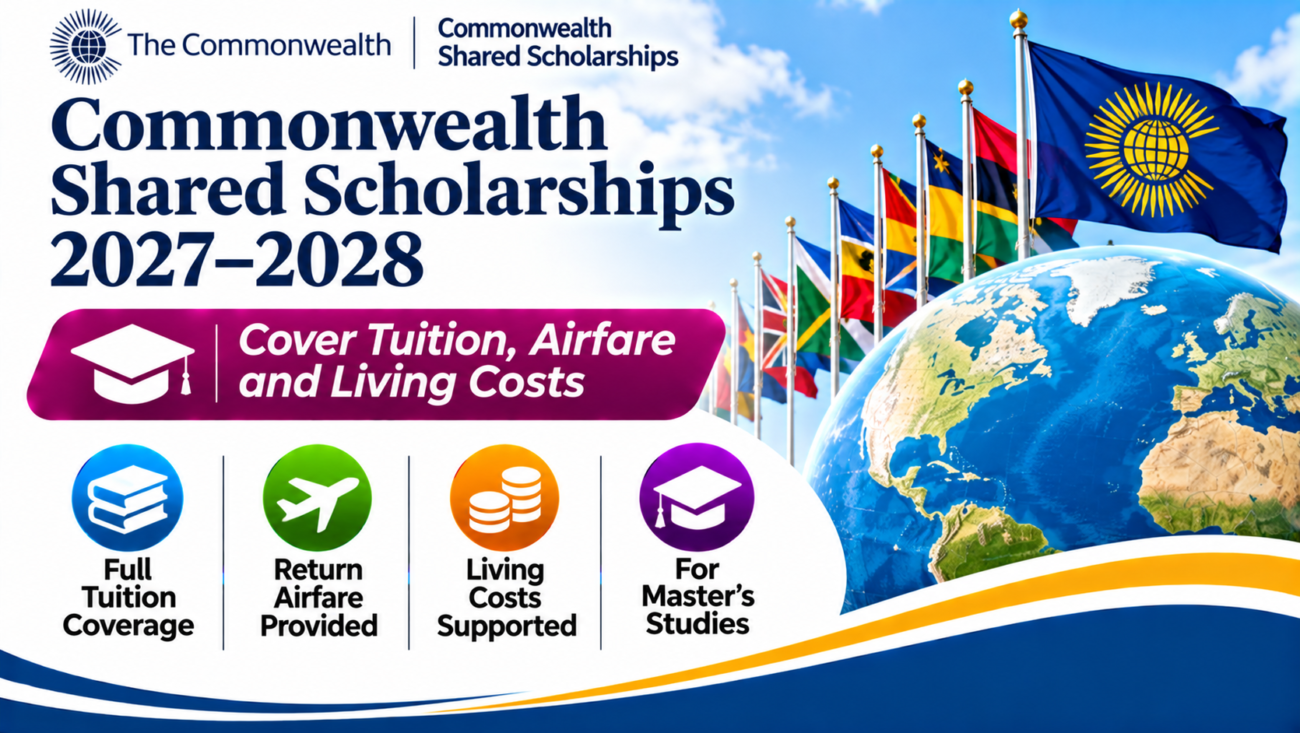
Commonwealth Shared Scholarships 2027–2028 Cover Tuition, Airfare and Living Costs in the UK
Commonwealth Shared Scholarships 2027–2028 Cover Tuition, Airfare and Living Costs in the UK. The Commonwealth Shared Scholarships 2027–2028 offer fully funded opportunities for eligible students from selected low- and middle-income Commonwealth countries to pursue one-year master’s degrees at participating universities in the United Kingdom.
Funded jointly by the UK Foreign, Commonwealth and Development Office (FCDO) and participating universities, the scholarships cover approved tuition fees, return airfare and a monthly living allowance. Additional support includes study-related travel, a thesis grant where applicable and assistance with certain visa-related expenses.
The 2027–2028 application period opened on 10 November 2026 and closes on 8 December 2026 at 16:00 GMT.
Important for Zimbabwean applicants: Zimbabwe is not included in the official list of eligible countries for the 2027–2028 Commonwealth Shared Scholarships. Zimbabwean citizens therefore cannot apply under this particular scheme, even though Zimbabwe is a Commonwealth member. Eligible neighbouring countries include Zambia, Botswana, Mozambique and South Africa, subject to the citizenship and permanent-residence requirements. Commonwealth Scholarship Commission in the UK+1
Key details
| Detail | Information |
|---|---|
| Scholarship | Commonwealth Shared Scholarships |
| Academic year | 2027–2028 |
| Host country | United Kingdom |
| Funding organisation | UK Foreign, Commonwealth and Development Office |
| Administering organisation | Commonwealth Scholarship Commission (CSC) |
| Study level | Master’s degree only |
| Duration | Normally 12 months |
| Study mode | Full-time, in person |
| Eligible applicants | Citizens or refugees from selected eligible Commonwealth countries |
| Tuition fees | Fully covered |
| Return airfare | Approved return economy airfare |
| Monthly stipend | £1,712 outside London |
| London stipend | £2,000 per month |
| Additional benefits | Study travel grant, thesis grant where applicable and eligible TB-test contribution |
| Application opening | 10 November 2026 |
| Application deadline | 8 December 2026, 16:00 GMT |
| Study commencement | September/October 2027 |
| Separate university admission | Required |
1. About the Commonwealth Shared Scholarships
Commonwealth Shared Scholarships 2027–2028 Cover Tuition, Airfare and Living Costs in the UK
The Commonwealth Shared Scholarship programme is administered by the Commonwealth Scholarship Commission in the UK.
It is funded through the UK government’s international development programme and jointly supported by participating British universities.
The programme aims to support talented students from eligible developing Commonwealth countries who:
- Have strong academic qualifications.
- Cannot otherwise afford to study in the UK.
- Have the potential to contribute to sustainable development.
- Intend to use their knowledge and skills to benefit their home countries.
Unlike some scholarship programmes that fund students in any university, Commonwealth Shared Scholarships are available only for specific master’s courses approved by the CSC at participating UK universities.
The programme expects to allocate approximately 180 new scholarships for 2027–2028. Commonwealth Scholarship Commission in the UK
2. Scholarship benefits and financial coverage
Fully funded master’s scholarship
The Commonwealth Shared Scholarship provides a comprehensive financial package covering the main costs of studying in the UK.
A. Full tuition-fee coverage
The scholarship covers approved tuition fees in full through an agreement between the CSC and the participating university.
Successful scholars are not expected to contribute towards the covered tuition fees.
The CSC’s university funding guidance specifies a tuition-fee contribution cap of £22,500. Universities must ensure that scholars are not asked to pay the university’s agreed share of the scholarship costs. Commonwealth Scholarship Commission in the UK+1
B. Monthly living allowance
Scholars receive a monthly stipend to support their living expenses while studying in the UK.
Universities outside London
£1,712/month
Universities in the London metropolitan area
£2,000/month
These are the published current rates. Updated rates may apply for the 2027–2028 academic year.
The stipend is paid by the participating university and is intended to support accommodation, food, transport and other everyday living costs.
C. Return airfare
The scholarship covers approved airfare from the scholar’s home country to the UK at the beginning of the award and return airfare at the end.
Important conditions include:
- Travel must comply with CSC travel arrangements.
- Dependants’ airfare is not covered.
- Journeys made before the award is confirmed will not be reimbursed.
D. Thesis grant
A thesis grant may be provided towards the cost of preparing a thesis or dissertation, where applicable.
The university administers this support, which is funded by the CSC.
E. Study travel grant
Scholars may receive a grant towards approved study-related travel within the UK or overseas.
This is intended for travel connected to the academic programme rather than general personal holidays.
F. Tuberculosis test contribution
Commonwealth Shared Scholarships 2027–2028 Cover Tuition, Airfare and Living Costs in the UK
The scholarship provides a contribution towards the cost of a mandatory tuberculosis (TB) test where it is required for a UK visa application.
Applicants must provide the relevant receipts and follow the university’s instructions.
G. Additional support for eligible scholars with children
The CSC provides a child allowance for scholars who are widowed, divorced or single parents, provided their eligible children under 16 live with them at the same address in the UK.
The published allowance is:
| Child | Monthly allowance |
|---|---|
| First child | £622 |
| Second child | £154 |
| Third child | £154 |
These family allowances are intended as contributions towards childcare and living expenses, not full coverage of the cost of maintaining a family in the UK.
3. Examples of approved master’s courses for 2027–2028
The CSC has published the approved courses and participating institutions for the 2027–2028 intake.
Examples include:
| University | Approved course |
|---|---|
| University of Oxford | MPP Public Policy |
| University of Oxford | MSc Economics for Development |
| University of Cambridge | MPhil Conservation Leadership |
| University of Cambridge | MPhil Engineering for Sustainable Development |
| Imperial College London | MSc Biomedical Engineering |
| Cranfield University | MSc Environmental Engineering |
| Cranfield University | MSc Renewable Energy |
| University of Nottingham | MSc AI and Digital Chemistry |
| Newcastle University | MSc Sustainable Agriculture and Food Security |
| University of Glasgow | MSc Global Development |
| University of Edinburgh | MSc International Development |
| University of Leeds | MSc Sustainable Food Systems and Food Security |
| University of Sussex | MA Food Systems and Sustainable Development |
| University of Bath | MSc International Development with Education |
| University College London | MSc Engineering for International Development |
This is a selection of approved courses, not the complete list. Applicants must consult the official course directory to confirm the course name, university and any university-specific recruitment preferences.
5. Which universities are participating?
The 2027–2028 programme includes a range of participating UK universities.
Examples include:
- University of Oxford.
- University of Cambridge.
- Imperial College London.
- University College London.
- London School of Economics and Political Science.
- University of Edinburgh.
- University of Glasgow.
- University of Birmingham.
- University of Bristol.
- University of Bath.
- University of Leeds.
- University of Nottingham.
- Newcastle University.
- Cranfield University.
- University of Aberdeen.
- University of Sussex.
- SOAS University of London.
- Liverpool School of Tropical Medicine.
- University of Stirling.
- University of Warwick.
The CSC has published university contact details, the number of scholarships allocated to participating institutions and, in some cases, additional recruitment preferences. Commonwealth Scholarship Commission in the UK
Applicants should not assume that every university offers every subject or that all courses are available to all eligible nationalities.
6. Who is eligible to apply?
To qualify for the Commonwealth Shared Scholarships 2027–2028, applicants must satisfy the following general conditions.
Nationality and residence
Applicants must:
- Be citizens of an eligible Commonwealth country, or have been granted refugee status by an eligible Commonwealth country.
- Be permanently resident in an eligible Commonwealth country.
- Meet any additional country or university-specific requirements.
Academic qualifications
By September 2027, applicants must hold:
- A first degree of at least upper second-class honours (2:1); or
- A lower second-class degree together with a relevant postgraduate qualification, usually a master’s degree.
Work experience cannot replace the minimum academic qualification.
Financial circumstances
Applicants must demonstrate that they would not be able to afford to study in the UK without the scholarship.
Participating universities may have procedures for checking applicants’ financial circumstances.
Previous study or employment in high-income countries
Commonwealth Shared Scholarships 2027–2028 Cover Tuition, Airfare and Living Costs in the UK
Applicants must not have studied or worked for one academic year or more in a high-income country, as defined by the CSC rules.
Distance learning completed at a university in a high-income country while remaining resident in the home country is permitted, but applicants must disclose it accurately.
Return-home commitment
Successful scholars must undertake to return to their home country before the end of their UK student visa.
Other requirements
Applicants must be available to start their studies in September/October 2027 and submit all supporting documents in the required format. There is no general age limit for this scholarship. Commonwealth Scholarship Commission in the UK+1
7. Eligible countries for the 2027–2028 scholarship
The official CSC list includes the following countries:
- Bangladesh
- Belize
- Botswana
- Dominica
- Eswatini
- Fiji
- Gabon
- Ghana
- Grenada
- Guyana
- India
- Jamaica
- Kenya
- Kiribati
- Lesotho
- Malawi
- Malaysia
- Maldives
- Mauritius
- Montserrat
- Mozambique
- Namibia
- Nauru
- Nigeria
- Pakistan
- Papua New Guinea
- Rwanda
- Saint Helena
- Saint Lucia
- Saint Vincent and the Grenadines
- Samoa
- Sierra Leone
- Solomon Islands
- South Africa
- Sri Lanka
- Tanzania
- The Gambia
- Togo
- Tonga
- Tuvalu
- Uganda
- Vanuatu
- Zambia
Important eligibility information for Zimbabweans
Zimbabwe is not eligible for this 2027–2028 scheme
Zimbabwe does not appear on the Commonwealth Shared Scholarships 2027–2028 eligible-country list.
This means Zimbabwean citizens cannot apply for this particular scholarship, even though Zimbabwe belongs to the Commonwealth.
However, applicants who are citizens of an eligible country and permanently resident there may qualify if they meet all other requirements. Simply living in an eligible country does not make a Zimbabwean citizen eligible.
Zimbabwean applicants should consider other UK scholarships, including the Oxford-Oak Zimbabwe Graduate Scholarship and other university-specific awards.
8. English-language requirements: Is IELTS compulsory?
The Commonwealth Scholarship Commission itself does not require candidates to take IELTS.
However, this does not mean that English-language proficiency is unnecessary.
The participating university must confirm that the applicant can study effectively in English and meets its own admission and UK visa-related language requirements.
Some universities may accept alternative evidence of English proficiency, depending on their policies.
Applicants should therefore check the language requirements of their selected master’s course before submitting an application. Commonwealth Scholarship Commission in the UK+1
9. Required application documents
Applicants must upload the required supporting documents through the CSC online application system.
The official scholarship guidance identifies the following documents:
| Document | Requirements |
|---|---|
| Passport or national ID | Must show photograph, date of birth and country of citizenship |
| Academic transcripts | Full transcripts for all higher education qualifications |
| Certified translations | Required for transcripts not issued in English |
| Academic references | Signed references in PDF format |
| Employment reference | One of the three referees should be a current employer, where applicable |
| Personal statement | Background, motivation and intended development contribution |
| Study plan | Detailed explanation of the proposed course and its relevance |
| Academic and employment history | Qualifications, employment and relevant experience |
| Publications and awards | Applicants may list up to 10 publications and prizes |
| Career plans | Five-year and long-term career objectives |
The application form asks applicants to provide the names and positions of three referees. At least two signed reference documents must be uploaded as supporting evidence by the deadline. Commonwealth Scholarship Commission in the UK
What should academic references contain?
References should be written by the referees themselves and should explain:
- How long they have known the applicant.
- The applicant’s academic and professional strengths.
- Their analytical ability and capacity for original thought.
- Their motivation and perseverance.
- Their suitability for the proposed master’s course.
- Their potential to contribute to development in their home country.
References must be signed and submitted on institutional letterhead or through an email that clearly identifies the sender.
10. How to apply for the Commonwealth Shared Scholarship 2027–2028
There are two separate application processes:
- The Commonwealth Scholarship Commission application.
- The university admission application.
Applicants must complete both.
Step 1: Check your country eligibility
Confirm that your citizenship and permanent residence meet the CSC’s 2027–2028 requirements.
Step 2: Choose an approved master’s course
Visit the official approved-course directory and identify a course that matches your academic background and development goals.
Step 3: Contact the participating university
Review the university’s scholarship page and contact the relevant funding or admissions office.
Some universities have additional selection preferences or earlier internal application deadlines.
Step 4: Apply for university admission
Submit a separate application for admission to your selected master’s course.
The CSC scholarship application does not automatically give you admission to the university.
Step 5: Register on CSC Central
Create an account on the official Commonwealth Scholarship Commission application system.
The application uses two-factor authentication, so applicants need access to a smartphone or a second email account.
Step 6: Complete the scholarship application
Provide your educational background, employment history, study plan, development objectives, personal statement and career plans.
Step 7: Upload the supporting documents
Upload your passport or national ID, transcripts and references in the required PDF format.
Step 8: Submit before the deadline
Submit your completed application through CSC Central by 8 December 2026 at 16:00 GMT.
The CSC does not accept scholarship applications or supporting documents sent by email or post.
Step 9: University selection and nomination
Participating universities assess applications and nominate their selected candidates to the CSC in March 2027.
Step 10: Final eligibility confirmation
The CSC checks nominated candidates against the programme’s eligibility requirements before confirming awards. Commonwealth Scholarship Commission in the UK+1
11. Application deadline and important dates
Closing soon
The Commonwealth Shared Scholarships 2027–2028 application timeline is:
| Event | Date |
|---|---|
| Applications opened | 10 November 2026 |
| Applications close | 8 December 2026 |
| Closing time | 16:00 GMT |
| Universities nominate candidates | March 2027 |
| Expected start of studies | September/October 2027 |
The deadline applies to the CSC application. Individual universities may have separate admission deadlines, which applicants must also meet. Commonwealth Scholarship Commission in the UK+1
12. How competitive is the scholarship?
The Commonwealth Shared Scholarship is highly competitive because it combines full tuition coverage, return airfare and a living allowance.
The CSC expects participating universities to select candidates with strong academic qualifications and the potential to contribute to development after returning home.
Applications are assessed against three central selection criteria:
- Candidate merit: Academic performance, qualifications and relevant achievements.
- Quality of the study proposal: The suitability of the selected course and the applicant’s reasons for pursuing it.
- Development impact: The potential to apply the acquired knowledge and skills to benefit the applicant’s home country.
Applicants should explain how the proposed master’s degree will address a development challenge in their country, sector or community. Commonwealth Scholarship Commission in the UK
13. Important conditions successful scholars must follow
Before accepting an award, applicants should understand the scholarship conditions.
- The scholarship normally lasts for one year and cannot be extended or renewed.
- It supports one approved master’s degree only.
- Scholars must study full-time.
- Scholars are expected to reside in the UK during the award.
- Paid employment during the scholarship requires prior CSC approval.
- Scholars must return to their home country before the end of their UK visa.
- The scholarship cannot be combined with another award covering the same costs.
- Scholars are not eligible for the UK Graduate visa through this scholarship arrangement.
The CSC may allow a scholar to remain in the UK in a limited situation involving a fully funded PhD offer, subject to strict conditions and agreement from the host university.
Frequently asked questions
1. Is the Commonwealth Shared Scholarship fully funded?
Yes. It covers approved tuition fees, approved return airfare and a monthly living allowance. Additional benefits include a thesis grant where applicable, study travel support and a contribution towards a mandatory TB test where required.
2. How much is the monthly stipend?
The published current rates are £1,712 per month for universities outside London and £2,000 per month for universities in the London metropolitan area. Updated rates may apply for the 2027–2028 academic year.
3. Can Zimbabweans apply?
No. Zimbabwe is not included in the official eligible-country list for the 2027–2028 Commonwealth Shared Scholarships.
4. Can Zambians apply?
Yes. Zambia is included in the eligible-country list. Applicants must also meet the permanent-residence, academic, financial and other eligibility requirements.
5. Can I apply for a PhD?
No. The Commonwealth Shared Scholarship supports approved one-year taught master’s programmes only. It does not fund undergraduate or PhD study.
6. Is IELTS compulsory?
The CSC does not require IELTS. However, the participating university may require IELTS or another acceptable form of English-language evidence.
7. Do I need to apply separately to the university?
Yes. Applicants must apply for admission to the approved master’s course as well as submitting their scholarship application through CSC Central.
8. Can I apply to more than one university?
Yes. Applicants may apply for more than one approved course and more than one participating university. However, they may accept only one Commonwealth Shared Scholarship.
9. Is there an age limit?
No general age limit is specified by the CSC. Applicants should nevertheless check any employment or study-leave restrictions that may apply to them.
10. When do successful applicants start studying?
Successful candidates are expected to begin their master’s studies in September or October 2027.
11. Do I have to return home after completing my studies?
Yes. Scholars must undertake to return to their home country before the end of their UK student visa.
12. Is there an application fee?
No. The CSC does not charge an application fee for its scholarship application system.
JOIN THE VACANCY BRIDGE WHATSAPP CHANNEL
https://whatsapp.com/channel/0029Vakee9aHFxOyCIBPJA0o
APPLY NOW ON THIS OFFICIAL PAGE
Final summary
Commonwealth Shared Scholarships 2027–2028 Cover Tuition, Airfare and Living Costs in the UK
Commonwealth Shared Scholarships 2027–2028 Cover Tuition, Airfare and Living Costs in the UK. The Commonwealth Shared Scholarships 2027–2028 provide fully funded opportunities for eligible students from selected developing Commonwealth countries to pursue one-year master’s degrees in the United Kingdom.
The scholarship covers approved tuition fees, return airfare and monthly living allowances of £1,712 outside London or £2,000 in the London metropolitan area at the currently published rates. Additional benefits include study travel support, thesis funding where applicable and certain visa-related assistance.
Applications opened on 10 November 2026 and close on 8 December 2026 at 16:00 GMT.
Applicants should carefully check the official eligible-country list before applying. Zimbabwe is excluded from the 2027–2028 programme, while Zambia, Botswana, Mozambique, Namibia and South Africa are among the eligible countries.
SEO keywords
Commonwealth Shared Scholarships 2027–2028, Commonwealth Shared Scholarship UK, fully funded master’s scholarships UK 2027, UK scholarships for international students, Commonwealth scholarships 2027, scholarships covering tuition and airfare, UK government scholarships, Commonwealth living allowance, master’s scholarships for African students, Commonwealth scholarships for Zambia, Commonwealth scholarships for Botswana, Commonwealth scholarships for South Africa.
