Oxford Clarendon Scholarships 2027–2028 | Fully Funded Master’s and PhD Scholarships in the UK
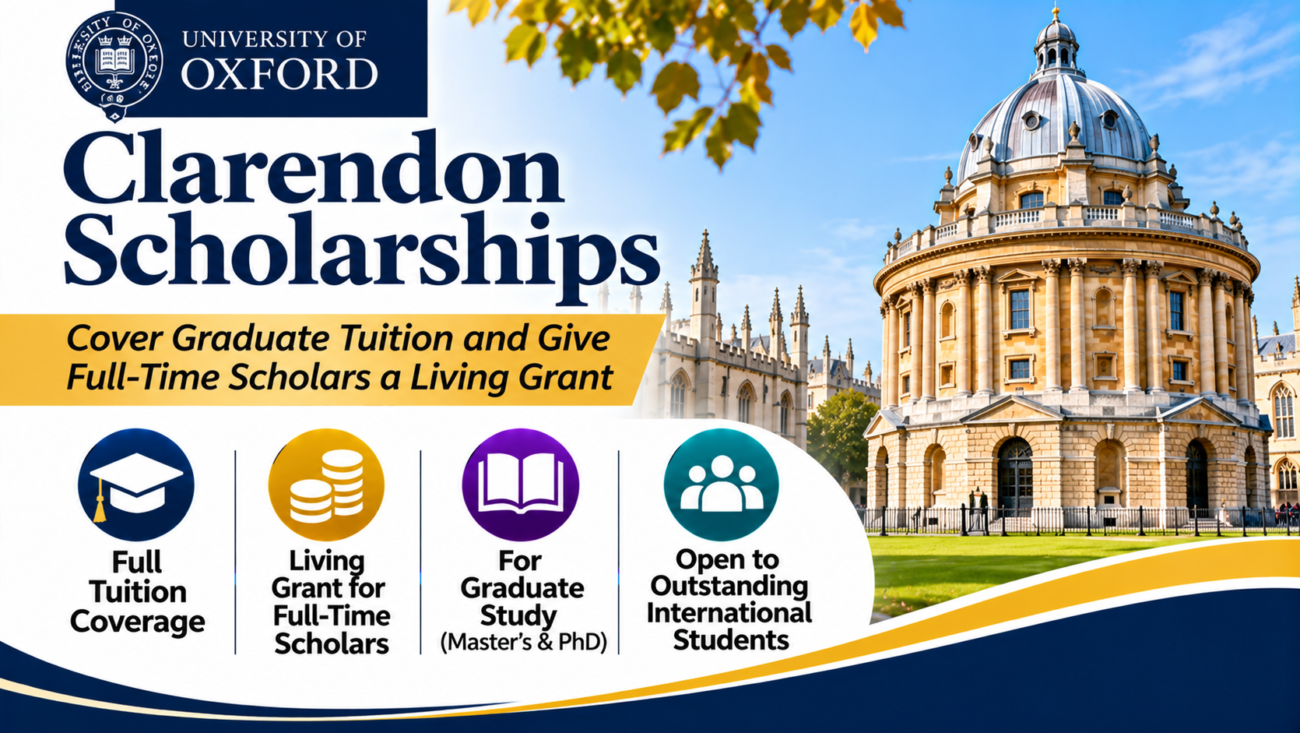
Oxford Clarendon Scholarships 2027–2028 | Fully Funded Master’s and PhD Scholarships in the UK. The University of Oxford Clarendon Scholarships 2027–2028 offer outstanding international students an opportunity to pursue fully funded graduate studies at one of the world’s leading universities. The scholarships cover course fees in full and provide a living-cost grant to full-time scholars for the applicable period of their course-fee liability.
The Clarendon Fund is open to applicants from all nationalities and academic disciplines. Zimbabwean students are eligible to apply, and there is no separate Clarendon scholarship application: applicants are automatically considered when they submit an eligible Oxford graduate-course application by the relevant December or January funding deadline.
Oxford states that it expects to offer more than 200 new Clarendon scholarships each year. Selection is highly competitive and based on outstanding academic merit and potential.
Key details
| Detail | Information |
|---|---|
| Scholarship | Oxford Clarendon Scholarships |
| Academic year | 2027–2028 |
| Host institution | University of Oxford |
| Country | United Kingdom |
| Study level | Master’s and DPhil/PhD |
| Study mode | Full-time and part-time eligible courses |
| Eligible nationalities | All countries |
| Subject areas | All academic disciplines |
| Tuition fees | 100% course-fee coverage |
| Living grant | Annual grant for full-time scholars |
| 2025–2026 published minimum grant | £20,780 per year |
| 2027–2028 stipend | To be confirmed |
| Separate scholarship application | Not required |
| Application deadline | Relevant December or January course deadline |
| Selection basis | Academic excellence and future potential |
1. About the University of Oxford Clarendon Fund
Oxford Clarendon Scholarships 2027–2028 | Fully Funded Master’s and PhD Scholarships in the UK
University of Oxford is one of the world’s most established universities, offering graduate programmes across a broad range of disciplines.
The Clarendon Fund was established to attract academically outstanding graduate students from around the world. It supports students who demonstrate exceptional academic ability, strong future potential and motivation to contribute to their chosen fields.
Clarendon is not restricted to a particular country, nationality or subject. It supports students across Oxford’s academic divisions and provides a scholarship community in addition to financial assistance.
Oxford reports that Clarendon supports more than 700 scholars from around 70 different nations at any one time. Oxford University
2. Scholarship benefits and financial coverage
Full course fees plus living grant
Clarendon provides two principal forms of financial support.
A. Full tuition-fee coverage
Successful scholars receive full payment of their Oxford course fees.
This applies to both:
- Home-fee-status students.
- Overseas-fee-status students.
For international applicants, this means the scholarship covers the applicable overseas course fees for the funded period.
The award normally covers the scholar’s period of fee liability for the agreed course. The precise duration is stated in the scholarship offer. Oxford University
B. Annual living-cost grant
Full-time Clarendon scholars receive an annual grant for living expenses.
Oxford states that the grant is at least the UK Research and Innovation (UKRI) minimum doctoral stipend rate.
Published minimum annual grant for 2025–2026
£20,780
Approximately £1,732 per month, calculated as an annual average.
This amount is the published 2025–2026 figure. Applicants for 2027–2028 should check the updated stipend amount when Oxford publishes it. The university describes the grant as normally sufficient to cover the living costs of a single student living in Oxford. Oxford University
C. Funding for part-time scholars
Part-time Clarendon scholars do not receive the same full annual living grant as full-time scholars.
Instead, they receive a study support grant to assist with non-fee costs. The value may be one-sixth, one-third or half of the UKRI minimum doctoral stipend rate, depending on the course’s nature and duration.
The exact amount is specified in the scholarship offer letter. Oxford University
D. How long does the scholarship last?
Clarendon awards normally cover the period during which the student is liable to pay course fees.
For some courses, academic divisions may approve additional funding beyond the normal fee-liability period. Where this happens, only the living-cost grant is paid during the additional period; continuation charges are not covered by Clarendon.
The exact scholarship duration is confirmed in the individual offer letter. Oxford University
E. What is not automatically covered?
Applicants should understand that full course-fee coverage and a living grant do not mean every possible expense is separately paid.
The official Clarendon information does not list a universal separate allowance for:
- International flights.
- Visa application charges.
- Dependants’ living expenses.
- Family accommodation.
- Personal travel.
- Every additional or continuation charge incurred after the scholarship’s approved fee-liability period.
Students should budget for expenses that are not expressly included in their scholarship offer.
3. Degree programmes covered by Clarendon
The Clarendon Fund supports a wide range of graduate courses at Oxford.
Eligible course categories include:
- Master’s degrees.
- Doctor of Philosophy (DPhil) programmes.
- Full-time graduate programmes.
- Eligible part-time graduate programmes.
The scholarship is open across academic disciplines, with no general subject-area restriction. Applicants must, however, apply for a new eligible Oxford Master’s or DPhil course. Oxford University+1
Examples of academic areas include:
| Academic area | Possible fields of study |
|---|---|
| Humanities | History, literature, philosophy and languages |
| Social sciences | Politics, sociology, development studies and international relations |
| Business and economics | Economics, finance and management |
| Law | Legal studies and international law |
| Engineering | Civil, chemical, mechanical and electrical engineering |
| Medical sciences | Biomedical sciences and clinical research |
| Mathematical and physical sciences | Mathematics, physics and statistics |
| Life sciences | Biology, biochemistry and environmental sciences |
| Computer science | Artificial intelligence, data science and computing |
| Education | Education policy and educational research |
These are examples of Oxford’s broad academic offerings, not a separate list of courses guaranteed to receive Clarendon funding. Applicants must check the eligibility of their specific graduate course.
4. Who is eligible to apply?
Oxford Clarendon Scholarships 2027–2028 | Fully Funded Master’s and PhD Scholarships in the UK
The Clarendon Fund is open to applicants from all nationalities and countries of ordinary residence.
To be considered, applicants must generally:
- Apply for a new eligible Master’s or DPhil course at Oxford.
- Submit their graduate application by the relevant December or January funding deadline.
- Demonstrate outstanding academic achievement.
- Show strong future academic potential.
- Provide evidence of motivation and commitment to the proposed course.
- Meet the admission requirements of the selected graduate programme.
There are no general nationality restrictions or restrictions based on academic subject. Oxford University+1
Who is not eligible?
The official guidance excludes certain applicants, including:
- Students holding deferred graduate offers.
- Current Oxford students continuing on the same degree in the next academic year.
Current Oxford master’s students may still be considered if they apply for a new DPhil or a second Master’s course, subject to the normal eligibility requirements. Oxford University
5. Can Zimbabwean students apply?
Zimbabwean applicants eligible
Yes. Zimbabwean students are eligible for the Oxford Clarendon Scholarships.
The university confirms that there are no restrictions based on nationality or country of ordinary residence. This means applicants from Zimbabwe can compete for Clarendon funding on the same general scholarship basis as other international applicants.
Zimbabwean candidates should:
- Hold the academic qualifications required for their chosen Oxford graduate programme.
- Demonstrate outstanding academic performance.
- Prepare a strong application and research proposal where required.
- Obtain persuasive academic references.
- Explain their motivation for studying at Oxford.
- Submit the graduate application before the relevant funding deadline.
There is no separate Zimbabwean quota specified in the general Clarendon eligibility rules. Oxford University+1
6. Academic requirements and selection criteria
Clarendon is highly competitive. Oxford selects scholars based on academic merit and future potential.
The university identifies three principal considerations.
A. Outstanding academic record
Excellent academic achievement is essential.
Oxford explains that most successful scholars usually have at least a first-class honours degree or equivalent.
For example, the university gives a GPA of at least 3.7 out of 4 as an illustrative benchmark, while noting that many successful applicants achieve higher results.
An exceptional master’s degree may compensate for a less outstanding undergraduate result in some cases.
Other evidence of academic excellence may include:
- University prizes and awards.
- High marks in relevant subjects.
- A strong position in the graduating class.
- Research publications.
- Outstanding academic performance at master’s level.
These are general selection indicators, not a universal minimum admission requirement for every Oxford course. Oxford University
B. Future potential and aptitude
Oxford considers whether applicants have the ability to make a significant contribution to their chosen academic field.
Assessment may include:
- Research experience.
- Academic references.
- Research proposals.
- Evidence of intellectual ability.
- Suitability for the proposed programme.
- Potential to contribute to the discipline.
For research-degree applicants, the strength and feasibility of the proposed research can be particularly important.
C. Student motivation
Applicants must demonstrate genuine commitment to their proposed course of study.
The university assesses motivation through:
- Personal statements.
- Academic references.
- Evidence of commitment to the subject.
- Reasons for choosing the programme.
- Academic and professional objectives.
Oxford University
7. Required application documents
Oxford Clarendon Scholarships 2027–2028 | Fully Funded Master’s and PhD Scholarships in the UK
Clarendon does not require a separate scholarship application or additional Clarendon-specific supporting documents.
Instead, applicants are considered using the information supplied in their Oxford graduate-course application. Oxford University+1
Depending on the course, applicants should prepare:
| Document | Purpose |
|---|---|
| Academic transcripts | Evidence of previous academic performance |
| Degree certificates | Confirmation of completed qualifications |
| Curriculum vitae | Academic and professional background, where requested |
| Personal statement | Motivation and suitability for the course |
| Research proposal | Research plan for programmes that require one |
| Academic references | Assessment of academic ability and potential |
| English-language evidence | Evidence of meeting the course’s language requirements |
| Writing sample | Required by some humanities and social-science programmes |
| Portfolio | Required by certain creative or practice-based courses |
The exact documents depend on the selected programme. Applicants should follow the requirements on their individual Oxford course page.
8. How to apply for the Oxford Clarendon Scholarship 2027–2028
One of the most important advantages of Clarendon is that there is no separate scholarship application.
Applicants are automatically considered when they submit an eligible graduate-course application by the relevant funding deadline.
Follow these steps:
Step 1: Find an eligible Oxford graduate programme
Visit Oxford’s graduate course directory and select a Master’s or DPhil course that matches your academic background and career objectives.
Step 2: Check the course deadline
Every graduate course has its own application deadlines. Some courses have December deadlines, while others have January deadlines.
Check the relevant course page and identify the deadline that applies to Clarendon funding consideration.
Step 3: Review the admission requirements
Check the academic qualifications, English-language requirements, references, research proposal requirements and any other programme-specific conditions.
Step 4: Prepare your supporting documents
Obtain transcripts, degree certificates, academic references and other documents required for the course.
Step 5: Complete the Oxford graduate application
Submit the online application for your chosen Master’s or DPhil programme.
Step 6: Submit before the relevant December or January deadline
This is essential. An application submitted after the relevant funding deadline will not be considered for Clarendon in that selection cycle.
Step 7: Automatic scholarship consideration
Eligible applicants are automatically considered for Clarendon. There is no additional Clarendon application form and no separate scholarship essay.
Step 8: Wait for the scholarship decision
Academic departments and divisions assess and nominate candidates. Successful applicants receive an email and an official scholarship offer.
9. Application deadlines for 2027–2028
Oxford Clarendon Scholarships 2027–2028 | Fully Funded Master’s and PhD Scholarships in the UK
Course-specific deadlines apply
Oxford does not have one universal Clarendon deadline.
To be considered, applicants must submit their graduate application by the relevant December or January admissions deadline for their chosen course.
The exact deadline varies by programme. Applicants should not assume that every course closes on the same date.
For the 2027–2028 academic year, prospective applicants should:
- Open the relevant Oxford graduate course page.
- Find the application deadlines section.
- Identify the December or January deadline associated with funding consideration.
- Submit the complete application before that date.
Oxford states that applicants must meet the relevant course deadline to receive automatic Clarendon consideration. Oxford University+1
Important: The date of the next funding deadline must be checked on the individual course page. Do not rely on a deadline published for another Oxford programme.
10. Selection process and scholarship notification
The Clarendon selection process involves academic departments and Oxford’s academic divisions.
The process generally follows these stages:
- Applicants submit graduate applications by the relevant funding deadline.
- Academic departments assess applicants for admission.
- Departments identify and nominate outstanding candidates for Clarendon.
- Academic divisions review the nominations and select the strongest candidates.
- Successful applicants receive a scholarship offer by email.
- Final funding arrangements are confirmed in the scholarship documentation.
Oxford states that most initial Clarendon offers are sent by the end of April.
The university generally contacts successful applicants only. If an applicant has not received an offer by mid-June, Oxford advises them to assume that they have not been awarded Clarendon funding. A small number of late nominations may occur if selected candidates withdraw.
11. How competitive is the Clarendon Scholarship?
Oxford Clarendon Scholarships 2027–2028 | Fully Funded Master’s and PhD Scholarships in the UK
Clarendon is one of Oxford’s highly competitive graduate funding programmes.
The university offers more than 200 new fully funded Clarendon scholarships each year, while attracting applications from academically outstanding candidates around the world. Oxford University
Applicants should therefore avoid treating admission to Oxford as an automatic guarantee of scholarship funding.
A strong application should demonstrate:
- Excellent academic performance.
- Strong references from academic professionals.
- A clear and well-developed academic purpose.
- Research ability and potential, where relevant.
- A convincing explanation of why the selected programme is appropriate.
- Evidence of commitment to the proposed field.
Applicants should also apply early enough to obtain references and prepare a complete application well before the deadline.
12. Other Oxford funding opportunities for Zimbabwean applicants
Zimbabwean applicants may also wish to investigate other Oxford scholarships alongside Clarendon.
One particularly relevant opportunity listed in Oxford’s 2027–2028 scholarship directory is the Oxford-Oak Zimbabwe Graduate Scholarship.
Oxford-Oak Zimbabwe Graduate Scholarship
Oxford’s scholarship directory states that up to two Oxford-Oak Zimbabwe Graduate Scholarships are available for applicants who:
- Are ordinarily resident in Zimbabwe or are Zimbabwean nationals.
- Are applying for a Master’s course in the social sciences.
- Demonstrate a commitment to contributing to Zimbabwean public service after completing their studies.
The university gives preference to eligible courses offered by the Blavatnik School of Government.
The scholarship covers course fees and provides a grant for living costs for the applicable fee-liability period.
However, Oxford states that the detailed arrangements for 2027–2028 are still to be confirmed. Oxford University
This is an important additional route for Zimbabwean applicants, particularly those interested in public policy, governance and social sciences.
Commonwealth Shared Scholarships at Oxford
Oxford also lists Commonwealth Shared Scholarships for selected 2027-entry courses.
Zimbabwe is not included in the eligible-country list published for the 2027 Oxford Commonwealth Shared Scholarship allocation, so Zimbabwean applicants should not assume that they qualify through this particular route.
Frequently asked questions
1. Is the Oxford Clarendon Scholarship fully funded?
Yes. Clarendon covers course fees in full and provides a living-cost grant for full-time scholars. The award normally covers the period of fee liability for the agreed course.
2. Can Zimbabwean students apply?
Yes. Clarendon has no nationality or country-of-residence restrictions. Zimbabwean applicants can be considered if they meet the course admission requirements and apply by the relevant funding deadline.
3. Does Clarendon cover both Master’s and PhD programmes?
Yes. Eligible full-time and part-time Master’s and DPhil courses are covered, provided applicants meet the relevant application deadline and scholarship requirements.
4. Do I need a separate scholarship application?
No. Applicants are automatically considered for Clarendon when they submit an eligible Oxford graduate-course application by the relevant December or January deadline.
5. How much is the Clarendon living allowance?
The published 2025–2026 minimum annual grant was £20,780. The 2027–2028 amount has not been confirmed in the information reviewed for this article.
6. Is there an age limit?
The general Clarendon eligibility information does not specify an age limit. Applicants must meet the academic and course-specific requirements.
7. Can I apply if I have not yet completed my undergraduate degree?
Potentially. Oxford graduate programmes may accept applicants who are completing their current qualifications, provided they meet the course’s conditions and deadlines. Applicants should check the specific programme requirements.
8. Does Clarendon cover accommodation?
The scholarship provides a living-cost grant intended to help meet living expenses in Oxford. It does not necessarily provide a separate free accommodation arrangement.
9. When will successful applicants be notified?
Oxford states that most initial Clarendon offers are sent by the end of April. If applicants have not heard by mid-June, they should assume that they have not received an award, although a small number of late offers may occur.
10. Can I apply for Clarendon and the Oxford-Oak Zimbabwe Scholarship?
Applicants who meet the relevant eligibility requirements can be considered for more than one Oxford funding opportunity. The university’s scholarship rules and individual award conditions determine how funding is allocated and combined.
JOIN THE VACANCY BRIDGE WHATSAPP CHANNEL
https://whatsapp.com/channel/0029Vakee9aHFxOyCIBPJA0o
APPLY NOW ON THIS OFFICIAL PAGE
Final summary
Oxford Clarendon Scholarships 2027–2028 | Fully Funded Master’s and PhD Scholarships in the UK
Oxford Clarendon Scholarships 2027–2028 | Fully Funded Master’s and PhD Scholarships in the UK. The Oxford Clarendon Scholarships 2027–2028 provide outstanding international students with an opportunity to pursue fully funded Master’s and DPhil studies at the University of Oxford.
The scholarship covers course fees in full and provides a living-cost grant to full-time scholars. It is open to all nationalities and academic disciplines, including Zimbabwean applicants.
The most important application requirement is to submit an eligible Oxford graduate-course application by the relevant December or January funding deadline. No separate Clarendon scholarship application is required.
Zimbabwean applicants should also investigate the Oxford-Oak Zimbabwe Graduate Scholarship, which is designed for eligible Zimbabwean or Zimbabwe-resident applicants pursuing social-science Master’s degrees and intending to contribute to public service in Zimbabwe.
SEO keywords
Oxford Clarendon Scholarships 2027, Clarendon Scholarship 2027–2028, University of Oxford scholarships for international students, fully funded scholarships in the UK, Oxford fully funded Master’s scholarships, Oxford PhD scholarships, DPhil scholarships at Oxford, Oxford scholarships for Zimbabweans, Clarendon living stipend, Oxford graduate funding 2027.
