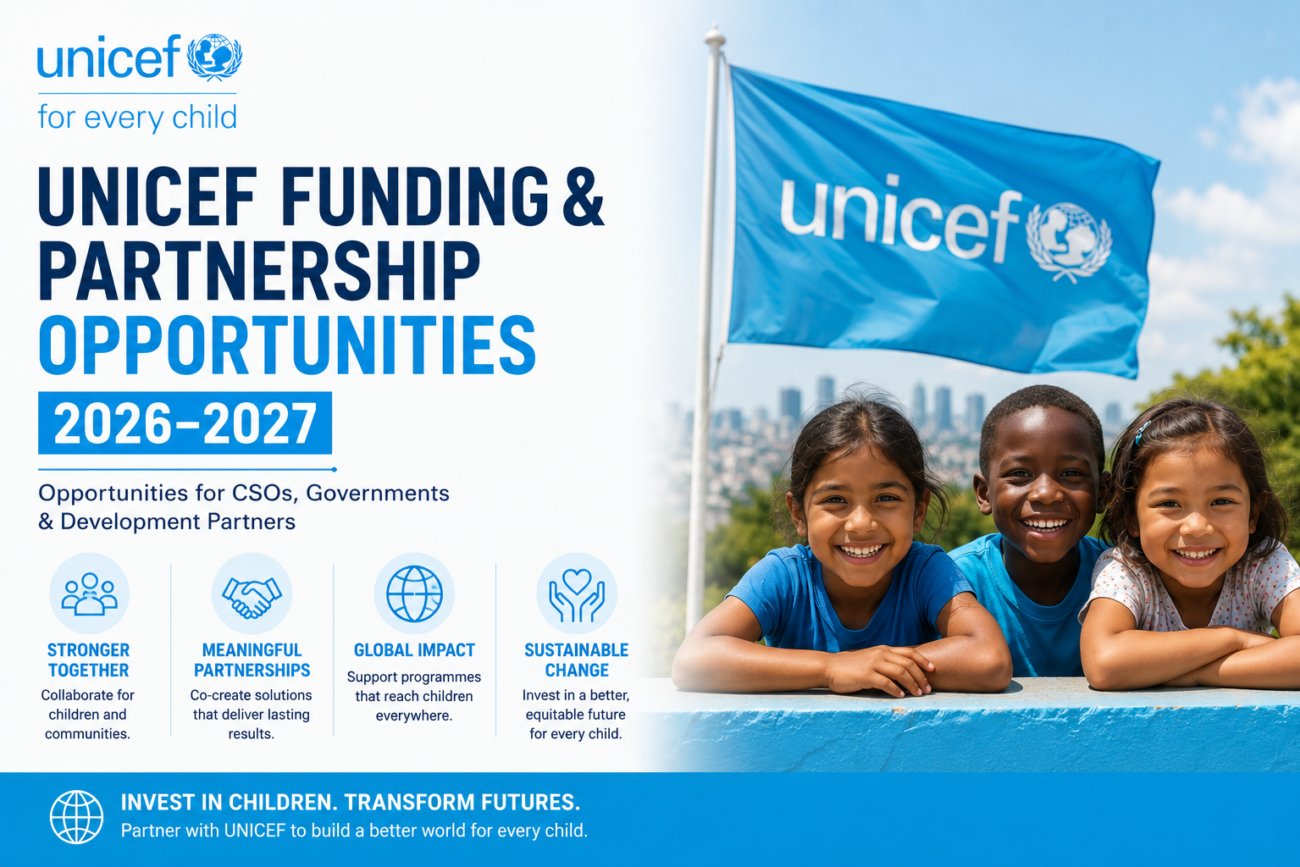
🌍 UNICEF Funding & Partnership Opportunities 2026–2027: Opportunities for CSOs, Governments & Development Partners
🌍 UNICEF Funding & Partnership Opportunities 2026–2027: Opportunities for CSOs, Governments & Development Partners. UNICEF works with civil society organizations (CSOs), governments, foundations, businesses, United Nations entities and other development partners to deliver programmes for children in more than 190 countries and territories. For organizations seeking to collaborate with UNICEF, opportunities can include programme implementation partnerships, Calls for Expressions of Interest (CFEIs), institutional contracts, procurement opportunities and broader funding partnerships.
Importantly, UNICEF is not a conventional open-grant foundation where every organization can simply submit a general request for funding. Many opportunities arise through specific country programmes, partnership calls or competitive procurement processes.
📌 UNICEF Partnership Opportunities at a Glance
| Detail | Information |
|---|---|
| 🏢 Organization | UNICEF |
| 🌍 Coverage | More than 190 countries and territories |
| 🤝 Partners | CSOs, governments, UN entities, foundations, businesses and development partners |
| 💰 Support | Depends on partnership and programme |
| 📢 Opportunities | CFEIs, programme partnerships, institutional contracts & procurement |
| 🎯 Key Areas | Education, health, nutrition, WASH, child protection, social policy and humanitarian response |
| 🌎 Geographic Scope | Global / country-specific |
| 📅 Deadlines | Vary by individual opportunity |
| 📝 CSO Platform | UN Partner Portal |
UNICEF currently works with more than 4,000 civil society organizations, around three quarters of which are local or national NGOs. Together, these partnerships deliver more than US$1 billion in programming annually to communities and children.
🌍 UNICEF Funding & Partnership Opportunities 2026–2027: Opportunities for CSOs, Governments & Development Partners
🤝 1. UNICEF Programme Implementation Partnerships
One of the most important routes for NGOs and CSOs is becoming a programme implementation partner.
UNICEF works with civil society organizations to implement programmes directly in communities. Its partners can bring local knowledge, technical expertise, community relationships and implementation capacity.
UNICEF says programme partnerships can enable CSOs to pilot innovative approaches, expand programming and strengthen knowledge, while partners may benefit from additional financial resources mobilized from governments and private-sector donors. (
This means a partnership can include financial resources, but organizations should not assume that every UNICEF partnership automatically comes with a grant.
📢 2. UNICEF Calls for Expressions of Interest
UNICEF country offices can publish Calls for Expressions of Interest (CFEIs) when seeking eligible organizations to implement particular programmes.
These opportunities can cover areas such as:
- Education
- Child protection
- Health and nutrition
- Water, sanitation and hygiene
- Climate resilience
- Youth participation
- Gender equality
- Social protection
- Skills development
- Humanitarian assistance
Recent UNICEF CFEIs demonstrate that eligible CSOs may be invited to apply individually or, for some opportunities, as coalitions.
🌐 3. UN Partner Portal
One of the most important platforms for organizations seeking UNICEF programme partnerships is the UN Partner Portal.
CSOs generally need to register and complete an organizational profile before applying for opportunities published through the portal. Recent UNICEF calls explicitly instruct interested organizations to register on the UN Partner Portal and complete their profiles before applying.
Organizations should prepare information about their:
Legal registration
Governance
Programme experience
Geographical presence
Technical expertise
Safeguarding systems
Financial management
Monitoring and evaluation capacity
Previous projects and results
A complete and accurate organizational profile can make it easier to respond when relevant calls become available.
👥 4. What Types of CSOs Can Partner With UNICEF?
UNICEF describes its civil-society partners broadly.
They include:
🌍 Non-governmental organizations
International, national and local NGOs can participate depending on the requirements of individual opportunities.
⛪ Faith-Based Organizations
Religious and faith-based organizations can also fall within UNICEF’s definition of civil-society partners.
🤝 Membership-Based Organizations
Associations and other membership organizations may be eligible for relevant partnerships.
🏘️ Service Organizations and Clubs
Organizations providing community services can also form part of UNICEF’s civil-society partnership ecosystem.
This is particularly significant for smaller national and community-based organizations because UNICEF reports that roughly three quarters of its 4,000+ CSO partners are local or national NGOs.
💰 5. Does UNICEF Provide Funding to NGOs?
Potentially, yes—but the structure needs to be understood correctly.
UNICEF programme implementation partners may receive resources to deliver agreed programmes. UNICEF specifically notes that CSO partners may benefit from additional financial resources mobilized from governments and private-sector donors to strengthen services for children.
Funding therefore usually relates to a defined partnership and agreed programme rather than unrestricted organizational funding.
UNICEF itself is primarily financed through voluntary contributions from governments and public and private partners.
💵 How UNICEF Funding Works
UNICEF categorizes funding it receives into three broad groups:
Core Resources – unrestricted resources that UNICEF can deploy flexibly.
Thematic Funding – flexible, softly earmarked funding supporting areas such as education, health, nutrition, child protection and WASH.
Restricted Funding – resources earmarked for specific programmes or countries.
For CSOs seeking partnership funding, the actual amount and structure will depend on the programme, country, donor arrangement and partnership agreement.
🏛️ 6. Opportunities for Governments
Governments are among UNICEF’s most important partners.
UNICEF works with national and local governments to strengthen systems affecting children, including:
🏥 Health systems
📚 Education
💧 Water and sanitation
🥗 Nutrition
🛡️ Child protection
💰 Social protection
🌱 Climate resilience
🚨 Emergency response
UNICEF’s partnerships are designed to align with national priorities while advancing children’s rights and the Sustainable Development Goals.
Government partnerships can therefore involve considerably more than conventional grants, including technical assistance, programme implementation, policy development, institutional strengthening and jointly financed initiatives.
🌐 7. Partnerships With Other UN Organizations
UNICEF also works extensively with other United Nations organizations.
These collaborations can operate through mechanisms including:
Joint Programmes
Multi-Partner Trust Funds
UN Trust Funds
UN-to-UN agreements
Central Emergency Response Fund arrangements
Country-Based Pooled Funds
In 2024, UNICEF received approximately US$404 million through UN inter-organizational arrangements supporting development and humanitarian interventions.
🏢 8. Institutional Consultancy and Procurement Opportunities
Organizations should also distinguish programme partnerships from procurement opportunities.
UNICEF country offices regularly issue Requests for Proposals and Invitations to Bid for companies, institutions and consultancy firms.
These can include opportunities involving:
📊 Research and assessments
📚 Education programmes
💻 Technology
🚚 Logistics
☀️ Renewable energy
📢 Communications
📸 Media services
🧠 Institutional consultancy
📈 Monitoring and evaluation
For example, UNICEF Zimbabwe currently lists a 2026 institutional consultancy seeking legally registered institutions and consultancy firms to help strengthen inclusive early childhood education, with proposals due 9 September 2026.
This is a current example of how organizations can secure contracts with UNICEF outside the traditional CSO programme-partnership model.
🌱 9. Climate and Sustainability Partnerships
Climate resilience is becoming an increasingly important component of UNICEF’s work.
Partnership opportunities can intersect with:
🌡️ Climate resilience
💧 Climate-resilient WASH
☀️ Renewable energy
🏫 Climate-resilient schools
🌱 Environmental education
🚨 Disaster-risk reduction
Recent partnership activity demonstrates the scale that climate-related collaboration can reach. UNICEF highlights, for example, a $69.1 million Green Climate Fund-supported project designed to provide climate-resilient WASH and disaster-risk-reduction services to more than 500,000 children and family members in the Central African Republic.
🚨 10. Humanitarian Partnerships
Organizations operating in emergency environments may also find UNICEF partnership opportunities involving:
- Emergency education
- Child protection
- Nutrition
- WASH
- Humanitarian cash programmes
- Health
- Emergency supplies
- Refugee and displaced populations
UNICEF works with partners to reach communities during natural disasters, conflict and other humanitarian emergencies.
A recent example is a 12-month, more than US$218 million partnership announced in June 2026 supporting rapid emergency response, nutrition interventions and child-survival activities in major humanitarian crises.
🎯 Who Should Explore UNICEF Partnership Opportunities?
These opportunities may be relevant to:
Local NGOs and CSOs
Organizations with strong community networks and proven implementation experience.
International NGOs
Organizations capable of implementing large-scale or specialized programmes.
Research institutions
Universities, think tanks and specialist organizations may compete for relevant institutional assignments.
Consultancy firms
Firms with expertise in education, health, evaluation, communications, technology and development may find institutional Requests for Proposals.
Governments
National and local authorities can collaborate with UNICEF on policy, systems strengthening and programme delivery.
Foundations and development partners
Organizations providing financial or strategic resources can explore funding partnerships with UNICEF.
Businesses
Private-sector organizations can engage through partnerships, innovation initiatives, procurement and other forms of collaboration.
📋 What Makes a Strong CSO Partner?
UNICEF’s partnership principles emphasize national capacity and accountability. Partnerships should strengthen national actors and communities while clearly defining responsibilities between UNICEF, the CSO and other programme partners.
Organizations should therefore be prepared to demonstrate:
✔ Legal and governance capacity
Your organization should have appropriate registration and governance arrangements.
✔ Relevant technical experience
Show evidence of programmes related to the specific UNICEF opportunity.
✔ Community presence
Local relationships and understanding can be particularly valuable.
✔ Financial management
Organizations need credible systems for managing and accounting for resources.
✔ Monitoring and reporting
Demonstrate how your organization measures outputs, outcomes and impact.
✔ Safeguarding
Organizations working with children need robust safeguarding policies and practices.
📄 Documents Organizations Should Prepare
Although requirements differ by opportunity, organizations should consider keeping an application-ready institutional package containing:
- Registration documents
- Organizational profile
- Governance information
- Strategic plan
- Recent annual reports
- Audited financial statements
- Safeguarding policies
- Previous project references
- Monitoring and evaluation framework
- Staff profiles and CVs
- Donor references
- Project portfolio
- Technical proposal templates
- Financial proposal templates
Having these documents prepared can make it easier to respond quickly to time-sensitive CFEIs and Requests for Proposals.
⚠️ UNICEF Does Not Charge Application Fees
Organizations should be cautious of fraudulent funding announcements.
UNICEF explicitly states in current procurement notices that it does not charge fees at any stage of its solicitation process, including application, evaluation or contract award.
Organizations should verify opportunities through official UNICEF channels and relevant UN platforms.
📝 How to Find and Apply for UNICEF Opportunities
There is no single universal application covering every UNICEF funding or partnership opportunity.
CSOs should monitor the UN Partner Portal and UNICEF country-office partnership announcements for Calls for Expressions of Interest and programme opportunities.
Institutional firms and suppliers should also monitor UNICEF country-office procurement pages for Requests for Proposals and Invitations to Bid.
Development partners interested in financing UNICEF programmes can explore UNICEF’s global partnership and funding channels. UNICEF works with the public sector, private sector and civil society and directs organizations seeking country-specific partnerships to the relevant UNICEF country office.
Why These Opportunities Matter
For NGOs and community organizations, working with UNICEF can provide more than funding.
Partnerships can provide opportunities to expand programmes, test innovative approaches, strengthen organizational knowledge and reach more children and communities.
UNICEF’s scale is substantial: it works with thousands of CSOs and channels more than $1 billion in programming annually through civil-society partnerships.
For local organizations, that makes understanding UNICEF’s partnership system—and maintaining an up-to-date UN Partner Portal profile—particularly valuable.
Final Thoughts
🌍 UNICEF Funding & Partnership Opportunities 2026–2027: Opportunities for CSOs, Governments & Development Partners
UNICEF Funding & Partnership Opportunities 2026–2027 can provide important pathways for CSOs, governments, institutions and development partners seeking to contribute to programmes benefiting children.
However, organizations should distinguish between programme partnerships, CFEIs, procurement contracts and funding partnerships rather than treating all UNICEF opportunities as conventional grants.
For CSOs, the UN Partner Portal is particularly important. For institutions and businesses, country-office procurement notices can provide additional opportunities. Governments, foundations and other development partners can engage directly with UNICEF through broader strategic and funding partnerships.
Key Details
🏢 Organization: UNICEF
🌍 Coverage: Global
🤝 Opportunities: Programme partnerships, CFEIs, institutional contracts, procurement & strategic partnerships
👥 Eligible Partners: CSOs, NGOs, governments, institutions, businesses and development partners
🎯 Areas: Education, health, nutrition, WASH, child protection, climate, humanitarian response and social policy
💰 Funding: Varies by programme and partnership
📅 Deadline: Opportunity-specific
🌐 CSO Platform: UN Partner Portal
📲 Get more NGO grants, UNICEF opportunities, UN partnerships, tenders, scholarships and international development opportunities through the Vacancy Bridge WhatsApp Channel:
Join the Vacancy Bridge WhatsApp Channel
APPLY ON THIS OFFICIAL PAGE
SEO Keywords
UNICEF Funding Opportunities 2026, UNICEF Grants 2026, UNICEF Funding for NGOs, UNICEF Partnership Opportunities 2026, UNICEF CSO Funding, UNICEF Grants for NGOs in Africa, UN Partner Portal Opportunities, UNICEF Calls for Expressions of Interest, UNICEF CFEI 2026, UNICEF NGO Partnerships, UNICEF Development Partners, UNICEF Government Partnerships, UNICEF Procurement Opportunities, UNICEF Institutional Consultancy, UNICEF Tenders 2026, Funding for Civil Society Organizations, International NGO Funding Opportunities, UN Funding for NGOs, Grants for African NGOs 2026, UNICEF Climate Funding, UNICEF Education Funding, UNICEF Humanitarian Partnerships, Development Funding Opportunities 2026, Vacancy Bridge.
